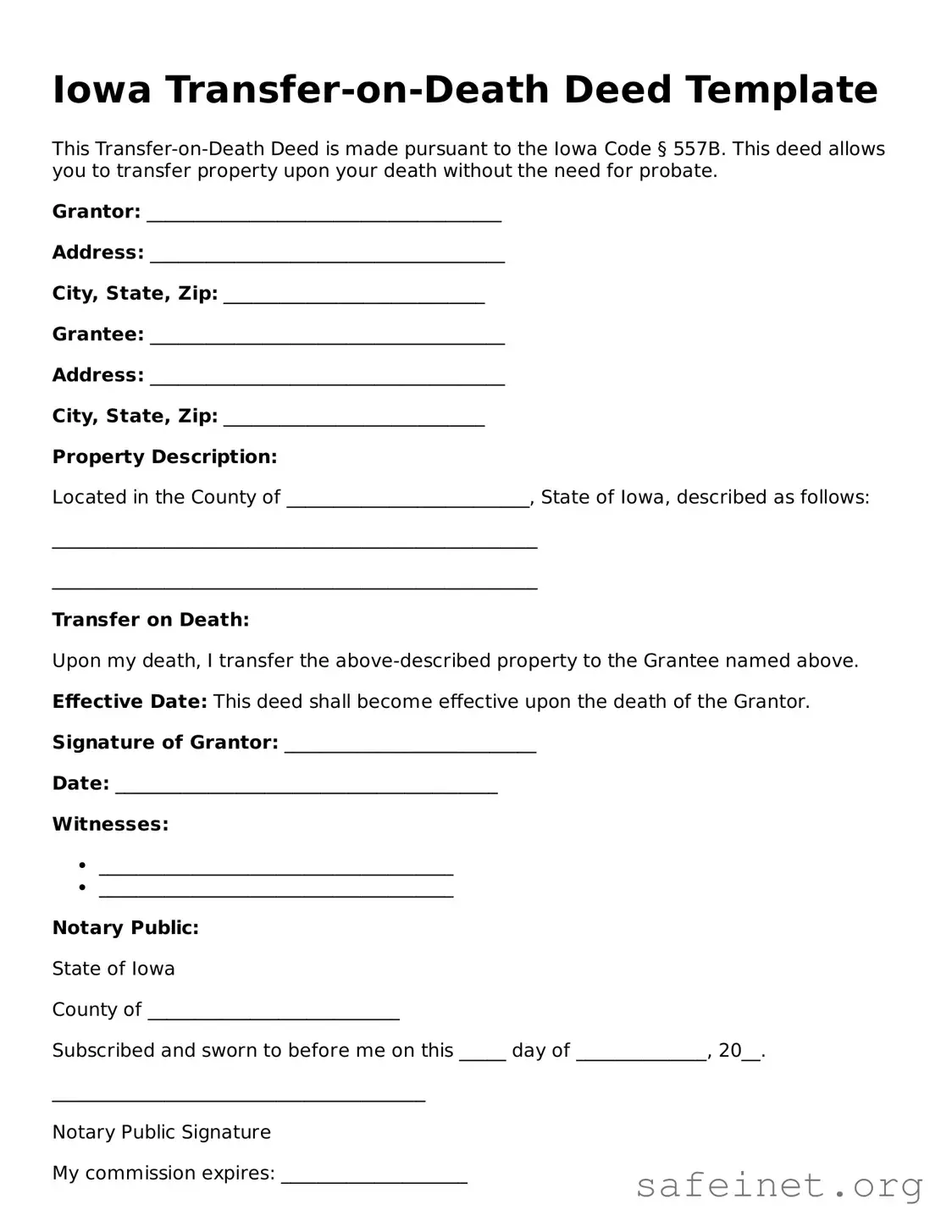
The Iowa Transfer-on-Death Deed (TOD) form is a powerful estate planning tool that allows property owners to seamlessly transfer their real estate to designated beneficiaries upon their death, without the need for probate. This form is particularly appealing for those who wish to simplify the transfer process and ensure that their loved ones inherit property quickly and efficiently. The TOD deed enables individuals to retain full control over their property during their lifetime, as it does not take effect until the owner passes away. Importantly, the form must be properly executed and recorded to be valid, and it can be revoked or modified at any time prior to the owner’s death. Understanding the nuances of this deed is essential for property owners in Iowa who want to make informed decisions about their estate planning strategies. By utilizing the TOD deed, individuals can help alleviate potential disputes among heirs and provide clarity regarding their intentions for their real estate assets.
Iowa Transfer-on-Death Deed Template
This Transfer-on-Death Deed is made pursuant to the Iowa Code § 557B. This deed allows you to transfer property upon your death without the need for probate.
Grantor: ______________________________________
Address: ______________________________________
City, State, Zip: ____________________________
Grantee: ______________________________________
Address: ______________________________________
City, State, Zip: ____________________________
Property Description:
Located in the County of __________________________, State of Iowa, described as follows:
____________________________________________________
____________________________________________________
Transfer on Death:
Upon my death, I transfer the above-described property to the Grantee named above.
Effective Date: This deed shall become effective upon the death of the Grantor.
Signature of Grantor: ___________________________
Date: _________________________________________
Witnesses:
Notary Public:
State of Iowa
County of ___________________________
Subscribed and sworn to before me on this _____ day of ______________, 20__.
________________________________________
Notary Public Signature
My commission expires: ____________________
| Fact Name | Description |
|---|---|
| Definition | The Iowa Transfer-on-Death Deed allows property owners to transfer real estate to beneficiaries upon their death without going through probate. |
| Governing Law | The deed is governed by Iowa Code § 614.2A, which outlines the requirements and procedures for creating and executing the deed. |
| Execution Requirements | To be valid, the deed must be signed by the property owner in the presence of a notary public and recorded with the county recorder's office. |
| Revocation | The property owner can revoke the deed at any time before their death by executing a new deed or by filing a revocation document. |
| Beneficiary Designation | Multiple beneficiaries can be named, and the property can be divided among them, but the deed must specify the shares or proportions. |
Once you have gathered the necessary information and documents, you can begin filling out the Iowa Transfer-on-Death Deed form. This form allows you to designate a beneficiary who will receive your property upon your passing, without the need for probate. Follow the steps below to complete the form accurately.
After filing the form, it is advisable to keep a copy for your records. Ensure that your designated beneficiaries are aware of the deed and understand their rights to the property. This proactive approach can help avoid confusion in the future.
What is a Transfer-on-Death Deed in Iowa?
A Transfer-on-Death Deed (TODD) in Iowa allows property owners to designate a beneficiary who will receive their property automatically upon their death. This form provides a way to transfer ownership without going through probate, simplifying the process for heirs.
Who can use a Transfer-on-Death Deed?
Any property owner in Iowa can utilize a Transfer-on-Death Deed. This includes individuals who own real estate, such as homes or land. However, it is essential to ensure that the deed is filled out correctly and meets all state requirements.
How do I complete a Transfer-on-Death Deed?
To complete a Transfer-on-Death Deed, you must fill out the form with accurate information about the property and the beneficiary. This includes the property’s legal description, the names of the current owner(s), and the name of the designated beneficiary. It is crucial to sign the deed in front of a notary public to ensure its validity.
Do I need to file the Transfer-on-Death Deed with the county?
Yes, after completing the Transfer-on-Death Deed, you must file it with the county recorder's office in the county where the property is located. This filing is necessary for the deed to be effective and to ensure that it is part of the public record.
Can I change or revoke a Transfer-on-Death Deed?
Yes, you can change or revoke a Transfer-on-Death Deed at any time before your death. To do this, you must create a new deed that either names a different beneficiary or explicitly states that the previous deed is revoked. This new deed must also be filed with the county recorder's office.
What happens if the beneficiary predeceases me?
If the beneficiary named in the Transfer-on-Death Deed passes away before you do, the property will not transfer to them. Instead, the property will go to the alternate beneficiaries, if any are named in the deed. If no alternate beneficiaries are designated, the property will become part of your estate and be distributed according to your will or state laws.
Are there any tax implications with a Transfer-on-Death Deed?
Generally, a Transfer-on-Death Deed does not trigger immediate tax consequences. The property is not considered part of your estate for tax purposes until your death. However, the beneficiary may be subject to capital gains taxes when they sell the property, depending on the property's value at the time of transfer.
Can I use a Transfer-on-Death Deed for all types of property?
A Transfer-on-Death Deed can only be used for real property, such as land and buildings. It cannot be used for personal property like vehicles, bank accounts, or other assets. Different legal mechanisms are available for transferring those types of assets.
Is legal assistance recommended when creating a Transfer-on-Death Deed?
While it is possible to complete a Transfer-on-Death Deed on your own, seeking legal assistance is often beneficial. An attorney can help ensure that the deed is completed correctly and complies with all Iowa laws, reducing the risk of complications in the future.
What should I do after the Transfer-on-Death Deed is filed?
After filing the Transfer-on-Death Deed, it is advisable to inform your beneficiary about the deed and its implications. Keeping a copy of the filed deed in a safe place and sharing its location with trusted family members can also be helpful for future reference.
Failing to include the full legal name of the property owner. It is crucial to ensure that names are accurate and complete.
Not providing the correct legal description of the property. This description should be precise and match what is recorded in public records.
Neglecting to sign the form in the presence of a notary public. A signature without proper notarization can render the deed invalid.
Using outdated or incorrect forms. Always ensure you have the most current version of the Transfer-on-Death Deed.
Forgetting to list all intended beneficiaries. If a beneficiary is not named, they may not receive their intended share of the property.
Not including the date of execution. The date is essential for establishing the validity of the deed.
Overlooking state-specific requirements. Each state may have unique rules regarding Transfer-on-Death Deeds that must be followed.
Failing to record the deed with the county recorder’s office. Without proper recording, the deed may not take effect.
Not discussing the deed with beneficiaries beforehand. Open communication can prevent misunderstandings or disputes later.
Ignoring tax implications. It is wise to consider how the transfer may affect taxes for both the owner and the beneficiaries.
When considering a Transfer-on-Death Deed in Iowa, it's essential to understand that several other forms and documents may be necessary to ensure a smooth transition of property ownership. These documents help clarify intentions, provide legal authority, and facilitate the transfer process. Below is a list of commonly used forms that accompany a Transfer-on-Death Deed.
Understanding these documents can significantly ease the process of transferring property. Each form serves a specific purpose, ensuring that your wishes are honored and that your loved ones are protected. Always consider consulting with a legal professional to navigate these forms effectively and to address any unique circumstances you may face.
The Iowa Transfer-on-Death Deed form is similar to a Last Will and Testament. Both documents allow individuals to express their wishes regarding the distribution of their assets after they pass away. However, a will goes into effect only after death and must go through probate, which can be a lengthy and costly process. In contrast, a Transfer-on-Death Deed allows property to pass directly to a beneficiary without the need for probate, making the transfer simpler and often quicker. This can provide peace of mind for both the property owner and their loved ones.
An Affidavit of Heirship shares similarities with the Transfer-on-Death Deed in that it helps establish the rightful heirs of a deceased person's property. While the Transfer-on-Death Deed clearly names a beneficiary, an Affidavit of Heirship is typically used when there is no will or deed specifying who should inherit. It serves as a legal document that identifies heirs based on state laws. This can help streamline the process of transferring property, although it may still require some legal verification.
The Quitclaim Deed is another document that shares characteristics with the Transfer-on-Death Deed. Both documents facilitate the transfer of property ownership. A Quitclaim Deed transfers whatever interest the grantor has in the property, without guaranteeing that the title is clear. This type of deed is often used between family members or in situations where the grantor does not wish to retain any ownership rights. While a Transfer-on-Death Deed specifies a beneficiary and ensures a smooth transition upon death, a Quitclaim Deed can be used at any time and does not necessarily involve death, making it a useful tool for transferring property during one’s lifetime.
When filling out the Iowa Transfer-on-Death Deed form, it is essential to approach the process with care and attention to detail. Here are some important dos and don’ts to consider:
Understanding the Iowa Transfer-on-Death Deed form is crucial for effective estate planning. However, several misconceptions can lead to confusion. Here are four common misconceptions:
While a Transfer-on-Death Deed does allow property to pass outside of probate, it does not automatically avoid probate for all assets. Other assets may still need to go through the probate process.
Not all properties qualify for a Transfer-on-Death Deed. In Iowa, this form is specifically designed for real estate and does not apply to personal property or financial accounts.
This is incorrect. A Transfer-on-Death Deed can be revoked or modified by the property owner at any time before their death, as long as the proper procedures are followed.
Beneficiaries do not have to be family members. Property owners in Iowa can designate anyone as a beneficiary, including friends or charitable organizations.
Filling out and using the Iowa Transfer-on-Death Deed form can be a straightforward process, but there are important details to keep in mind. Here are some key takeaways to consider:
Understanding these key points can help ensure that the process of using a Transfer-on-Death Deed in Iowa is executed smoothly and effectively.