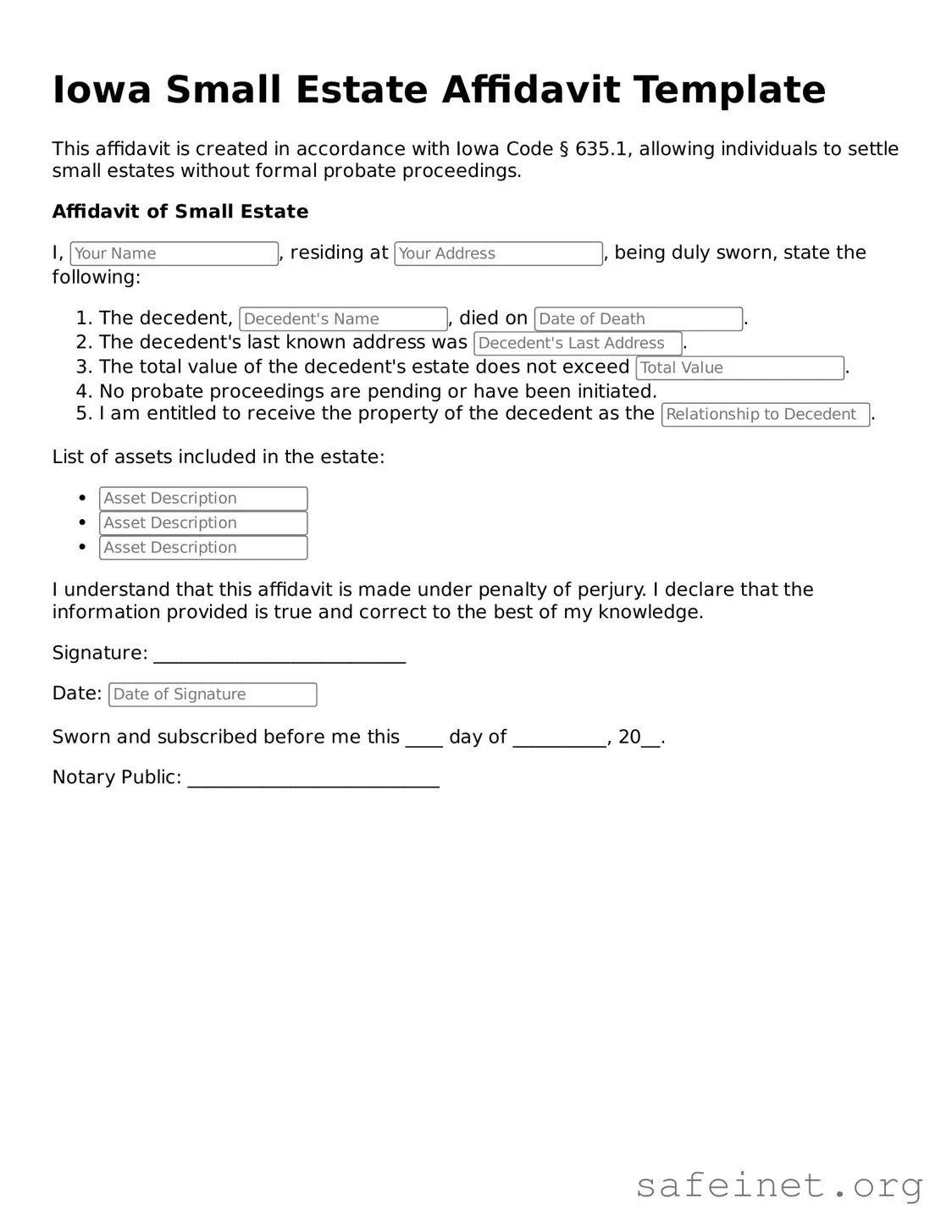
The Iowa Small Estate Affidavit form serves as a valuable tool for individuals managing the estate of a deceased person, particularly when the total value of the estate is below a specified threshold. This form allows heirs or beneficiaries to collect assets without the need for a formal probate process, which can be time-consuming and costly. By utilizing the Small Estate Affidavit, individuals can claim personal property, bank accounts, and other assets directly from institutions or individuals holding the deceased's property. The form requires essential information, including the name of the deceased, the date of death, and a list of the assets involved. Additionally, it must be signed under oath, affirming the accuracy of the information provided. This streamlined approach not only facilitates the transfer of assets but also simplifies the overall process for those left behind, making it an important resource in estate management in Iowa.
Iowa Small Estate Affidavit Template
This affidavit is created in accordance with Iowa Code § 635.1, allowing individuals to settle small estates without formal probate proceedings.
Affidavit of Small Estate
I, , residing at , being duly sworn, state the following:
List of assets included in the estate:
I understand that this affidavit is made under penalty of perjury. I declare that the information provided is true and correct to the best of my knowledge.
Signature: ___________________________
Date:
Sworn and subscribed before me this ____ day of __________, 20__.
Notary Public: ___________________________
| Fact Name | Description |
|---|---|
| Purpose | The Iowa Small Estate Affidavit is used to simplify the process of transferring assets from a deceased person's estate when the total value is below a certain threshold. |
| Threshold Amount | As of 2023, the threshold for using the Small Estate Affidavit in Iowa is $100,000 for personal property. |
| Governing Law | The use of the Small Estate Affidavit is governed by Iowa Code § 635.1. |
| Eligibility | Only individuals who are entitled to inherit from the deceased can use the Small Estate Affidavit. |
| Filing Requirements | The affidavit must be filed with the appropriate county recorder's office to officially transfer the assets. |
| No Probate Needed | This process allows heirs to avoid the lengthy and costly probate process for small estates. |
| Affidavit Content | The affidavit must include information about the deceased, the heirs, and a list of the assets being transferred. |
After gathering the necessary information, you are ready to fill out the Iowa Small Estate Affidavit form. This process will help ensure that the estate is handled according to the wishes of the deceased. Follow these steps carefully to complete the form accurately.
Once the form is submitted, the court will review it. If everything is in order, the estate can be distributed according to the information provided in the affidavit.
What is the Iowa Small Estate Affidavit form?
The Iowa Small Estate Affidavit form is a legal document that allows heirs to claim property from a deceased person's estate without going through the formal probate process. This form is typically used when the total value of the estate is below a certain threshold, making it a simpler and more efficient option for settling the estate.
Who is eligible to use the Small Estate Affidavit?
To use the Small Estate Affidavit, the estate must meet specific criteria. The total value of the estate, excluding certain assets, must be less than $100,000. Additionally, the person filing the affidavit must be an heir or a designated representative of the deceased, such as a spouse, child, or other close relative.
What assets are considered when calculating the estate's value?
When calculating the estate's value, you should include all assets owned by the deceased, such as bank accounts, real estate, and personal property. However, some assets, like life insurance proceeds and retirement accounts with designated beneficiaries, are generally excluded from this calculation.
How do I complete the Small Estate Affidavit form?
Completing the Small Estate Affidavit form involves providing information about the deceased, the heirs, and the assets of the estate. You will need to fill out all required sections accurately. It is important to ensure that all information is truthful and complete, as any inaccuracies could lead to legal complications.
Where do I file the Small Estate Affidavit?
The Small Estate Affidavit must be filed with the clerk of the district court in the county where the deceased resided at the time of death. You may need to provide copies of the death certificate and any other relevant documents along with the affidavit.
Is there a fee to file the Small Estate Affidavit?
Yes, there is usually a filing fee associated with submitting the Small Estate Affidavit. The fee can vary by county, so it is advisable to check with the local court for the exact amount. Fee waivers may be available for those who qualify based on financial need.
What happens after I file the Small Estate Affidavit?
Once the Small Estate Affidavit is filed, the court will review it. If everything is in order, the court will issue an order allowing the heirs to collect the assets listed in the affidavit. This process can take several weeks, so patience is important as you await the court's decision.
Incorrect Value Assessment: One common mistake is underestimating or overestimating the total value of the estate. It's crucial to provide an accurate valuation of assets to avoid complications.
Missing Signatures: Failing to obtain the necessary signatures from all heirs can lead to delays. Ensure that everyone entitled to inherit has signed the affidavit.
Not Including All Assets: Some individuals overlook certain assets, such as personal property or bank accounts. Every asset needs to be listed to ensure a smooth process.
Improperly Notarizing the Document: Neglecting to have the affidavit properly notarized can invalidate it. Always ensure that a notary public is involved in the process.
Ignoring State Requirements: Each state has specific rules regarding small estate affidavits. Failing to adhere to Iowa's requirements can result in the affidavit being rejected.
The Iowa Small Estate Affidavit is a useful tool for individuals managing the estate of a deceased person when the total value of the estate falls below a certain threshold. However, several other forms and documents may be necessary to ensure a smooth process. Below is a list of documents often used in conjunction with the Small Estate Affidavit.
Utilizing these documents alongside the Iowa Small Estate Affidavit can streamline the estate settlement process and ensure all legal obligations are met. Proper preparation and organization of these forms are essential for a successful outcome.
The Iowa Small Estate Affidavit form shares similarities with the Affidavit of Heirship. Both documents are used to establish the rightful heirs of a deceased individual. The Affidavit of Heirship is typically utilized when a person dies without a will. It allows heirs to claim assets by providing sworn statements about their relationship to the deceased. This document is often used in situations where the estate is not large enough to warrant formal probate proceedings, similar to the purpose of the Small Estate Affidavit.
Another document that bears resemblance to the Iowa Small Estate Affidavit is the Will. A Will outlines how a deceased person's assets should be distributed. While a Will requires formal probate, the Small Estate Affidavit allows for a simpler process when the estate's value is below a certain threshold. Both documents serve to clarify the intentions of the deceased regarding asset distribution, but the Small Estate Affidavit expedites the process for smaller estates.
The Declaration of Trust also has similarities with the Iowa Small Estate Affidavit. A Declaration of Trust is a legal document that outlines the management of assets held in trust. When a trust is established, it can bypass probate, similar to the Small Estate Affidavit. In both cases, the intent is to simplify the transfer of assets and avoid lengthy legal processes, although the contexts in which they are used differ significantly.
The Transfer on Death Deed (TOD) is another document that operates in a similar manner to the Small Estate Affidavit. A TOD allows individuals to transfer property directly to beneficiaries upon their death, thus avoiding probate. Like the Small Estate Affidavit, it simplifies the transfer process and is particularly useful for individuals wishing to ensure a smooth transition of assets without the need for court intervention.
The Affidavit of Support is comparable in that it also requires sworn statements, though its focus is on financial responsibility rather than asset distribution. This document is often used in immigration cases, where a sponsor must demonstrate their ability to financially support an immigrant. Both affidavits require a declaration of facts and are executed under penalty of perjury, emphasizing the importance of honesty in both processes.
The Summary Administration form is another document that parallels the Iowa Small Estate Affidavit. Summary Administration is a simplified probate process available in some states for smaller estates. It allows for quicker distribution of assets without the full probate process. Both documents aim to facilitate the efficient transfer of assets, reducing the burden on heirs and the court system.
The Small Estate Affidavit is also similar to the Petition for Letters of Administration. This petition is filed when an individual seeks court authority to manage a deceased person's estate. While the Petition for Letters of Administration involves formal probate proceedings, the Small Estate Affidavit provides a more straightforward alternative for smaller estates, allowing heirs to claim assets without extensive legal processes.
Finally, the Certificate of Trust can be likened to the Iowa Small Estate Affidavit. A Certificate of Trust serves to confirm the existence of a trust and the authority of its trustee. Similar to the Small Estate Affidavit, it can help streamline the transfer of assets and avoid probate. Both documents provide a mechanism for managing and distributing assets efficiently, albeit in different contexts.
When filling out the Iowa Small Estate Affidavit form, attention to detail is crucial. Here are some guidelines to ensure a smooth process:
The Iowa Small Estate Affidavit is a useful tool for settling estates with limited assets, but several misconceptions can lead to confusion. Here are nine common misunderstandings about this form:
This is not entirely true. While the Small Estate Affidavit is designed for estates with limited assets, it can still be used even if there are some debts, as long as the total value of the estate does not exceed a certain threshold.
While the Small Estate Affidavit simplifies the process, it does not completely replace probate. It is a streamlined alternative for small estates, but it still requires specific legal procedures to be followed.
Agreement among heirs is not a requirement. However, it is advisable for all interested parties to be informed, as disputes can arise if some heirs are unaware of the process.
There is a time frame for filing the Small Estate Affidavit, typically within a specific period after the decedent's death. Waiting too long can complicate the process.
While legal assistance can be beneficial, individuals can complete the affidavit themselves if they understand the requirements and have the necessary information.
This is a misconception. The Small Estate Affidavit can be used for both personal and real property, as long as the total value is within the allowed limits.
While the affidavit facilitates the distribution process, it does not guarantee that all assets will be distributed without any disputes. Heirs may still contest the distribution.
Filing the affidavit is a step in the process, but it does not automatically close the estate. Additional steps may be necessary to finalize the estate settlement.
While the Small Estate Affidavit is generally less expensive than full probate, there may still be court fees or other costs involved in the filing process.
Filling out and using the Iowa Small Estate Affidavit form can simplify the process of settling a deceased person's estate. Here are some key takeaways to keep in mind:
Understanding these points can make the process smoother and more efficient for those managing a small estate in Iowa.