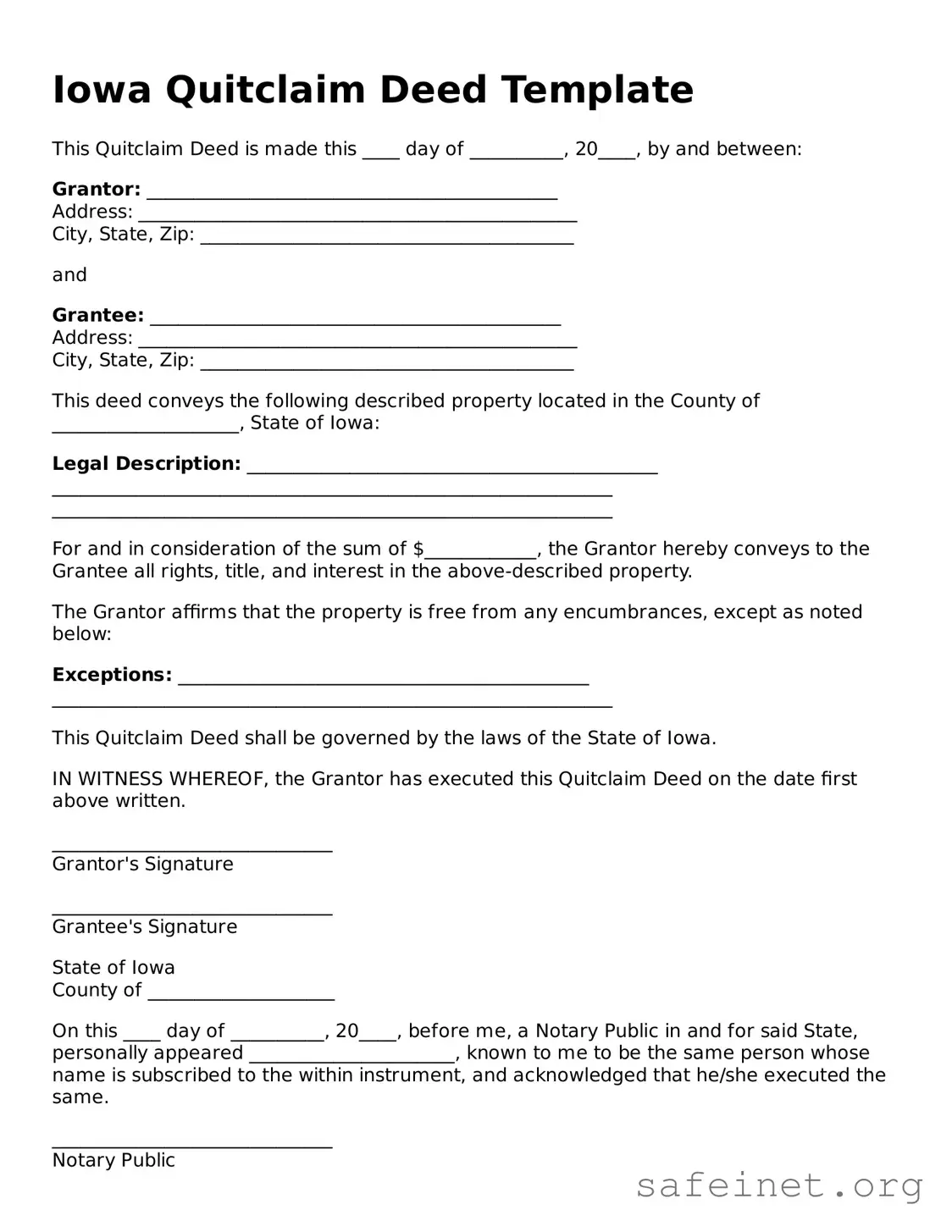
When it comes to transferring property ownership in Iowa, the Quitclaim Deed form serves as a straightforward and effective tool. This legal document allows an individual, known as the grantor, to relinquish any interest they may have in a property to another party, referred to as the grantee. Unlike other types of deeds, a Quitclaim Deed does not guarantee that the grantor holds clear title to the property, nor does it provide any warranties regarding the property’s condition or potential claims against it. Instead, it simply conveys whatever interest the grantor has, if any, at the time of the transfer. This makes it particularly useful in situations such as transferring property between family members, clearing up title issues, or finalizing divorce settlements. Understanding the specific requirements and implications of using a Quitclaim Deed in Iowa is crucial for anyone considering this option, as it can significantly impact future ownership rights and responsibilities.
Iowa Quitclaim Deed Template
This Quitclaim Deed is made this ____ day of __________, 20____, by and between:
Grantor: ____________________________________________
Address: _______________________________________________
City, State, Zip: ________________________________________
and
Grantee: ____________________________________________
Address: _______________________________________________
City, State, Zip: ________________________________________
This deed conveys the following described property located in the County of ____________________, State of Iowa:
Legal Description: ____________________________________________
____________________________________________________________
____________________________________________________________
For and in consideration of the sum of $____________, the Grantor hereby conveys to the Grantee all rights, title, and interest in the above-described property.
The Grantor affirms that the property is free from any encumbrances, except as noted below:
Exceptions: ____________________________________________
____________________________________________________________
This Quitclaim Deed shall be governed by the laws of the State of Iowa.
IN WITNESS WHEREOF, the Grantor has executed this Quitclaim Deed on the date first above written.
______________________________
Grantor's Signature
______________________________
Grantee's Signature
State of Iowa
County of ____________________
On this ____ day of __________, 20____, before me, a Notary Public in and for said State, personally appeared ______________________, known to me to be the same person whose name is subscribed to the within instrument, and acknowledged that he/she executed the same.
______________________________
Notary Public
My commission expires: ____________________
| Fact Name | Details |
|---|---|
| Definition | A quitclaim deed is a legal document used to transfer ownership of real estate without any warranties. |
| Governing Law | The Iowa Quitclaim Deed is governed by Iowa Code Chapter 557. |
| Use Cases | Commonly used in property transfers between family members or to clear up title issues. |
| Requirements | The deed must be signed by the grantor and should be notarized to be valid. |
| Filing | After signing, the deed must be filed with the county recorder's office where the property is located. |
| Consideration | While consideration (payment) is not required, it is often included for record-keeping purposes. |
| Limitations | A quitclaim deed does not guarantee that the grantor has clear title to the property. |
After you have the Iowa Quitclaim Deed form in front of you, it's time to fill it out. Make sure to have all necessary information ready, such as the names of the parties involved and a description of the property. Once completed, the form will need to be signed and possibly notarized before it can be filed with the appropriate county office.
What is a Quitclaim Deed in Iowa?
A Quitclaim Deed is a legal document used to transfer ownership of real estate from one party to another. In Iowa, this type of deed conveys whatever interest the grantor has in the property, without guaranteeing that the title is clear. It is commonly used in situations where property is transferred between family members or in divorce settlements.
How do I complete an Iowa Quitclaim Deed?
To complete a Quitclaim Deed in Iowa, you need to fill out the form with specific information. This includes the names of the grantor (the person transferring the property) and the grantee (the person receiving the property), a legal description of the property, and the date of the transfer. Ensure all information is accurate to avoid future disputes.
Do I need to have the Quitclaim Deed notarized?
Yes, in Iowa, a Quitclaim Deed must be signed in the presence of a notary public. The notary will verify the identities of the signers and witness the signing of the document. This step is crucial for the deed to be legally valid.
Is a Quitclaim Deed the same as a Warranty Deed?
No, a Quitclaim Deed is not the same as a Warranty Deed. While a Quitclaim Deed transfers any interest the grantor has in the property without warranties, a Warranty Deed provides guarantees about the title. This means that with a Warranty Deed, the grantor assures the grantee that the title is clear and free of any claims.
Where do I file the Quitclaim Deed in Iowa?
After completing and notarizing the Quitclaim Deed, it must be filed with the county recorder's office in the county where the property is located. This filing makes the transfer official and provides public notice of the change in ownership.
Are there any fees associated with filing a Quitclaim Deed in Iowa?
Yes, there are fees associated with filing a Quitclaim Deed in Iowa. The fees vary by county, so it is advisable to check with the local county recorder’s office for the exact amount. Additionally, there may be costs related to notarization and any necessary property surveys.
Can I use a Quitclaim Deed to transfer property to a trust?
Yes, a Quitclaim Deed can be used to transfer property into a trust. This process can help with estate planning and may provide benefits such as avoiding probate. It is recommended to consult with a legal professional to ensure the transfer is executed correctly.
What happens if there are existing liens on the property?
If there are existing liens on the property, a Quitclaim Deed does not remove them. The grantee assumes the risk of any existing claims or liens against the property. It is advisable to conduct a title search before transferring property to understand any potential issues.
Not including the correct names of the parties involved. It’s essential to ensure that the grantor (the person transferring the property) and the grantee (the person receiving the property) are accurately named. Any discrepancies can lead to confusion or legal issues later.
Failing to provide a legal description of the property. A vague or incomplete description can render the deed ineffective. Always include the full legal description as found in the property’s title.
Neglecting to sign the form. The grantor must sign the deed for it to be valid. If the form is not signed, it will not be accepted by the county recorder.
Overlooking the need for notarization. In Iowa, the quitclaim deed must be notarized to be legally binding. Without a notary’s signature, the document may not hold up in court.
A Quitclaim Deed is an important document used to transfer ownership of real estate. In Iowa, several other forms and documents often accompany this deed to ensure a smooth transaction. Below are some commonly used documents that can enhance the process of property transfer.
Using these documents alongside the Quitclaim Deed can facilitate a more organized and secure property transfer process. Always ensure that all forms are completed accurately to avoid potential issues in the future.
The Iowa Quitclaim Deed is similar to a Warranty Deed. Both documents transfer ownership of real property from one party to another. However, a Warranty Deed offers more protection to the buyer. It guarantees that the seller holds clear title to the property and is responsible for any claims against it. In contrast, a Quitclaim Deed does not provide such assurances. It merely conveys whatever interest the seller has, if any, without any warranties regarding the title's status.
Another document that resembles the Quitclaim Deed is the Bargain and Sale Deed. This type of deed transfers property from the seller to the buyer without any warranties against encumbrances. Like the Quitclaim Deed, it conveys only the interest the seller possesses. However, a Bargain and Sale Deed implies that the seller has some ownership interest in the property, while a Quitclaim Deed may not imply any ownership at all.
A Special Warranty Deed is also similar to a Quitclaim Deed. This deed provides a limited warranty, meaning the seller guarantees that they have not encumbered the property during their ownership. However, it does not cover issues that may have arisen before the seller acquired the property. Like the Quitclaim Deed, it transfers ownership but with some level of assurance about the seller's actions, unlike the complete lack of warranties in a Quitclaim Deed.
Lastly, a Deed of Trust shares some characteristics with a Quitclaim Deed. While primarily used in financing transactions, both documents involve the transfer of property rights. A Deed of Trust secures a loan by transferring the property to a trustee, who holds it until the borrower repays the loan. In contrast, a Quitclaim Deed is typically used for straightforward ownership transfers without the context of financing. Both documents facilitate the transfer of property but serve different purposes in real estate transactions.
When filling out the Iowa Quitclaim Deed form, it is essential to follow certain guidelines to ensure the document is completed correctly. Below is a list of things you should and shouldn't do:
Many people hold misconceptions about the Iowa Quitclaim Deed form. Understanding the truth can help individuals make informed decisions when transferring property. Here are nine common misconceptions:
By clarifying these misconceptions, individuals can better navigate the process of property transfer in Iowa.
When filling out and using the Iowa Quitclaim Deed form, it is essential to understand several key aspects to ensure proper execution and legal validity. Below are ten important takeaways:
By following these guidelines, individuals can effectively navigate the process of completing and utilizing the Iowa Quitclaim Deed form.