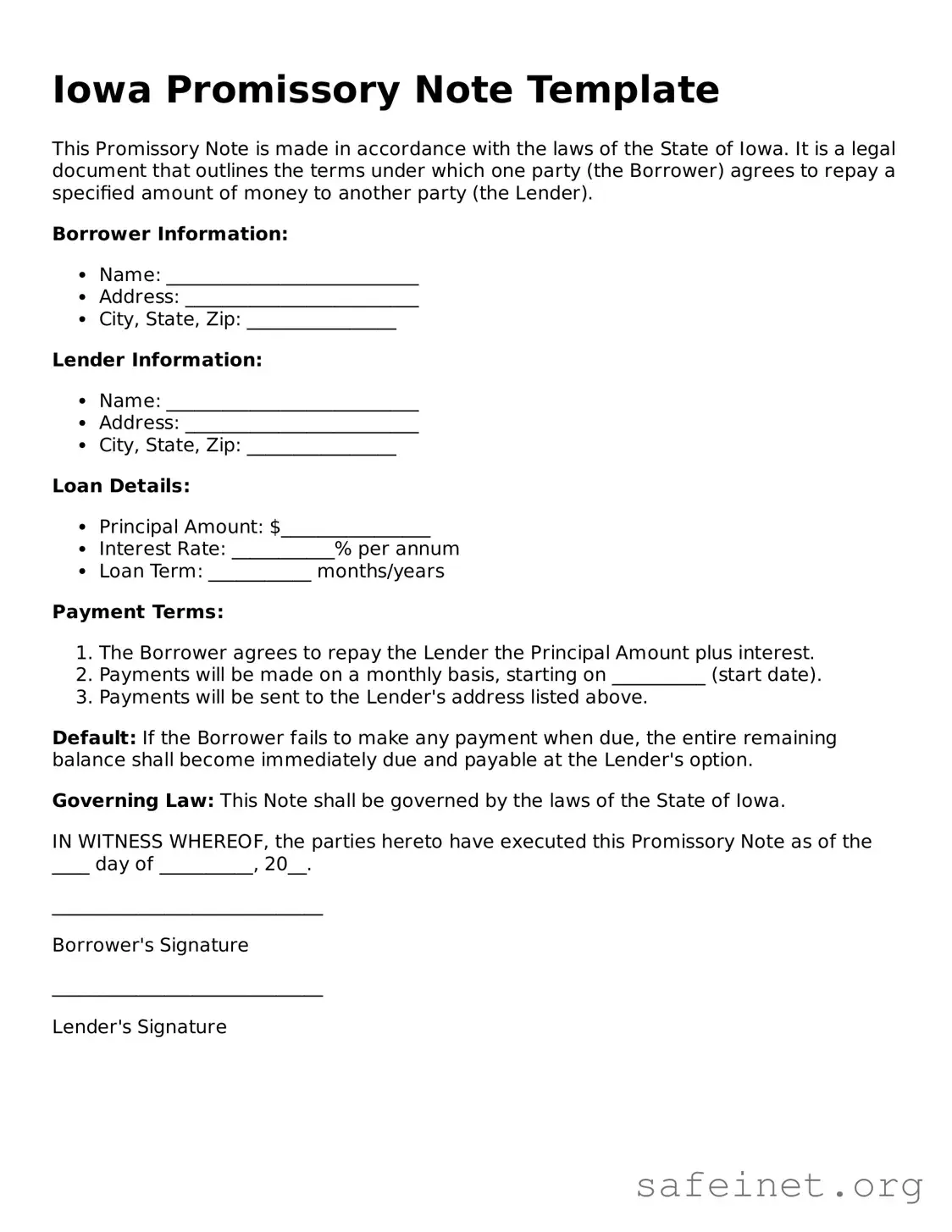
When entering into a loan agreement in Iowa, understanding the Promissory Note form is essential for both lenders and borrowers. This legal document outlines the borrower's promise to repay a specified amount of money to the lender under agreed-upon terms. Key components of the Iowa Promissory Note include the principal amount, interest rate, repayment schedule, and any applicable fees or penalties for late payments. Additionally, the form often specifies the consequences of default, ensuring both parties are aware of their rights and obligations. By clearly detailing these elements, the Promissory Note serves as a vital tool for fostering trust and accountability in financial transactions. Whether you are borrowing money for personal reasons or securing funds for a business venture, understanding the intricacies of this form can help facilitate a smoother lending process.
Iowa Promissory Note Template
This Promissory Note is made in accordance with the laws of the State of Iowa. It is a legal document that outlines the terms under which one party (the Borrower) agrees to repay a specified amount of money to another party (the Lender).
Borrower Information:
Lender Information:
Loan Details:
Payment Terms:
Default: If the Borrower fails to make any payment when due, the entire remaining balance shall become immediately due and payable at the Lender's option.
Governing Law: This Note shall be governed by the laws of the State of Iowa.
IN WITNESS WHEREOF, the parties hereto have executed this Promissory Note as of the ____ day of __________, 20__.
_____________________________
Borrower's Signature
_____________________________
Lender's Signature
| Fact Name | Description |
|---|---|
| Definition | An Iowa Promissory Note is a written promise to pay a specific amount of money to a designated person or entity at a specified time. |
| Governing Law | The Iowa Promissory Note is governed by the Iowa Uniform Commercial Code (UCC), specifically under Chapter 554. |
| Parties Involved | The note typically involves two parties: the maker (borrower) and the payee (lender). |
| Interest Rate | The interest rate can be specified in the note, and it may be fixed or variable. |
| Repayment Terms | Repayment terms, including the due date and payment schedule, should be clearly outlined in the note. |
| Secured vs. Unsecured | A promissory note can be secured by collateral or be unsecured, depending on the agreement between the parties. |
| Transferability | The Iowa Promissory Note can be transferred to another party, allowing the new holder to collect the debt. |
| Default Consequences | If the borrower defaults, the lender may have the right to take legal action to recover the owed amount. |
| Notarization | While notarization is not mandatory, having the note notarized can provide additional legal protection. |
| Legal Requirements | The note must include essential elements such as the amount, interest rate, and signatures of the parties involved. |
After obtaining the Iowa Promissory Note form, you will need to carefully complete it to ensure all necessary information is accurately provided. This form typically requires details about the borrower, lender, and the terms of the loan. Once the form is filled out, both parties should review it for accuracy before signing.
What is an Iowa Promissory Note?
An Iowa Promissory Note is a legal document that outlines a borrower's promise to repay a specified amount of money to a lender. This note includes essential details such as the principal amount, interest rate, repayment schedule, and any conditions related to the loan. It serves as a formal agreement that protects both parties involved in the transaction.
Who can use a Promissory Note in Iowa?
Any individual or business in Iowa can use a Promissory Note. This document is commonly utilized by lenders and borrowers in various situations, such as personal loans, business loans, or real estate transactions. However, it is crucial that both parties understand the terms outlined in the note before signing.
What are the key components of an Iowa Promissory Note?
The key components of an Iowa Promissory Note include the names and addresses of the borrower and lender, the principal amount being borrowed, the interest rate (if applicable), the repayment terms, and the maturity date. Additionally, the document may contain clauses regarding late payments, prepayment options, and the consequences of default.
Is a Promissory Note legally binding in Iowa?
Yes, a Promissory Note is legally binding in Iowa, provided that it meets the necessary legal requirements. For the note to be enforceable, it must be in writing, signed by the borrower, and include clear terms regarding the repayment. If the borrower fails to meet the obligations outlined in the note, the lender may take legal action to recover the owed amount.
Can a Promissory Note be modified after it is signed?
Yes, a Promissory Note can be modified after it is signed, but both parties must agree to the changes. It is advisable to document any modifications in writing and have both parties sign the amended agreement. This ensures that there is a clear record of the changes and helps prevent disputes in the future.
Failing to include all required parties. It’s essential to list both the borrower and lender accurately. Omitting a party can lead to complications later.
Not specifying the loan amount clearly. Ensure that the amount is written both in numbers and words to avoid any misunderstandings.
Leaving out the interest rate. Clearly state the interest rate being charged, as this is a critical component of the agreement.
Neglecting to define the payment schedule. Indicate when payments are due, including any grace periods or late fees.
Not including a default clause. Outline what happens if the borrower fails to make payments, including any penalties or actions that may be taken.
Overlooking the signature requirements. Both parties must sign the document to make it legally binding. Ensure that signatures are dated as well.
Failing to keep a copy of the signed document. Both the borrower and lender should retain a copy for their records to prevent future disputes.
The Iowa Promissory Note is an important document that outlines the terms of a loan agreement between a borrower and a lender. However, several other forms and documents often accompany this note to ensure clarity and legal compliance. Here is a list of these related documents, each serving a specific purpose in the lending process.
Each of these documents plays a vital role in the lending process, ensuring that both parties are protected and informed throughout the duration of the loan. Understanding these forms can help borrowers navigate their obligations and rights more effectively.
The Iowa Promissory Note form shares similarities with a Secured Promissory Note. Both documents outline a borrower's promise to repay a loan, but the secured version includes collateral. This means that if the borrower defaults, the lender can claim the specified asset. The core promise remains the same, but the added security provides the lender with more assurance regarding repayment.
Another document similar to the Iowa Promissory Note is the Demand Note. Like the promissory note, a demand note represents a borrower's commitment to repay a loan. However, a demand note allows the lender to request repayment at any time, rather than on a set schedule. This flexibility can benefit lenders seeking quicker access to their funds.
A Loan Agreement is also comparable to the Iowa Promissory Note. Both documents detail the terms of a loan, including the amount borrowed and repayment conditions. However, a loan agreement typically covers more comprehensive terms, such as interest rates, fees, and the responsibilities of both parties. This makes it a more detailed contract compared to a standard promissory note.
The Iowa Promissory Note is similar to an IOU, which is an informal acknowledgment of a debt. While an IOU may lack the formal structure of a promissory note, both documents recognize that one party owes money to another. An IOU is generally less binding, but it serves a similar purpose in acknowledging a financial obligation.
A Mortgage Note also shares characteristics with the Iowa Promissory Note. Both documents involve a borrower's promise to repay a loan, but a mortgage note specifically pertains to loans used to purchase real estate. In this case, the property itself serves as collateral, adding an extra layer of security for the lender.
A Business Loan Agreement resembles the Iowa Promissory Note as well. Both documents outline the terms of a loan, including repayment details. However, a business loan agreement often includes specific provisions related to the operation of the business, such as performance metrics or conditions that must be met for continued funding.
The Student Loan Note is another document akin to the Iowa Promissory Note. Both involve a borrower's commitment to repay borrowed funds. However, a student loan note typically includes specific terms related to education expenses and may offer deferment options, reflecting the unique nature of educational financing.
Finally, a Credit Agreement is similar to the Iowa Promissory Note in that both documents establish the terms under which money is borrowed. A credit agreement, however, often involves a revolving line of credit, allowing borrowers to draw funds as needed up to a certain limit. This flexibility contrasts with the fixed amount typically associated with a promissory note.
When filling out the Iowa Promissory Note form, it's important to pay attention to detail. Here are some helpful tips on what to do and what to avoid:
Following these guidelines can help ensure that your Promissory Note is filled out correctly and processed without issues.
Below are seven common misconceptions about the Iowa Promissory Note form, along with clarifications for each.
Filling out and using the Iowa Promissory Note form is essential for establishing a clear agreement between a borrower and a lender. Here are some key takeaways to consider:
By following these guidelines, individuals can effectively use the Iowa Promissory Note form to protect their interests and ensure clarity in the lending process.