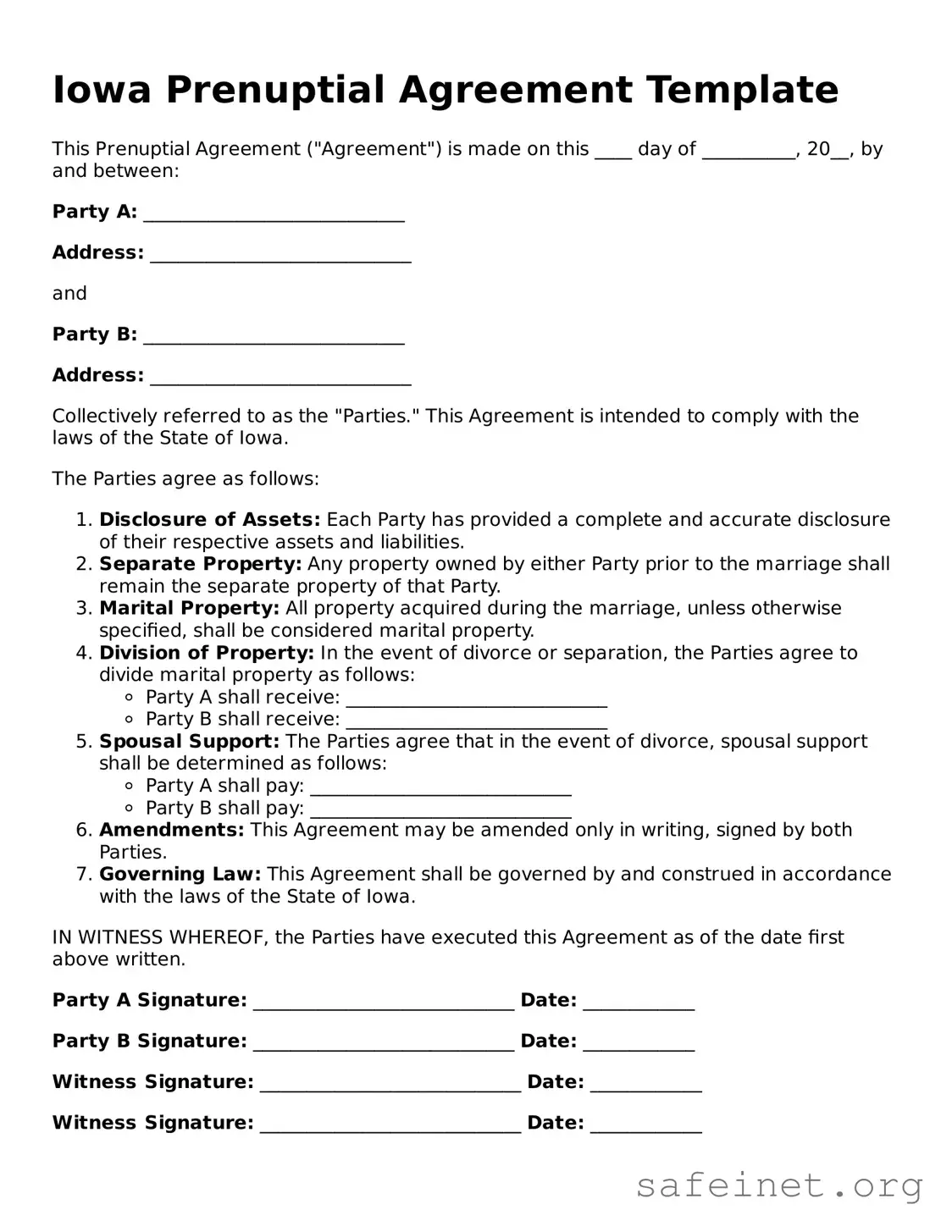
In the state of Iowa, couples considering marriage often turn to a prenuptial agreement as a proactive measure to safeguard their financial interests and clarify expectations. This legal document serves as a foundation for addressing various aspects of a couple's assets, debts, and responsibilities, should the marriage end in divorce or separation. It allows individuals to outline the division of property, spousal support, and other financial matters, ensuring that both parties are on the same page before tying the knot. By discussing and agreeing upon these terms in advance, couples can reduce potential conflicts and misunderstandings in the future. Moreover, the Iowa Prenuptial Agreement form provides a structured way to communicate and document each partner's wishes, fostering transparency and trust. Understanding the components of this agreement is crucial for anyone looking to navigate their marital financial landscape effectively.
Iowa Prenuptial Agreement Template
This Prenuptial Agreement ("Agreement") is made on this ____ day of __________, 20__, by and between:
Party A: ____________________________
Address: ____________________________
and
Party B: ____________________________
Address: ____________________________
Collectively referred to as the "Parties." This Agreement is intended to comply with the laws of the State of Iowa.
The Parties agree as follows:
IN WITNESS WHEREOF, the Parties have executed this Agreement as of the date first above written.
Party A Signature: ____________________________ Date: ____________
Party B Signature: ____________________________ Date: ____________
Witness Signature: ____________________________ Date: ____________
Witness Signature: ____________________________ Date: ____________
| Fact Name | Details |
|---|---|
| Definition | A prenuptial agreement is a contract between two individuals before marriage that outlines the division of assets and responsibilities in the event of divorce or separation. |
| Governing Law | The Iowa Prenuptial Agreement is governed by Iowa Code Chapter 596. |
| Enforceability | For a prenuptial agreement to be enforceable in Iowa, it must be in writing and signed by both parties. |
| Full Disclosure | Both parties must provide a full and fair disclosure of their financial situations prior to signing the agreement. |
| Independent Counsel | It is advisable for both parties to seek independent legal counsel to ensure that their rights are protected. |
| Modification | A prenuptial agreement can be modified after marriage, but any changes must also be in writing and signed by both parties. |
| Judicial Review | Courts in Iowa will review prenuptial agreements for fairness and may set aside those deemed unconscionable. |
| Timing | It is recommended that a prenuptial agreement be signed well in advance of the wedding to avoid claims of coercion. |
| Common Misconceptions | Many people believe prenuptial agreements are only for the wealthy, but they can benefit anyone looking to clarify financial responsibilities. |
Filling out the Iowa Prenuptial Agreement form is an important step for couples looking to clarify their financial rights and responsibilities before marriage. Following these steps will help ensure that the process is smooth and straightforward.
After completing the form, both parties should keep a copy for their records. It may also be wise to consult with a legal professional to ensure that the agreement meets all necessary legal requirements and adequately protects both parties' interests.
What is a prenuptial agreement in Iowa?
A prenuptial agreement, often called a "prenup," is a legal document that couples create before getting married. It outlines how assets and debts will be divided in case of divorce or separation. In Iowa, this agreement can also address spousal support and other financial matters. It helps provide clarity and can protect both parties’ interests.
Why should I consider a prenuptial agreement?
Many couples choose to create a prenup for various reasons. If you or your partner have significant assets, a business, or children from a previous relationship, a prenup can protect those interests. It can also help prevent future disputes and provide peace of mind, knowing that both parties agree on financial matters before marriage.
How do I create a prenuptial agreement in Iowa?
To create a prenuptial agreement in Iowa, both parties should first discuss their financial situations and goals. It’s important to be open and honest. Then, you can draft the agreement, ideally with the help of an attorney to ensure it meets legal requirements. Both parties must sign the document voluntarily, and it’s best to do this well in advance of the wedding.
Is a prenuptial agreement enforceable in Iowa?
Yes, a prenuptial agreement is enforceable in Iowa, provided it meets certain legal standards. The agreement must be in writing and signed by both parties. Additionally, it should be fair and not signed under duress or coercion. It’s advisable to have separate legal representation to ensure that both parties understand their rights.
Can I modify a prenuptial agreement after marriage?
Yes, you can modify a prenuptial agreement after marriage. Both parties must agree to any changes, and it is best to put the modifications in writing. This ensures that the new terms are clear and legally binding. Consulting with an attorney during this process is recommended to avoid potential issues later.
What happens if we don’t have a prenuptial agreement?
If you do not have a prenuptial agreement and later divorce, Iowa law will govern how your assets and debts are divided. This could lead to outcomes that neither party finds favorable. Without a prenup, you lose the opportunity to set your own terms and may end up in a lengthy legal dispute.
How much does it cost to create a prenuptial agreement in Iowa?
The cost of creating a prenuptial agreement can vary widely. It typically depends on the complexity of your financial situation and whether you hire an attorney. Basic agreements may cost a few hundred dollars, while more complex ones could run into the thousands. Investing in a prenup can save you money and stress in the long run.
Failing to fully disclose assets and debts. Both parties must provide complete information about their financial situation. Omitting significant details can lead to complications later.
Not having the agreement reviewed by legal professionals. It is advisable for both parties to consult with separate attorneys to ensure understanding and fairness.
Using vague language. Clear and specific terms should be used to avoid misunderstandings. Ambiguities can create confusion regarding the agreement's intent.
Not considering future changes. The agreement should account for potential changes in circumstances, such as income fluctuations or additional assets.
Neglecting to include a clause for dispute resolution. It is beneficial to outline how disputes regarding the agreement will be handled, such as through mediation or arbitration.
Ignoring state laws. Each state has specific requirements for prenuptial agreements. Ensure that the form complies with Iowa's legal standards.
Failing to sign the agreement in front of witnesses. Proper execution often requires signatures from witnesses to validate the document.
Rushing the process. Taking the time to discuss and negotiate terms can prevent future conflicts. Hasty decisions may lead to dissatisfaction.
Not updating the agreement. As life circumstances change, it is important to revisit and revise the agreement to reflect new realities.
Overlooking the importance of timing. The agreement should be signed well in advance of the wedding date to avoid claims of coercion or pressure.
When preparing for a prenuptial agreement in Iowa, several other documents may be useful to ensure clarity and protection for both parties. Here’s a list of common forms and documents that can accompany the Iowa Prenuptial Agreement.
Having these documents prepared and reviewed can facilitate smoother discussions and negotiations. They help both parties feel secure and informed as they enter into marriage.
The Iowa Prenuptial Agreement form shares similarities with a Marital Settlement Agreement. Both documents outline the division of assets and responsibilities in the event of a divorce. A Marital Settlement Agreement typically comes into play after a marriage has ended, detailing how property will be divided and any alimony or child support obligations. In contrast, a Prenuptial Agreement is created before marriage, allowing couples to proactively address these issues and set clear expectations for their financial futures.
Another document that resembles the Iowa Prenuptial Agreement is the Postnuptial Agreement. Like a Prenuptial Agreement, a Postnuptial Agreement also addresses asset division and financial responsibilities. However, it is executed after the marriage has already taken place. Couples may choose to create a Postnuptial Agreement to clarify their financial arrangements or to resolve issues that have arisen during their marriage, making it a useful tool for ongoing financial management.
The Cohabitation Agreement is another document that shares key features with the Iowa Prenuptial Agreement. This agreement is typically used by couples who live together but are not married. It outlines how assets will be divided and responsibilities shared if the relationship ends. Similar to a Prenuptial Agreement, it seeks to provide clarity and protection for both parties regarding their financial matters, ensuring that both individuals understand their rights and obligations.
A Separation Agreement also bears resemblance to the Iowa Prenuptial Agreement. This document is created when a couple decides to live apart but is not yet divorced. It outlines the terms of the separation, including asset division, child custody, and support obligations. Like a Prenuptial Agreement, it aims to prevent disputes by clearly defining each party's rights and responsibilities during a transitional period.
The Living Will, while not directly related to marriage, shares the concept of preemptively addressing important decisions. A Living Will allows individuals to specify their medical care preferences in the event they become incapacitated. Similar to a Prenuptial Agreement, it is a proactive measure that ensures personal wishes are respected, providing clarity and reducing potential conflicts among family members during difficult times.
The Durable Power of Attorney is another document that parallels the Iowa Prenuptial Agreement in its focus on planning for the future. This legal document grants someone the authority to make financial or medical decisions on behalf of another person if they become unable to do so. Like a Prenuptial Agreement, it emphasizes the importance of clear communication and understanding in managing one’s affairs, ensuring that the chosen individual can act in accordance with the person’s wishes.
Lastly, the Trust Agreement can be likened to the Iowa Prenuptial Agreement in its goal of asset protection and management. A Trust Agreement allows individuals to designate how their assets will be managed and distributed, often for the benefit of heirs or beneficiaries. Both documents serve to clarify intentions regarding asset distribution, providing a framework to avoid disputes and ensure that assets are handled according to the individual’s wishes.
When filling out the Iowa Prenuptial Agreement form, it's important to approach the process with care. Here are five things to keep in mind:
Following these guidelines can help create a fair and effective prenuptial agreement that protects both parties' interests.
Understanding prenuptial agreements can be challenging, and several misconceptions often arise regarding the Iowa Prenuptial Agreement form. Below is a list of common misunderstandings and clarifications to help individuals navigate this important legal document.
By addressing these misconceptions, individuals can make informed decisions about prenuptial agreements and their role in a successful marriage.
When considering a prenuptial agreement in Iowa, it’s essential to understand the key aspects of filling out and utilizing the form effectively. Here are some important takeaways:
By keeping these key points in mind, individuals can navigate the process of creating a prenuptial agreement in Iowa more confidently and effectively.