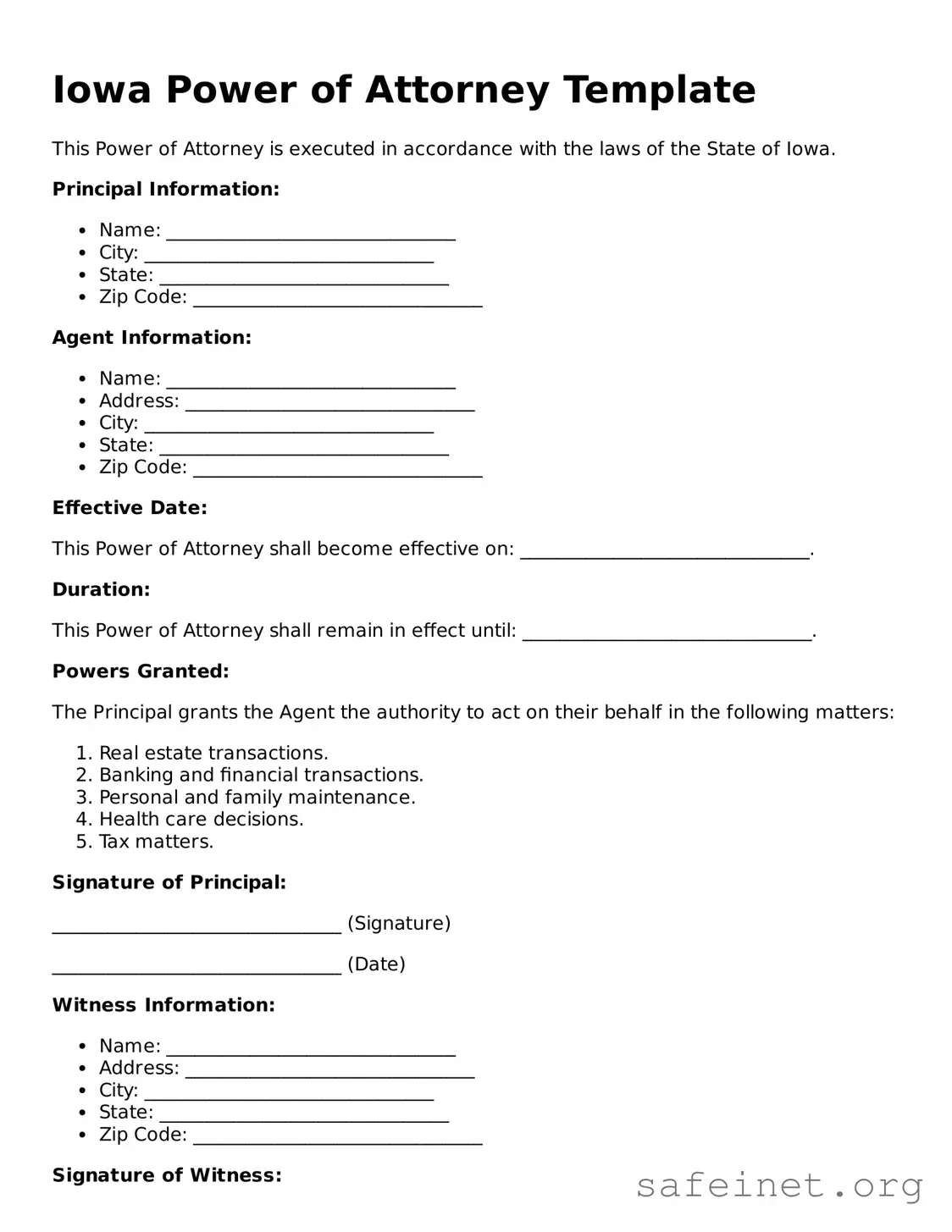
The Iowa Power of Attorney form serves as a crucial legal tool that allows individuals to appoint an agent to make decisions on their behalf, especially when they are unable to do so due to illness, disability, or absence. This form covers various aspects, including financial matters, healthcare decisions, and property management. It grants the appointed agent the authority to act in the principal's best interest, ensuring that their wishes are respected even when they cannot communicate them directly. The form can be tailored to meet specific needs, allowing for broad or limited powers, depending on the principal's preferences. Additionally, it is essential to understand the importance of choosing a trustworthy agent, as this person will have significant control over critical aspects of the principal's life. Understanding the nuances of the Iowa Power of Attorney form empowers individuals to make informed decisions about their future and the management of their affairs.
Iowa Power of Attorney Template
This Power of Attorney is executed in accordance with the laws of the State of Iowa.
Principal Information:
Agent Information:
Effective Date:
This Power of Attorney shall become effective on: _______________________________.
Duration:
This Power of Attorney shall remain in effect until: _______________________________.
Powers Granted:
The Principal grants the Agent the authority to act on their behalf in the following matters:
Signature of Principal:
_______________________________ (Signature)
_______________________________ (Date)
Witness Information:
Signature of Witness:
_______________________________ (Signature)
_______________________________ (Date)
Notary Public:
State of Iowa
County of _______________________________
Subscribed and sworn to before me this _____ day of ______________, 20__.
_______________________________ (Notary Public Signature)
My commission expires: _______________________________.
| Fact Name | Description |
|---|---|
| Definition | A Power of Attorney (POA) in Iowa is a legal document that allows one person to act on behalf of another in legal and financial matters. |
| Governing Law | The Iowa Power of Attorney is governed by Iowa Code Chapter 502. |
| Types of POA | Iowa recognizes several types of Power of Attorney, including durable, non-durable, and springing POAs. |
| Durable POA | A durable Power of Attorney remains in effect even if the principal becomes incapacitated. |
| Non-Durable POA | A non-durable Power of Attorney is effective only while the principal is competent and terminates if the principal becomes incapacitated. |
| Springing POA | A springing Power of Attorney becomes effective only upon the occurrence of a specified event, typically the principal's incapacitation. |
| Agent's Authority | The agent’s authority can be broad or limited, depending on the principal's specifications in the document. |
| Signing Requirements | The Iowa Power of Attorney must be signed by the principal and notarized to be valid. |
| Revocation | The principal can revoke the Power of Attorney at any time, provided they are competent. |
| Healthcare POA | A separate Healthcare Power of Attorney is recommended for decisions regarding medical treatment and health care. |
Filling out the Iowa Power of Attorney form is an important step in designating someone to act on your behalf in financial or legal matters. Once completed, this document will allow your chosen agent to manage your affairs according to your wishes. Follow the steps below to ensure that the form is filled out correctly.
What is a Power of Attorney in Iowa?
A Power of Attorney (POA) in Iowa is a legal document that allows one person (the principal) to grant another person (the agent) the authority to make decisions on their behalf. This can include financial matters, medical decisions, or other personal affairs. The principal must be of sound mind when creating the document.
What types of Power of Attorney are available in Iowa?
Iowa recognizes several types of Power of Attorney. The most common are General Power of Attorney, which grants broad powers to the agent, and Limited Power of Attorney, which restricts the agent's authority to specific tasks or timeframes. Additionally, there is a Durable Power of Attorney, which remains effective even if the principal becomes incapacitated.
How do I create a Power of Attorney in Iowa?
To create a Power of Attorney in Iowa, you must complete the appropriate form, which can be found online or through legal resources. The document should clearly state the powers being granted and must be signed by the principal. It is advisable to have the document notarized to ensure its validity.
Do I need witnesses to sign the Power of Attorney?
While Iowa law does not require witnesses for a Power of Attorney, having witnesses can strengthen the document's validity. If the principal is unable to sign, it is crucial to have a notary public present to acknowledge the signature.
Can I revoke a Power of Attorney in Iowa?
Yes, a Power of Attorney can be revoked at any time as long as the principal is competent. To revoke the document, the principal should create a written revocation and notify the agent and any institutions that may have relied on the original Power of Attorney.
What happens if the principal becomes incapacitated?
If the principal becomes incapacitated and has executed a Durable Power of Attorney, the agent can continue to act on their behalf. However, if a non-durable Power of Attorney was used, it would become void upon the principal's incapacity.
Can I choose multiple agents for my Power of Attorney?
Yes, a principal can appoint multiple agents in Iowa. However, it is essential to specify whether the agents must act jointly or if they can act independently. Clear instructions can help prevent conflicts and confusion in decision-making.
What responsibilities does the agent have under a Power of Attorney?
The agent has a fiduciary duty to act in the best interest of the principal. This includes managing finances responsibly, keeping accurate records, and making decisions that align with the principal's wishes. The agent should avoid conflicts of interest and act transparently.
Is a Power of Attorney valid if executed in another state?
A Power of Attorney executed in another state may be valid in Iowa, provided it complies with Iowa's laws. However, it is advisable to review the document to ensure it meets Iowa's requirements, especially if it involves real estate or financial transactions.
Not specifying the powers granted: Many individuals fail to clearly outline the specific powers they wish to grant. This can lead to confusion and may limit the agent's ability to act effectively on behalf of the principal.
Ignoring the agent's responsibilities: Some people do not consider the qualifications or trustworthiness of the person they appoint as their agent. It is crucial to choose someone who understands their responsibilities and can act in the principal's best interest.
Not signing the document correctly: A common mistake is not signing the Power of Attorney form in the presence of a notary or witnesses, if required. This can render the document invalid and ineffective.
Failing to date the form: Omitting the date can create complications later. It is essential to date the document to establish when the powers become effective.
Neglecting to review and update: People often forget to review their Power of Attorney regularly. Life changes, such as marriage or divorce, may necessitate updates to the form to ensure it reflects current wishes.
The Iowa Power of Attorney form is a crucial document that allows an individual, known as the principal, to designate another person, called the agent, to make decisions on their behalf. While this form is essential for managing financial and legal matters, several other documents often accompany it to ensure comprehensive management of personal affairs. Below is a list of these documents, each serving a specific purpose.
Each of these documents plays a significant role in ensuring that an individual's wishes are honored and that their affairs are managed according to their preferences. When used together, they create a comprehensive framework for decision-making in various aspects of life, particularly in times of uncertainty or incapacity.
The Iowa Power of Attorney form shares similarities with the Durable Power of Attorney. Both documents allow individuals to designate someone else to make decisions on their behalf. The key difference lies in the durability aspect; a Durable Power of Attorney remains effective even if the principal becomes incapacitated. This is crucial for individuals who want to ensure that their financial and medical decisions can continue to be managed by a trusted person when they are unable to do so themselves.
Another document comparable to the Iowa Power of Attorney is the Medical Power of Attorney. This specific form empowers an individual to make healthcare decisions for someone else. While the general Power of Attorney can cover a wide range of decisions, the Medical Power of Attorney focuses exclusively on health-related matters. This distinction is vital for ensuring that medical preferences are honored, particularly in situations where the principal is unable to communicate their wishes.
The Living Will is also similar to the Iowa Power of Attorney, particularly in its focus on healthcare decisions. A Living Will outlines an individual’s preferences regarding end-of-life care and medical treatment in situations where they cannot express their wishes. Unlike a Power of Attorney, which designates someone to make decisions, a Living Will directly states the individual's desires. Together, these documents can provide comprehensive guidance to loved ones and healthcare providers during critical times.
Lastly, the Advance Directive is another document that aligns closely with the Iowa Power of Attorney. An Advance Directive combines elements of both the Living Will and the Medical Power of Attorney. It allows individuals to specify their healthcare preferences while also appointing someone to make decisions on their behalf. This dual approach ensures that both the individual’s wishes and their chosen advocate are clearly communicated, offering peace of mind in the face of uncertainty regarding medical care.
When filling out the Iowa Power of Attorney form, it's essential to approach the task with care. Here are some important do's and don'ts to consider:
By following these guidelines, you can help ensure that your Power of Attorney is valid and effective when needed.
Understanding the Iowa Power of Attorney form is crucial for effective planning. However, several misconceptions can lead to confusion. Here are ten common misunderstandings about this important legal document:
By clearing up these misconceptions, individuals can make more informed decisions about their Power of Attorney needs and ensure their wishes are honored.
Filling out and using the Iowa Power of Attorney form can be straightforward if you keep these key points in mind: