The Iowa Power of Attorney for a Child form serves as a critical legal document that enables a parent or legal guardian to designate another individual to make decisions on behalf of their child. This form is particularly useful in situations where the parent or guardian is temporarily unable to care for the child, such as during travel, medical emergencies, or other unforeseen circumstances. The appointed individual, often referred to as the agent, gains the authority to make decisions related to the child's education, healthcare, and general welfare. The form requires the signatures of both the parent or guardian and the agent, ensuring that the arrangement is consensual and legally binding. Additionally, it is important to note that this power of attorney can be limited in scope, specifying the duration of authority and the particular decisions the agent is allowed to make. As such, understanding the nuances of this document is essential for any parent or guardian considering its use, as it provides a structured way to ensure that a child's needs are met in their absence.
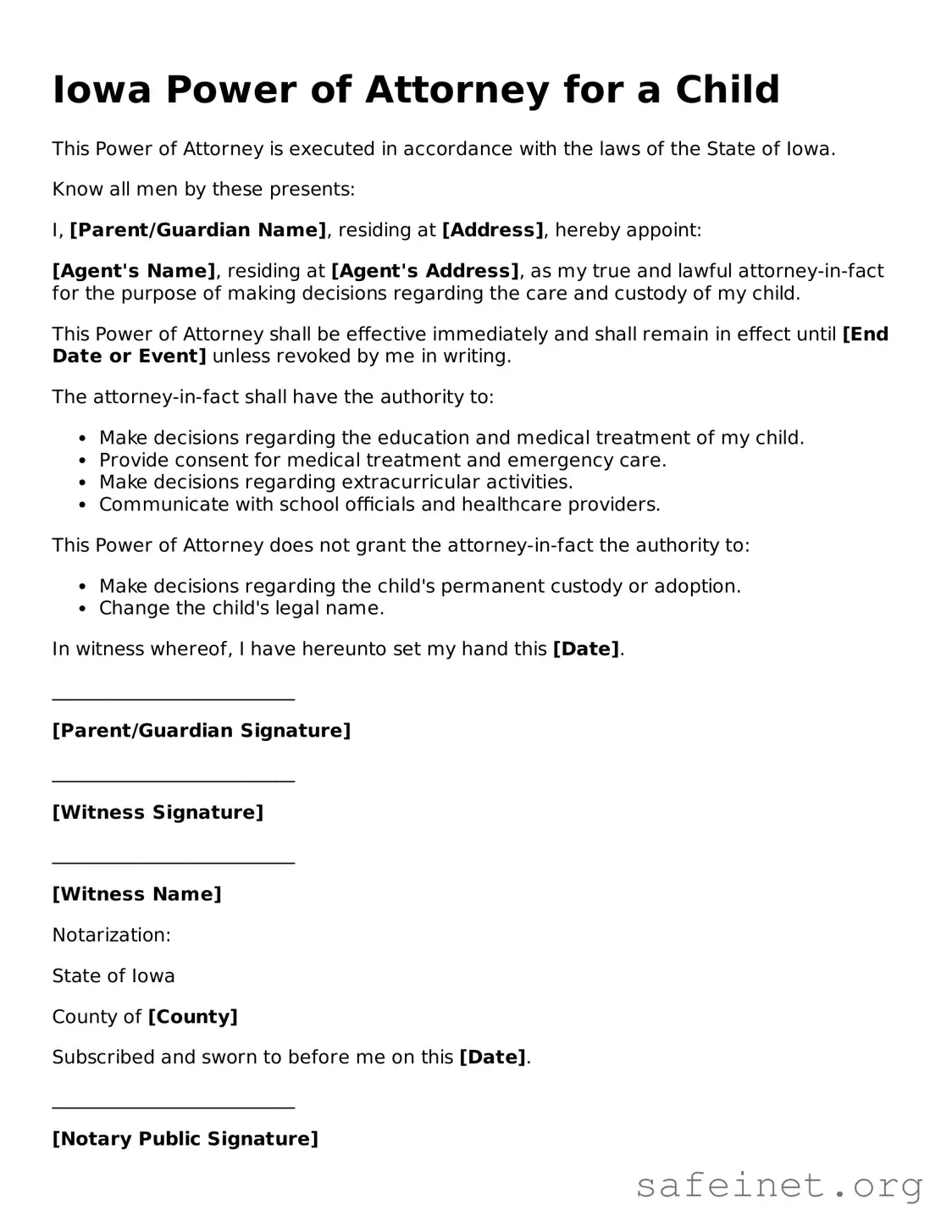
Iowa Power of Attorney for a Child
This Power of Attorney is executed in accordance with the laws of the State of Iowa.
Know all men by these presents:
I, [Parent/Guardian Name], residing at [Address], hereby appoint:
[Agent's Name], residing at [Agent's Address], as my true and lawful attorney-in-fact for the purpose of making decisions regarding the care and custody of my child.
This Power of Attorney shall be effective immediately and shall remain in effect until [End Date or Event] unless revoked by me in writing.
The attorney-in-fact shall have the authority to:
This Power of Attorney does not grant the attorney-in-fact the authority to:
In witness whereof, I have hereunto set my hand this [Date].
__________________________
[Parent/Guardian Signature]
__________________________
[Witness Signature]
__________________________
[Witness Name]
Notarization:
State of Iowa
County of [County]
Subscribed and sworn to before me on this [Date].
__________________________
[Notary Public Signature]
My commission expires: [Expiration Date]
| Fact Name | Description |
|---|---|
| Purpose | The Iowa Power of Attorney for a Child form allows a parent or guardian to designate another adult to make decisions for their child in their absence. |
| Governing Law | This form is governed by Iowa Code Chapter 633.557. |
| Duration | The power of attorney can be effective for a specific period or until revoked by the parent or guardian. |
| Eligibility | Any parent or legal guardian of a child can complete this form to grant authority to another adult. |
| Limitations | The appointed agent cannot make decisions regarding the child's education or health care without additional consent. |
| Revocation | The power of attorney can be revoked at any time by the parent or guardian, provided they notify the agent. |
| Notarization | While notarization is not required, it is recommended to ensure the document's validity and acceptance. |
Filling out the Iowa Power of Attorney for a Child form is a straightforward process, but it requires careful attention to detail. This form allows a parent or legal guardian to designate another individual to make decisions on behalf of their child. To ensure that the form is completed correctly, follow the steps outlined below.
After completing the form, make copies for all relevant parties. It is advisable to keep a copy for personal records and provide copies to the individual receiving power of attorney. This ensures clarity and helps prevent any potential misunderstandings in the future.
What is the Iowa Power of Attorney for a Child form?
The Iowa Power of Attorney for a Child form is a legal document that allows a parent or legal guardian to designate another adult to make decisions on behalf of their child. This form is particularly useful in situations where a parent may be temporarily unavailable, such as during travel, military deployment, or medical emergencies. By completing this form, the designated adult can take on responsibilities such as making educational, medical, and other important decisions for the child, ensuring that the child's needs are met in the parent's absence.
How do I complete the Iowa Power of Attorney for a Child form?
Completing the Iowa Power of Attorney for a Child form requires careful attention to detail. First, you will need to provide the full names and addresses of both the parent or guardian and the designated agent. Next, clearly outline the specific powers you wish to grant the agent. This can include decisions related to healthcare, education, and general welfare. It is crucial to sign the document in the presence of a notary public to ensure its validity. Once notarized, keep a copy for your records and provide a copy to the designated agent.
How long is the Iowa Power of Attorney for a Child form valid?
The validity of the Iowa Power of Attorney for a Child form can vary based on the specific terms outlined within the document. Generally, it remains effective until the parent or guardian revokes it or until a specified expiration date, if one is included. If the parent returns to a situation where they can resume their responsibilities, they can revoke the power of attorney at any time. It is advisable to communicate any changes in the arrangement to all parties involved, including the designated agent and any relevant institutions, such as schools or healthcare providers.
Can I revoke the Iowa Power of Attorney for a Child form once it is completed?
Yes, you can revoke the Iowa Power of Attorney for a Child form at any time, as long as you are of sound mind and able to make decisions. To do so, you should create a written revocation document that clearly states your intention to revoke the previously granted powers. This revocation should be signed and dated, and it is wise to notify the designated agent and any relevant institutions of the change. Keeping a record of the revocation is important to avoid any confusion in the future.
Not Including Specific Powers: One common mistake is failing to clearly define the powers granted to the agent. It’s important to specify what decisions the agent can make regarding the child’s education, health care, and other significant matters.
Incorrectly Identifying the Child: Ensure that the child’s full name and date of birth are accurately filled out. Omitting any details or making typographical errors can lead to confusion or legal challenges.
Neglecting to Sign and Date: The document must be signed and dated by the parent or legal guardian. Failing to do this renders the form invalid, which defeats its purpose.
Not Notarizing the Document: In Iowa, a Power of Attorney for a Child must be notarized. Skipping this step can result in the document not being recognized by schools or medical facilities.
Choosing the Wrong Agent: Selecting someone who is not trustworthy or reliable can lead to complications. It’s essential to choose an agent who understands the responsibilities and can act in the child’s best interest.
Failing to Review the Document Periodically: Life changes, and so do circumstances. Not reviewing or updating the Power of Attorney can result in outdated information or decisions that no longer reflect the parent’s wishes.
When creating a Power of Attorney for a Child in Iowa, several other forms and documents can be helpful. These documents can provide additional support and clarity for guardianship and care arrangements. Here’s a list of some commonly used forms:
Having these documents ready can make it easier to manage a child’s care and ensure their needs are met. They provide clarity and help avoid misunderstandings in various situations.
The Iowa Power of Attorney for a Child form is similar to a standard Power of Attorney document, which allows an individual to designate another person to make decisions on their behalf. In both cases, the principal grants authority to an agent to act in specific areas, such as financial or medical matters. However, the Power of Attorney for a Child specifically focuses on decisions related to the care and welfare of a minor, ensuring that the child’s best interests are prioritized in situations where the parent or legal guardian is unable to act.
Another similar document is the Guardianship Agreement. This legal arrangement appoints a guardian to take care of a minor when the biological parents are unable to do so, whether due to incapacity, absence, or other reasons. While a Power of Attorney for a Child is often temporary and can be revoked, a guardianship is typically more permanent and may require court approval. Both documents aim to protect the child’s welfare, but they differ in the duration and the legal processes involved.
The Child Custody Agreement also shares similarities with the Power of Attorney for a Child. This document outlines the terms of custody between parents or guardians, detailing where the child will live and how decisions will be made regarding their upbringing. Like the Power of Attorney, it is focused on the child’s best interests. However, custody agreements often arise during divorce or separation proceedings and involve more complex legal considerations regarding parental rights and responsibilities.
A Temporary Custody Order is another document that parallels the Power of Attorney for a Child. This order is issued by a court to grant temporary custody of a child to a relative or another individual when the parents are unable to care for them. Similar to the Power of Attorney, it is intended to provide immediate care and protection for the child. However, a Temporary Custody Order typically requires judicial oversight, making it more formal than a Power of Attorney.
The Medical Power of Attorney is also akin to the Power of Attorney for a Child, as it allows an individual to appoint someone to make healthcare decisions on their behalf. While the latter focuses on decisions regarding a minor’s welfare, the Medical Power of Attorney is broader and can apply to adults as well. Both documents empower an agent to act in the best interests of the person they represent, but the Medical Power of Attorney specifically addresses health-related matters.
A Caregiver Authorization Affidavit is another document that resembles the Power of Attorney for a Child. This affidavit allows a parent to authorize a caregiver to make decisions regarding the child’s education, health, and welfare. It is often used when a parent is temporarily unable to care for their child. While it shares the same goal of ensuring the child's needs are met, it is less formal than a Power of Attorney and may not require legal notarization.
Finally, the Child Welfare Agreement is similar in purpose to the Power of Attorney for a Child. This document outlines the responsibilities and rights of caregivers in situations where a child’s welfare is at stake. It may involve agreements between parents and social services or other agencies. Both documents focus on ensuring the child’s safety and well-being, but a Child Welfare Agreement often involves multiple parties and may be influenced by state or federal regulations.
When filling out the Iowa Power of Attorney for a Child form, it's essential to approach the task with care. Here are some important dos and don'ts to keep in mind:
Many people have misunderstandings about the Iowa Power of Attorney for a Child form. Here are five common misconceptions:
While the form can be useful in emergencies, it is not limited to such situations. Parents may use it for planned absences, such as vacations or work commitments, allowing another trusted adult to make decisions for their child.
The Power of Attorney for a Child does not transfer custody. It allows the designated person to make specific decisions, such as medical or educational choices, but does not change the legal custody status of the child.
While notarization is recommended for added validity, it is not always required. The form can be effective without a notary if it meets other legal criteria.
The form does not have a built-in expiration date. It remains in effect until the parent revokes it or until the child reaches the age of majority, unless otherwise specified in the document.
Multiple individuals can be designated in the Power of Attorney for a Child. Parents can name alternate agents to ensure that someone is always available to make decisions when needed.
Filling out and using the Iowa Power of Attorney for a Child form is an important process for parents and guardians. Here are key takeaways to keep in mind:
By following these key points, you can ensure that the Iowa Power of Attorney for a Child form is filled out correctly and used effectively.