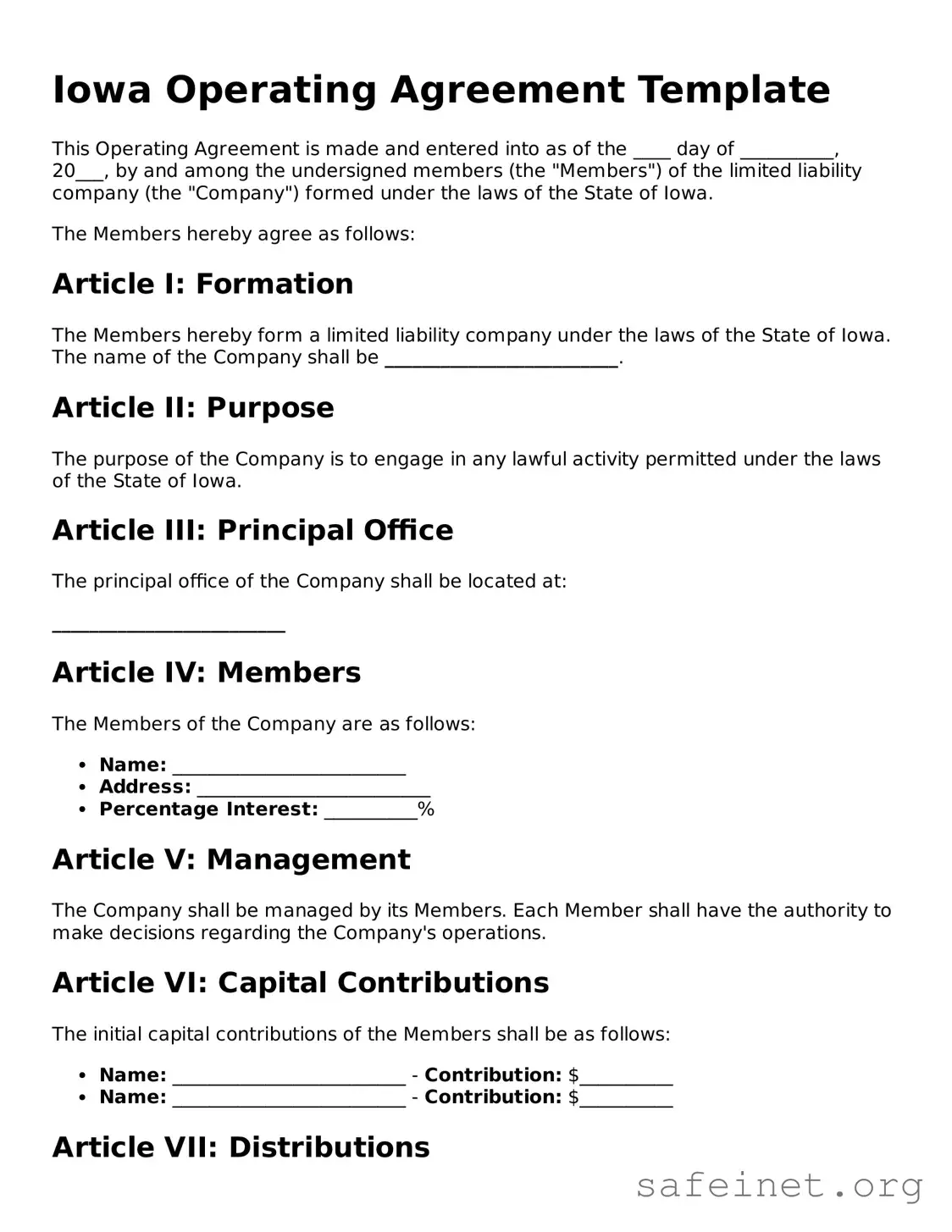
The Iowa Operating Agreement form plays a critical role in the governance and management of limited liability companies (LLCs) within the state. This document outlines the operational framework, defining the rights and responsibilities of members, as well as the management structure of the LLC. Key aspects include provisions for capital contributions, profit distribution, and decision-making processes, which are essential for maintaining clarity and reducing potential conflicts among members. Additionally, the form addresses the procedures for adding or removing members, the process for handling disputes, and the dissolution of the company. By establishing these guidelines, the Iowa Operating Agreement ensures that all parties have a mutual understanding of their roles and the operational mechanics of the business, thereby fostering a collaborative environment conducive to growth and stability.
Iowa Operating Agreement Template
This Operating Agreement is made and entered into as of the ____ day of __________, 20___, by and among the undersigned members (the "Members") of the limited liability company (the "Company") formed under the laws of the State of Iowa.
The Members hereby agree as follows:
Article I: Formation
The Members hereby form a limited liability company under the laws of the State of Iowa. The name of the Company shall be _________________________.
Article II: Purpose
The purpose of the Company is to engage in any lawful activity permitted under the laws of the State of Iowa.
Article III: Principal Office
The principal office of the Company shall be located at:
_________________________
Article IV: Members
The Members of the Company are as follows:
Article V: Management
The Company shall be managed by its Members. Each Member shall have the authority to make decisions regarding the Company's operations.
Article VI: Capital Contributions
The initial capital contributions of the Members shall be as follows:
Article VII: Distributions
Distributions shall be made to the Members in proportion to their respective percentage interests in the Company.
Article VIII: Indemnification
The Company shall indemnify each Member against any and all expenses and liabilities incurred in connection with the Company, to the fullest extent permitted by Iowa law.
Article IX: Amendments
This Agreement may be amended only by a written agreement signed by all Members.
Article X: Governing Law
This Agreement shall be governed by and construed in accordance with the laws of the State of Iowa.
IN WITNESS WHEREOF, the Members have executed this Operating Agreement as of the date first above written.
_________________________ _________________________
Member Signature Member Signature
_________________________ _________________________
Print Name Print Name
| Fact Name | Description |
|---|---|
| Definition | The Iowa Operating Agreement form outlines the management structure and operating procedures of a limited liability company (LLC) in Iowa. |
| Governing Law | The form is governed by the Iowa Code, specifically Chapter 489, which covers the Iowa Limited Liability Company Act. |
| Purpose | This document serves to clarify the rights and responsibilities of members and managers within the LLC. |
| Member Contributions | The agreement typically details the contributions of each member, whether in cash, property, or services. |
| Profit Distribution | It specifies how profits and losses will be allocated among members, often based on their ownership percentages. |
| Management Structure | The form allows for either member-managed or manager-managed structures, depending on the needs of the LLC. |
| Amendments | Members can outline the process for making amendments to the agreement, ensuring flexibility as the business evolves. |
| Dispute Resolution | The agreement may include provisions for resolving disputes among members, such as mediation or arbitration. |
| State Filing | While the operating agreement does not need to be filed with the state, it is recommended to keep it on record for internal use. |
Filling out the Iowa Operating Agreement form is a straightforward process that requires attention to detail. Once completed, the form will serve as a foundational document for your business entity, outlining the structure and operational guidelines.
What is an Iowa Operating Agreement?
An Iowa Operating Agreement is a legal document that outlines the management structure and operating procedures of a limited liability company (LLC) in Iowa. This agreement serves as an internal guideline for the members of the LLC, detailing their rights, responsibilities, and the processes for decision-making and profit distribution.
Is an Operating Agreement required in Iowa?
No, an Operating Agreement is not legally required in Iowa. However, having one is highly recommended. It helps to clarify the roles of members, reduce misunderstandings, and provide a framework for resolving disputes. Without an agreement, Iowa’s default LLC laws will govern the company, which may not align with the members' intentions.
Who should draft the Operating Agreement?
What key elements should be included in the Operating Agreement?
Key elements of an Operating Agreement should include the following: the names of the members, the purpose of the LLC, the management structure (member-managed or manager-managed), the allocation of profits and losses, procedures for adding or removing members, and guidelines for resolving disputes. These components help create a comprehensive framework for the LLC's operations.
Can the Operating Agreement be amended?
What happens if there is no Operating Agreement?
If there is no Operating Agreement, the LLC will be governed by Iowa's default laws for LLCs. This can lead to confusion and potential disputes among members, as the default laws may not reflect the members' intentions or preferences. It is advisable to create an Operating Agreement to avoid these complications.
How does the Operating Agreement affect liability protection?
Can a single-member LLC have an Operating Agreement?
Where can I find a template for an Iowa Operating Agreement?
Failing to include all members: It's crucial to list every member involved in the business. Omitting a member can lead to disputes later on.
Not specifying ownership percentages: Clearly defining each member's ownership stake prevents confusion and potential conflict.
Overlooking voting rights: Each member should know their voting power. If voting rights aren't clearly outlined, decision-making can become complicated.
Ignoring profit distribution: The agreement should specify how profits and losses will be shared among members. This helps in managing expectations.
Neglecting to address member roles: Clearly defining each member's responsibilities and roles within the company can help avoid misunderstandings.
Not including a buy-sell agreement: Planning for the future is essential. A buy-sell agreement can help manage what happens if a member wants to exit the business.
Failing to update the agreement: As circumstances change, so should the agreement. Regular updates ensure that it remains relevant and effective.
Skipping legal review: Even if the form seems straightforward, having a legal professional review the agreement can prevent costly mistakes down the line.
When forming a limited liability company (LLC) in Iowa, the Operating Agreement is a crucial document. However, several other forms and documents often accompany it to ensure compliance with state laws and to facilitate smooth business operations. Below is a list of five essential documents that are commonly used alongside the Iowa Operating Agreement.
Understanding these documents and their purposes can help ensure that your LLC is established correctly and operates smoothly. Being well-prepared will not only facilitate compliance with legal requirements but also foster a strong foundation for your business's future.
The Iowa Operating Agreement form shares similarities with the Limited Liability Company (LLC) Articles of Organization. Both documents are essential for establishing an LLC in Iowa. While the Articles of Organization primarily focus on the formation of the company and outline basic information like the business name, address, and registered agent, the Operating Agreement delves deeper into the internal workings of the LLC. It specifies the roles and responsibilities of members, management structure, and procedures for decision-making. Together, they provide a comprehensive framework for both the legal formation and operational guidelines of the LLC.
Another document that parallels the Iowa Operating Agreement is the Partnership Agreement. Like the Operating Agreement, a Partnership Agreement outlines the relationships and responsibilities among partners in a business. It details how profits and losses will be shared, decision-making processes, and procedures for adding or removing partners. Both documents aim to prevent disputes by clearly defining expectations and roles, although the Operating Agreement is tailored specifically for LLCs, while the Partnership Agreement focuses on traditional partnerships.
The Member Control Agreement is also similar to the Iowa Operating Agreement. This document, often used in multi-member LLCs, serves to clarify the management and operational procedures among members. It typically includes provisions regarding voting rights, profit distribution, and member responsibilities. While the Operating Agreement provides a broader framework for governance, the Member Control Agreement often focuses on specific operational aspects, ensuring that all members are aligned in their understanding of how the LLC will function.
The Bylaws of a corporation can also be compared to the Iowa Operating Agreement. Bylaws govern the internal management of a corporation, similar to how an Operating Agreement governs an LLC. Both documents outline the roles of directors or managers, the process for meetings, and how decisions are made. While the Operating Agreement is specific to LLCs and emphasizes flexibility in management structure, Bylaws reflect the more rigid structure of corporate governance.
Lastly, the Shareholder Agreement bears resemblance to the Iowa Operating Agreement. This document is crucial for corporations and outlines the rights and obligations of shareholders. It often addresses issues such as the transfer of shares, voting rights, and dispute resolution. Much like the Operating Agreement, it aims to provide clarity and structure to the relationships among stakeholders, ensuring that all parties understand their rights and responsibilities within the business framework.
When filling out the Iowa Operating Agreement form, it’s essential to approach the task with care and attention to detail. Here’s a list of things you should and shouldn’t do to ensure that your agreement is both effective and compliant.
Things You Should Do:
Things You Shouldn't Do:
By following these guidelines, you can create a well-structured Operating Agreement that serves the best interests of your business and its members.
Many individuals have misunderstandings about the Iowa Operating Agreement form. These misconceptions can lead to confusion and potentially costly mistakes. Here are six common misconceptions:
Understanding these misconceptions can help individuals make informed decisions regarding their business structures and legal documents.
When filling out and using the Iowa Operating Agreement form, it is important to keep several key points in mind. These takeaways will help ensure that the process is smooth and effective.
By keeping these key takeaways in mind, you can create a comprehensive and effective Operating Agreement that meets the needs of your business.