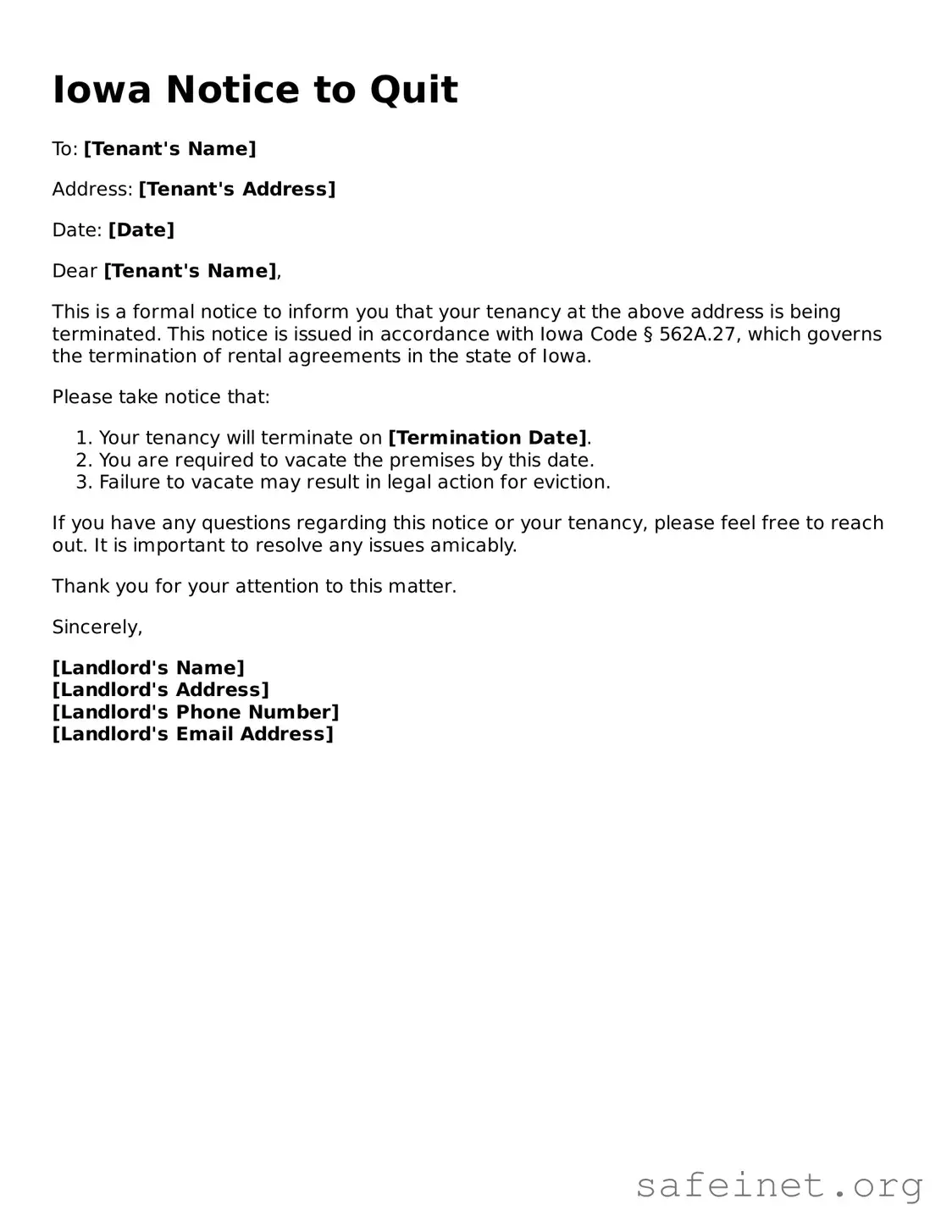
The Iowa Notice to Quit form plays a crucial role in the landlord-tenant relationship, serving as a formal notification that a tenant must vacate a rental property. This document is typically issued when a tenant has violated the terms of their lease agreement, such as failing to pay rent or engaging in illegal activities. It outlines specific details, including the reason for the notice, the date by which the tenant must leave, and any applicable state laws that govern the eviction process. The form must be delivered in a manner consistent with Iowa law, ensuring that tenants receive adequate notice and an opportunity to address the issues at hand. Understanding the intricacies of this form is essential for both landlords seeking to protect their property rights and tenants who may face eviction. Proper completion and delivery of the Notice to Quit can significantly impact the outcome of any subsequent legal proceedings, making it a vital document in the realm of rental agreements.
Iowa Notice to Quit
To: [Tenant's Name]
Address: [Tenant's Address]
Date: [Date]
Dear [Tenant's Name],
This is a formal notice to inform you that your tenancy at the above address is being terminated. This notice is issued in accordance with Iowa Code § 562A.27, which governs the termination of rental agreements in the state of Iowa.
Please take notice that:
If you have any questions regarding this notice or your tenancy, please feel free to reach out. It is important to resolve any issues amicably.
Thank you for your attention to this matter.
Sincerely,
[Landlord's Name]
[Landlord's Address]
[Landlord's Phone Number]
[Landlord's Email Address]
| Fact Name | Details |
|---|---|
| Purpose | The Iowa Notice to Quit form is used by landlords to inform tenants of the termination of their lease agreement. |
| Governing Law | The form is governed by Iowa Code Section 562A.27. |
| Delivery Method | The notice can be delivered in person, by mail, or through electronic means, depending on the lease agreement. |
| Notice Period | Typically, a 30-day notice is required, although this can vary based on the lease terms. |
| Content Requirements | The notice must include the reason for termination and the date by which the tenant must vacate. |
| Tenant Rights | Tenants have the right to contest the notice in court if they believe it is unjustified. |
| Legal Representation | Tenants may seek legal counsel to understand their rights and options following a Notice to Quit. |
| Failure to Comply | If the tenant does not vacate by the specified date, the landlord may initiate eviction proceedings. |
| Form Availability | The Iowa Notice to Quit form can be obtained from legal aid organizations or online legal resources. |
| Record Keeping | Landlords should keep a copy of the notice for their records, along with proof of delivery. |
Once you have the Iowa Notice to Quit form ready, it’s important to fill it out accurately. Completing this form correctly is essential for ensuring that the next steps in the process are clear and effective. Follow the instructions below to fill out the form properly.
What is the Iowa Notice to Quit form?
The Iowa Notice to Quit form is a legal document used by landlords to inform tenants that they must vacate the rental property. This notice is typically issued when a tenant has violated the terms of their lease or rental agreement, such as failing to pay rent or causing damage to the property. It serves as a formal request for the tenant to leave the premises within a specified timeframe.
How long does a tenant have to respond to a Notice to Quit?
The timeframe for a tenant to respond to a Notice to Quit can vary depending on the reason for the notice. Generally, if the notice is based on non-payment of rent, the tenant may have three days to pay the overdue rent or vacate the property. For other lease violations, the notice period may be longer, often ranging from 14 to 30 days. It is essential for tenants to read the notice carefully to understand the specific requirements and deadlines.
Can a tenant contest a Notice to Quit?
Yes, a tenant has the right to contest a Notice to Quit. If a tenant believes the notice was issued unfairly or that they have rectified the issue cited in the notice, they can communicate with the landlord to discuss the situation. If an agreement cannot be reached, the tenant may choose to seek legal advice and potentially challenge the notice in court.
What happens if a tenant does not comply with the Notice to Quit?
If a tenant fails to comply with the Notice to Quit, the landlord may initiate eviction proceedings. This process typically involves filing a lawsuit in the local court. The court will then schedule a hearing, where both parties can present their cases. If the court rules in favor of the landlord, a judgment may be issued, allowing the landlord to proceed with the eviction.
Is a Notice to Quit required before eviction in Iowa?
Yes, in Iowa, a Notice to Quit is generally required before a landlord can initiate eviction proceedings. This notice serves as a formal warning to the tenant, providing them an opportunity to remedy the situation or vacate the property. However, in certain emergency situations, such as illegal activity or significant damage to the property, a landlord may be able to bypass the notice requirement.
What information should be included in a Notice to Quit?
A Notice to Quit should include several key pieces of information. This includes the date the notice is issued, the tenant's name and address, the reason for the notice, and the specific timeframe in which the tenant must respond or vacate. Additionally, it should clearly state the consequences of failing to comply with the notice.
Can a landlord issue a Notice to Quit for reasons other than non-payment of rent?
Yes, a landlord can issue a Notice to Quit for various reasons beyond non-payment of rent. Common reasons include lease violations such as unauthorized pets, excessive noise, or damage to the property. Each reason must be clearly stated in the notice, along with the necessary actions the tenant must take to avoid eviction.
What should a tenant do upon receiving a Notice to Quit?
Upon receiving a Notice to Quit, a tenant should carefully read the document to understand the reason for the notice and the required actions. It is advisable for the tenant to communicate with the landlord to discuss the situation and explore possible resolutions. If necessary, seeking legal advice may also be beneficial to understand their rights and options.
Are there any protections for tenants against retaliatory Notices to Quit?
Yes, Iowa law provides certain protections for tenants against retaliatory actions from landlords. If a tenant has recently exercised their legal rights, such as reporting housing code violations or joining a tenants' union, a landlord may not issue a Notice to Quit in retaliation. If a tenant believes they are facing retaliation, they may want to consult legal counsel to explore their options.
Where can I find a template for the Iowa Notice to Quit form?
Templates for the Iowa Notice to Quit form can often be found online through legal aid organizations, local housing authorities, or court websites. It is important to ensure that any template used complies with Iowa state laws and accurately reflects the specific circumstances of the situation.
Inaccurate Tenant Information: One common mistake is providing incorrect or incomplete tenant details. This includes the tenant's name, address, and any other identifying information. Always double-check that these details are accurate to avoid confusion.
Missing Landlord Information: Just as tenant information is crucial, so is the landlord's information. Failing to include the landlord's name, address, and contact details can lead to issues in communication and legal proceedings.
Not Specifying the Reason for Termination: The form requires a clear reason for the notice to quit. Some individuals neglect to specify this, which can render the notice ineffective. It is important to articulate the reason clearly and concisely.
Incorrect Dates: Dates are vital in the Notice to Quit form. Mistakes such as entering the wrong date for when the notice is served or the date by which the tenant must vacate can lead to significant complications. Verify all dates before submission.
Failure to Sign and Date: A common oversight is neglecting to sign and date the form. Without a signature, the notice may be considered invalid. Ensure that the form is properly signed and dated to affirm its authenticity.
Not Keeping Copies: After filling out the form, it is essential to keep a copy for your records. Some people forget to do this, which can create difficulties later on if there are disputes regarding the notice.
The Iowa Notice to Quit form is an important document used in landlord-tenant relationships, particularly when a landlord seeks to terminate a lease agreement. However, this form is often accompanied by several other documents that help clarify the legal process and ensure that both parties understand their rights and obligations. Below are some commonly used forms and documents that may accompany the Notice to Quit in Iowa.
Understanding these documents can help both landlords and tenants navigate the complexities of rental agreements and ensure compliance with Iowa law. Each form plays a role in protecting the rights of both parties and maintaining a clear record of the rental relationship.
The Iowa Notice to Quit form shares similarities with the Eviction Notice, commonly used in various states. An Eviction Notice is a formal declaration from a landlord to a tenant, indicating that they must vacate the rental property by a specified date. Both documents serve to inform tenants of their lease violations or failure to pay rent. The key difference lies in the specific legal requirements and timelines that vary by jurisdiction. Nevertheless, both documents aim to initiate the process of reclaiming possession of the property and ensure that tenants are aware of their obligations.
Another document that resembles the Iowa Notice to Quit is the Lease Termination Notice. This notice is often utilized when a landlord or tenant wishes to end a lease agreement, regardless of any lease violations. Like the Notice to Quit, it provides a clear communication of intent to terminate the tenancy. However, the Lease Termination Notice typically allows for a longer notice period, depending on the lease terms and state laws. Both documents emphasize the importance of following proper procedures to avoid misunderstandings and potential legal disputes.
The Demand for Rent is also akin to the Iowa Notice to Quit. This document is issued when a tenant has failed to pay rent on time. It formally requests the overdue payment and may specify a timeframe for payment before further action is taken. While the Notice to Quit can be issued for various reasons, including lease violations, the Demand for Rent focuses specifically on the issue of non-payment. Both documents serve as crucial steps in the eviction process, ensuring that tenants are aware of their financial obligations and the potential consequences of non-compliance.
Lastly, the Notice of Non-Renewal is another document that parallels the Iowa Notice to Quit. This notice is used when a landlord decides not to renew a lease agreement at the end of its term. It informs the tenant that they must vacate the property by a certain date. Similar to the Notice to Quit, the Notice of Non-Renewal establishes clear communication regarding the end of tenancy. However, it typically does not address any lease violations or failures to pay rent, focusing instead on the conclusion of the lease term itself. Both documents are essential for maintaining transparency and ensuring that all parties understand their rights and responsibilities as the lease period comes to a close.
When filling out the Iowa Notice to Quit form, it's important to follow certain guidelines to ensure the document is completed correctly. Here are four things you should and shouldn't do:
Understanding the Iowa Notice to Quit form is essential for both landlords and tenants. However, several misconceptions can lead to confusion. Here are nine common misunderstandings:
This is not true. A Notice to Quit is a preliminary step that informs a tenant they must vacate the property. An eviction notice follows if the tenant does not comply.
While using a standard form is advisable for clarity, landlords can create their own Notice to Quit as long as it meets legal requirements.
Delivery methods must adhere to state laws. Typically, personal delivery or certified mail is required to ensure proper notice.
Landlords can issue this notice for specific reasons, such as non-payment of rent or lease violations, but not for arbitrary reasons.
Tenants retain rights and can contest the notice or seek legal advice. They may also have time to remedy the situation before eviction proceedings begin.
This is incorrect. The Notice to Quit is a communication to the tenant and does not need to be filed with the court unless it leads to an eviction process.
Tenants usually have a specific time frame to vacate the premises or address the issue, which is often outlined in the notice itself.
Notices can vary based on local ordinances and specific circumstances. It's important to check local regulations for any additional requirements.
This is a misconception. A Notice to Quit is just the beginning of the process, and eviction is not guaranteed if the tenant complies or contests the notice successfully.
When dealing with the Iowa Notice to Quit form, it is essential to understand its purpose and how to use it effectively. Here are some key takeaways: