In the realm of legal documentation, the Iowa Notary Acknowledgement form plays a pivotal role in ensuring the authenticity and integrity of various transactions. This form is essential for confirming that a signer has willingly executed a document, providing a layer of protection against fraud. It typically includes vital information such as the name of the signer, the date of the acknowledgment, and the notary's signature, along with their official seal. The presence of a notary public, who serves as an impartial witness, adds credibility to the process. Furthermore, this form is often required for important documents like deeds, contracts, and powers of attorney, making it a cornerstone of legal practice in Iowa. Understanding the nuances of this form can empower individuals to navigate their legal obligations with confidence, ensuring that their agreements are not only valid but also enforceable.
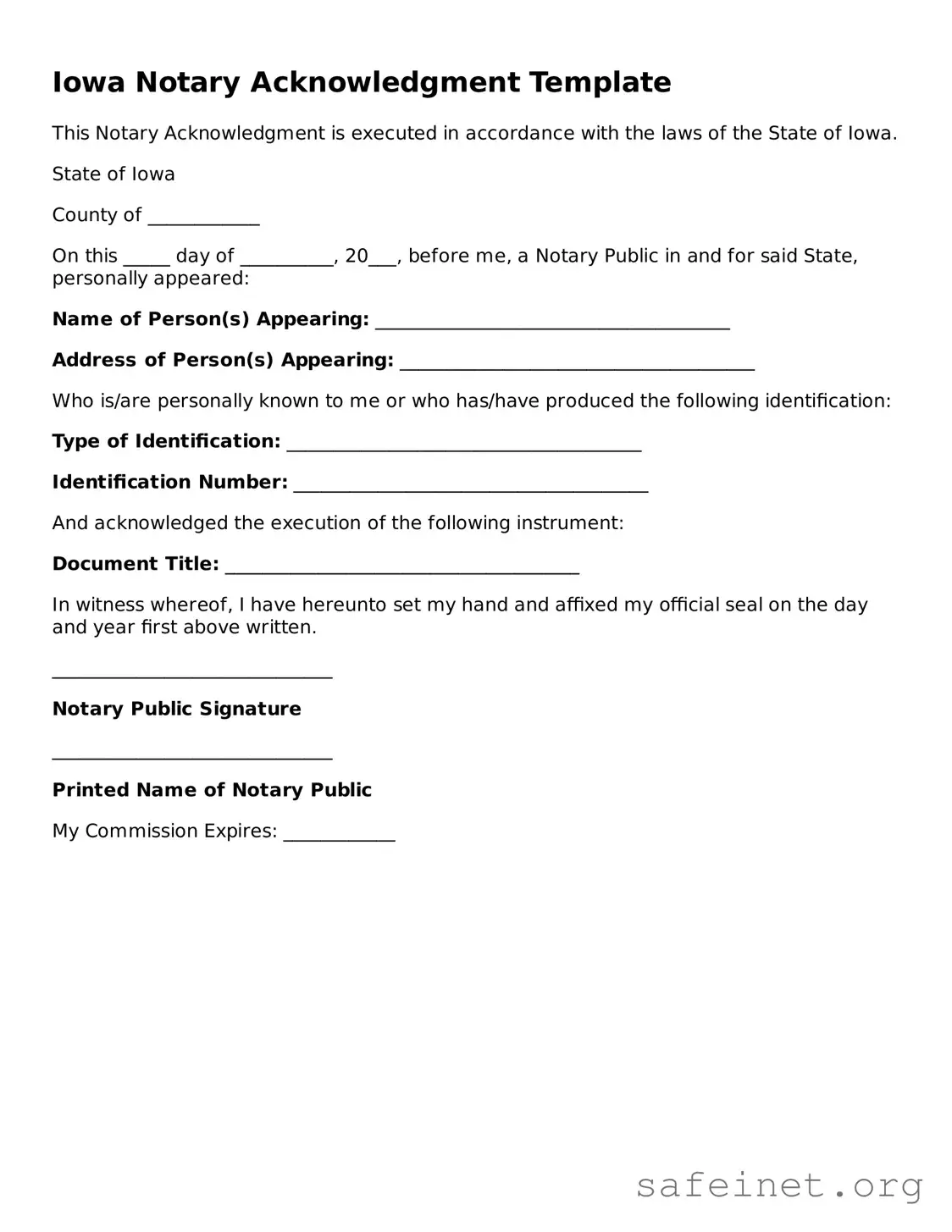
Iowa Notary Acknowledgment Template
This Notary Acknowledgment is executed in accordance with the laws of the State of Iowa.
State of Iowa
County of ____________
On this _____ day of __________, 20___, before me, a Notary Public in and for said State, personally appeared:
Name of Person(s) Appearing: ______________________________________
Address of Person(s) Appearing: ______________________________________
Who is/are personally known to me or who has/have produced the following identification:
Type of Identification: ______________________________________
Identification Number: ______________________________________
And acknowledged the execution of the following instrument:
Document Title: ______________________________________
In witness whereof, I have hereunto set my hand and affixed my official seal on the day and year first above written.
______________________________
Notary Public Signature
______________________________
Printed Name of Notary Public
My Commission Expires: ____________
| Fact Name | Description |
|---|---|
| Purpose | The Iowa Notary Acknowledgment form is used to verify the identity of the signer and their willingness to sign a document. |
| Governing Law | This form is governed by Iowa Code Chapter 9B, which outlines the requirements for notaries public in Iowa. |
| Signature Requirement | The signer must personally appear before the notary to acknowledge their signature on the document. |
| Notary's Role | The notary public certifies that the signer is who they claim to be and that they signed the document voluntarily. |
| Form Components | The form typically includes the notary's signature, seal, and the date of acknowledgment. |
| Validity | The acknowledgment is valid only if it is completed and signed in the presence of the notary. |
| Record Keeping | Notaries are required to keep a record of all acknowledgments they perform, including details about the signer. |
| Applicable Documents | This form can be used for various legal documents, including contracts, deeds, and affidavits. |
| Fees | Notaries in Iowa may charge a fee for their services, typically ranging from $5 to $10 per acknowledgment. |
After you have gathered the necessary information, you are ready to fill out the Iowa Notary Acknowledgement form. This form requires specific details to ensure it is completed correctly. Follow these steps carefully to ensure accuracy.
What is the Iowa Notary Acknowledgement form?
The Iowa Notary Acknowledgement form is a legal document used to verify the identity of a signer and confirm that they willingly signed a particular document. This form is essential for ensuring that the signing process is legitimate and that the signer understands the contents of the document they are signing. It typically includes the notary's signature, seal, and details about the transaction, such as the date and type of document being acknowledged.
Who can act as a notary in Iowa?
In Iowa, a notary public must be at least 18 years old, a resident of the state, and possess the ability to read and write in English. Additionally, applicants must complete a training course and pass an examination. Once appointed, a notary public has the authority to perform various duties, including taking acknowledgments, administering oaths, and witnessing signatures on legal documents.
How is the Iowa Notary Acknowledgement form completed?
To complete the Iowa Notary Acknowledgement form, the signer must first appear before the notary public. The notary will then confirm the identity of the signer, often by reviewing a government-issued identification. Once the notary is satisfied with the identification, they will fill out the form, which includes details such as the signer's name, the date of the acknowledgment, and the type of document being acknowledged. The notary will then sign and affix their seal to the form, completing the process.
Is the Iowa Notary Acknowledgement form required for all documents?
No, not all documents require a notary acknowledgment in Iowa. Typically, documents that may require notarization include real estate transactions, powers of attorney, and certain legal agreements. However, it is essential to check the specific requirements for each document type, as some may not necessitate notarization. Consulting with a legal professional can help clarify these requirements.
What happens if a notary fails to properly complete the acknowledgment?
If a notary fails to complete the acknowledgment correctly, it can lead to complications regarding the validity of the document. In some cases, the document may be considered invalid, which can result in legal disputes or challenges. It is crucial for notaries to follow proper procedures and ensure all necessary information is accurately recorded to prevent such issues.
Can a notary in Iowa refuse to perform an acknowledgment?
Yes, a notary in Iowa can refuse to perform an acknowledgment under certain circumstances. If the notary has doubts about the signer's identity, if the signer appears to be under duress, or if the document seems incomplete or improper, the notary has the right to decline the request. It is essential for notaries to act in accordance with the law and their ethical obligations, prioritizing the integrity of the notarization process.
Incorrect Date: One common mistake is failing to write the correct date on the form. This can lead to confusion about when the document was notarized.
Missing Signatures: Notaries often forget to ensure that all required parties have signed the document before the acknowledgment is completed. Each signature is crucial for the validity of the notarization.
Improper Identification: Another frequent error is not properly identifying the signers. Notaries must verify the identity of each person signing the document to prevent fraud.
Inaccurate Notary Information: Filling in incorrect notary details, such as the notary's name or commission number, can invalidate the acknowledgment. It's essential to double-check this information.
Failure to Use the Correct Form: Sometimes, people use an outdated version of the notary acknowledgment form. Always ensure you have the most current version to avoid any legal complications.
Neglecting to Include the Venue: The venue, or location where the notarization takes place, is often overlooked. Including this information is important for legal clarity and record-keeping.
When engaging in legal transactions in Iowa, the Notary Acknowledgement form often plays a crucial role. However, it is typically accompanied by other important documents that help establish the validity and legality of the agreements being made. Below is a list of common forms and documents that are frequently used alongside the Iowa Notary Acknowledgement form.
Understanding these documents and their functions can help individuals navigate legal processes more effectively. When combined with the Iowa Notary Acknowledgement form, they contribute to a more secure and legally sound transaction.
The Iowa Notary Acknowledgment form shares similarities with the Affidavit. An affidavit is a written statement confirmed by oath or affirmation, typically used as evidence in court. Both documents require the signer's acknowledgment of their identity and willingness to sign the document. However, while a notary acknowledgment verifies the signer’s identity and intent to sign, an affidavit often contains the signer’s sworn statements regarding facts relevant to a legal matter.
Another document akin to the Iowa Notary Acknowledgment is the Power of Attorney (POA). A Power of Attorney grants someone the authority to act on another person’s behalf in legal or financial matters. Like the notary acknowledgment, a POA must be signed in the presence of a notary to ensure that the principal (the person granting authority) is willingly giving that power. Both documents require careful verification of identity to prevent fraud.
The Deed is also similar to the Iowa Notary Acknowledgment form. A deed is a legal document that transfers ownership of property. When a deed is executed, it typically requires notarization to confirm that the signatures are genuine and that the parties involved understand the transaction. This process is crucial in both documents to maintain the integrity of the transaction and protect against disputes.
The Affidavit of Identity is another document that shares characteristics with the notary acknowledgment. This affidavit is often used to confirm a person’s identity, especially in situations where identity verification is critical, such as applying for a passport or bank account. Both documents involve the signer affirming their identity before a notary, ensuring that the information provided is accurate and legally binding.
Next, consider the Certification of Trust. This document provides evidence of the existence of a trust and outlines the powers of the trustee. Similar to the notary acknowledgment, a certification of trust must be notarized to verify the identities of the parties involved and ensure the authenticity of the document. Both documents serve to protect the interests of all parties by confirming the legitimacy of the signatures.
The Mortgage is another related document. A mortgage is a legal agreement where a borrower pledges property as security for a loan. Notarization is often required for mortgages to validate the signatures of the borrower and lender. This process is similar to that of the notary acknowledgment, as both require the presence of a notary to authenticate the parties’ identities and intentions.
The Bill of Sale also shares similarities with the Iowa Notary Acknowledgment. A bill of sale is a document that transfers ownership of personal property from one party to another. Notarization can enhance the document’s credibility by confirming the identities of the buyer and seller. Both documents ensure that the parties involved are aware of the transaction and have willingly signed the agreement.
Lastly, the Lease Agreement can be compared to the Iowa Notary Acknowledgment. A lease agreement outlines the terms under which one party agrees to rent property from another. While not always required, notarizing a lease can provide an extra layer of protection for both parties, similar to the notary acknowledgment. This process helps to confirm that all parties understand and agree to the terms laid out in the document.
When filling out the Iowa Notary Acknowledgement form, attention to detail is crucial. Here are important dos and don'ts to ensure the process goes smoothly.
By following these guidelines, you can help ensure that the acknowledgment is valid and legally binding.
When it comes to the Iowa Notary Acknowledgment form, several misconceptions can lead to confusion. Here are five common misunderstandings:
Many people believe that notaries can draft legal documents. In reality, notaries are only authorized to witness signatures and verify identities. They do not provide legal advice or create documents.
Another misconception is that all notaries are attorneys. While some notaries may have legal training, most are not lawyers. Their role is to serve as impartial witnesses, not to offer legal counsel.
People often think that notarization means a document is valid or legally binding. However, notarization only verifies that the signer appeared before the notary and identified themselves. It does not confirm the content of the document.
Some confuse a notary acknowledgment with a general notarization. Acknowledgment specifically refers to the process where a signer declares that they willingly signed the document, while notarization can include other acts, such as administering oaths.
Lastly, there is a belief that notaries can notarize any type of document. In Iowa, certain documents may have specific requirements or restrictions. It's essential to ensure the document is eligible for notarization under state law.
Understanding these misconceptions can help individuals navigate the notary process more effectively and ensure that their documents are handled correctly.
Filling out and using the Iowa Notary Acknowledgement form is a critical process for ensuring the validity of documents. Here are five key takeaways to keep in mind:
By following these guidelines, you can ensure that the Iowa Notary Acknowledgement form is used effectively and legally.