In the ever-evolving landscape of business and personal relationships, safeguarding sensitive information has become a top priority for many individuals and organizations. One effective tool for achieving this is the Iowa Non-disclosure Agreement (NDA) form. This legal document serves as a protective measure, ensuring that confidential information shared between parties remains secure and is not disclosed to unauthorized individuals. The Iowa NDA outlines the specific types of information considered confidential, the obligations of the parties involved, and the duration of the confidentiality obligation. By clearly defining what constitutes sensitive data, this agreement helps prevent misunderstandings and potential disputes. Additionally, the form includes provisions for handling breaches of confidentiality, offering a pathway for recourse should the need arise. Whether you are a business owner sharing trade secrets, an employee discussing proprietary information, or a freelancer collaborating with clients, understanding the Iowa Non-disclosure Agreement can empower you to protect your interests effectively.
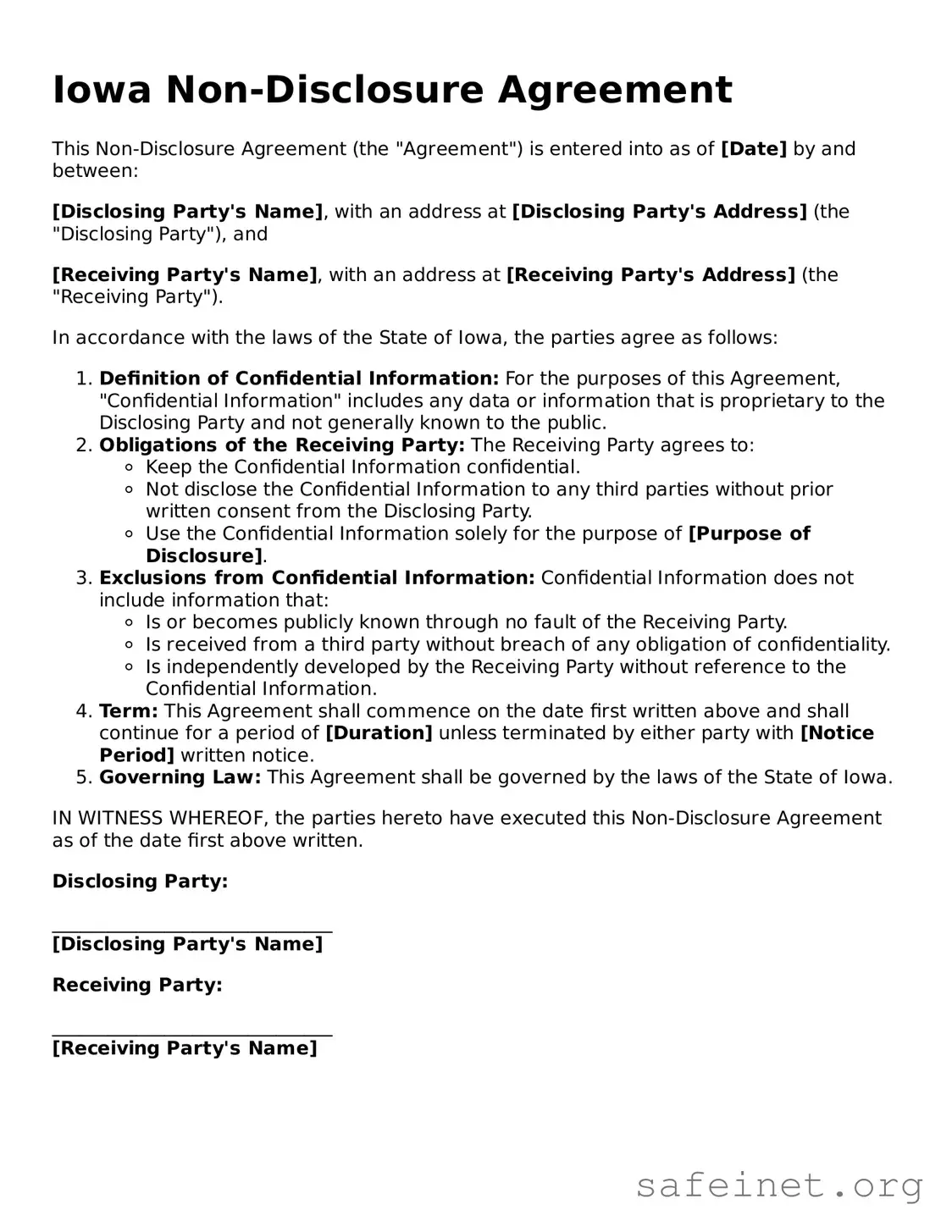
Iowa Non-Disclosure Agreement
This Non-Disclosure Agreement (the "Agreement") is entered into as of [Date] by and between:
[Disclosing Party's Name], with an address at [Disclosing Party's Address] (the "Disclosing Party"), and
[Receiving Party's Name], with an address at [Receiving Party's Address] (the "Receiving Party").
In accordance with the laws of the State of Iowa, the parties agree as follows:
IN WITNESS WHEREOF, the parties hereto have executed this Non-Disclosure Agreement as of the date first above written.
Disclosing Party:
______________________________
[Disclosing Party's Name]
Receiving Party:
______________________________
[Receiving Party's Name]
| Fact Name | Description |
|---|---|
| Purpose | The Iowa Non-disclosure Agreement (NDA) is designed to protect confidential information shared between parties during business discussions or collaborations. |
| Parties Involved | The NDA typically involves at least two parties: the disclosing party, who shares the confidential information, and the receiving party, who agrees to keep it secret. |
| Governing Law | The agreement is governed by the laws of the State of Iowa, ensuring that any disputes are resolved under Iowa law. |
| Duration of Confidentiality | NDAs often specify a duration for confidentiality, which can range from a few years to indefinitely, depending on the nature of the information. |
| Enforceability | For an NDA to be enforceable in Iowa, it must be reasonable in scope and duration, and it should not impose undue hardship on the receiving party. |
After you have gathered all necessary information, it’s time to fill out the Iowa Non-disclosure Agreement form. This document will require specific details to ensure it is complete and accurate. Follow the steps below carefully to ensure everything is filled out correctly.
What is a Non-disclosure Agreement (NDA) in Iowa?
A Non-disclosure Agreement (NDA) in Iowa is a legal contract that protects confidential information shared between parties. It ensures that sensitive information, such as business secrets, client lists, or proprietary data, remains private and is not disclosed to unauthorized individuals or entities. NDAs are commonly used in various business relationships, including partnerships, employment, and vendor agreements.
Why should I use an NDA?
Using an NDA is crucial for safeguarding your business interests. It establishes a clear understanding of what information is confidential and the obligations of the parties involved. By signing an NDA, you can prevent potential misuse of your sensitive information, which can be vital for maintaining a competitive edge in your industry.
Who can sign an NDA in Iowa?
Any individual or entity can sign an NDA in Iowa. This includes businesses, employees, contractors, and even freelancers. It's important that all parties involved in sharing confidential information agree to the terms outlined in the NDA to ensure protection for everyone.
What should be included in an NDA?
An effective NDA should clearly outline several key components: the definition of confidential information, the obligations of the parties regarding that information, the duration of the confidentiality obligation, and any exclusions from confidentiality. Additionally, it may include terms regarding the return or destruction of confidential information after the agreement ends.
How long does an NDA last?
The duration of an NDA can vary based on the specific agreement between the parties. Some NDAs may last for a set period, such as two or three years, while others may remain in effect indefinitely, especially if the information shared is particularly sensitive. It’s essential to specify the duration in the agreement to avoid any confusion later on.
What happens if someone breaches an NDA?
If someone breaches an NDA, the affected party may pursue legal action for damages. The consequences of breaching an NDA can include monetary compensation for losses incurred and, in some cases, injunctive relief to prevent further disclosures. It's important to enforce the terms of the NDA to ensure compliance and protect your interests.
Can an NDA be modified after it’s signed?
Yes, an NDA can be modified after it’s signed, but both parties must agree to the changes. Modifications should be documented in writing and signed by all parties involved to ensure clarity and legal enforceability. This helps prevent misunderstandings and keeps the agreement relevant as circumstances change.
Is an NDA enforceable in Iowa?
Yes, NDAs are generally enforceable in Iowa, provided they meet certain legal standards. The agreement must be reasonable in scope and duration, and it should protect legitimate business interests. Courts will uphold NDAs that are clear and fair, so it’s important to draft them carefully.
Where can I find a template for an NDA in Iowa?
Templates for NDAs can be found online through various legal websites or business resources. However, it’s wise to consult with a legal professional to ensure that the template meets your specific needs and complies with Iowa laws. Tailoring the NDA to your unique situation can provide better protection for your confidential information.
Failing to clearly define the confidential information. It is crucial to specify what information is considered confidential to avoid ambiguity.
Not including the duration of confidentiality. An agreement should state how long the information must remain confidential.
Overlooking the need for signatures. Both parties must sign the agreement for it to be legally binding.
Using vague language can lead to misunderstandings. Be precise in wording to ensure clarity.
Neglecting to identify the parties involved. Clearly list all parties to avoid confusion about who is bound by the agreement.
Forgetting to include any exclusions from confidentiality. Certain information may not need to be kept confidential, and this should be specified.
Not considering the governing law. Indicate which state’s laws will apply to the agreement, as this can affect enforcement.
Failing to provide a method for dispute resolution. Outline how disputes will be handled to prevent future conflicts.
Ignoring the importance of reviewing the agreement with legal counsel. It is wise to have a professional review the document before signing.
Not keeping a copy of the signed agreement. Always retain a copy for your records to ensure both parties have access to the terms.
When entering into a Non-disclosure Agreement (NDA) in Iowa, several other forms and documents may be utilized to support the agreement and clarify the terms of the relationship between the parties involved. Below is a list of documents that are often associated with NDAs, along with brief descriptions of each.
These documents can enhance the effectiveness of a Non-disclosure Agreement by providing additional context and legal clarity regarding the relationships and obligations of the parties involved. Understanding these forms can help ensure that all parties are adequately protected and informed throughout their business interactions.
A Non-Disclosure Agreement (NDA) is a crucial tool for protecting sensitive information, but it shares similarities with several other legal documents. One such document is the Confidentiality Agreement. Like an NDA, a Confidentiality Agreement binds parties to maintain the secrecy of shared information. However, it often focuses on a broader range of confidential information, not just trade secrets. Both documents serve the same purpose: to prevent unauthorized disclosure of proprietary information.
Another document that aligns closely with an NDA is the Proprietary Information Agreement (PIA). This agreement specifically addresses the protection of proprietary information, which may include formulas, processes, or techniques. While an NDA can cover various types of confidential information, a PIA is typically more focused on the intellectual property aspect, ensuring that proprietary knowledge remains secure.
Trade Secret Agreements are also similar to NDAs. These agreements specifically protect trade secrets, which are defined as information that derives economic value from being kept secret. While an NDA can encompass a wider range of confidential information, a Trade Secret Agreement hones in on the unique characteristics that qualify information as a trade secret, thus providing targeted protection for businesses.
A Mutual Non-Disclosure Agreement is another variant worth noting. This type of NDA is entered into by two parties who both wish to share confidential information with each other. Unlike a standard NDA, which typically protects one party’s information, a Mutual NDA ensures that both parties are equally committed to confidentiality. This agreement fosters trust and collaboration, especially in partnerships or joint ventures.
In the realm of employment, an Employment Confidentiality Agreement serves a similar purpose to an NDA. This document is often signed by employees to protect their employer’s sensitive information during and after their employment. It ensures that employees understand their obligation to keep company secrets confidential, thus safeguarding the employer’s competitive edge.
A Non-Compete Agreement, while primarily focused on restricting a person's ability to work in a competing business, often includes confidentiality clauses similar to those found in NDAs. These clauses prevent individuals from disclosing sensitive business information they may have accessed during their employment. Thus, a Non-Compete Agreement can complement an NDA by providing an additional layer of protection for a company’s confidential information.
Another related document is the Non-Circumvention Agreement. This agreement is designed to protect parties from being bypassed in business dealings, particularly in situations where one party introduces another to a potential business opportunity. While its primary focus is on business relationships, it often includes confidentiality provisions to ensure that sensitive information shared during negotiations remains protected.
A License Agreement can also bear similarities to an NDA, especially when it involves the sharing of proprietary information. In a License Agreement, one party grants another the right to use certain intellectual property while often requiring the recipient to keep that information confidential. This ensures that sensitive details about the licensed material are not disclosed to unauthorized parties.
Collaboration Agreements, especially in research and development, can incorporate elements of NDAs. These agreements outline the terms of cooperation between parties working together on a project, often necessitating the sharing of sensitive information. By including confidentiality clauses, Collaboration Agreements ensure that both parties protect each other’s proprietary information throughout the duration of their partnership.
Finally, a Data Sharing Agreement shares similarities with an NDA in the context of data protection. This document governs the sharing of sensitive data between parties, ensuring that the information is used appropriately and remains confidential. Like an NDA, it seeks to protect the interests of both parties by outlining the terms under which data can be shared, thus mitigating risks associated with data breaches.
When filling out the Iowa Non-disclosure Agreement form, it’s important to follow certain guidelines to ensure accuracy and compliance. Here’s a list of things you should and shouldn't do:
Understanding the Iowa Non-disclosure Agreement (NDA) form is crucial for individuals and businesses looking to protect sensitive information. However, several misconceptions can lead to confusion. Here are seven common misconceptions:
Being aware of these misconceptions can help individuals and businesses make informed decisions when drafting or signing an Iowa Non-disclosure Agreement.
When filling out and using the Iowa Non-disclosure Agreement (NDA) form, there are several important points to keep in mind. Here are some key takeaways:
These takeaways can help ensure that the NDA serves its intended purpose effectively.