In the competitive landscape of today's job market, employers often seek to protect their business interests by implementing various legal agreements, one of which is the non-compete agreement. This particular form is designed to restrict employees from engaging in certain activities that could potentially harm their employer's business after leaving their position. In Iowa, the non-compete agreement outlines essential elements such as the duration of the restriction, the geographic scope, and the specific activities that are prohibited. The agreement aims to balance the interests of both the employer and the employee, ensuring that while businesses can safeguard their proprietary information and client relationships, employees still have the opportunity to pursue their careers without undue limitations. Understanding the nuances of this form is crucial for both parties, as it not only defines the legal landscape surrounding employment but also influences the dynamics of the employer-employee relationship. By carefully considering the terms and implications of a non-compete agreement, individuals can navigate their professional paths more effectively while ensuring compliance with Iowa's legal standards.
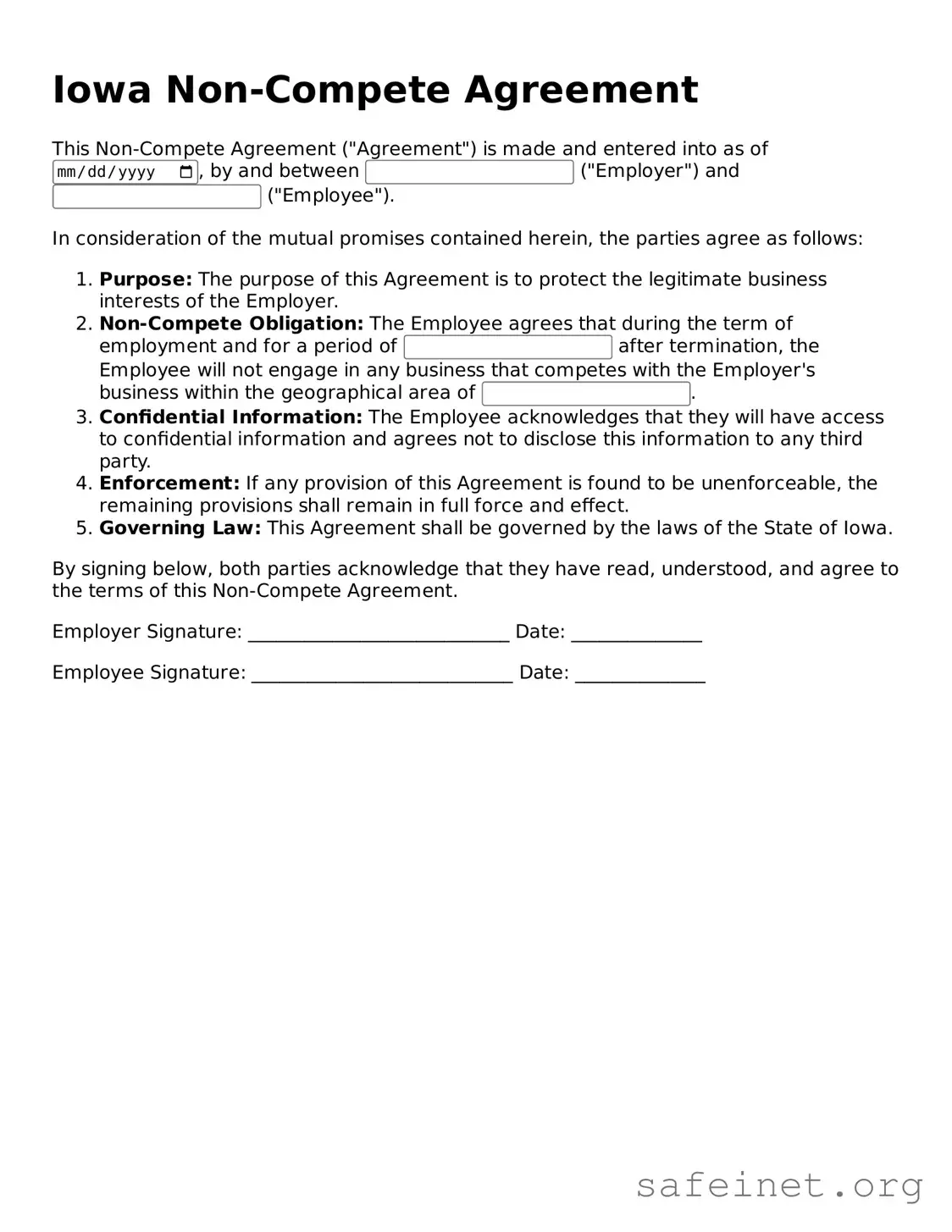
Iowa Non-Compete Agreement
This Non-Compete Agreement ("Agreement") is made and entered into as of , by and between ("Employer") and ("Employee").
In consideration of the mutual promises contained herein, the parties agree as follows:
By signing below, both parties acknowledge that they have read, understood, and agree to the terms of this Non-Compete Agreement.
Employer Signature: ____________________________ Date: ______________
Employee Signature: ____________________________ Date: ______________
| Fact Name | Description |
|---|---|
| Governing Law | The Iowa Non-compete Agreement is governed by Iowa Code Section 614.24. |
| Enforceability | Non-compete agreements in Iowa are enforceable only if they are reasonable in duration and geographic scope. |
| Consideration | For a non-compete agreement to be valid in Iowa, there must be adequate consideration, such as employment or access to confidential information. |
| Restrictions | Iowa courts may void overly broad restrictions that limit an individual's ability to work in their chosen profession. |
Filling out the Iowa Non-compete Agreement form is a straightforward process. Once you have the form in hand, you will need to provide specific information to ensure it is valid and enforceable. Carefully follow the steps outlined below to complete the form accurately.
Once you have completed the form, keep a copy for your records. You may need to provide it to your employer or legal advisor for further processing. Ensure that both parties retain a signed copy to avoid any future misunderstandings.
What is a non-compete agreement in Iowa?
A non-compete agreement is a contract between an employer and an employee. It restricts the employee from working for competitors or starting a competing business for a certain period after leaving the company. In Iowa, these agreements must be reasonable in scope and duration to be enforceable.
Are non-compete agreements enforceable in Iowa?
Yes, non-compete agreements can be enforceable in Iowa, but they must meet specific criteria. The agreement should protect legitimate business interests, be reasonable in time and geographic scope, and not impose undue hardship on the employee. Courts will review these factors before deciding if the agreement is valid.
How long can a non-compete agreement last in Iowa?
The duration of a non-compete agreement can vary. Generally, a period of six months to two years is considered reasonable, depending on the industry and circumstances. However, longer periods may be scrutinized by courts, so it’s essential to keep the duration reasonable.
What should be included in a non-compete agreement?
A non-compete agreement should clearly outline the scope of the restrictions, including the types of activities that are prohibited, the geographic area covered, and the duration of the restrictions. It’s also helpful to include a statement of the legitimate business interests being protected.
Can I negotiate a non-compete agreement?
Yes, you can negotiate the terms of a non-compete agreement. If you feel that certain restrictions are too broad or unreasonable, discuss your concerns with your employer. It's important to reach a mutual understanding before signing the agreement.
What happens if I violate a non-compete agreement?
If you violate a non-compete agreement, your former employer may take legal action against you. This could include seeking an injunction to prevent you from continuing the prohibited activity or pursuing damages for any losses incurred due to your actions. It's best to consult with a lawyer if you find yourself in this situation.
Can I work in my field after signing a non-compete agreement?
Not Understanding the Terms: Many individuals rush through the agreement without fully grasping the implications of the non-compete clauses. It's crucial to take the time to read and understand what you are agreeing to before signing.
Ignoring Duration and Geographic Scope: Some people overlook the specified duration and geographic limitations of the non-compete. These factors can significantly affect your ability to work in your field after leaving a job.
Leaving Out Important Details: Failing to fill in all required fields can lead to an incomplete agreement. Ensure that all sections are filled out accurately to avoid potential legal issues later on.
Not Seeking Legal Advice: Many individuals skip consulting a legal professional. Getting advice can help clarify any confusing aspects and ensure that your rights are protected.
Assuming It’s Standard: Just because a non-compete agreement looks familiar doesn’t mean it’s standard. Each agreement can have unique terms that may not be in your best interest.
The Iowa Non-compete Agreement is a crucial document for protecting business interests. However, several other forms and documents often accompany it to ensure comprehensive legal coverage. Below is a list of these documents, each serving a specific purpose.
These documents work together to create a clear framework for the employer-employee relationship. Ensuring that all relevant agreements are in place can help prevent misunderstandings and protect both parties' interests.
The Iowa Non-compete Agreement is similar to an Employment Agreement, which outlines the terms of employment between an employer and an employee. Both documents establish expectations and responsibilities, ensuring that both parties understand their rights. While the Non-compete Agreement focuses on restricting certain activities post-employment, the Employment Agreement lays the groundwork for the working relationship, including job duties, compensation, and benefits.
Another related document is the Confidentiality Agreement, often used in conjunction with a Non-compete Agreement. This document protects sensitive information that an employee might access during their employment. While the Non-compete Agreement restricts where an employee can work after leaving a company, the Confidentiality Agreement ensures that proprietary information remains secure, preventing employees from sharing trade secrets with competitors.
The Non-solicitation Agreement shares similarities with the Non-compete Agreement in that both aim to protect a company's interests after an employee departs. A Non-solicitation Agreement specifically prevents former employees from soliciting clients or employees of the company. This helps maintain business relationships and workforce stability, while the Non-compete Agreement restricts the employee from working in a competing business altogether.
In some cases, a Partnership Agreement may resemble a Non-compete Agreement, particularly when partners want to protect their business interests. This document outlines the terms of the partnership, including roles, profit sharing, and what happens if a partner leaves. Similar to a Non-compete Agreement, it can include clauses that prevent partners from starting competing businesses or soliciting clients if they exit the partnership.
The Franchise Agreement is another document that has aspects in common with the Non-compete Agreement. Franchise Agreements often contain clauses that restrict franchisees from competing with the franchisor during and after the term of the franchise. This ensures that the franchisor's brand and customer base remain protected, similar to how a Non-compete Agreement secures a company's interests against former employees.
A Shareholder Agreement may also include non-compete clauses, particularly in closely held corporations. This document outlines the rights and responsibilities of shareholders, including what happens if a shareholder decides to leave the company. Non-compete provisions within this agreement serve to protect the company's market position by preventing departing shareholders from starting competing ventures.
The Independent Contractor Agreement is another document that can resemble a Non-compete Agreement. While independent contractors typically have more flexibility than employees, these agreements can include non-compete clauses to protect the hiring company's interests. This ensures that contractors do not take their skills and knowledge to a direct competitor immediately after their contract ends.
Lastly, a Non-disclosure Agreement (NDA) is closely related to the Non-compete Agreement. Both documents aim to protect a company's sensitive information. An NDA specifically prohibits individuals from disclosing confidential information, while a Non-compete Agreement restricts them from working for competitors. Together, they create a comprehensive framework for safeguarding a company's proprietary interests both during and after employment.
When filling out the Iowa Non-compete Agreement form, it's crucial to approach the process with care. Here’s a list of important dos and don’ts to guide you.
Taking these steps seriously can help protect your rights and future career prospects. Make informed decisions and seek guidance when necessary.
Understanding the Iowa Non-compete Agreement form is crucial for both employers and employees. However, several misconceptions can lead to confusion. Here are six common misunderstandings:
Many believe that all non-compete agreements are legally binding. In Iowa, these agreements must meet specific criteria to be enforceable, including reasonableness in duration, geographic scope, and the protection of legitimate business interests.
This is not entirely true. A non-compete may restrict you from working for a specific employer or within a certain area, but it doesn’t necessarily prevent you from working in your field entirely. The terms of the agreement dictate the limits.
Non-compete agreements can vary significantly. Each agreement is unique and tailored to the specific business and employee relationship. It's essential to read and understand the specific terms of your agreement.
This misconception overlooks the fact that non-compete agreements can be used for various positions, not just executives or high-level employees. Employers may require them for any role where sensitive information or trade secrets are involved.
Many people think that once a non-compete is presented, it’s set in stone. In reality, these agreements can often be negotiated. It’s important to discuss any concerns with your employer before signing.
While both types of agreements aim to protect a business's interests, they serve different purposes. A non-disclosure agreement (NDA) focuses on keeping confidential information private, whereas a non-compete restricts where and for whom you can work after leaving a job.
By addressing these misconceptions, both employers and employees can better navigate the complexities of non-compete agreements in Iowa.
When filling out and using the Iowa Non-compete Agreement form, it is important to consider several key points. These agreements can significantly impact both employers and employees. Here are some essential takeaways: