The Iowa Motor Vehicle Power of Attorney form serves as a crucial document for individuals who need to delegate authority regarding their vehicle transactions. This form allows a designated person, often referred to as the attorney-in-fact, to handle various tasks on behalf of the vehicle owner. These tasks can include signing titles, transferring ownership, and managing registration processes. By utilizing this form, vehicle owners can ensure that their interests are protected even when they cannot be present to manage these important matters. Whether you're selling a car, buying a new one, or simply need someone to handle registration renewals, this form simplifies the process and provides peace of mind. Understanding the requirements and implications of the Iowa Motor Vehicle Power of Attorney can empower you to make informed decisions and navigate the complexities of vehicle ownership with confidence.
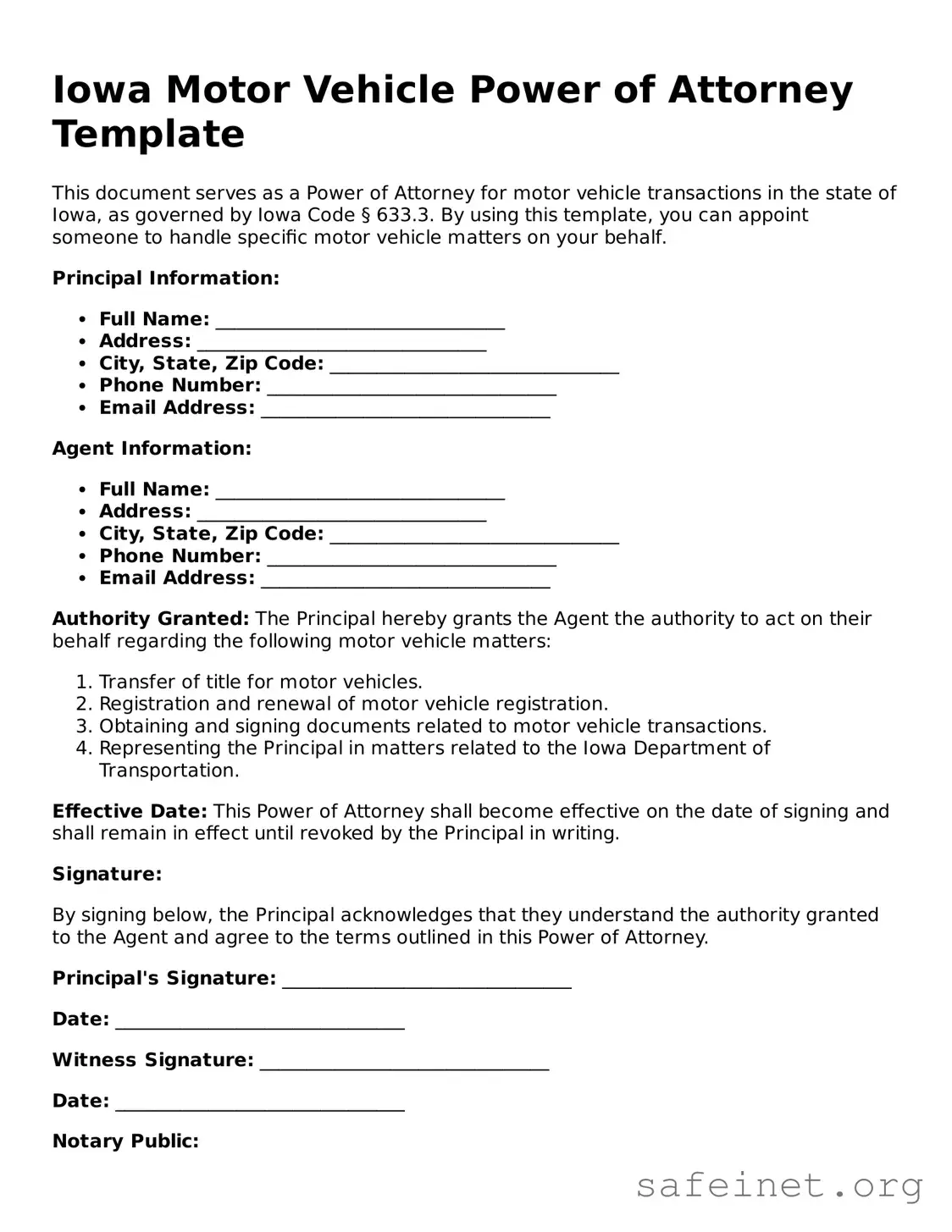
Iowa Motor Vehicle Power of Attorney Template
This document serves as a Power of Attorney for motor vehicle transactions in the state of Iowa, as governed by Iowa Code § 633.3. By using this template, you can appoint someone to handle specific motor vehicle matters on your behalf.
Principal Information:
Agent Information:
Authority Granted: The Principal hereby grants the Agent the authority to act on their behalf regarding the following motor vehicle matters:
Effective Date: This Power of Attorney shall become effective on the date of signing and shall remain in effect until revoked by the Principal in writing.
Signature:
By signing below, the Principal acknowledges that they understand the authority granted to the Agent and agree to the terms outlined in this Power of Attorney.
Principal's Signature: _______________________________
Date: _______________________________
Witness Signature: _______________________________
Date: _______________________________
Notary Public:
State of Iowa, County of _______________________________
Subscribed and sworn to before me this ____ day of ____________, 20__.
Notary Public Signature: _______________________________
My Commission Expires: _______________________________
| Fact Name | Description |
|---|---|
| Purpose | The Iowa Motor Vehicle Power of Attorney form allows an individual to designate another person to handle motor vehicle-related transactions on their behalf. |
| Governing Law | This form is governed by the Iowa Code, specifically sections related to powers of attorney and motor vehicle transactions. |
| Principal | The individual granting authority is known as the principal. They must be at least 18 years old and of sound mind. |
| Agent | The person receiving the authority is referred to as the agent. This person must also be at least 18 years old. |
| Scope of Authority | The agent can perform various tasks, such as signing titles, transferring ownership, and registering vehicles. |
| Duration | The power of attorney remains in effect until the principal revokes it or passes away. |
| Revocation | The principal can revoke the power of attorney at any time, as long as they are mentally competent to do so. |
| Notarization | While notarization is not always required, it is highly recommended to ensure the document is legally binding and accepted by authorities. |
| Usage | This form is commonly used in situations where the principal cannot be present to handle vehicle transactions personally. |
| Filing | The completed form should be presented to the Iowa Department of Transportation or relevant authorities when conducting vehicle transactions. |
Filling out the Iowa Motor Vehicle Power of Attorney form is a straightforward process that enables you to designate someone to act on your behalf regarding motor vehicle transactions. Once the form is completed and signed, it can be submitted to the appropriate authorities to ensure that your designated agent can proceed with the necessary actions.
What is the Iowa Motor Vehicle Power of Attorney form?
The Iowa Motor Vehicle Power of Attorney form is a legal document that allows one person (the principal) to authorize another person (the agent) to act on their behalf in matters related to motor vehicle transactions. This includes tasks such as registering a vehicle, transferring ownership, or obtaining a title.
Who can be designated as an agent in this form?
Any competent adult can be designated as an agent. This could be a family member, friend, or even a professional, such as an attorney or a title service provider. The principal must trust the agent to handle their vehicle-related affairs responsibly.
How do I complete the form?
To complete the form, fill in the required information, including the names and addresses of both the principal and the agent. Specify the powers granted to the agent, and ensure the form is signed and dated by the principal. It is advisable to have the signature notarized to enhance its validity.
Is notarization required for the form?
While notarization is not strictly required, it is highly recommended. Having the form notarized can help prevent disputes about its authenticity and ensure that the principal's identity is verified.
How long is the Power of Attorney valid?
The Power of Attorney remains valid until the principal revokes it or until the specified task is completed. It is important to communicate any changes or revocations to the agent and any relevant parties involved in vehicle transactions.
Can I revoke the Power of Attorney once it is in effect?
Yes, the principal can revoke the Power of Attorney at any time. To do this, a written notice of revocation should be created and provided to the agent and any entities that may have relied on the original Power of Attorney.
What if the principal is unable to sign the form?
If the principal is unable to sign due to incapacity, a court-appointed guardian or conservator may sign on their behalf. It is important to provide documentation proving the guardian's authority to act for the principal.
Where can I obtain the Iowa Motor Vehicle Power of Attorney form?
The form can be obtained from the Iowa Department of Transportation's website or local county treasurer's offices. Ensure you are using the most current version of the form to avoid any issues.
Are there any fees associated with using the Power of Attorney for vehicle transactions?
Fees may apply depending on the specific vehicle transaction being conducted, such as title transfers or registration. It is advisable to check with the Iowa Department of Transportation or your local county office for any applicable fees.
Not Specifying the Vehicle: One common mistake is failing to clearly identify the vehicle for which the power of attorney is being granted. Without the vehicle's make, model, year, and VIN, the document may be rendered ineffective.
Incorrect Signatures: All required signatures must be present. A common error is neglecting to sign the form or having the wrong person sign it. Each signature must match the names provided in the document.
Omitting Dates: Dates play a crucial role in the validity of the power of attorney. Failing to date the document can lead to confusion about when the authority was granted or when it is set to expire.
Not Notarizing the Document: In Iowa, a power of attorney for motor vehicles typically requires notarization. Skipping this step can invalidate the entire document.
Using Outdated Forms: Laws and forms can change. Utilizing an outdated version of the Power of Attorney form can lead to legal complications or rejection by the Department of Transportation.
Failing to Specify Powers Granted: The form should clearly outline what powers are being granted to the agent. A vague description can lead to misunderstandings or misuse of authority.
Not Keeping Copies: After completing the form, it is essential to keep copies for personal records. Failing to do so can result in difficulties if the original document is lost or needs to be referenced in the future.
When dealing with motor vehicle transactions in Iowa, several forms and documents may accompany the Motor Vehicle Power of Attorney. These documents help ensure that everything is handled smoothly and legally. Here’s a brief overview of some commonly used forms:
Having these documents ready can simplify the process of transferring vehicle ownership. Make sure to check that all forms are completed accurately to avoid any delays.
The Iowa Motor Vehicle Power of Attorney form is similar to a General Power of Attorney. Both documents allow an individual to appoint someone else to act on their behalf. In the case of a General Power of Attorney, the appointed agent can handle a wide range of financial and legal matters, not just those related to motor vehicles. This broader scope can be beneficial for individuals who need someone to manage various aspects of their affairs, especially if they are unable to do so themselves due to illness or absence.
Another document that shares similarities is the Durable Power of Attorney. Like the Motor Vehicle Power of Attorney, this document allows someone to make decisions on behalf of another person. However, the Durable Power of Attorney remains effective even if the person who created it becomes incapacitated. This feature ensures that the appointed agent can continue to manage the individual's affairs, providing peace of mind that their interests will be protected at all times.
The Limited Power of Attorney is also comparable. This document grants specific powers to an agent for a defined period or for a particular purpose. For example, if someone only needs assistance with the sale of a vehicle, they can use a Limited Power of Attorney to allow the agent to act solely for that transaction. This targeted approach can be advantageous for individuals who want to maintain control over their broader affairs while delegating specific tasks.
A Medical Power of Attorney is another related document. While it focuses on health care decisions rather than vehicle transactions, it similarly allows a designated person to make important choices on behalf of another. This document is crucial for ensuring that an individual’s medical preferences are honored when they cannot communicate their wishes. Both forms empower trusted individuals to act in the best interest of someone who may not be able to advocate for themselves.
The Financial Power of Attorney is also worth mentioning. This document allows an agent to handle financial matters, such as managing bank accounts or making investments, on behalf of another person. While the Iowa Motor Vehicle Power of Attorney is specifically focused on vehicle-related issues, both documents share the underlying principle of delegating authority to someone trusted. This delegation can alleviate stress for individuals who may be overwhelmed by their responsibilities.
Lastly, the Real Estate Power of Attorney is similar in that it allows someone to manage real estate transactions on behalf of another person. While the Iowa Motor Vehicle Power of Attorney deals with vehicles, both documents provide a means for individuals to empower others to handle significant transactions. This can be particularly useful for those who may not be available to sign documents in person or who prefer to have someone else manage these important affairs.
When filling out the Iowa Motor Vehicle Power of Attorney form, it's important to follow certain guidelines to ensure the document is valid and effective. Here are some things you should and shouldn't do:
The Iowa Motor Vehicle Power of Attorney form is a useful legal document, but several misconceptions surround its purpose and use. Understanding these misconceptions can help individuals navigate the process more effectively. Below is a list of common misunderstandings:
By clarifying these misconceptions, individuals can better understand the purpose and limitations of the Iowa Motor Vehicle Power of Attorney form, ensuring they utilize it effectively for their needs.
Filling out and using the Iowa Motor Vehicle Power of Attorney form can be straightforward if you keep a few key points in mind. Below are essential takeaways to consider:
By following these guidelines, you can effectively utilize the Iowa Motor Vehicle Power of Attorney form to manage your vehicle affairs.