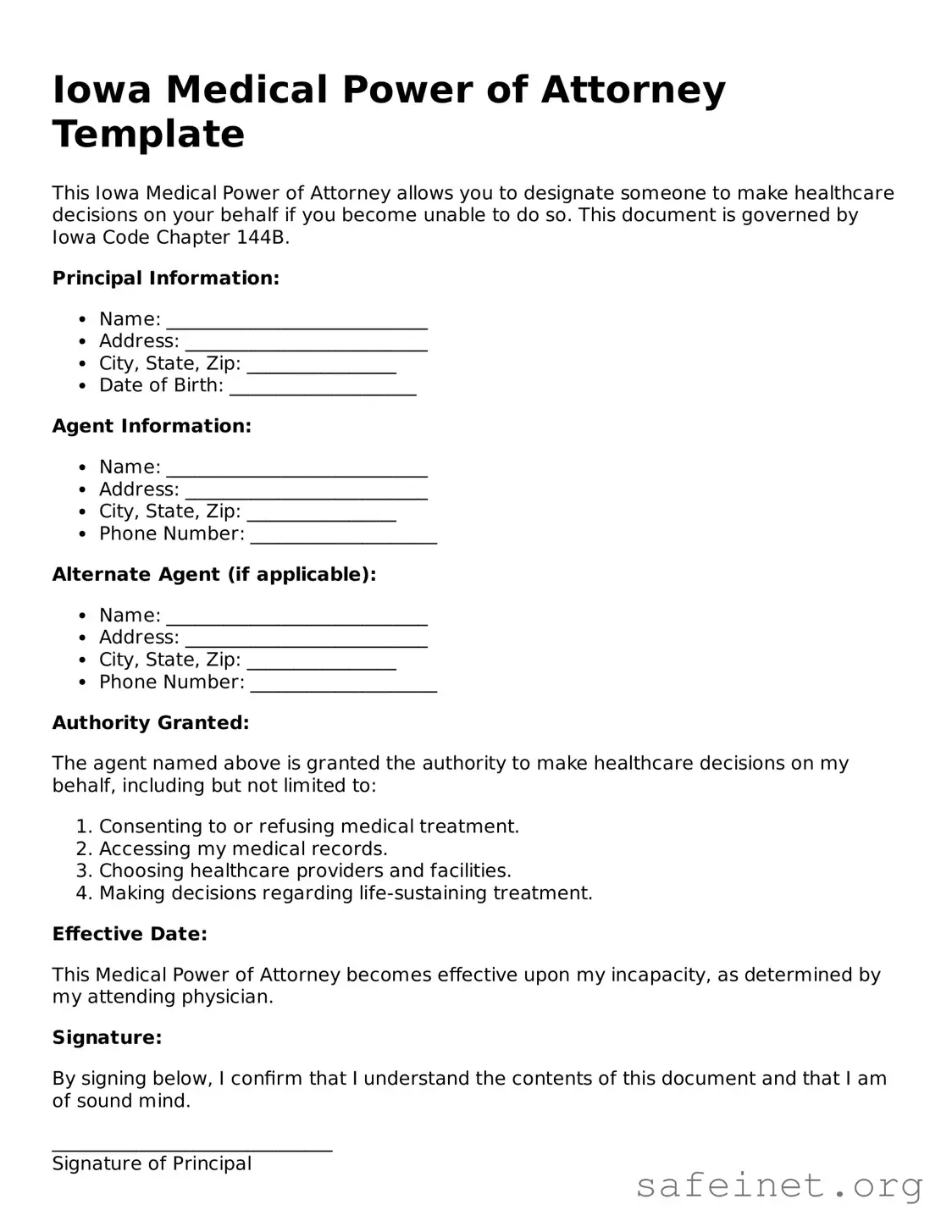
In Iowa, the Medical Power of Attorney (MPOA) form plays a crucial role in ensuring that individuals can make their healthcare wishes known, even when they are unable to communicate those desires themselves. This important document allows you to appoint a trusted person—often referred to as your agent or proxy—to make medical decisions on your behalf. It covers a wide range of healthcare choices, from routine medical care to more complex treatments, ensuring that your preferences regarding life-sustaining measures and end-of-life care are respected. By completing the MPOA, you can provide clear guidance to your healthcare providers and loved ones, alleviating the burden of decision-making during challenging times. Understanding the nuances of this form, including how to properly execute it and the rights it grants your designated agent, is essential for anyone looking to safeguard their medical care preferences. With thoughtful preparation, the Iowa Medical Power of Attorney can serve as a vital tool in planning for your future healthcare needs.
Iowa Medical Power of Attorney Template
This Iowa Medical Power of Attorney allows you to designate someone to make healthcare decisions on your behalf if you become unable to do so. This document is governed by Iowa Code Chapter 144B.
Principal Information:
Agent Information:
Alternate Agent (if applicable):
Authority Granted:
The agent named above is granted the authority to make healthcare decisions on my behalf, including but not limited to:
Effective Date:
This Medical Power of Attorney becomes effective upon my incapacity, as determined by my attending physician.
Signature:
By signing below, I confirm that I understand the contents of this document and that I am of sound mind.
______________________________
Signature of Principal
Date: ________________________
Witnesses:
This document must be signed in the presence of two witnesses who are not related to the principal or the agent.
Notarization (if desired):
This document may be notarized for additional validation.
______________________________
Notary Public Signature
Date: ________________________
| Fact Name | Details |
|---|---|
| Definition | The Iowa Medical Power of Attorney form allows an individual to designate someone to make healthcare decisions on their behalf if they become unable to do so. |
| Governing Law | The form is governed by Iowa Code Chapter 144B, which outlines the requirements and procedures for medical powers of attorney in Iowa. |
| Eligibility | Any competent adult can create a Medical Power of Attorney in Iowa, provided they are at least 18 years old. |
| Designation of Agent | The individual creating the form can choose any adult as their agent, but it is often recommended to select someone who understands their healthcare wishes. |
| Revocation | The Medical Power of Attorney can be revoked at any time by the principal, as long as they are still competent to make that decision. |
| Witness Requirements | The form must be signed in the presence of two witnesses or a notary public to be legally valid. |
| Healthcare Decisions | The agent can make a wide range of healthcare decisions, including choices about medical treatment, surgeries, and end-of-life care. |
| Durability | This power of attorney remains effective even if the principal becomes incapacitated, ensuring continuous representation in medical decisions. |
| Importance of Communication | It is crucial for the principal to discuss their wishes and preferences with their chosen agent to ensure alignment in decision-making. |
Completing the Iowa Medical Power of Attorney form is an important step in ensuring your healthcare preferences are respected. This document allows you to designate someone to make medical decisions on your behalf if you are unable to do so. Following the steps below will guide you through the process of filling out the form accurately.
Once you have completed these steps, your Iowa Medical Power of Attorney form will be ready for use. Ensure that you keep the original document in a safe place and inform your agents about its location.
What is a Medical Power of Attorney in Iowa?
A Medical Power of Attorney (MPOA) in Iowa is a legal document that allows an individual, known as the principal, to appoint someone else, referred to as the agent, to make healthcare decisions on their behalf. This arrangement is particularly important in situations where the principal becomes unable to communicate their wishes due to illness or incapacity. The agent's authority can encompass a wide range of medical decisions, including treatment options, end-of-life care, and medical procedures.
Who can be appointed as an agent in an Iowa Medical Power of Attorney?
In Iowa, the principal can choose any competent adult to serve as their agent. This can include family members, friends, or trusted individuals. However, it is advisable to select someone who understands the principal's values and healthcare preferences. Additionally, the selected agent should be willing to take on this responsibility and be available to make decisions when needed.
How does one create a Medical Power of Attorney in Iowa?
Creating a Medical Power of Attorney in Iowa involves several steps. First, the principal must complete the MPOA form, which is available through various legal resources or healthcare providers. After filling out the form, the principal must sign it in the presence of two witnesses or a notary public. It is crucial that the witnesses are not related to the principal or the agent and do not stand to gain anything from the principal's decisions. Once signed, the document should be shared with the appointed agent and healthcare providers to ensure that it is honored when necessary.
Can a Medical Power of Attorney be revoked in Iowa?
Yes, a Medical Power of Attorney can be revoked at any time by the principal, as long as they are still competent to make decisions. Revocation can be done by destroying the original document, creating a new MPOA, or providing a written notice to the agent and any healthcare providers involved. It is important for the principal to communicate their decision clearly to avoid any confusion regarding their healthcare wishes.
What happens if there is no Medical Power of Attorney in place?
If an individual becomes incapacitated without a Medical Power of Attorney, healthcare providers may be required to seek a court-appointed guardian to make medical decisions on their behalf. This process can be time-consuming and may not reflect the individual's personal wishes. Having an MPOA in place ensures that the principal's healthcare preferences are respected and that a trusted individual is making decisions during critical times.
Failing to specify the agent clearly. It is essential to identify the person who will make medical decisions on your behalf. This includes providing their full name and contact information. Without this information, the document may not be valid.
Not signing the document in the presence of witnesses. In Iowa, the Medical Power of Attorney must be signed by the principal in the presence of two witnesses. If this requirement is overlooked, the document may not hold up in legal situations.
Neglecting to date the form. A date is crucial as it indicates when the Medical Power of Attorney was created. Without a date, it may lead to confusion about the document’s validity, especially if multiple versions exist.
Overlooking the need for alternate agents. It is advisable to name a secondary agent in case the primary agent is unavailable or unable to act. Failing to do so can lead to complications in urgent situations.
Using vague language regarding medical decisions. The form should clearly outline the types of medical treatments the agent is authorized to make decisions about. Ambiguity can lead to misunderstandings and disputes among family members or healthcare providers.
The Iowa Medical Power of Attorney form is a crucial document that allows individuals to designate someone to make healthcare decisions on their behalf if they become unable to do so. Alongside this form, several other documents can enhance clarity and ensure that an individual's healthcare preferences are respected. Below is a list of commonly used forms and documents that complement the Iowa Medical Power of Attorney.
These documents work together to create a comprehensive plan for healthcare and financial decisions. It is essential to consider each form's purpose and ensure that they align with personal values and preferences.
The Iowa Medical Power of Attorney form shares similarities with the General Power of Attorney. Both documents allow individuals to designate someone to make decisions on their behalf. However, while the General Power of Attorney can cover a wide range of legal and financial matters, the Medical Power of Attorney is specifically focused on healthcare decisions. This distinction is crucial for individuals who want to ensure that their health-related choices are made by someone they trust, especially in situations where they may be unable to communicate their wishes.
Another document that resembles the Iowa Medical Power of Attorney is the Living Will. Both serve to express an individual's healthcare preferences, particularly concerning end-of-life care. However, a Living Will primarily outlines specific medical treatments one does or does not want, whereas the Medical Power of Attorney appoints a trusted person to make decisions when the individual cannot do so. Together, these documents provide comprehensive guidance for healthcare providers and loved ones during critical times.
The Advance Directive is another document akin to the Iowa Medical Power of Attorney. Like the Medical Power of Attorney, an Advance Directive allows individuals to outline their healthcare preferences in advance. However, it often combines elements of both the Medical Power of Attorney and the Living Will. This means that it not only appoints a healthcare agent but also specifies the types of medical treatment desired or refused, creating a more holistic approach to healthcare decision-making.
The Health Care Proxy is similar in function to the Iowa Medical Power of Attorney, as it allows individuals to designate someone to make medical decisions on their behalf. This document is commonly used in various states and serves the same purpose of ensuring that a trusted person can act according to the individual's wishes when they are unable to do so. The main difference lies in the terminology and specific state laws governing each document.
Another comparable document is the Do Not Resuscitate (DNR) order. While not a direct substitute for the Medical Power of Attorney, a DNR order specifies that an individual does not wish to receive CPR or other resuscitative measures in the event of cardiac arrest. This document can be part of a broader healthcare plan that includes a Medical Power of Attorney, ensuring that the appointed agent is aware of and can honor the individual's wishes regarding resuscitation efforts.
The Physician Orders for Life-Sustaining Treatment (POLST) form also bears similarities to the Iowa Medical Power of Attorney. The POLST form is designed for individuals with serious health conditions and outlines specific medical orders regarding treatment preferences. While the Medical Power of Attorney designates someone to make decisions, the POLST provides actionable medical orders that healthcare providers must follow. This document is particularly useful for ensuring that an individual’s wishes are respected in emergency situations.
Lastly, the Consent to Treatment form is relevant to the discussion. This document grants permission for healthcare providers to administer specific treatments or procedures. While it does not appoint an agent like the Medical Power of Attorney, it serves a similar purpose by ensuring that healthcare decisions align with the individual’s preferences. The Consent to Treatment form can be used in conjunction with the Medical Power of Attorney to provide clarity on what treatments an individual consents to under various circumstances.
When filling out the Iowa Medical Power of Attorney form, it is essential to approach the process carefully. This document allows you to appoint someone to make medical decisions on your behalf if you are unable to do so. Here are some important dos and don'ts to keep in mind:
By following these guidelines, you can ensure that your Medical Power of Attorney form accurately reflects your wishes and provides clear guidance for your loved ones during challenging times.
When considering the Iowa Medical Power of Attorney form, several misconceptions may arise. Understanding these can help individuals make informed decisions regarding their healthcare choices. Below are seven common misconceptions:
Misconception 1: The Iowa Medical Power of Attorney is only for the elderly.
This form is beneficial for anyone, regardless of age. It allows individuals to designate someone to make healthcare decisions on their behalf if they become unable to do so.
Misconception 2: A Medical Power of Attorney can only be created in a hospital setting.
This form can be completed anywhere, as long as the individual is of sound mind and understands the implications of the document.
Misconception 3: Once signed, the Medical Power of Attorney cannot be changed.
Individuals have the right to revoke or modify their Medical Power of Attorney at any time, as long as they are mentally competent.
Misconception 4: The appointed agent must be a family member.
While many choose a family member, the agent can be anyone the individual trusts, including friends or professionals.
Misconception 5: A Medical Power of Attorney gives the agent control over financial decisions.
This form specifically pertains to healthcare decisions. A separate financial power of attorney is needed for financial matters.
Misconception 6: The Medical Power of Attorney is only effective during a medical emergency.
This document remains effective as long as the individual is incapacitated, not just during emergencies.
Misconception 7: The Medical Power of Attorney is the same as a living will.
While both documents relate to healthcare decisions, a living will specifically outlines end-of-life wishes, whereas a Medical Power of Attorney designates someone to make decisions.
Addressing these misconceptions can help individuals better prepare for their healthcare needs and ensure their wishes are honored.
When considering the Iowa Medical Power of Attorney form, it's essential to understand its purpose and how to use it effectively. Here are some key takeaways:
Understanding these points can help you navigate the process with confidence. Taking the time to fill out the Iowa Medical Power of Attorney form can provide peace of mind for you and your loved ones.