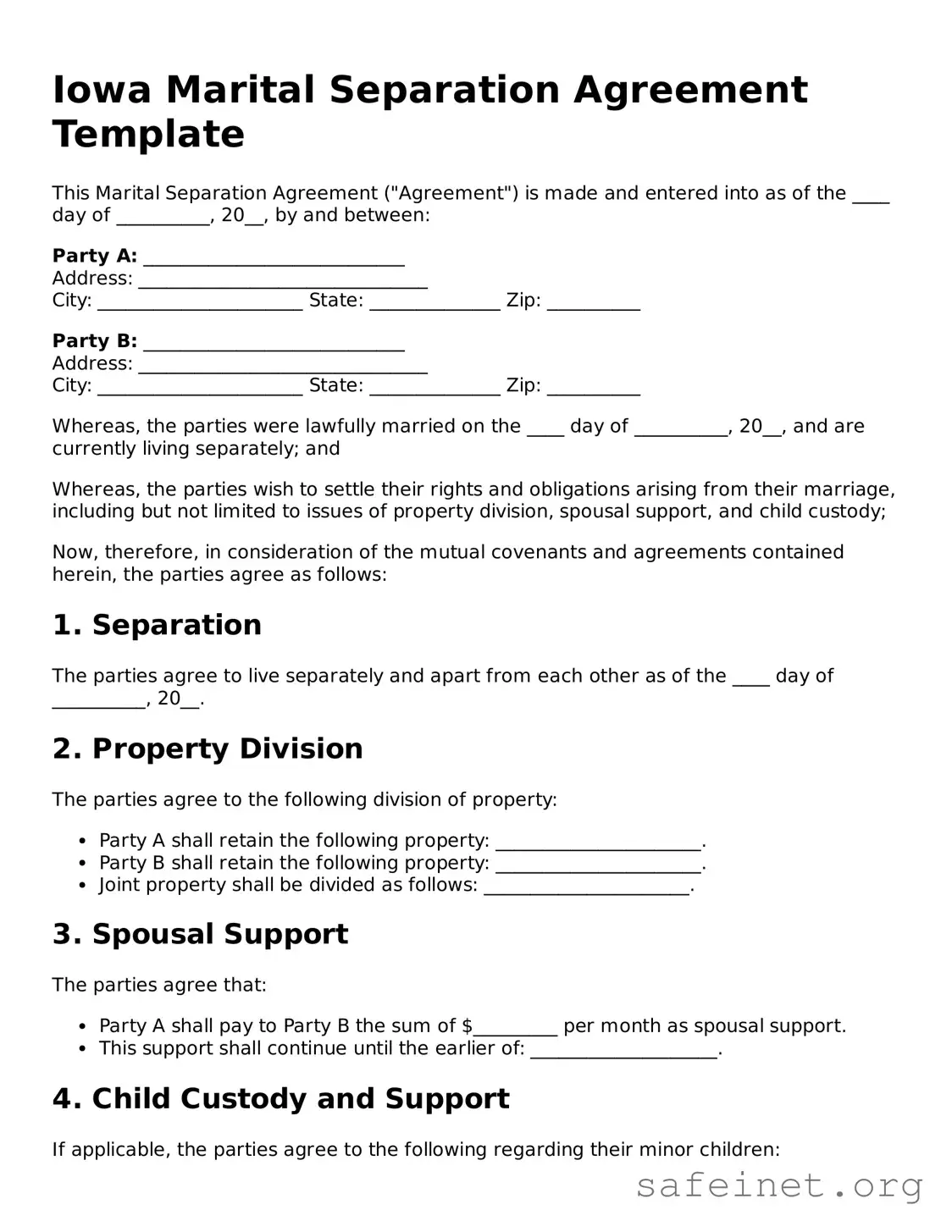
The Iowa Marital Separation Agreement form serves as a crucial document for couples who have decided to live apart while addressing various aspects of their marital relationship. This form outlines the terms of separation, including the division of property, allocation of debts, and arrangements for child custody and support. By clearly defining each party's responsibilities and rights, the agreement helps prevent misunderstandings and disputes during a challenging time. It also provides a framework for future interactions, ensuring that both parties are aware of their obligations. Additionally, the form may cover spousal support and other considerations that arise from the separation. Ultimately, a well-drafted Marital Separation Agreement can facilitate a smoother transition for both individuals, allowing them to focus on their personal well-being while navigating the complexities of separation.
Iowa Marital Separation Agreement Template
This Marital Separation Agreement ("Agreement") is made and entered into as of the ____ day of __________, 20__, by and between:
Party A: ____________________________
Address: _______________________________
City: ______________________ State: ______________ Zip: __________
Party B: ____________________________
Address: _______________________________
City: ______________________ State: ______________ Zip: __________
Whereas, the parties were lawfully married on the ____ day of __________, 20__, and are currently living separately; and
Whereas, the parties wish to settle their rights and obligations arising from their marriage, including but not limited to issues of property division, spousal support, and child custody;
Now, therefore, in consideration of the mutual covenants and agreements contained herein, the parties agree as follows:
1. Separation
The parties agree to live separately and apart from each other as of the ____ day of __________, 20__.
2. Property Division
The parties agree to the following division of property:
3. Spousal Support
The parties agree that:
4. Child Custody and Support
If applicable, the parties agree to the following regarding their minor children:
5. Miscellaneous
This Agreement constitutes the entire understanding between the parties. It supersedes all prior negotiations and agreements, whether written or oral.
This Agreement shall be governed by the laws of the State of Iowa.
IN WITNESS WHEREOF, the parties hereto have executed this Marital Separation Agreement as of the day and year first above written.
______________________________
Party A
______________________________
Party B
______________________________
Date
| Fact Name | Description |
|---|---|
| Purpose | The Iowa Marital Separation Agreement is designed to outline the terms of separation between spouses, including asset division and child custody arrangements. |
| Governing Law | This agreement is governed by Iowa Code Chapter 598, which covers divorce and separation laws in the state. |
| Mutual Consent | Both parties must voluntarily agree to the terms laid out in the separation agreement for it to be valid. |
| Notarization | While notarization is not mandatory, having the agreement notarized can provide additional legal protection and verification. |
| Modification | Changes to the agreement can be made if both parties consent, but modifications must be documented in writing. |
| Enforceability | The agreement can be enforced in court, provided it meets legal requirements and both parties have signed it. |
Completing the Iowa Marital Separation Agreement form is a significant step in the separation process. After filling out the form, both parties will need to review it for accuracy and completeness. This ensures that all terms are clear and agreed upon before proceeding further.
What is a Marital Separation Agreement in Iowa?
A Marital Separation Agreement is a legal document that outlines the terms agreed upon by spouses who wish to live separately while remaining legally married. This agreement typically addresses issues such as property division, child custody, child support, and spousal support. It serves as a framework for both parties to understand their rights and responsibilities during the separation period, ensuring clarity and reducing potential conflicts.
How do I create a Marital Separation Agreement in Iowa?
To create a Marital Separation Agreement in Iowa, both spouses should first discuss and negotiate the terms they wish to include in the document. It is advisable to consider seeking legal counsel to ensure that the agreement complies with Iowa law and adequately protects both parties' interests. Once the terms are agreed upon, the document should be drafted, signed by both parties, and ideally notarized to enhance its legal standing. It is important to keep a copy for personal records and to provide a copy to each party involved.
Is a Marital Separation Agreement legally binding in Iowa?
Yes, a Marital Separation Agreement is legally binding in Iowa, provided that it is created voluntarily by both parties and includes all necessary elements, such as the signatures of both spouses. However, it is important to note that if the agreement is not fair or if it was signed under duress, a court may choose not to enforce it. Additionally, if circumstances change, either party can petition the court to modify the agreement, especially regarding child custody or support matters.
Can a Marital Separation Agreement be modified after it is signed?
Yes, a Marital Separation Agreement can be modified after it is signed, but both parties must agree to the changes. If circumstances change significantly, such as changes in income or living arrangements, it may be necessary to revisit the terms of the agreement. To modify the agreement, it is recommended to draft a new document that outlines the changes and have both parties sign it. This ensures that the modifications are legally recognized and enforceable.
Inaccurate Information: One common mistake is providing inaccurate or incomplete information. This can include incorrect names, addresses, or financial details. It is essential to double-check all personal information to ensure accuracy, as errors can lead to complications in the separation process.
Failure to Disclose Assets: Some individuals may unintentionally omit certain assets or debts. Full disclosure is crucial for a fair agreement. Not listing all assets can result in disputes later on, potentially leading to legal challenges.
Neglecting to Address Child Custody: If children are involved, failing to outline custody arrangements can create confusion and conflict. Clearly defining custody, visitation rights, and child support obligations is vital for the well-being of the children and to prevent future misunderstandings.
Not Seeking Legal Advice: Many people attempt to complete the form without consulting a legal professional. This can lead to misunderstandings of rights and responsibilities. Seeking guidance can help ensure that the agreement is fair and complies with Iowa law.
When navigating a marital separation in Iowa, several forms and documents may accompany the Marital Separation Agreement. These documents help clarify various aspects of the separation and ensure that both parties understand their rights and responsibilities. Below is a list of commonly used forms that can assist in this process.
Understanding these documents can greatly aid in the separation process. Each form plays a crucial role in ensuring that both parties are protected and that the needs of any children involved are prioritized. By being well-informed, individuals can navigate this challenging time with greater confidence and clarity.
The Iowa Marital Separation Agreement form shares similarities with the Divorce Settlement Agreement. Both documents outline the terms of separation between spouses, detailing the division of assets, debts, and responsibilities for children. While the Divorce Settlement Agreement is typically used when a marriage is legally dissolved, the Marital Separation Agreement serves as a temporary arrangement, allowing couples to live separately while still legally married.
Another document akin to the Iowa Marital Separation Agreement is the Child Custody Agreement. This document specifically addresses the care and upbringing of children following a separation. It outlines custody arrangements, visitation schedules, and decision-making responsibilities. Similar to the Marital Separation Agreement, the Child Custody Agreement aims to prioritize the well-being of children during a time of transition.
The Property Settlement Agreement also parallels the Iowa Marital Separation Agreement. This document focuses on the division of marital property and assets. Both agreements require a clear understanding of what belongs to whom, ensuring that both parties can move forward without disputes over shared property. This clarity is essential for maintaining peace during a difficult time.
A Cohabitation Agreement can be compared to the Iowa Marital Separation Agreement in terms of establishing terms between partners. While typically used by unmarried couples, it outlines financial responsibilities and property rights. In a similar vein, the Marital Separation Agreement clarifies the expectations and obligations of each spouse during their separation.
The Prenuptial Agreement also bears resemblance to the Iowa Marital Separation Agreement. Though created before marriage, it serves to protect individual assets and outline financial responsibilities. Both documents aim to provide clarity and security, helping individuals understand their rights and obligations, whether they are entering or exiting a marital relationship.
The Legal Separation Agreement is another document that closely aligns with the Iowa Marital Separation Agreement. Both documents formalize the terms under which a couple will live apart, including financial arrangements and child custody. However, while the Marital Separation Agreement may be temporary, a Legal Separation Agreement often serves as a more permanent solution, allowing couples to live separately without divorcing.
Lastly, the Mediation Agreement can be viewed as similar to the Iowa Marital Separation Agreement. This document results from mediation sessions where couples negotiate the terms of their separation. Both agreements focus on mutual understanding and cooperation, emphasizing the importance of communication and compromise during a challenging period.
When filling out the Iowa Marital Separation Agreement form, it is essential to approach the process thoughtfully. Here are ten important do's and don'ts to keep in mind:
Many people have misunderstandings about the Iowa Marital Separation Agreement form. Here are nine common misconceptions:
Understanding these misconceptions can help couples navigate their separation more effectively.
When filling out the Iowa Marital Separation Agreement form, it’s essential to keep several key points in mind. This document can help couples navigate their separation amicably and ensure that both parties understand their rights and responsibilities. Here are some important takeaways:
By keeping these points in mind, individuals can navigate the process of filling out the Iowa Marital Separation Agreement form with greater confidence and clarity. The goal is to create a fair and respectful arrangement that meets the needs of both parties.