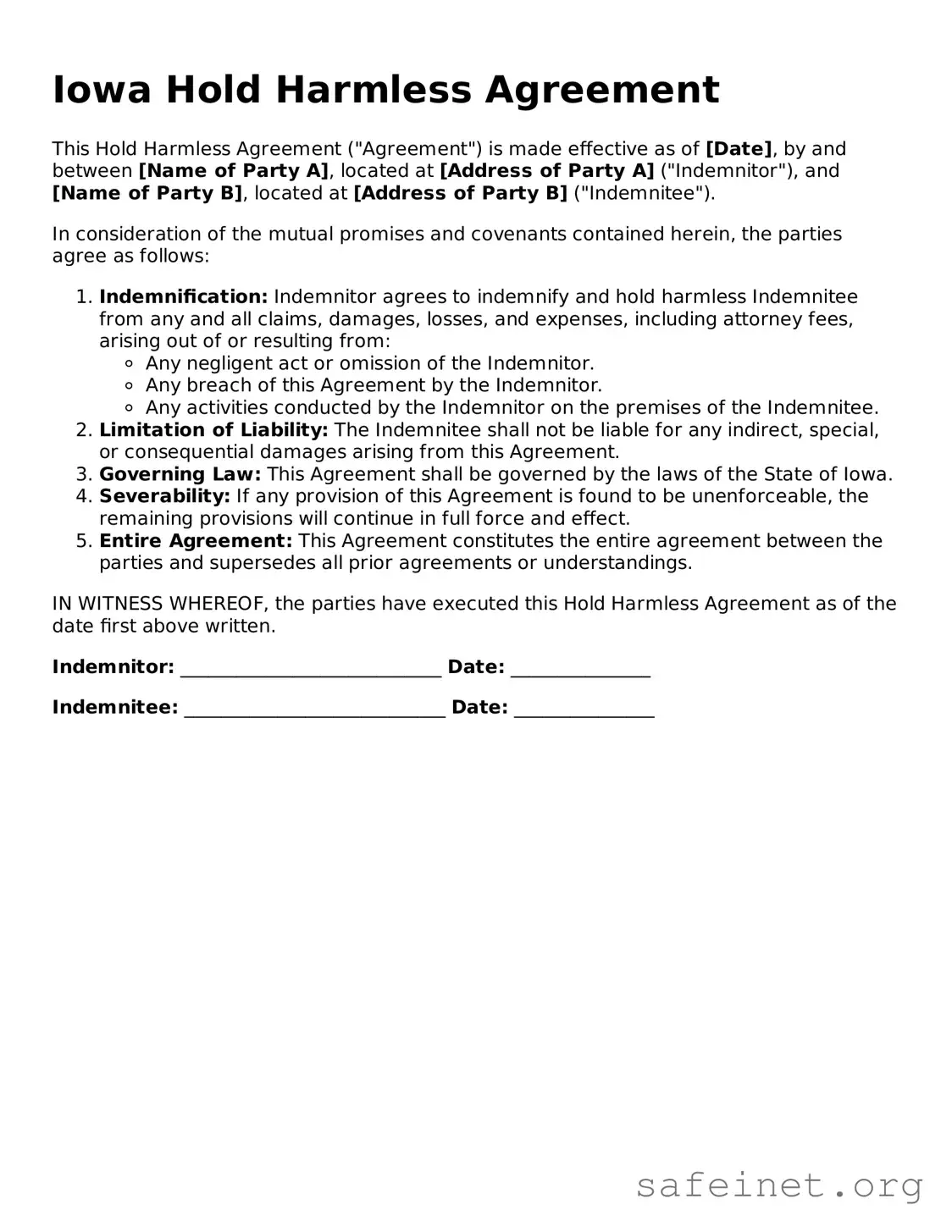
The Iowa Hold Harmless Agreement form serves a crucial role in various legal and business contexts, providing a framework for parties to outline their responsibilities and liabilities. This agreement is designed to protect one party from legal claims or damages that may arise during specific activities or events, effectively shifting the risk to another party. It is commonly used in situations such as property rentals, construction projects, and recreational activities, where the potential for accidents or unforeseen incidents exists. By signing this form, individuals or organizations acknowledge the inherent risks involved and agree to indemnify the other party against any legal repercussions. The clarity and specificity of the terms within the agreement are vital, as they define the scope of protection and the obligations of each party. Understanding this form is essential for anyone engaging in agreements that involve potential liability, as it helps ensure that all parties are aware of their rights and responsibilities.
Iowa Hold Harmless Agreement
This Hold Harmless Agreement ("Agreement") is made effective as of [Date], by and between [Name of Party A], located at [Address of Party A] ("Indemnitor"), and [Name of Party B], located at [Address of Party B] ("Indemnitee").
In consideration of the mutual promises and covenants contained herein, the parties agree as follows:
IN WITNESS WHEREOF, the parties have executed this Hold Harmless Agreement as of the date first above written.
Indemnitor: ____________________________ Date: _______________
Indemnitee: ____________________________ Date: _______________
| Fact Name | Description |
|---|---|
| Purpose | The Iowa Hold Harmless Agreement is designed to protect one party from legal liability for any injuries or damages that may occur during an activity or event. |
| Parties Involved | This agreement typically involves two parties: the indemnitor (the party providing the hold harmless protection) and the indemnitee (the party being protected). |
| Governing Law | The agreement is governed by Iowa state law, which outlines the enforceability and requirements of such agreements. |
| Written Format | The agreement must be in written form to be legally binding. Verbal agreements may not hold up in court. |
| Scope of Protection | The agreement can cover various types of liabilities, including personal injury, property damage, and other claims arising from the specified activity. |
| Signatures Required | Both parties must sign the agreement for it to be valid. This indicates mutual consent to the terms outlined. |
| Limitations | There may be limitations on the enforceability of hold harmless agreements in Iowa, especially if they attempt to waive liability for gross negligence or willful misconduct. |
After obtaining the Iowa Hold Harmless Agreement form, you are ready to complete it. This process involves providing specific information to ensure that all parties understand their responsibilities and liabilities. Follow the steps below to fill out the form accurately.
Once completed, keep a copy for your records and provide a copy to the other party. This ensures that everyone has the same understanding of the agreement.
What is an Iowa Hold Harmless Agreement?
An Iowa Hold Harmless Agreement is a legal document that protects one party from liability for any damages or injuries that may occur during a specific activity or event. Typically, this agreement is used in situations where one party agrees to take on the risk of potential claims or lawsuits arising from the actions of another party. It is commonly utilized in contracts involving construction, rentals, and events to ensure that one party is not held financially responsible for issues that may arise due to the other party's actions or negligence.
Who typically uses a Hold Harmless Agreement in Iowa?
Various individuals and organizations may use a Hold Harmless Agreement in Iowa. Contractors often use it when working on projects to protect themselves from liability related to accidents on the job site. Property owners may require tenants or event organizers to sign this agreement to shield themselves from claims related to injuries or damages that occur on their property. Nonprofit organizations and sports leagues frequently use it to protect against liability during events or activities involving participants.
Are there any specific requirements for an Iowa Hold Harmless Agreement?
While there are no strict legal requirements for a Hold Harmless Agreement in Iowa, it is essential that the document is clear and specific. It should outline the parties involved, the scope of the activities covered, and the extent of the liability being waived. Both parties should sign the agreement, and it is advisable to have it notarized to enhance its enforceability. Clarity in language and intent helps prevent misunderstandings and disputes later on.
Can a Hold Harmless Agreement be enforced in Iowa?
Yes, a Hold Harmless Agreement can be enforced in Iowa, provided it meets the necessary criteria. The agreement must be clear and unambiguous, and it should not violate public policy. Courts generally uphold these agreements as long as they are reasonable and both parties voluntarily consent to the terms. However, there are exceptions, especially if gross negligence or willful misconduct is involved, which may render the agreement unenforceable.
How can I create a Hold Harmless Agreement in Iowa?
Creating a Hold Harmless Agreement in Iowa can be straightforward. You can find templates online or consult with a legal professional to draft a customized agreement that suits your specific needs. Ensure that all relevant details are included, such as the names of the parties, the nature of the activities, and the specific liabilities being waived. After drafting, both parties should review the document carefully before signing. Keeping a copy for your records is also a good practice.
Not reading the entire agreement before signing. It’s important to understand all terms and conditions.
Failing to provide accurate information. Double-check names, addresses, and other details to avoid mistakes.
Overlooking the date. Ensure the agreement is dated correctly to avoid confusion about when it takes effect.
Neglecting to sign the form. A signature is necessary for the agreement to be valid.
Not including all necessary parties. Make sure everyone involved signs the agreement to ensure it is enforceable.
Using unclear language. Be specific and clear in your wording to prevent misunderstandings.
Ignoring local laws or requirements. Research any specific rules in Iowa that may affect the agreement.
The Iowa Hold Harmless Agreement is a key document that protects parties from liability in various situations. However, it is often used in conjunction with other forms and documents that serve specific purposes. Below is a list of commonly associated documents that enhance the effectiveness and clarity of the Hold Harmless Agreement.
These documents collectively contribute to a clearer understanding of liability and responsibilities among parties involved. Utilizing them alongside the Iowa Hold Harmless Agreement can significantly enhance legal protections and foster better communication between stakeholders.
The Liability Waiver is a document that releases one party from legal responsibility for any injuries or damages that may occur during an event or activity. Like the Iowa Hold Harmless Agreement, it aims to protect one party from claims by another. Both documents require clear language and mutual understanding, ensuring that individuals acknowledge the risks involved. While the Hold Harmless Agreement is often used in various contexts, such as construction or property use, the Liability Waiver is frequently utilized in recreational settings, such as sports or fitness activities.
The Indemnity Agreement is another document that shares similarities with the Iowa Hold Harmless Agreement. This agreement not only protects one party from liability but also requires the other party to compensate for any losses or damages incurred. Both documents serve to allocate risk between parties and often include specific terms outlining the scope of indemnification. While the Hold Harmless Agreement focuses primarily on protecting against claims, the Indemnity Agreement goes a step further by ensuring financial compensation for losses that may arise.
The Release of Liability form is closely related to the Iowa Hold Harmless Agreement as it also aims to limit legal liability. This document releases one party from any claims or lawsuits that may arise from an activity. Both forms require the signer to acknowledge the risks involved and agree not to hold the other party responsible for any injuries or damages. However, the Release of Liability form is typically more straightforward, focusing solely on relinquishing the right to sue, while the Hold Harmless Agreement may include broader terms regarding indemnification.
The Service Agreement often contains provisions similar to those found in the Iowa Hold Harmless Agreement. This document outlines the terms of a service relationship between two parties and may include clauses that limit liability. Both agreements emphasize the importance of understanding risks and responsibilities. In a Service Agreement, the Hold Harmless provisions can protect the service provider from claims arising from the client’s use of the service, thereby ensuring that both parties are aware of their obligations and potential liabilities.
The Construction Contract frequently includes a Hold Harmless clause, making it similar to the Iowa Hold Harmless Agreement. In construction projects, this clause protects contractors from claims arising from accidents or damages that occur on the job site. Both documents serve to allocate responsibility and reduce the risk of litigation. The Hold Harmless clause in a Construction Contract ensures that the property owner or project manager assumes certain risks, while the Iowa Hold Harmless Agreement can be used in various contexts beyond construction, highlighting its versatility in risk management.
When filling out the Iowa Hold Harmless Agreement form, it's essential to approach the task with care. Here’s a list of things you should and shouldn't do to ensure the process goes smoothly.
By following these guidelines, you can help ensure that your Hold Harmless Agreement is completed correctly and efficiently.
Misconceptions about the Iowa Hold Harmless Agreement form can lead to confusion. Here are five common misunderstandings:
Many people believe that only businesses use the Hold Harmless Agreement. However, individuals can also use this form to protect themselves from liability in various situations.
Some think that signing a Hold Harmless Agreement completely removes all responsibility. In reality, it may limit liability but does not eliminate it entirely in every situation.
There is a misconception that these agreements hold no legal weight. In fact, if properly drafted and executed, they can be enforceable in a court of law.
Many assume that the agreement protects only one party involved. In truth, it can be structured to protect multiple parties, depending on the specific terms agreed upon.
Some people confuse the Hold Harmless Agreement with insurance. While both provide protection, they serve different purposes and should not be viewed as interchangeable.
The Iowa Hold Harmless Agreement form is an important legal document that serves specific purposes. Below are key takeaways regarding its completion and use: