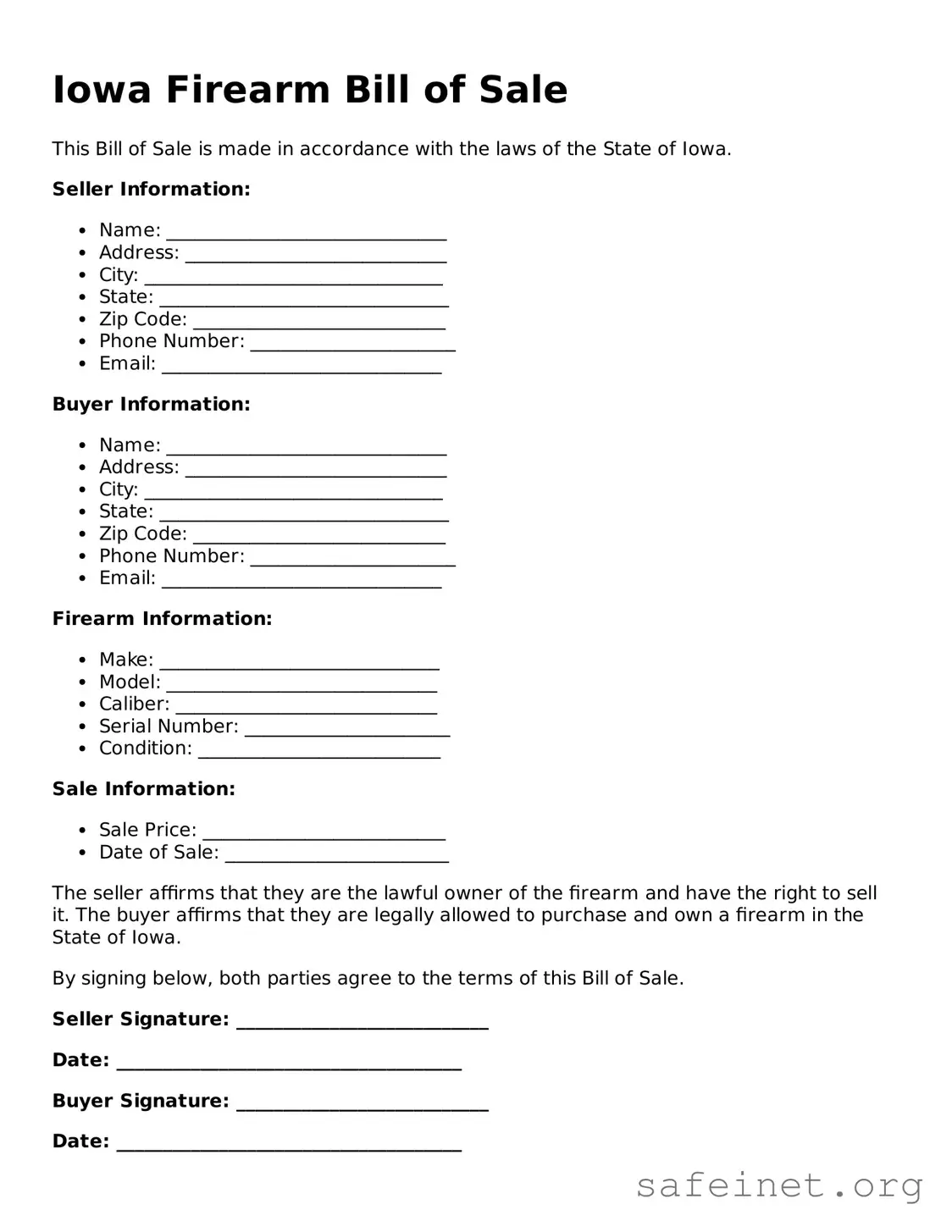
The Iowa Firearm Bill of Sale form serves as a crucial document in the private sale or transfer of firearms within the state. This form is designed to provide both buyers and sellers with a clear record of the transaction, ensuring compliance with state laws and promoting responsible firearm ownership. Key elements of the form include the identification of the parties involved, detailed descriptions of the firearm being sold, and the terms of the sale. By documenting the sale, the form helps protect both parties in case of future legal disputes or questions about ownership. Additionally, it often includes a declaration of the buyer's eligibility to purchase a firearm, which is essential for adhering to federal and state regulations. Overall, the Iowa Firearm Bill of Sale form plays a vital role in facilitating legal and transparent firearm transactions, contributing to public safety and accountability in gun ownership.
Iowa Firearm Bill of Sale
This Bill of Sale is made in accordance with the laws of the State of Iowa.
Seller Information:
Buyer Information:
Firearm Information:
Sale Information:
The seller affirms that they are the lawful owner of the firearm and have the right to sell it. The buyer affirms that they are legally allowed to purchase and own a firearm in the State of Iowa.
By signing below, both parties agree to the terms of this Bill of Sale.
Seller Signature: ___________________________
Date: _____________________________________
Buyer Signature: ___________________________
Date: _____________________________________
| Fact Name | Description |
|---|---|
| Purpose | The Iowa Firearm Bill of Sale form is used to document the sale or transfer of firearms between individuals. |
| Governing Law | The form adheres to Iowa Code Chapter 724, which governs firearm regulations in the state. |
| Parties Involved | The form requires information from both the seller and the buyer, ensuring transparency in the transaction. |
| Firearm Details | Specific details about the firearm, such as make, model, and serial number, must be included in the form. |
| Date of Sale | The date of the transaction is recorded to establish a timeline for the sale. |
| Signatures | Both parties must sign the form to validate the sale and acknowledge the transfer of ownership. |
| Record Keeping | It is advisable for both the seller and buyer to keep a copy of the completed form for their records. |
| Notarization | While notarization is not required, it can provide an extra layer of authenticity to the transaction. |
| Legal Age | Both parties must be of legal age to own a firearm, which is 18 years old in Iowa. |
Filling out the Iowa Firearm Bill of Sale form is a straightforward process. After completing the form, you will have a record of the transaction that can be useful for both the buyer and seller. This document serves as proof of the sale and includes important details about the firearm and the parties involved.
What is an Iowa Firearm Bill of Sale?
An Iowa Firearm Bill of Sale is a legal document that records the sale or transfer of a firearm between two parties. This form includes essential information such as the buyer's and seller's names, addresses, and details about the firearm being sold, including its make, model, and serial number. It serves as proof of the transaction and can be important for both parties for legal and record-keeping purposes.
Is the Iowa Firearm Bill of Sale required by law?
While it is not legally required to have a Bill of Sale for private firearm sales in Iowa, it is highly recommended. This document can protect both the buyer and seller by providing a record of the transaction. It can also help clarify ownership and ensure compliance with any applicable laws.
What information should be included in the Bill of Sale?
The Bill of Sale should include the names and addresses of both the buyer and seller, the date of the sale, a detailed description of the firearm (including make, model, caliber, and serial number), and the sale price. Both parties should sign and date the document to validate the transaction.
Do I need to have the Bill of Sale notarized?
No, notarization is not required for an Iowa Firearm Bill of Sale. However, having the document notarized can add an extra layer of authenticity and may be beneficial if disputes arise in the future.
Can I use a generic Bill of Sale template for firearms?
While a generic Bill of Sale template can be used, it is advisable to use a template specifically designed for firearms. This ensures that all necessary details are included and that the document complies with Iowa laws regarding firearm sales.
What should I do if I lose the Bill of Sale?
If the Bill of Sale is lost, it is recommended to create a new document that states the details of the original transaction. Both parties should sign this new document. Keeping a copy of the Bill of Sale in a safe place is essential for future reference.
Are there any restrictions on who can buy a firearm in Iowa?
Yes, certain individuals are prohibited from purchasing firearms in Iowa. This includes convicted felons, individuals with domestic violence restraining orders, and those deemed mentally incompetent by a court. Buyers should ensure they meet all legal requirements before proceeding with a purchase.
What should I do if I suspect a firearm is stolen?
If you suspect that a firearm is stolen, do not proceed with the sale. It is important to report your concerns to local law enforcement. They can help verify the firearm's status and guide you on the next steps to take.
Incomplete Information: Many people fail to fill in all required fields. Missing details like the buyer's or seller's name, address, or contact information can lead to issues later.
Incorrect Firearm Details: Some individuals provide inaccurate information about the firearm. This includes the make, model, and serial number. Errors here can complicate ownership verification.
Not Signing the Form: A common mistake is neglecting to sign the form. Both parties must sign to validate the transaction. Without signatures, the document lacks legal standing.
Failure to Date the Document: People often forget to include the date of the transaction. This omission can lead to confusion about when the sale took place.
Not Keeping Copies: After completing the form, individuals sometimes do not keep a copy for their records. Having a copy can be crucial for future reference or disputes.
Ignoring Local Laws: Some individuals overlook state and local regulations regarding firearm sales. It's essential to understand these laws to ensure compliance and avoid legal issues.
When engaging in the sale or transfer of firearms in Iowa, several additional forms and documents may be required to ensure compliance with state laws and to protect the interests of both the buyer and seller. Below are six important documents that are often used alongside the Iowa Firearm Bill of Sale form.
Using these documents can help ensure a smooth and lawful transaction when buying or selling firearms in Iowa. It's essential to be thorough and diligent in completing all necessary paperwork to protect everyone involved.
The Iowa Firearm Bill of Sale form is similar to a Vehicle Bill of Sale. Both documents serve as proof of transfer of ownership. When a vehicle changes hands, the seller provides a bill of sale to the buyer, documenting the transaction details such as the sale price, vehicle identification number (VIN), and the names of both parties. This document is crucial for registering the vehicle in the buyer's name and for any future legal matters related to ownership.
Another document that shares similarities is the Boat Bill of Sale. Like the firearm bill of sale, this form is used to record the transfer of ownership of a boat. It includes essential details such as the boat's hull identification number (HIN), sale price, and the names and addresses of both the seller and buyer. This documentation is important for registering the boat and ensuring that the new owner has proof of purchase.
The Home Bill of Sale is also comparable. This document is used when personal property within a home, such as appliances or furniture, is sold. It outlines the items being sold, their condition, and the agreed-upon price. This form helps to clarify the transaction and can protect both parties in case of disputes regarding the sale.
A similar document is the ATV Bill of Sale. This form is used for the sale of all-terrain vehicles. It includes details like the make, model, and VIN of the ATV, along with the sale price and buyer and seller information. This document is essential for the buyer to register the ATV and for the seller to have proof of the sale.
The Motorcycle Bill of Sale is another relevant document. It serves a similar purpose in documenting the sale of a motorcycle. This form includes information about the motorcycle, such as its VIN and condition, as well as the sale price and the identities of both parties involved. It acts as a safeguard for both the buyer and seller, ensuring a clear record of the transaction.
The Equipment Bill of Sale is also akin to the Iowa Firearm Bill of Sale. This document is used for the sale of various types of equipment, such as construction or farming machinery. It details the equipment being sold, its condition, and the sale price. This form is vital for establishing ownership and can be important for warranty claims or future sales.
Another similar document is the Business Bill of Sale. This form is used when a business is sold, detailing the assets being transferred, such as inventory, equipment, and goodwill. It outlines the terms of the sale and provides both parties with a record of the transaction, ensuring clarity and legal protection.
The Personal Property Bill of Sale is also relevant. This document is used for the sale of personal items that do not fall under specific categories like vehicles or boats. It includes a description of the items sold, the sale price, and the parties involved. This form helps to document the transfer of ownership and can be useful in resolving any future disputes.
Lastly, the Firearm Transfer Record is similar in purpose. While it may not be a bill of sale, this document is used to record the transfer of firearms between individuals. It includes information about the firearm, the seller, and the buyer. This record is important for compliance with state and federal laws regarding firearm ownership and transfers.
When filling out the Iowa Firearm Bill of Sale form, it is essential to follow specific guidelines to ensure accuracy and compliance. Below is a list of things you should and shouldn't do.
Following these guidelines will help ensure a smooth transaction and maintain compliance with Iowa laws.
When it comes to the Iowa Firearm Bill of Sale form, many people hold misconceptions that can lead to confusion or missteps. Here are nine common misunderstandings, along with clarifications to help set the record straight.
While not legally required, having a Bill of Sale provides proof of the transaction and can help protect both the buyer and seller in case of future disputes.
Private individuals engaging in firearm sales are also encouraged to use a Bill of Sale to document the transaction, ensuring both parties have a record.
The Iowa Firearm Bill of Sale can be used for all types of firearms, including rifles and shotguns, not just handguns.
The Bill of Sale is straightforward and typically requires basic information about the buyer, seller, and the firearm being sold.
Sellers should keep a copy of the Bill of Sale for their records, as it may be needed for legal or personal reasons in the future.
While it offers some protection, it does not absolve the seller of all responsibility, especially if the firearm is used in a crime.
It’s essential to ensure that the buyer is legally allowed to purchase a firearm, as sellers can face legal consequences for selling to prohibited individuals.
Notarization is not a requirement for the Iowa Firearm Bill of Sale, although it can add an extra layer of authenticity if desired.
If both parties agree, corrections can be made to the form, but it’s best to do so before finalizing the transaction.
Understanding these misconceptions can lead to more informed and secure firearm transactions in Iowa. Always consider consulting with a legal expert if you have specific questions or concerns regarding firearm sales.
When dealing with the Iowa Firearm Bill of Sale form, it’s essential to understand its purpose and how to use it effectively. Here are some key takeaways to keep in mind:
By following these guidelines, you can navigate the process of filling out and using the Iowa Firearm Bill of Sale form with confidence.