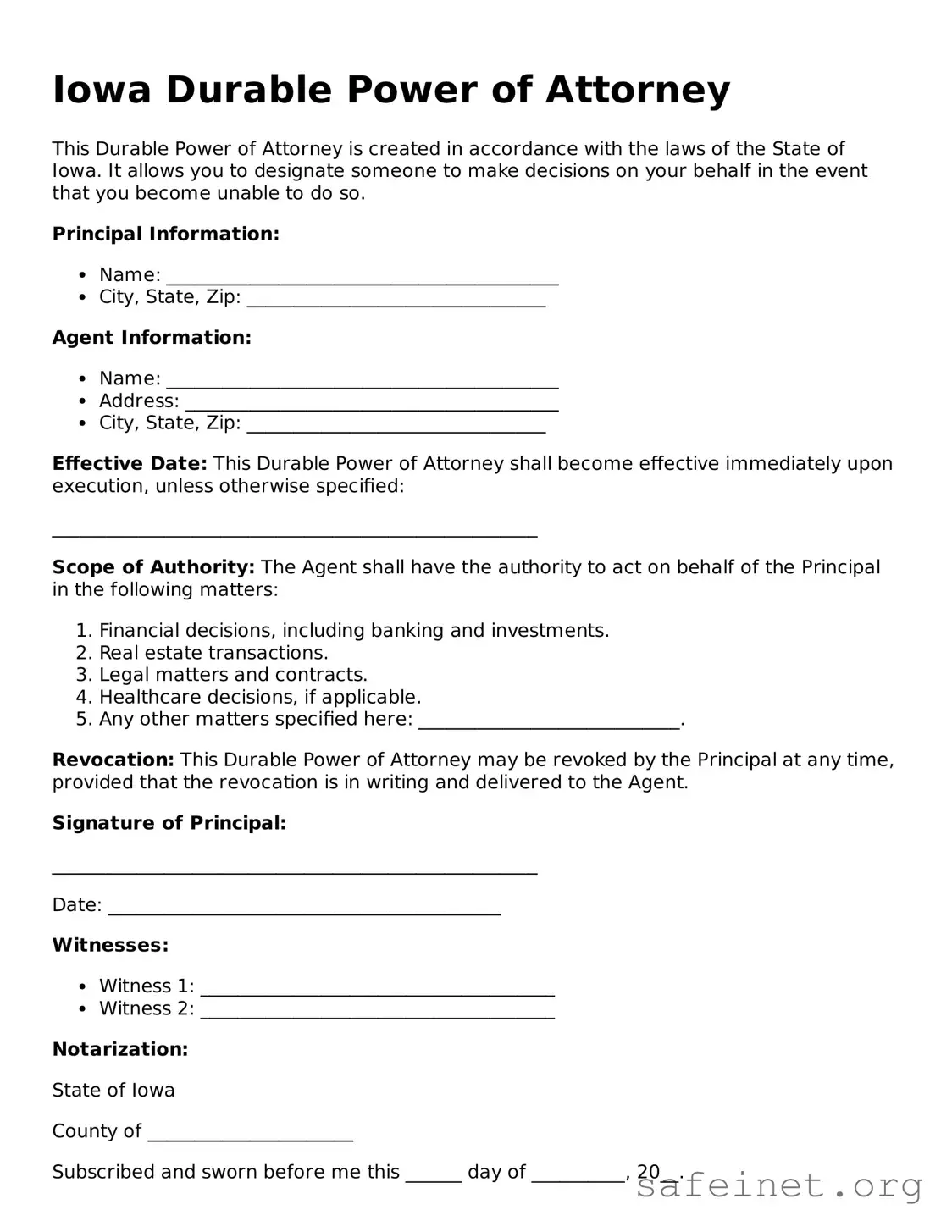
The Iowa Durable Power of Attorney form serves as a vital tool for individuals seeking to ensure their financial and healthcare decisions are managed according to their wishes, even in the event of incapacitation. This legal document allows a person, known as the principal, to designate an agent who will act on their behalf, making decisions that can range from handling bank transactions to managing medical care. One of the key features of this form is its durability; it remains effective even if the principal becomes unable to make decisions due to illness or injury. This aspect provides peace of mind, knowing that trusted individuals can step in when necessary. Additionally, the form can be tailored to include specific powers, allowing the principal to delineate what their agent can and cannot do. Understanding the nuances of this form is crucial, as it not only empowers individuals to take control of their future but also ensures that their preferences are honored during critical times. Furthermore, it is important to consider the implications of choosing a reliable agent, as this decision can significantly impact the principal's well-being and financial security.
Iowa Durable Power of Attorney
This Durable Power of Attorney is created in accordance with the laws of the State of Iowa. It allows you to designate someone to make decisions on your behalf in the event that you become unable to do so.
Principal Information:
Agent Information:
Effective Date: This Durable Power of Attorney shall become effective immediately upon execution, unless otherwise specified:
____________________________________________________
Scope of Authority: The Agent shall have the authority to act on behalf of the Principal in the following matters:
Revocation: This Durable Power of Attorney may be revoked by the Principal at any time, provided that the revocation is in writing and delivered to the Agent.
Signature of Principal:
____________________________________________________
Date: __________________________________________
Witnesses:
Notarization:
State of Iowa
County of ______________________
Subscribed and sworn before me this ______ day of __________, 20__.
____________________________________________________
Notary Public Signature
| Fact Name | Description |
|---|---|
| Definition | A Durable Power of Attorney (DPOA) allows an individual to designate someone to make decisions on their behalf, even if they become incapacitated. |
| Governing Law | The Iowa Durable Power of Attorney is governed by Iowa Code Chapter 633B. |
| Durability | This form remains effective even if the principal becomes incapacitated, which distinguishes it from a regular Power of Attorney. |
| Principal | The person granting authority in the DPOA is known as the principal. |
| Agent | The individual designated to act on behalf of the principal is referred to as the agent or attorney-in-fact. |
| Signing Requirements | The DPOA must be signed by the principal and acknowledged before a notary public or signed by two witnesses. |
| Revocation | The principal can revoke the DPOA at any time, as long as they are competent to do so. |
| Limitations | Agents must act in the best interest of the principal and cannot make decisions that are contrary to the principal's wishes. |
| Healthcare Decisions | A separate form is required for healthcare decisions; the DPOA does not cover medical choices unless specified. |
Filling out the Iowa Durable Power of Attorney form is a straightforward process. Once completed, this document will allow you to designate someone to make decisions on your behalf if you are unable to do so. Follow the steps below to ensure that you fill out the form correctly.
What is a Durable Power of Attorney in Iowa?
A Durable Power of Attorney is a legal document that allows you to appoint someone to make decisions on your behalf if you become unable to do so. This can include financial decisions, medical care, and other important matters. The "durable" aspect means that the authority remains in effect even if you become incapacitated.
Who can be appointed as my agent under a Durable Power of Attorney?
You can choose any competent adult as your agent. This can be a family member, friend, or a trusted professional. It's important to select someone you trust completely, as they will have significant control over your affairs.
Do I need to use a specific form for the Durable Power of Attorney in Iowa?
While Iowa does not require a specific form, it is recommended to use a state-compliant template to ensure that all necessary elements are included. This helps avoid any potential legal issues in the future. You can often find these forms online or through legal resources in your area.
Can I limit the powers granted to my agent?
Yes, you can specify what powers your agent has. For example, you might allow them to handle financial matters but not make healthcare decisions. Clearly outlining these limitations in the document is crucial for ensuring your wishes are followed.
How do I revoke a Durable Power of Attorney in Iowa?
If you decide to revoke your Durable Power of Attorney, you must do so in writing. It's best to notify your agent and any institutions that may have a copy of the document. This ensures that everyone is aware of the change and helps prevent any confusion.
Is it necessary to have the Durable Power of Attorney notarized?
In Iowa, it is not mandatory to have your Durable Power of Attorney notarized, but it is highly recommended. Having a notary public witness your signature adds an extra layer of validity and can help prevent disputes later on.
When does the Durable Power of Attorney take effect?
You can choose when your Durable Power of Attorney takes effect. It can be immediate, meaning your agent can act on your behalf right away, or it can be springing, which means it only becomes effective when you become incapacitated. Clearly stating your preference in the document is essential.
Can I change my Durable Power of Attorney once it is created?
Yes, you can change your Durable Power of Attorney at any time while you are still competent. This includes updating the agent, altering the powers granted, or revoking the document entirely. Just remember to follow the proper procedures to ensure your changes are legally recognized.
Failing to specify the powers granted: Individuals often overlook the importance of clearly defining the powers they wish to grant to their agent. This can lead to confusion or disputes later.
Not signing the document: A common mistake is neglecting to sign the Durable Power of Attorney form. Without a signature, the document holds no legal weight.
Ignoring witness requirements: In Iowa, the presence of witnesses is necessary for the validity of the form. Many people forget to include the required number of witnesses.
Using outdated forms: Some individuals may use older versions of the Durable Power of Attorney form. It is crucial to ensure the form is the most current version to comply with Iowa laws.
Not discussing the document with the agent: Failing to communicate with the designated agent can result in misunderstandings about the individual’s wishes and intentions.
Neglecting to review the document periodically: Life circumstances change, and so do the needs for a Durable Power of Attorney. Many people forget to review and update their documents as necessary.
The Iowa Durable Power of Attorney form allows individuals to appoint an agent to make financial or legal decisions on their behalf, especially in situations where they may become incapacitated. Alongside this important document, several other forms and documents are commonly utilized to ensure comprehensive planning for one's personal and financial affairs.
Incorporating these documents alongside the Iowa Durable Power of Attorney can provide a well-rounded approach to personal and financial management, ensuring that an individual's preferences are respected and upheld in various circumstances.
The Iowa Durable Power of Attorney form shares similarities with a General Power of Attorney. Both documents allow an individual, known as the principal, to designate another person, the agent, to act on their behalf. However, the key difference lies in the durability aspect. While a General Power of Attorney typically becomes invalid if the principal becomes incapacitated, a Durable Power of Attorney remains effective even in such circumstances. This ensures that the agent can continue to manage the principal's affairs without interruption.
Another document akin to the Iowa Durable Power of Attorney is the Healthcare Power of Attorney. This form specifically grants authority to an agent to make medical decisions on behalf of the principal if they are unable to do so themselves. Like the Durable Power of Attorney, it ensures that the principal's wishes are respected during times of incapacity. Both documents emphasize the importance of appointing a trusted individual to act in the best interest of the principal.
The Living Will is another important document that complements the Durable Power of Attorney. While the Durable Power of Attorney allows someone to manage financial and legal matters, a Living Will specifically addresses healthcare decisions regarding end-of-life care. It outlines the principal's preferences for medical treatment when they are unable to communicate their wishes. Together, these documents provide a comprehensive approach to ensuring that both healthcare and financial decisions align with the principal's values.
A Revocable Trust shares similarities with the Durable Power of Attorney in that both allow for the management of an individual's assets. A Revocable Trust can hold property and assets during the principal's lifetime, and it can be modified or revoked at any time. When the principal becomes incapacitated, a successor trustee can step in to manage the trust without the need for court intervention. This provides a seamless transition in managing financial affairs, much like the Durable Power of Attorney.
The Medical Directive, or Advance Directive, is closely related to the Healthcare Power of Attorney. It outlines the principal's preferences regarding medical treatment and interventions in various situations. While the Healthcare Power of Attorney appoints an agent to make decisions, the Medical Directive provides specific instructions about the types of treatment the principal desires or wishes to avoid. Both documents work together to ensure that medical care aligns with the principal's wishes.
A Financial Power of Attorney is another document that resembles the Iowa Durable Power of Attorney. This form specifically focuses on financial matters, allowing the agent to handle banking, investments, and property transactions on behalf of the principal. While the Durable Power of Attorney can cover both financial and legal matters, the Financial Power of Attorney is more narrowly focused. This distinction can be important for individuals who want to separate their financial management from other legal decisions.
The Conservatorship is a legal arrangement that can be compared to the Durable Power of Attorney. In situations where an individual becomes incapacitated without having a Durable Power of Attorney in place, a court may appoint a conservator to manage their affairs. This process can be lengthy and costly, contrasting with the more straightforward approach of a Durable Power of Attorney, which allows the principal to choose their agent in advance. The Durable Power of Attorney provides a proactive solution to avoid the need for court intervention.
Lastly, a Guardianship can be likened to the Durable Power of Attorney in terms of decision-making authority. A guardianship is typically established for minors or individuals deemed incapacitated, allowing a guardian to make personal and medical decisions on their behalf. While a Durable Power of Attorney allows for a chosen agent to manage affairs based on the principal's preferences, a guardianship often involves a court's oversight. This distinction highlights the importance of planning ahead with a Durable Power of Attorney to maintain control over one's affairs.
When filling out the Iowa Durable Power of Attorney form, it's important to be careful and thorough. Here’s a list of what you should and shouldn’t do.
Taking these steps can help ensure that your Durable Power of Attorney is valid and effective when you need it.
Understanding the Iowa Durable Power of Attorney (DPOA) form is essential for anyone considering designating someone to make decisions on their behalf. However, several misconceptions can lead to confusion. Here’s a list of common misunderstandings:
By addressing these misconceptions, individuals can better understand the importance and functionality of the Iowa Durable Power of Attorney. Making informed decisions about your legal documents ensures that your wishes are respected and that the right people are in place to act on your behalf when needed.
When it comes to filling out and using the Iowa Durable Power of Attorney form, there are several important points to keep in mind. Here are key takeaways to help you navigate the process:
By following these guidelines, you can ensure that your Durable Power of Attorney is effective and aligns with your personal wishes.