In the realm of healthcare decision-making, the Iowa Do Not Resuscitate (DNR) Order form plays a crucial role for individuals who wish to communicate their preferences regarding life-sustaining treatments. This legally binding document allows patients to express their desire not to receive cardiopulmonary resuscitation (CPR) in the event of cardiac arrest or respiratory failure. It is essential for patients, families, and healthcare providers to understand the implications of this form, as it not only reflects personal values and beliefs but also ensures that medical teams respect the wishes of the patient. The DNR Order must be completed and signed by the patient, or their legal representative, and must include specific information such as the patient's name, date of birth, and the signatures of witnesses. Furthermore, the form is intended to be readily accessible, often kept in a visible location to inform emergency responders and healthcare professionals of the patient's wishes. Understanding the nuances of the Iowa DNR Order form empowers individuals to make informed decisions about their healthcare and end-of-life preferences, fostering a sense of control during challenging times.
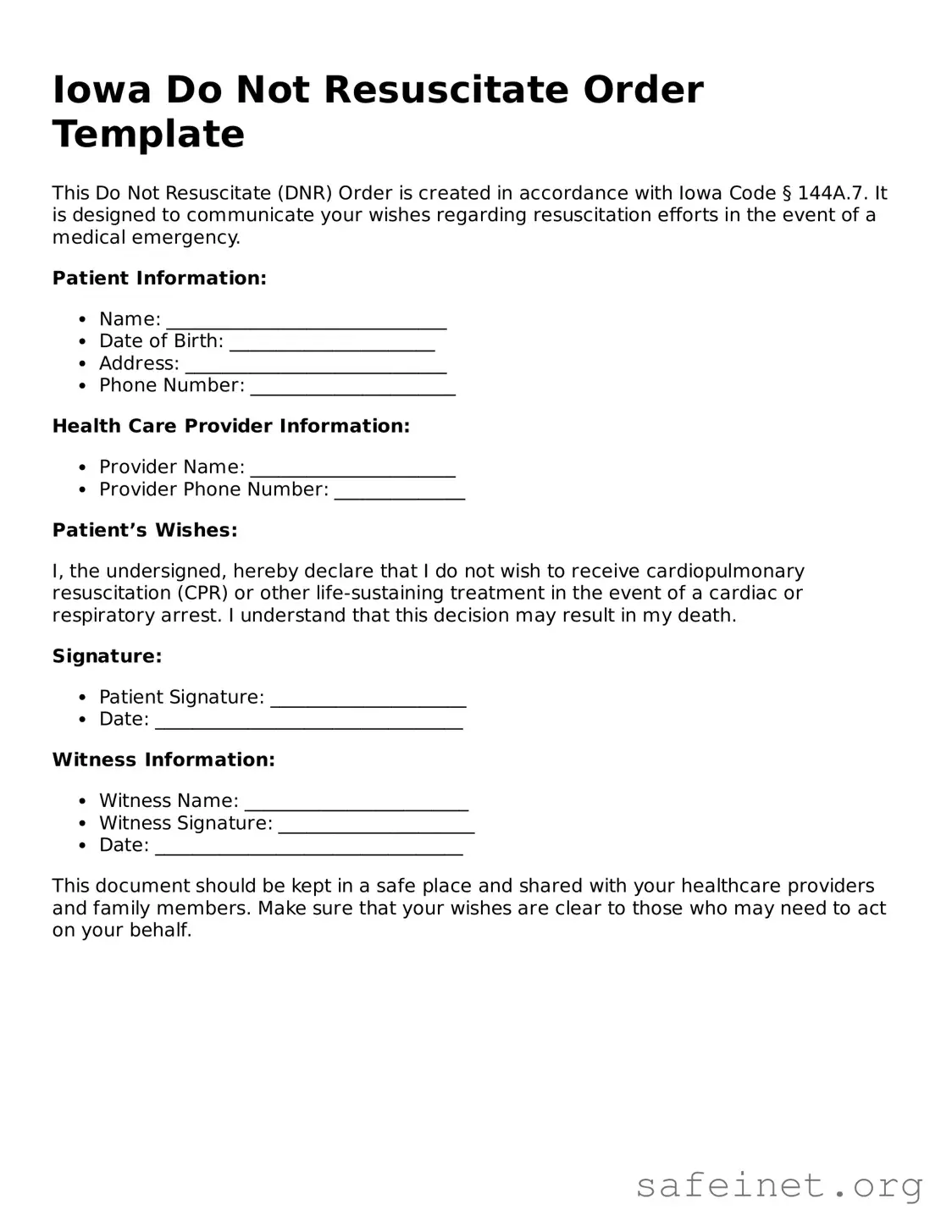
Iowa Do Not Resuscitate Order Template
This Do Not Resuscitate (DNR) Order is created in accordance with Iowa Code § 144A.7. It is designed to communicate your wishes regarding resuscitation efforts in the event of a medical emergency.
Patient Information:
Health Care Provider Information:
Patient’s Wishes:
I, the undersigned, hereby declare that I do not wish to receive cardiopulmonary resuscitation (CPR) or other life-sustaining treatment in the event of a cardiac or respiratory arrest. I understand that this decision may result in my death.
Signature:
Witness Information:
This document should be kept in a safe place and shared with your healthcare providers and family members. Make sure that your wishes are clear to those who may need to act on your behalf.
| Fact Name | Description |
|---|---|
| Purpose | The Iowa Do Not Resuscitate Order form allows individuals to express their wish not to receive cardiopulmonary resuscitation (CPR) in the event of cardiac or respiratory arrest. |
| Governing Law | This form is governed by Iowa Code Section 144A, which outlines the legal framework for advance directives and do-not-resuscitate orders. |
| Eligibility | Any adult, or a parent or guardian of a minor, can complete the Iowa Do Not Resuscitate Order form, provided they understand the implications of their decision. |
| Signature Requirement | The form must be signed by the individual or their legal representative, and it requires the signature of a witness or a notary public to be considered valid. |
Completing the Iowa Do Not Resuscitate Order form is an important step in expressing your healthcare preferences. Once the form is filled out, it should be signed and dated, then shared with your healthcare provider to ensure your wishes are known and respected.
What is a Do Not Resuscitate (DNR) order in Iowa?
A Do Not Resuscitate order is a legal document that allows individuals to refuse resuscitation efforts in the event of a cardiac arrest or respiratory failure. In Iowa, this order is designed to ensure that a person’s wishes regarding medical treatment are respected, particularly when they are unable to communicate those wishes themselves.
Who can request a DNR order in Iowa?
In Iowa, a DNR order can be requested by a patient who is at least 18 years old and has the capacity to make informed decisions about their healthcare. Additionally, a parent or legal guardian can request a DNR order on behalf of a minor. It is essential that the individual understands the implications of the order before it is signed.
How do I obtain a DNR order form in Iowa?
You can obtain a DNR order form from various sources, including hospitals, healthcare providers, and the Iowa Department of Public Health website. It is important to use the official Iowa DNR form to ensure that it meets all legal requirements.
What information is required on the DNR order form?
The DNR order form typically requires the patient’s name, date of birth, and a clear statement indicating the desire for a DNR order. Additionally, it must be signed by the patient or their authorized representative, as well as a physician who agrees with the decision. This ensures that the order is both valid and enforceable.
Is a DNR order valid in all healthcare settings?
Yes, a properly completed DNR order is valid in all healthcare settings in Iowa, including hospitals, nursing homes, and emergency medical services. However, it is crucial that the order is readily accessible to healthcare providers at the time of an emergency.
Can I change or revoke my DNR order?
Yes, individuals have the right to change or revoke their DNR order at any time. This can be done by destroying the original document and notifying healthcare providers of the change. It is advisable to create a new order if you wish to alter your preferences regarding resuscitation.
What happens if I do not have a DNR order?
If you do not have a DNR order in place, healthcare providers are obligated to perform all standard resuscitation measures in the event of cardiac or respiratory arrest. This may include CPR, intubation, and advanced life support, depending on the situation.
Are there any costs associated with obtaining a DNR order?
There are typically no costs associated with obtaining a DNR order itself. However, some healthcare providers may charge for consultations or related services. It is best to check with your healthcare provider about any potential fees.
How can I ensure my DNR order is honored?
To ensure that your DNR order is honored, keep a copy of the signed document in an easily accessible location. Inform your family members, healthcare proxy, and primary care physician about your wishes. Additionally, consider wearing a medical alert bracelet that indicates your DNR status.
What should I discuss with my healthcare provider regarding a DNR order?
When discussing a DNR order with your healthcare provider, consider addressing your overall health condition, prognosis, and the implications of a DNR order. It is important to have an open and honest conversation about your values and preferences regarding end-of-life care.
Failing to provide accurate personal information. It's crucial to include the correct name, address, and date of birth. Inaccurate details can lead to confusion in emergencies.
Not having the form signed by a physician. A valid Do Not Resuscitate (DNR) order requires a physician's signature to be legally recognized.
Leaving out the patient's signature. The patient or their legal representative must sign the form. Without this signature, the order may not be honored.
Using outdated forms. Ensure that the DNR order is the most current version. Regulations can change, and using an old form may result in complications.
Not discussing the DNR order with family members. It's important to communicate your wishes to loved ones to prevent misunderstandings during critical situations.
Overlooking the need for copies. After completing the form, make copies for healthcare providers, family members, and keep one for personal records.
Failing to review the DNR order regularly. Circumstances can change, and it’s wise to reassess the order periodically to ensure it still reflects the patient’s wishes.
Not considering the implications of a DNR order. Understanding what a DNR means for medical treatment and care is essential before completing the form.
Neglecting to inform emergency medical services (EMS). Ensure that EMS personnel are aware of the DNR order, as they may not have access to the form during an emergency.
The Iowa Do Not Resuscitate Order (DNR) form is an important document that outlines a person's wishes regarding resuscitation efforts in the event of a medical emergency. Alongside this form, several other documents are often utilized to ensure that an individual's healthcare preferences are respected and clearly communicated. Below is a list of related forms and documents that may accompany the DNR form.
These documents work together to create a comprehensive approach to healthcare decision-making, ensuring that individuals' wishes are honored and respected. Understanding each form's purpose can aid in effective planning and communication with healthcare providers.
The Iowa Do Not Resuscitate (DNR) Order form is similar to the Advance Directive. An Advance Directive allows individuals to outline their preferences for medical treatment in case they become unable to communicate their wishes. Like the DNR, it empowers patients to make choices about their care ahead of time, ensuring that their values and desires are respected, even if they cannot speak for themselves. Both documents serve as a way to communicate personal health care decisions to medical professionals and family members.
Another document that shares similarities with the DNR Order is the Medical Power of Attorney. This legal document designates a person, known as an agent, to make health care decisions on behalf of the individual if they are unable to do so. Just like the DNR, it provides clarity on the individual’s wishes regarding medical treatment. This ensures that someone trusted will advocate for the person’s preferences, which can include decisions about resuscitation and other critical care measures.
The Physician Orders for Life-Sustaining Treatment (POLST) form is also comparable to the DNR Order. POLST is a medical order that outlines a patient’s preferences for life-sustaining treatment, including resuscitation. It is intended for individuals with serious illnesses or those who are near the end of life. While the DNR specifically addresses resuscitation, POLST provides a broader scope of treatment options, ensuring that medical staff understand the patient’s wishes in various scenarios.
Lastly, the Living Will is another document that aligns with the DNR Order. A Living Will allows individuals to specify what types of medical treatment they do or do not want in case they become terminally ill or permanently unconscious. Similar to the DNR, it reflects a person’s wishes regarding end-of-life care. Both documents aim to guide health care providers and loved ones in making decisions that honor the individual’s values and choices during critical moments.
When filling out the Iowa Do Not Resuscitate Order form, it is important to follow specific guidelines to ensure that your wishes are clearly communicated. Below is a list of things you should and shouldn't do.
Understanding the Iowa Do Not Resuscitate (DNR) Order form is crucial for individuals and families making end-of-life decisions. However, several misconceptions can lead to confusion. Below are five common misconceptions about the Iowa DNR Order form, along with explanations to clarify them.
Filling out the Iowa Do Not Resuscitate Order (DNR) form is an important step for individuals who wish to make their healthcare preferences clear. Here are key takeaways to consider:
These points can guide individuals in making informed decisions about their end-of-life care preferences.