The Indiana Transfer-on-Death Deed form offers a straightforward way for property owners to transfer their real estate to beneficiaries without the need for probate. This legal document allows individuals to retain full ownership of their property during their lifetime while designating who will receive the property upon their passing. By completing this form, property owners can simplify the transfer process and provide peace of mind for their loved ones. The form requires specific information, such as the property description and the names of the beneficiaries, ensuring clarity and legal validity. Additionally, the deed must be properly executed and recorded with the county recorder's office to take effect. Understanding the nuances of this form can help individuals make informed decisions about their estate planning, ultimately protecting their assets and easing the burden on family members during a difficult time.
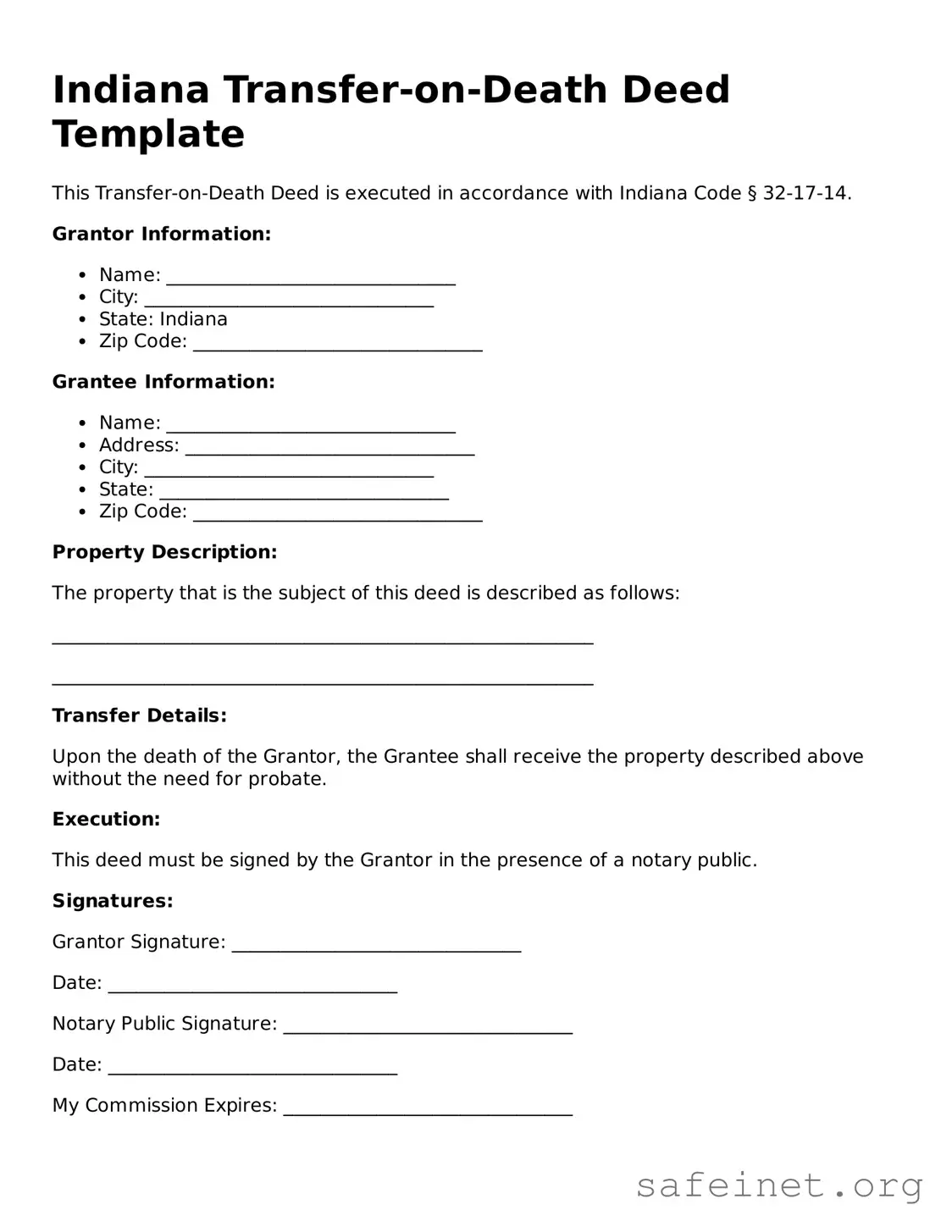
Indiana Transfer-on-Death Deed Template
This Transfer-on-Death Deed is executed in accordance with Indiana Code § 32-17-14.
Grantor Information:
Grantee Information:
Property Description:
The property that is the subject of this deed is described as follows:
__________________________________________________________
__________________________________________________________
Transfer Details:
Upon the death of the Grantor, the Grantee shall receive the property described above without the need for probate.
Execution:
This deed must be signed by the Grantor in the presence of a notary public.
Signatures:
Grantor Signature: _______________________________
Date: _______________________________
Notary Public Signature: _______________________________
Date: _______________________________
My Commission Expires: _______________________________
| Fact Name | Description |
|---|---|
| Purpose | The Indiana Transfer-on-Death Deed allows property owners to transfer real estate to beneficiaries upon their death without going through probate. |
| Governing Law | The use of the Transfer-on-Death Deed in Indiana is governed by Indiana Code § 32-17-14. |
| Eligibility | Any individual who owns real estate in Indiana can create a Transfer-on-Death Deed. |
| Beneficiary Designation | Property owners can designate one or more beneficiaries in the deed. |
| Revocation | A Transfer-on-Death Deed can be revoked at any time by the property owner before their death. |
| Recording Requirement | The deed must be recorded with the county recorder’s office in the county where the property is located. |
| Effect on Creditors | The property transferred via a Transfer-on-Death Deed is still subject to the deceased owner's debts. |
| Tax Implications | There may be tax implications for beneficiaries when they inherit property through a Transfer-on-Death Deed. |
Once you have the Indiana Transfer-on-Death Deed form, the next steps involve carefully filling it out to ensure that your intentions regarding property transfer are clearly documented. This process is straightforward, but attention to detail is essential.
What is a Transfer-on-Death Deed in Indiana?
A Transfer-on-Death Deed (TODD) in Indiana allows property owners to transfer their real estate to designated beneficiaries upon their death without going through the probate process. This legal tool provides a straightforward way to ensure that property passes directly to heirs, making the transition smoother and often more cost-effective.
How does a Transfer-on-Death Deed work?
When a property owner executes a Transfer-on-Death Deed, they retain full ownership and control of the property during their lifetime. The deed becomes effective only upon the owner's death. At that point, the named beneficiaries automatically receive the property, bypassing probate. This process simplifies the transfer and can help reduce the associated costs and delays.
Who can be named as beneficiaries in a Transfer-on-Death Deed?
Beneficiaries can be individuals, such as family members or friends, or even entities like charities or organizations. However, it is important to ensure that the beneficiaries are clearly identified in the deed to avoid any confusion or disputes later on.
Can a Transfer-on-Death Deed be revoked or changed?
Yes, a Transfer-on-Death Deed can be revoked or modified at any time during the property owner's lifetime. To do this, the owner must execute a new deed that explicitly revokes the previous one or simply record a revocation document with the county recorder’s office. It is essential to follow proper procedures to ensure that the changes are legally binding.
Are there any limitations on using a Transfer-on-Death Deed?
While a Transfer-on-Death Deed can be a powerful estate planning tool, there are some limitations. For instance, it cannot be used for transferring property that is subject to a mortgage unless the mortgage allows for such a transfer. Additionally, the deed does not affect any liens or debts associated with the property, which may still need to be settled by the estate.
What happens if a beneficiary predeceases the property owner?
If a named beneficiary passes away before the property owner, the deed may become ineffective for that beneficiary. However, Indiana law allows for contingent beneficiaries to be named in the deed, ensuring that the property still transfers according to the owner’s wishes. It is advisable to review and update the deed regularly to reflect any changes in circumstances.
How do I create a Transfer-on-Death Deed in Indiana?
Creating a Transfer-on-Death Deed involves filling out the appropriate form, which must include specific information about the property and the beneficiaries. Once completed, the deed must be signed by the property owner in the presence of a notary public and then recorded with the county recorder’s office where the property is located. It is wise to consult with a legal professional to ensure that the deed is completed correctly and complies with all applicable laws.
Failing to include the full legal description of the property. This is crucial because a vague description can lead to confusion or disputes about which property is being transferred.
Not signing the deed in the presence of a notary public. A signature that is not notarized can invalidate the deed, making it unenforceable.
Overlooking the requirement to name a beneficiary. If no beneficiary is named, the property may not transfer as intended upon the owner's death.
Using outdated or incorrect forms. It's important to use the most current version of the Transfer-on-Death Deed form, as laws and requirements can change.
Neglecting to record the deed with the county recorder's office. Failing to do so means that the transfer may not be recognized by the state or may lead to complications later on.
Not considering the implications of the transfer on other estate planning documents. It is advisable to ensure that the Transfer-on-Death Deed aligns with wills or trusts to avoid conflicts.
Forgetting to inform the beneficiary about the transfer. Communication can help avoid confusion and ensure that the beneficiary is aware of their rights and responsibilities.
Assuming that the deed eliminates the need for a will. While a Transfer-on-Death Deed can simplify the transfer of property, it does not replace the need for comprehensive estate planning.
When considering the Indiana Transfer-on-Death Deed, it's essential to understand that this form often works in conjunction with several other important documents. Each of these documents plays a critical role in estate planning and property transfer, ensuring that your wishes are honored and that the process is as smooth as possible for your loved ones.
Understanding these documents and how they relate to the Indiana Transfer-on-Death Deed can significantly ease the burden on your loved ones during a challenging time. Proper planning ensures that your wishes are honored and that your estate is managed according to your intentions.
The Indiana Transfer-on-Death Deed (TOD Deed) is similar to a Last Will and Testament in that both documents allow individuals to dictate how their property will be distributed after their death. A will requires probate, which is a legal process to validate the will and distribute assets. In contrast, a TOD Deed bypasses probate, allowing for a more straightforward transfer of property directly to the designated beneficiary upon the owner's death. This can simplify the process and potentially reduce costs associated with estate administration.
Another document that shares similarities with the TOD Deed is a Living Trust. Both instruments allow for the transfer of assets without going through probate. A Living Trust can manage assets during the grantor's lifetime and specify distribution upon death. While a TOD Deed is limited to real estate, a Living Trust can encompass various types of property, including bank accounts and personal belongings. This flexibility can be beneficial for comprehensive estate planning.
The TOD Deed also resembles a Joint Tenancy with Right of Survivorship. In joint tenancy, two or more individuals own property together, and upon the death of one owner, the surviving owner automatically inherits the deceased's share. Like the TOD Deed, this arrangement avoids probate. However, joint tenancy requires active ownership by multiple parties, whereas a TOD Deed allows the original owner to retain full control until death.
A Beneficiary Designation form is another document that functions similarly to a TOD Deed. This form is often used for financial accounts, retirement plans, and life insurance policies. It allows the owner to designate a beneficiary who will receive the asset upon the owner's death, bypassing probate. While the TOD Deed specifically addresses real estate, beneficiary designations apply to various financial instruments, making them a common tool in estate planning.
Finally, a Life Estate is another document that shares characteristics with the TOD Deed. In a life estate arrangement, an individual retains the right to use and benefit from a property during their lifetime, while transferring the remainder interest to another party. Upon the life tenant's death, the property automatically passes to the remainderman without going through probate, similar to the transfer process outlined in a TOD Deed.
When filling out the Indiana Transfer-on-Death Deed form, it is crucial to approach the task with care. Here are some important guidelines to follow, as well as common pitfalls to avoid.
Understanding the Indiana Transfer-on-Death Deed (TODD) can be challenging. Many people hold misconceptions about this legal tool. Here are eight common misconceptions, along with explanations to clarify them.
By addressing these misconceptions, individuals can better understand the Indiana Transfer-on-Death Deed and how it may fit into their estate planning strategies.
Here are some key takeaways about filling out and using the Indiana Transfer-on-Death Deed form: