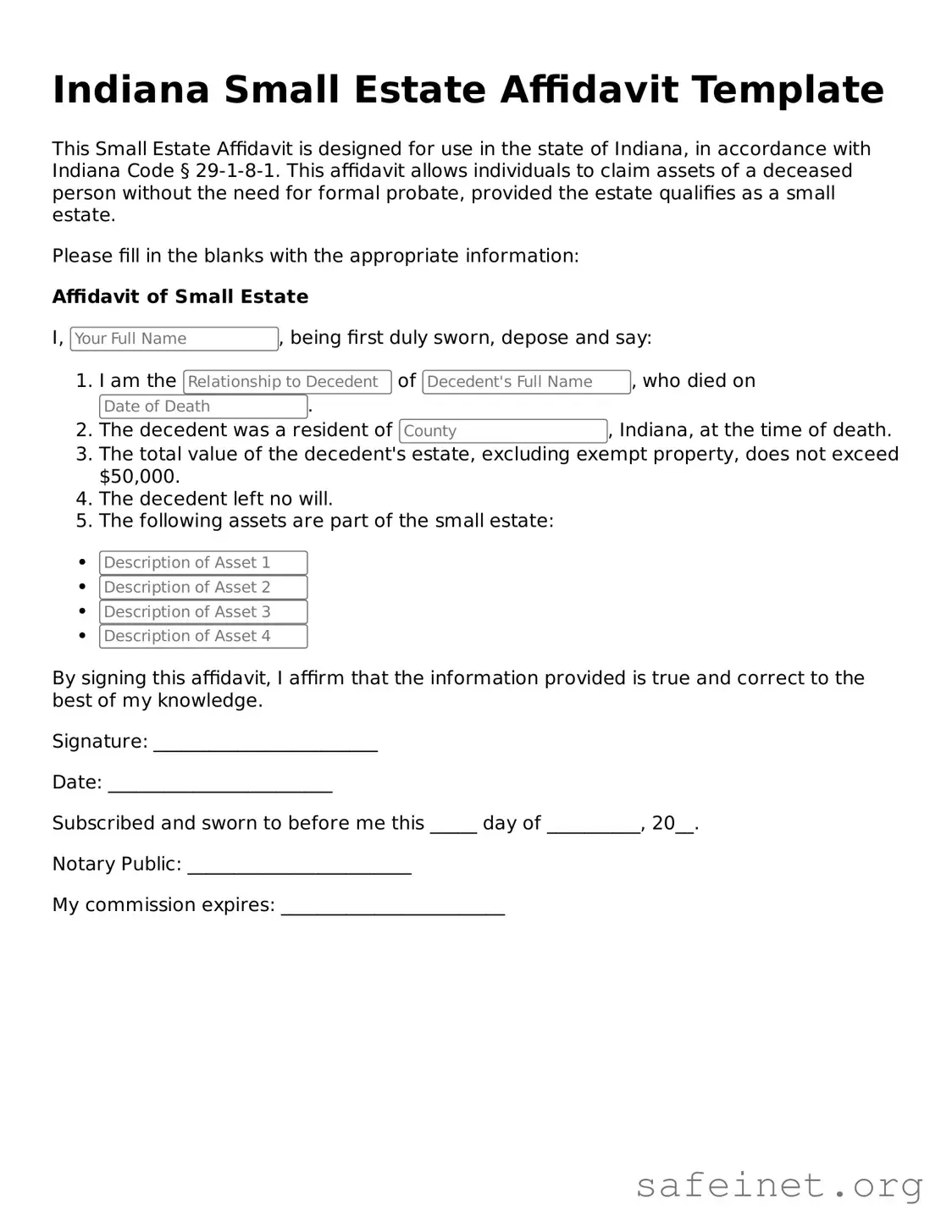
In the state of Indiana, the Small Estate Affidavit serves as a vital tool for individuals seeking to simplify the process of settling an estate when the total value of the deceased's assets is below a certain threshold. This form allows heirs and beneficiaries to claim property without the need for a lengthy probate process, which can often be both time-consuming and costly. Typically, the Small Estate Affidavit can be utilized when the estate's value does not exceed $50,000, or $100,000 if the deceased was married and the surviving spouse is the only heir. By completing this affidavit, individuals can assert their rights to the decedent's assets, including bank accounts, personal property, and other holdings. It is important to note that the affidavit must be signed under oath and may require the presence of a notary public to ensure its validity. This streamlined approach not only alleviates some of the burdens associated with estate management but also provides a clear pathway for heirs to access what is rightfully theirs in a timely manner.
Indiana Small Estate Affidavit Template
This Small Estate Affidavit is designed for use in the state of Indiana, in accordance with Indiana Code § 29-1-8-1. This affidavit allows individuals to claim assets of a deceased person without the need for formal probate, provided the estate qualifies as a small estate.
Please fill in the blanks with the appropriate information:
Affidavit of Small Estate
I, , being first duly sworn, depose and say:
By signing this affidavit, I affirm that the information provided is true and correct to the best of my knowledge.
Signature: ________________________
Date: ________________________
Subscribed and sworn to before me this _____ day of __________, 20__.
Notary Public: ________________________
My commission expires: ________________________
| Fact Name | Details |
|---|---|
| Purpose | The Indiana Small Estate Affidavit allows heirs to claim property without going through probate for estates valued under a certain threshold. |
| Value Limit | As of 2023, the total value of the estate must not exceed $50,000, excluding certain assets like real estate. |
| Eligibility | Only heirs or beneficiaries named in the will or by state law can use the affidavit to collect assets. |
| Governing Law | The process is governed by Indiana Code § 29-1-8-1 through § 29-1-8-3. |
| Filing Process | The affidavit must be filed with the appropriate county clerk's office along with a death certificate. |
| Asset Transfer | Once the affidavit is accepted, financial institutions and other entities will transfer the assets directly to the heirs. |
After you have gathered all necessary information and documents, you are ready to fill out the Indiana Small Estate Affidavit form. This process involves providing specific details about the deceased, their estate, and the individuals entitled to inherit. Follow these steps carefully to ensure the form is completed correctly.
Once you have completed the form and gathered the necessary signatures, you can proceed to file it with the appropriate court. This step is crucial for the distribution of the estate according to Indiana law.
What is the Indiana Small Estate Affidavit?
The Indiana Small Estate Affidavit is a legal document that allows individuals to claim the assets of a deceased person without going through the formal probate process. This option is available when the total value of the estate is below a certain threshold, which, as of 2023, is $50,000 for personal property and $300,000 for real estate. By using this affidavit, heirs can simplify the transfer of assets, making it easier and faster to settle the deceased's affairs.
Who is eligible to use the Small Estate Affidavit?
To use the Small Estate Affidavit in Indiana, you must be an eligible heir of the deceased. This typically includes spouses, children, parents, or siblings, depending on the circumstances. Additionally, the estate must meet the financial criteria mentioned earlier. If the estate exceeds the limits, the heirs will need to pursue formal probate proceedings instead. It's essential to ensure that all legal requirements are met before filing the affidavit to avoid potential complications.
How do I complete and file the Small Estate Affidavit?
Completing the Small Estate Affidavit involves filling out a specific form, which can usually be obtained from the Indiana court system's website or local courthouse. The form requires information about the deceased, the heirs, and the assets being claimed. After filling it out, the affidavit must be signed in front of a notary public. Once notarized, the document should be filed with the appropriate court in the county where the deceased lived. Some courts may have additional requirements, so checking with local rules is advisable.
What happens after I file the Small Estate Affidavit?
After filing the Small Estate Affidavit, the court will review the document. If everything is in order, the court will issue an order allowing the heirs to collect the assets listed in the affidavit. This may include bank accounts, vehicles, or personal property. Once the assets are transferred, the heirs can manage them as they see fit. It's important to keep a copy of the affidavit and any court orders for future reference, as they may be needed for tax purposes or further legal matters.
Incorrect Information: Providing inaccurate names, addresses, or dates can lead to delays or rejections. Ensure all details match official documents.
Missing Signatures: Failing to sign the affidavit or having the wrong person sign can invalidate the form. Double-check who needs to sign.
Not Including Required Documentation: Attach necessary documents, such as death certificates or proof of assets. Omitting these can cause processing issues.
Ignoring State-Specific Requirements: Each state may have unique rules. Familiarize yourself with Indiana's specific requirements for small estate affidavits.
Overlooking the Value Limit: Indiana has a threshold for small estates. Ensure the total value of the estate falls within the allowed limit to use this form.
Not Consulting Legal Help: Some may attempt to fill out the form without guidance. Seeking advice from a legal professional can prevent costly mistakes.
When navigating the process of settling a small estate in Indiana, individuals often encounter various forms and documents that assist in the administration of the estate. Each document serves a unique purpose and helps streamline the legal proceedings. Below is a list of commonly used forms in conjunction with the Indiana Small Estate Affidavit.
Collectively, these documents form a comprehensive framework for managing the small estate process in Indiana. Proper preparation and understanding of each form can facilitate a smoother transition during a challenging time.
The Indiana Small Estate Affidavit is similar to the Affidavit of Heirship, which is used to establish the heirs of a deceased person. This document allows heirs to claim property without going through probate. Like the Small Estate Affidavit, the Affidavit of Heirship simplifies the transfer process, making it easier for family members to access assets. Both documents require signatures from witnesses and may need to be notarized, ensuring their legitimacy in the eyes of the law.
Another document akin to the Indiana Small Estate Affidavit is the Transfer on Death (TOD) Deed. This deed allows property owners to designate beneficiaries who will inherit the property upon the owner’s death. Similar to the Small Estate Affidavit, the TOD Deed avoids probate and allows for a straightforward transfer of assets. Both documents require careful completion to ensure that the intended beneficiaries receive the property without unnecessary delays.
The Will is another document that shares similarities with the Indiana Small Estate Affidavit. While a Will outlines how a person's assets should be distributed after death, it typically goes through probate, unlike the Small Estate Affidavit. However, both documents serve to express the deceased's wishes regarding asset distribution. In cases where the estate is small enough, the Small Estate Affidavit can be used to bypass the complexities of probate that a Will would normally entail.
The Durable Power of Attorney is also comparable, as it allows individuals to designate someone to manage their affairs if they become incapacitated. While it is not specifically for post-death asset distribution, both documents facilitate the management and transfer of assets without court intervention. The Durable Power of Attorney is effective during the grantor's lifetime, while the Small Estate Affidavit comes into play after death, but both aim to streamline processes for the individual’s estate.
Lastly, the Living Trust can be likened to the Indiana Small Estate Affidavit. A Living Trust allows individuals to place their assets into a trust during their lifetime, which can then be distributed to beneficiaries upon death without going through probate. Like the Small Estate Affidavit, it simplifies the transfer of assets and can help avoid delays. Both documents are designed to ease the burden on heirs and facilitate a smoother transition of ownership.
When filling out the Indiana Small Estate Affidavit form, there are important steps to follow to ensure the process goes smoothly. Below is a list of things you should and shouldn't do.
By following these guidelines, you can help ensure that the process of managing a small estate in Indiana is as straightforward as possible.
Many individuals have misunderstandings about the Indiana Small Estate Affidavit form. Here are four common misconceptions:
This is not true. The Small Estate Affidavit can be used even if the deceased had debts, as long as the total assets are below the threshold set by Indiana law. However, the heirs may still need to address outstanding debts before distributing assets.
While it is often helpful to consult an attorney, it is not a legal requirement. Individuals can complete and file the form on their own, provided they understand the process and requirements.
This is incorrect. Certain assets, such as real estate or assets held in a trust, cannot be transferred using a Small Estate Affidavit. The affidavit is typically limited to personal property and bank accounts.
While the process can be simpler than formal probate, it can still involve complexities. Gathering necessary documents, notifying creditors, and ensuring compliance with state laws can take time and effort.
When dealing with the Indiana Small Estate Affidavit, understanding the process can simplify the transfer of assets for estates that meet certain criteria. Here are some key takeaways to keep in mind:
By following these steps and understanding the requirements, you can effectively navigate the Indiana Small Estate Affidavit process.