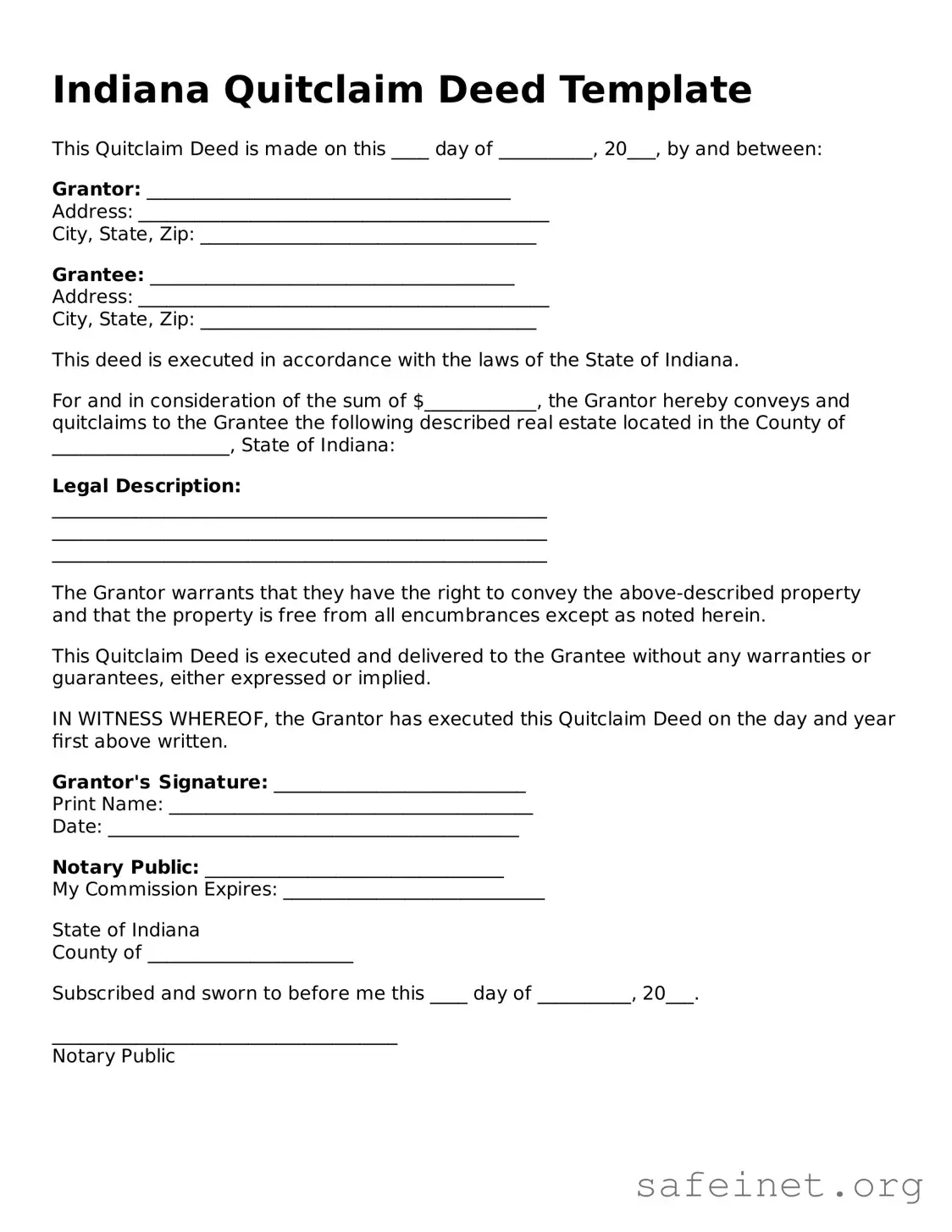
The Indiana Quitclaim Deed form serves as a vital tool in real estate transactions, allowing property owners to transfer their interest in a property to another party without making any guarantees about the title's validity. This type of deed is particularly useful in situations where the granter may not be able to provide a warranty deed, such as transfers between family members or in divorce settlements. Unlike warranty deeds, which offer assurances regarding the title, quitclaim deeds simply convey whatever interest the granter has, if any. This means that the recipient, known as the grantee, accepts the property "as is," with no promises made about its legal standing. The form must be properly filled out, including essential details such as the names of the parties involved, a description of the property, and the date of transfer. Additionally, the document must be signed by the granter in the presence of a notary public to ensure its legality. Understanding the implications of using a quitclaim deed is crucial for both parties, as it can significantly affect future ownership rights and responsibilities.
Indiana Quitclaim Deed Template
This Quitclaim Deed is made on this ____ day of __________, 20___, by and between:
Grantor: _______________________________________
Address: ____________________________________________
City, State, Zip: ____________________________________
Grantee: _______________________________________
Address: ____________________________________________
City, State, Zip: ____________________________________
This deed is executed in accordance with the laws of the State of Indiana.
For and in consideration of the sum of $____________, the Grantor hereby conveys and quitclaims to the Grantee the following described real estate located in the County of ___________________, State of Indiana:
Legal Description:
_____________________________________________________
_____________________________________________________
_____________________________________________________
The Grantor warrants that they have the right to convey the above-described property and that the property is free from all encumbrances except as noted herein.
This Quitclaim Deed is executed and delivered to the Grantee without any warranties or guarantees, either expressed or implied.
IN WITNESS WHEREOF, the Grantor has executed this Quitclaim Deed on the day and year first above written.
Grantor's Signature: ___________________________
Print Name: _______________________________________
Date: ____________________________________________
Notary Public: ________________________________
My Commission Expires: ____________________________
State of Indiana
County of ______________________
Subscribed and sworn to before me this ____ day of __________, 20___.
_____________________________________
Notary Public
| Fact Name | Description |
|---|---|
| Definition | A quitclaim deed is a legal document used to transfer ownership of real estate without any warranties. |
| Governing Law | Indiana Code Title 32, Article 21 governs the use and execution of quitclaim deeds in Indiana. |
| Purpose | This form is often used to transfer property between family members or to clear up title issues. |
| Consideration | The deed can be executed with or without consideration, meaning the transfer can be for payment or a gift. |
| Signature Requirements | The grantor must sign the deed in front of a notary public for it to be valid. |
| Recording | To protect the interests of the grantee, the quitclaim deed should be recorded with the county recorder's office. |
| Limitations | A quitclaim deed does not guarantee that the grantor holds clear title to the property. |
| Common Uses | It is frequently used in divorce settlements, estate transfers, or to add or remove a spouse from the title. |
After completing the Indiana Quitclaim Deed form, the next step involves filing the document with the appropriate county recorder's office. This ensures that the transfer of property is officially recognized. It is advisable to keep a copy for personal records.
What is a Quitclaim Deed in Indiana?
A Quitclaim Deed is a legal document used to transfer ownership of real estate from one party to another. In Indiana, this type of deed is often used when the property is being transferred between family members, during divorce settlements, or in situations where the grantor is not providing any warranties regarding the title. Essentially, it conveys whatever interest the grantor has in the property without guaranteeing that the title is clear or free of liens. This means the recipient may assume some risk regarding the property’s title status.
How do I complete a Quitclaim Deed in Indiana?
To complete a Quitclaim Deed in Indiana, you will need to gather some essential information. Start by identifying the grantor (the person transferring the property) and the grantee (the person receiving the property). You’ll need to include their full names and addresses. Next, provide a legal description of the property, which can usually be found on the property’s tax records or previous deeds. After filling out the form, the grantor must sign it in the presence of a notary public. This step is crucial, as it ensures the document is legally binding.
Is a Quitclaim Deed the same as a Warranty Deed?
No, a Quitclaim Deed is not the same as a Warranty Deed. While both are used to transfer property, they differ significantly in terms of the guarantees provided. A Warranty Deed offers assurances that the grantor holds clear title to the property and has the right to sell it. In contrast, a Quitclaim Deed transfers whatever interest the grantor may have without any guarantees. This makes the Quitclaim Deed a riskier option for the grantee, as they may inherit any existing issues with the title.
Do I need to record a Quitclaim Deed in Indiana?
Yes, it is advisable to record a Quitclaim Deed in Indiana. Recording the deed with the county recorder’s office provides public notice of the property transfer and protects the grantee’s interests. If the deed is not recorded, there may be challenges in proving ownership, especially if disputes arise in the future. Recording also helps to establish a clear chain of title, which can be crucial for any future transactions involving the property.
Are there any fees associated with filing a Quitclaim Deed in Indiana?
Yes, there are typically fees associated with filing a Quitclaim Deed in Indiana. These fees can vary by county, so it’s essential to check with your local county recorder’s office for the exact amount. In addition to recording fees, you may also need to pay for notary services if you do not have access to a notary public. It’s a good idea to budget for these costs when planning to execute a Quitclaim Deed.
Can a Quitclaim Deed be revoked in Indiana?
Once a Quitclaim Deed has been executed and recorded, it cannot be unilaterally revoked. However, the grantor and grantee can agree to reverse the transaction by executing another deed that transfers the property back to the original owner or to another party. This new deed must also be properly completed and recorded to ensure that the change in ownership is legally recognized. Always consult with a legal professional if you’re considering reversing a property transfer to understand the implications fully.
Incomplete Information: One common mistake is leaving sections of the form blank. All required fields must be filled out to ensure the deed is valid. Omitting information can lead to delays or complications in the property transfer process.
Incorrect Legal Descriptions: Providing an inaccurate or vague legal description of the property can result in legal disputes. It is crucial to include the exact boundaries and any relevant details that define the property.
Not Notarizing the Document: Failing to have the deed notarized is another frequent error. A notarized signature is often necessary for the deed to be recognized legally. Without it, the deed may not be accepted by the county recorder’s office.
Improper Signatures: The form must be signed by the grantor, and sometimes by the grantee as well. Not adhering to the signature requirements can invalidate the deed. Each party involved should ensure their signature is correctly placed and dated.
Not Recording the Deed: After completing the form, individuals sometimes forget to file the deed with the appropriate county office. Recording the deed is essential for public notice and to protect ownership rights. Failing to do so can lead to complications in future property transactions.
The Indiana Quitclaim Deed form is a legal document used to transfer property ownership without guaranteeing that the title is clear. When completing a property transfer, several additional forms and documents may be necessary to ensure the process is legally sound and comprehensive. Below is a list of other common documents that are often used in conjunction with the Quitclaim Deed in Indiana.
Understanding these documents is crucial for anyone involved in a property transaction in Indiana. Each plays a distinct role in ensuring the transfer is completed smoothly and legally. Proper preparation and attention to detail can help avoid potential complications in the future.
The warranty deed is a document that, like a quitclaim deed, transfers ownership of real property from one party to another. However, the key difference lies in the guarantees provided. A warranty deed offers a guarantee that the grantor holds clear title to the property and has the right to sell it. This means the grantee is protected against any future claims to the title. In contrast, a quitclaim deed does not provide such assurances, making it a less secure option for transferring property ownership.
The special warranty deed is another document that shares similarities with the quitclaim deed. It also transfers property ownership but includes limited warranties. The grantor guarantees that they have not caused any defects in the title during their ownership. Unlike a quitclaim deed, which offers no warranties, a special warranty deed provides some level of protection to the grantee, though it is not as comprehensive as that found in a full warranty deed.
A bargain and sale deed is similar to a quitclaim deed in that it conveys property without warranties. However, it implies that the grantor has ownership of the property and the right to sell it. This type of deed is often used in transactions where the seller is not providing any guarantees about the title, similar to a quitclaim deed. While it does not offer the same level of protection as a warranty deed, it does provide a degree of assurance that the grantor holds title.
The grant deed is another document that resembles a quitclaim deed. It transfers property ownership and typically includes implied warranties that the grantor has not transferred the property to anyone else and that the property is free from encumbrances made by the grantor. While a grant deed offers more protection than a quitclaim deed, it still does not provide the comprehensive guarantees found in a warranty deed.
Lastly, the deed of trust is a document that is often used in real estate transactions involving loans. While it serves a different primary purpose—securing a loan—it shares the characteristic of transferring an interest in property. In this case, the borrower conveys the property to a trustee, who holds it as security for the loan. Although it functions differently than a quitclaim deed, both documents involve the transfer of property rights and can impact ownership status.
When filling out the Indiana Quitclaim Deed form, it is important to adhere to certain guidelines to ensure accuracy and compliance. Below is a list of things to do and avoid.
When it comes to the Indiana Quitclaim Deed form, several misconceptions can lead to confusion for property owners. Understanding these misconceptions is crucial for anyone considering using this type of deed.
While it is true that a quitclaim deed does not come with warranties, many people mistakenly believe this means it is not a valid form of transfer. In fact, it is a legitimate legal document that allows the transfer of whatever interest the grantor has in the property, even if that interest is unclear.
Many individuals associate quitclaim deeds solely with divorce settlements. However, these deeds can be used in various situations, such as transferring property between family members or clearing up title issues. They are not limited to any specific circumstance.
Some people believe that by using a quitclaim deed, they can escape all liabilities associated with the property. This is not accurate. While the deed transfers ownership, it does not remove any existing debts or liens on the property. The new owner may still be responsible for those obligations.
Many assume that quitclaim deeds and warranty deeds serve the same purpose. This is a misunderstanding. A warranty deed provides guarantees about the title and protects the buyer from any future claims, while a quitclaim deed does not offer such protections. Understanding these differences is vital for making informed decisions.
When filling out and using the Indiana Quitclaim Deed form, keep these key takeaways in mind: