In Indiana, the Power of Attorney (POA) form serves as a vital legal document that empowers individuals to designate someone they trust to make decisions on their behalf. This form is essential for managing financial affairs, healthcare choices, and other critical matters when one is unable to act independently. The POA can be tailored to be durable, meaning it remains effective even if the principal becomes incapacitated, or it can be limited to specific transactions or timeframes. It's important to note that the chosen agent must act in the best interest of the principal, adhering to their wishes and values. Additionally, the Indiana POA form requires clear identification of both the principal and the agent, along with a signature and date to validate the document. Understanding these key elements helps ensure that individuals can effectively plan for the future, making informed decisions about their health and finances.
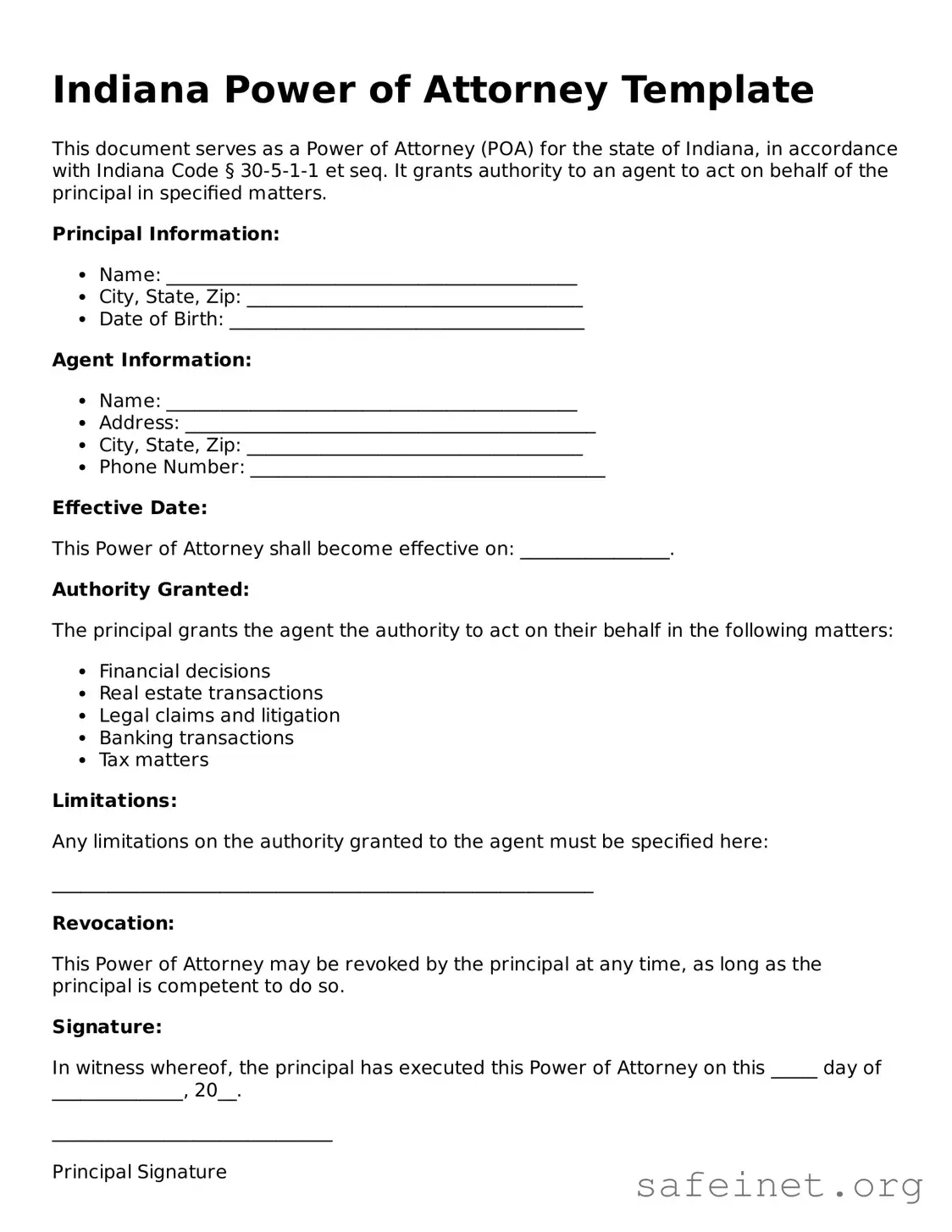
Indiana Power of Attorney Template
This document serves as a Power of Attorney (POA) for the state of Indiana, in accordance with Indiana Code § 30-5-1-1 et seq. It grants authority to an agent to act on behalf of the principal in specified matters.
Principal Information:
Agent Information:
Effective Date:
This Power of Attorney shall become effective on: ________________.
Authority Granted:
The principal grants the agent the authority to act on their behalf in the following matters:
Limitations:
Any limitations on the authority granted to the agent must be specified here:
__________________________________________________________
Revocation:
This Power of Attorney may be revoked by the principal at any time, as long as the principal is competent to do so.
Signature:
In witness whereof, the principal has executed this Power of Attorney on this _____ day of ______________, 20__.
______________________________
Principal Signature
Witnesses:
Two witnesses are required to sign below:
Notarization:
This document must be notarized to be valid.
______________________________
Notary Public Signature
My commission expires: ________________
| Fact Name | Description |
|---|---|
| Definition | The Indiana Power of Attorney form allows an individual to appoint someone else to make decisions on their behalf. |
| Governing Law | This form is governed by Indiana Code Title 30, Article 5. |
| Types of Authority | The form can grant general or specific powers, depending on the individual's needs. |
| Durability | The Indiana Power of Attorney can be durable, meaning it remains effective even if the principal becomes incapacitated. |
| Revocation | The principal can revoke the Power of Attorney at any time, as long as they are competent. |
| Witness Requirement | Two witnesses must sign the form for it to be valid, ensuring that the principal understands the document. |
| Notarization | Notarization is recommended but not required for the Power of Attorney to be effective in Indiana. |
Filling out the Indiana Power of Attorney form is an important step in designating someone to handle your affairs. Once completed, this document allows your chosen representative to act on your behalf in various matters. Follow the steps below to ensure the form is filled out correctly.
After filling out the form, ensure that all parties understand their roles and responsibilities. This will help facilitate a smoother process when the Power of Attorney is needed.
What is a Power of Attorney in Indiana?
A Power of Attorney (POA) in Indiana is a legal document that allows you to appoint someone else, known as your agent or attorney-in-fact, to make decisions on your behalf. This can include financial matters, healthcare decisions, or other personal affairs. The authority granted can be broad or limited, depending on your specific needs and preferences. It’s essential to choose someone you trust, as they will have significant control over your affairs while the POA is in effect.
What types of Power of Attorney are available in Indiana?
Indiana recognizes several types of Power of Attorney forms. The most common are the General Power of Attorney, which grants broad powers to your agent, and the Limited Power of Attorney, which restricts the agent's authority to specific tasks or timeframes. There is also a Durable Power of Attorney, which remains effective even if you become incapacitated, and a Healthcare Power of Attorney, which specifically allows your agent to make medical decisions on your behalf if you are unable to do so.
How do I create a Power of Attorney in Indiana?
To create a Power of Attorney in Indiana, you must complete the appropriate form and sign it in the presence of a notary public. It’s crucial to clearly outline the powers you wish to grant to your agent. You can find templates and forms online or consult with a legal professional to ensure that your document meets all state requirements. Once completed, provide copies to your agent and any relevant institutions, such as banks or healthcare providers, to ensure they recognize the authority granted.
Can I revoke a Power of Attorney in Indiana?
Yes, you can revoke a Power of Attorney in Indiana at any time, as long as you are mentally competent. To do this, you should create a written revocation document and notify your agent and any institutions that may have a copy of the original POA. It’s advisable to destroy the original document to prevent any confusion. If you have appointed multiple agents, you may need to specify whether you are revoking the entire Power of Attorney or just the authority of certain individuals.
Not Specifying the Powers Granted: One common mistake is failing to clearly outline the specific powers being granted to the agent. Without this clarity, the agent may not have the authority to act in the best interest of the principal.
Choosing the Wrong Agent: Selecting someone who is not trustworthy or lacks the necessary judgment can lead to significant issues. It is crucial to choose an agent who understands your values and will act accordingly.
Not Signing the Document Properly: A Power of Attorney must be signed by the principal in the presence of a notary public. Failing to do so can render the document invalid, which defeats its purpose.
Overlooking State-Specific Requirements: Each state has its own laws regarding Powers of Attorney. Ignoring Indiana's specific requirements can lead to complications, making the document unenforceable.
Not Reviewing the Document Periodically: Circumstances change, and so do relationships. Failing to review and update the Power of Attorney can result in outdated information that does not reflect current wishes.
When creating a Power of Attorney in Indiana, it is often beneficial to consider additional documents that can complement this legal instrument. Each of these documents serves a unique purpose and can enhance the effectiveness of the Power of Attorney.
Incorporating these documents with a Power of Attorney can provide comprehensive coverage for both health and financial decisions. Each document plays a vital role in ensuring that an individual’s preferences are respected and that their affairs are managed effectively.
The Indiana Power of Attorney form shares similarities with the Durable Power of Attorney. Both documents allow an individual to designate someone else to make decisions on their behalf. The key difference lies in durability; the Durable Power of Attorney remains effective even if the principal becomes incapacitated. This ensures that the designated agent can continue to act without interruption, making it a critical tool for long-term planning.
Another related document is the Medical Power of Attorney. This form specifically grants authority to an agent to make healthcare decisions for the principal. While the general Power of Attorney covers a wide range of financial and legal matters, the Medical Power of Attorney focuses solely on health-related issues. This distinction is crucial for individuals who want to separate their medical decision-making from other financial responsibilities.
The Living Will is also similar, as it addresses end-of-life decisions. While the Power of Attorney appoints someone to make decisions, the Living Will outlines the principal's wishes regarding medical treatment in specific situations. It serves as a guide for the agent appointed under the Medical Power of Attorney, ensuring that the principal's preferences are honored when they cannot communicate them directly.
A Revocable Trust is another document that bears resemblance to the Power of Attorney. Both allow for the management of an individual's assets, but they function differently. A Revocable Trust transfers ownership of assets to the trust, allowing the trustee to manage them. In contrast, a Power of Attorney grants authority to an agent to act on behalf of the principal without changing ownership. This distinction can affect estate planning strategies and asset protection.
The Guardianship document is also comparable, particularly in situations where an individual cannot make decisions due to incapacity. A Guardianship is established through a court process, granting a guardian the authority to make decisions for the incapacitated person. Unlike a Power of Attorney, which is voluntary and can be revoked, Guardianship is often a more permanent arrangement that requires judicial oversight.
Finally, the Advance Healthcare Directive combines elements of both the Medical Power of Attorney and the Living Will. It allows individuals to specify their healthcare preferences and appoint an agent to make decisions if they become unable to do so. This document ensures that an individual's medical wishes are respected while providing the necessary authority to a trusted person to act on their behalf.
When filling out the Indiana Power of Attorney form, it is important to follow specific guidelines to ensure the document is valid and effective. Here is a list of things you should and shouldn't do:
Many people have misunderstandings about the Indiana Power of Attorney form. Below is a list of common misconceptions along with clarifications.
In reality, a Power of Attorney can cover various areas, including healthcare decisions, property management, and legal affairs.
This is incorrect. The individual can specify the powers granted and can revoke the document at any time, as long as they are competent.
This is true for standard Powers of Attorney. However, a Durable Power of Attorney remains in effect even if the person becomes incapacitated.
While most adults can serve, certain individuals, such as those with a felony conviction or those who are unable to fulfill the responsibilities, may be disqualified.
In Indiana, notarization is not strictly required, but having the document notarized can help avoid disputes about its validity.
Each Power of Attorney can be tailored to meet specific needs and preferences. It is important to outline the powers clearly.
This is false. Individuals can create a Power of Attorney at any time, even when they are fully capable of making their own decisions.
This is not true. The individual can modify or revoke the Power of Attorney at any time, provided they are still competent.
A Power of Attorney is used for managing affairs while the person is alive, whereas a will only takes effect after death.
When filling out and using the Indiana Power of Attorney form, keep these key takeaways in mind: