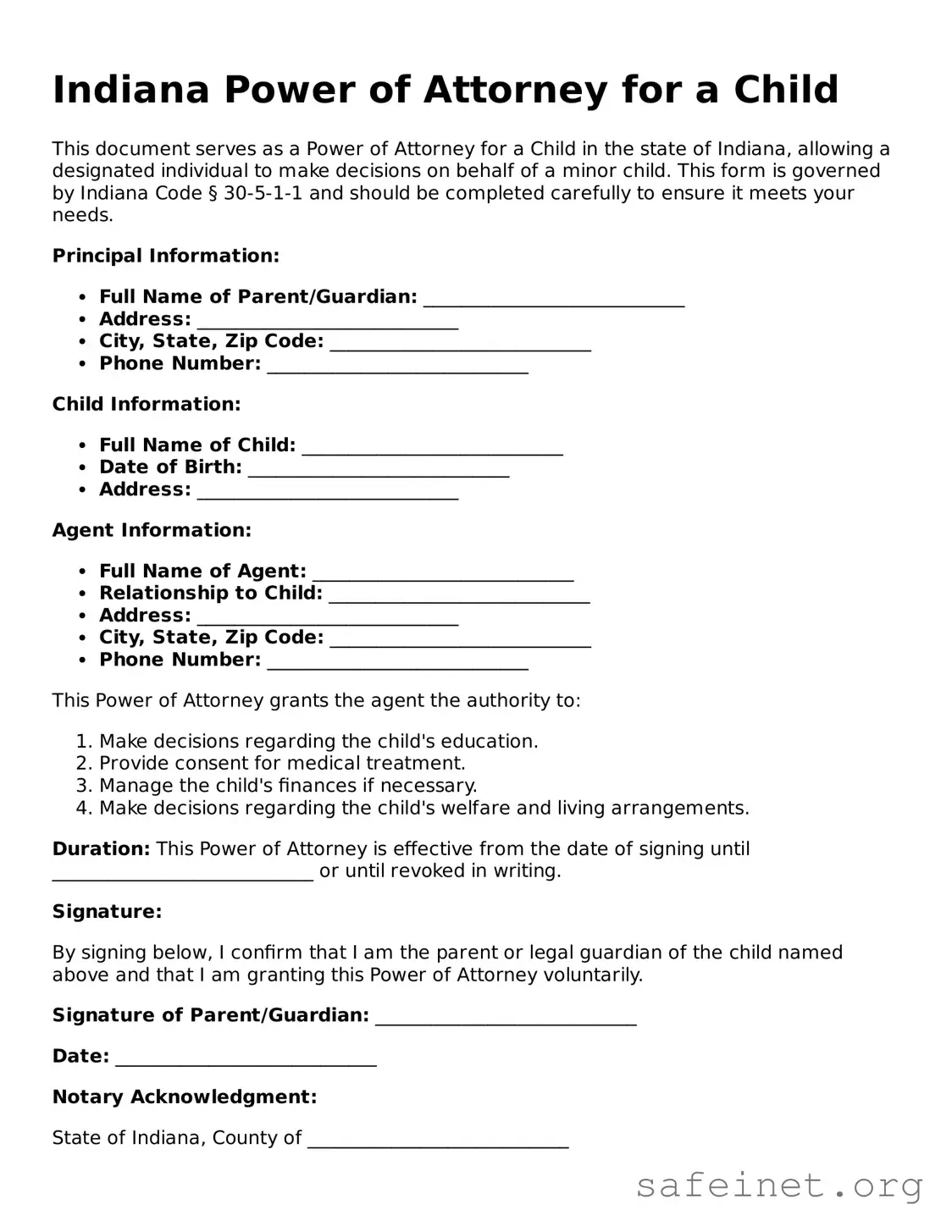
The Indiana Power of Attorney for a Child form serves as a crucial legal document that allows a parent or legal guardian to designate another adult to make decisions on behalf of their child. This form is particularly useful in situations where a parent may be temporarily unable to care for their child due to travel, illness, or other circumstances. By completing this form, the parent grants specific authority to the designated individual, often referred to as the agent, to handle various responsibilities, including medical care, education, and general welfare. The document ensures that the child's needs are met without interruption, providing peace of mind to parents who may be away. It is essential to understand the scope of authority granted, as well as the duration of the power of attorney, which can be tailored to fit the specific needs of the family. Additionally, this form must be signed and notarized to ensure its validity, emphasizing the importance of following proper procedures to protect the child's best interests.
Indiana Power of Attorney for a Child
This document serves as a Power of Attorney for a Child in the state of Indiana, allowing a designated individual to make decisions on behalf of a minor child. This form is governed by Indiana Code § 30-5-1-1 and should be completed carefully to ensure it meets your needs.
Principal Information:
Child Information:
Agent Information:
This Power of Attorney grants the agent the authority to:
Duration: This Power of Attorney is effective from the date of signing until ____________________________ or until revoked in writing.
Signature:
By signing below, I confirm that I am the parent or legal guardian of the child named above and that I am granting this Power of Attorney voluntarily.
Signature of Parent/Guardian: ____________________________
Date: ____________________________
Notary Acknowledgment:
State of Indiana, County of ____________________________
Subscribed and sworn to before me on this ______ day of ____________, 20__.
Notary Public: ____________________________
My Commission Expires: ____________________________
| Fact Name | Description |
|---|---|
| Definition | The Indiana Power of Attorney for a Child form allows a parent or guardian to delegate authority to another adult for the care of their child. |
| Governing Law | This form is governed by Indiana Code § 30-5-1-1 through § 30-5-1-7. |
| Duration | The power of attorney can be effective for a specific period or until revoked by the parent or guardian. |
| Limitations | The agent cannot make decisions about the child's education or health care unless specifically granted that authority. |
| Eligibility | Any adult can be designated as an agent, provided they are willing to accept the responsibility. |
| Revocation | The parent or guardian can revoke the power of attorney at any time, as long as they provide notice to the agent. |
| Witness Requirement | The form must be signed in the presence of a notary public or two witnesses to be legally valid. |
| Use Cases | This form is often used when parents are temporarily unable to care for their child, such as during travel or hospitalization. |
Filling out the Indiana Power of Attorney for a Child form is a straightforward process. This document allows you to designate someone to make decisions on behalf of your child when you are unable to do so. Follow the steps below to ensure that you complete the form correctly.
Once you have completed the form, make copies for your records and provide a copy to the designated person. Keep the original in a safe place, as it may be needed in the future.
What is a Power of Attorney for a Child in Indiana?
A Power of Attorney for a Child in Indiana is a legal document that allows a parent or legal guardian to give another adult the authority to make decisions on behalf of their child. This can include decisions about education, healthcare, and other important matters. The form is useful when a parent is unable to care for their child temporarily, such as during travel or medical emergencies.
Who can be appointed as an attorney-in-fact for a child?
Any responsible adult can be appointed as an attorney-in-fact for a child in Indiana. This could be a relative, family friend, or trusted neighbor. It is important to choose someone who is reliable and has the child’s best interests at heart. The appointed person will have the authority to make decisions as outlined in the Power of Attorney document.
How long does a Power of Attorney for a Child last?
The duration of the Power of Attorney for a Child can vary. It can be set for a specific period, such as a few months, or it can be effective until a certain event occurs, like the return of the parent. If no specific end date is mentioned, the document generally remains in effect until the parent or guardian revokes it or until the child reaches the age of majority, which is 18 in Indiana.
Do I need to have the Power of Attorney for a Child notarized?
Yes, in Indiana, the Power of Attorney for a Child must be signed in the presence of a notary public. This step helps to verify the identities of the individuals involved and ensures that the document is legally binding. It is also a good idea to keep copies of the signed document in a safe place and provide copies to the attorney-in-fact and any relevant parties, such as schools or medical providers.
Not including the child's full name. Always ensure that the child's complete name is clearly stated. This avoids any confusion about who the document pertains to.
Failing to specify the duration of the Power of Attorney. It's important to indicate how long the authority will last. Without this, the document may be considered indefinite, which can lead to complications.
Not signing the document in the presence of a notary. A notary's signature is often required to validate the Power of Attorney. Skipping this step can render the form ineffective.
Leaving out the alternate agent. Designating an alternate agent can provide a backup option if the primary agent is unavailable. This is a crucial step that many overlook.
Using vague language when describing the powers granted. Be specific about what decisions the agent can make. Ambiguity can lead to disputes later on.
Not including the date of signing. The date is essential for establishing when the Power of Attorney takes effect. Omitting this can create confusion.
Forgetting to inform the child about the Power of Attorney. It's important for the child to understand the arrangement. This helps them feel secure and aware of their situation.
Neglecting to keep a copy of the document. Always retain a copy for personal records. This ensures that you have access to the document when needed.
Not reviewing the form for errors before submission. Simple mistakes can lead to significant issues. Take the time to double-check all entries for accuracy.
When completing the Indiana Power of Attorney for a Child form, several other documents may be beneficial to ensure comprehensive legal coverage. These documents can provide additional clarity and support for the authority being granted. Below is a list of commonly used forms that often accompany the Power of Attorney for a Child.
Utilizing these additional forms can enhance the effectiveness of the Indiana Power of Attorney for a Child. They help clarify roles and responsibilities, ensuring that the child’s needs are met in various situations.
The Indiana Power of Attorney for a Child form shares similarities with the General Power of Attorney. Both documents allow individuals to designate another person to make decisions on their behalf. While the General Power of Attorney can cover a broad range of matters, the Indiana Power of Attorney for a Child specifically focuses on decisions related to the care and welfare of a minor child. This targeted approach ensures that the child's needs are prioritized, while still granting the designated individual authority similar to what is found in a general power of attorney.
Another document that resembles the Indiana Power of Attorney for a Child is the Medical Power of Attorney. This form specifically grants authority to someone to make medical decisions for another person. Like the Power of Attorney for a Child, it is crucial in situations where the individual cannot make decisions due to illness or incapacity. However, the Medical Power of Attorney is tailored to health-related decisions, while the Indiana version encompasses broader aspects of a child's upbringing and daily care.
The Child Custody Agreement is another relevant document. This agreement outlines the responsibilities and rights of parents or guardians regarding the care of a child. Similar to the Indiana Power of Attorney for a Child, it addresses the child's welfare and living arrangements. However, a custody agreement typically arises from divorce or separation, whereas the power of attorney can be established without any legal proceedings, making it a more flexible option for temporary arrangements.
The Guardianship Agreement also parallels the Indiana Power of Attorney for a Child. In both cases, an adult is appointed to take care of a minor. The key difference lies in the permanence of guardianship. A guardianship is often a long-term arrangement established through a court process, while the power of attorney is usually temporary and can be revoked by the parent at any time, providing more immediate and less formal options for child care.
The Adoption Agreement is another document that shares a focus on child welfare. While it is a legal process that permanently transfers parental rights, it reflects the same underlying concern for a child's best interests. In contrast to the Indiana Power of Attorney for a Child, which is a temporary delegation of authority, adoption creates a lasting legal relationship between the child and the adoptive parents.
The Temporary Custody Order is similar in its focus on the immediate care of a child. This document is often issued by a court to grant temporary custody to a relative or other caregiver. Like the Indiana Power of Attorney for a Child, it aims to ensure the child's safety and well-being. However, a Temporary Custody Order is typically more formal and involves judicial oversight, while the power of attorney can be executed privately without court intervention.
The Child Care Authorization form also bears resemblance to the Indiana Power of Attorney for a Child. This document allows a parent to grant another individual the authority to make decisions regarding a child's care, such as enrolling them in school or authorizing medical treatment. Both documents aim to facilitate the care of a child when a parent is unavailable, but the Child Care Authorization is often limited to specific situations, while the power of attorney can cover a wider range of responsibilities.
The Release of Liability form is another document that can be compared to the Indiana Power of Attorney for a Child. This form is often used by parents to allow a caregiver to take a child on trips or participate in activities, while limiting the parent's liability in case of accidents. Both documents serve to protect the interests of the child and the caregiver, but the Release of Liability focuses on risk management rather than the broader delegation of authority found in the power of attorney.
Finally, the School Authorization form is similar in that it allows a designated individual to make decisions related to a child's education. This document enables a caregiver to enroll a child in school or attend parent-teacher conferences. While it shares the goal of ensuring a child's educational needs are met, the Indiana Power of Attorney for a Child encompasses a wider scope, allowing for decisions beyond just educational matters, thus providing a more comprehensive approach to child care.
Filling out the Indiana Power of Attorney for a Child form can be a straightforward process if you keep a few important guidelines in mind. Here are six key things to do and avoid:
By following these guidelines, you can help ensure that the form is filled out correctly and serves its intended purpose effectively.
Understanding the Indiana Power of Attorney for a Child form can be challenging. Here are nine common misconceptions that people often have about this important legal document:
Being informed about these misconceptions can help ensure that the Indiana Power of Attorney for a Child form is used correctly and effectively.
Filling out and using the Indiana Power of Attorney for a Child form can be straightforward when you keep a few important points in mind. Here are some key takeaways to consider:
By keeping these points in mind, you can ensure that the Power of Attorney for a Child form serves its intended purpose effectively.