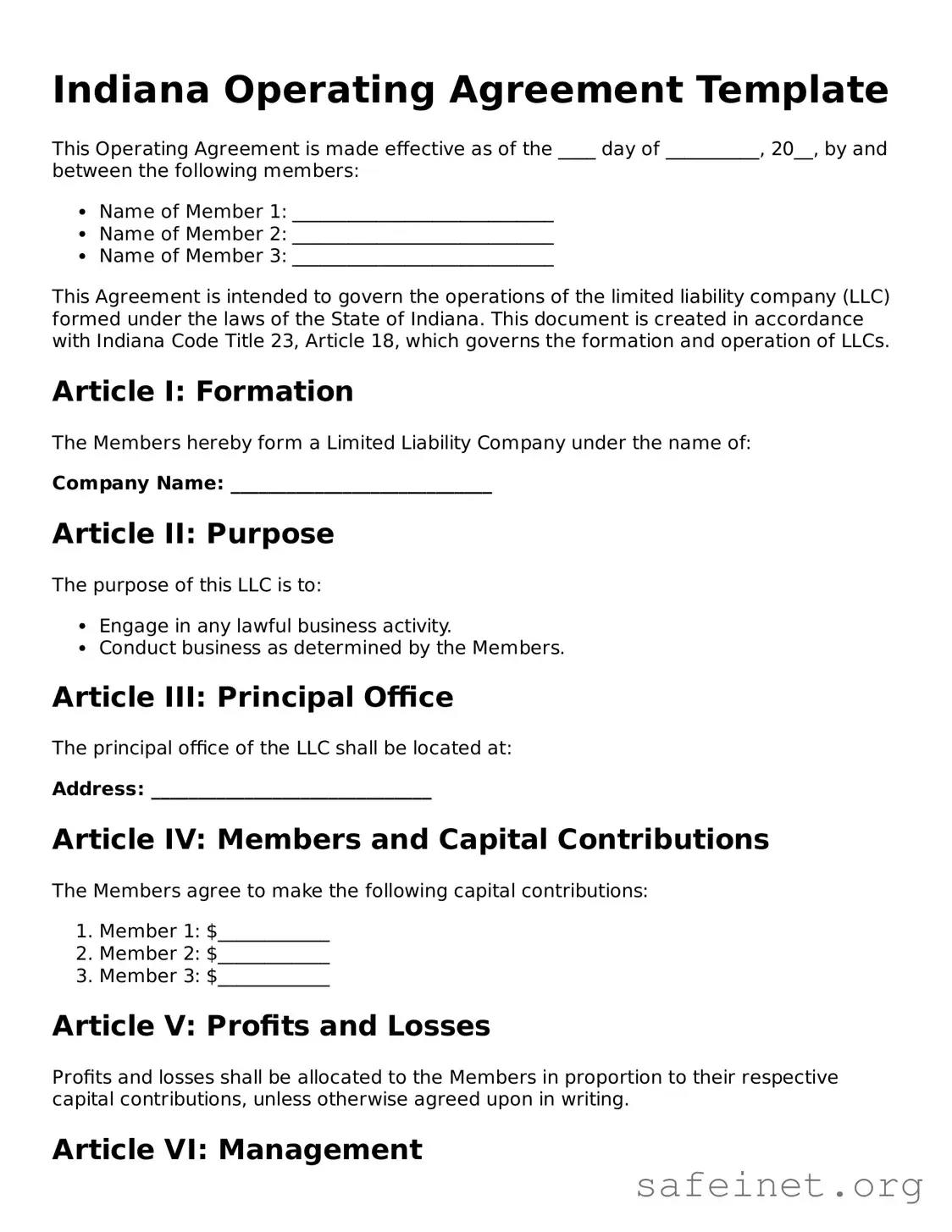
The Indiana Operating Agreement form serves as a crucial document for businesses operating as limited liability companies (LLCs) in the state of Indiana. This agreement outlines the internal management structure and operational guidelines of the LLC, ensuring that all members understand their rights, responsibilities, and the procedures for decision-making. It typically includes provisions related to ownership interests, profit distribution, and the roles of members and managers. Additionally, the form addresses the process for adding or removing members, handling disputes, and outlining the procedures for dissolution of the LLC. By establishing clear expectations and guidelines, the Operating Agreement helps to prevent misunderstandings and conflicts among members, promoting a smoother business operation. Having this form in place is not just a best practice; it is essential for legal protection and business clarity.
Indiana Operating Agreement Template
This Operating Agreement is made effective as of the ____ day of __________, 20__, by and between the following members:
This Agreement is intended to govern the operations of the limited liability company (LLC) formed under the laws of the State of Indiana. This document is created in accordance with Indiana Code Title 23, Article 18, which governs the formation and operation of LLCs.
Article I: Formation
The Members hereby form a Limited Liability Company under the name of:
Company Name: ____________________________
Article II: Purpose
The purpose of this LLC is to:
Article III: Principal Office
The principal office of the LLC shall be located at:
Address: ______________________________
Article IV: Members and Capital Contributions
The Members agree to make the following capital contributions:
Article V: Profits and Losses
Profits and losses shall be allocated to the Members in proportion to their respective capital contributions, unless otherwise agreed upon in writing.
Article VI: Management
The management of the LLC shall be vested in:
Article VII: Meetings
Regular meetings of the Members shall be held at least once a year. Special meetings may be called by any Member upon written notice to the other Members.
Article VIII: Amendments
This Operating Agreement may be amended only by a written agreement signed by all Members.
Article IX: Governing Law
This Agreement shall be governed by and construed in accordance with the laws of the State of Indiana.
IN WITNESS WHEREOF, the Members have executed this Operating Agreement as of the date first above written.
__________________________ (Member 1 Signature)
__________________________ (Member 2 Signature)
__________________________ (Member 3 Signature)
| Fact Name | Description |
|---|---|
| Purpose | The Indiana Operating Agreement outlines the management structure and operational procedures for a limited liability company (LLC) in Indiana. |
| Governing Law | This form is governed by the Indiana Code Title 23, Article 18, which covers the Indiana Limited Liability Company Act. |
| Flexibility | LLCs in Indiana can customize their Operating Agreement to meet their specific needs, as long as it complies with state law. |
| Importance | Having an Operating Agreement is crucial for establishing clear roles and responsibilities among members, which can help prevent disputes. |
After obtaining the Indiana Operating Agreement form, the next steps involve providing specific information about your business and its members. This process ensures that all parties understand their roles and responsibilities. Follow the steps below to complete the form accurately.
What is an Indiana Operating Agreement?
An Indiana Operating Agreement is a legal document that outlines the management structure and operating procedures of a limited liability company (LLC) in Indiana. This agreement is essential for defining the roles and responsibilities of members, how profits and losses are distributed, and the processes for making decisions. While Indiana does not require LLCs to have an Operating Agreement, having one can help prevent misunderstandings and disputes among members in the future.
Why is an Operating Agreement important for my LLC?
An Operating Agreement is crucial for several reasons. First, it helps establish clear guidelines for the operation of the LLC, which can protect the interests of all members. Second, it provides a framework for resolving disputes, should they arise. Additionally, an Operating Agreement can enhance your LLC's credibility with banks and investors, as it demonstrates a formal structure and professionalism. Lastly, having this document can help maintain the limited liability status of the LLC, which protects members' personal assets from business debts.
What should be included in an Indiana Operating Agreement?
When drafting an Indiana Operating Agreement, several key elements should be included. Start with the basic information about the LLC, such as its name, principal address, and purpose. Next, outline the ownership structure, detailing each member's contributions and percentage of ownership. Include provisions for management, specifying whether the LLC will be member-managed or manager-managed. Additionally, address how profits and losses will be allocated, the process for adding or removing members, and how disputes will be resolved. Finally, consider including terms for amending the agreement in the future.
How can I create an Operating Agreement for my Indiana LLC?
Creating an Operating Agreement for your Indiana LLC can be done in a few simple steps. First, gather all members to discuss and agree on the terms that will be included in the document. It's helpful to use a template or sample agreement as a starting point. After drafting the agreement, review it thoroughly to ensure all important aspects are covered and that all members are in agreement. Once finalized, have all members sign the document. While it is not required to file the Operating Agreement with the state, keeping it in your records is essential for your LLC's operation and legal protection.
Not Including Member Information: One common mistake is failing to list all members of the LLC. Every member's name and address should be clearly stated to avoid future disputes.
Omitting Capital Contributions: Members often forget to specify their initial capital contributions. Clearly outlining each member’s investment helps in establishing ownership percentages.
Ignoring Profit and Loss Distribution: Some people neglect to detail how profits and losses will be shared among members. It’s crucial to define this to prevent misunderstandings later on.
Not Defining Member Roles: Failing to specify the roles and responsibilities of each member can lead to confusion. Clearly defined roles help in smooth operations and decision-making.
Inadequate Voting Procedures: Many overlook the importance of establishing voting procedures. Define how decisions will be made, including what constitutes a quorum.
Forgetting to Include a Buy-Sell Agreement: A buy-sell agreement is essential for outlining what happens if a member wants to leave the LLC. Not including this can complicate future transitions.
Neglecting Amendment Procedures: Some people do not include how amendments to the Operating Agreement can be made. Establishing a clear process for changes is important for future flexibility.
Not Addressing Dispute Resolution: Failing to outline how disputes will be resolved can lead to prolonged conflicts. Consider including mediation or arbitration procedures.
Using Vague Language: Ambiguities in language can lead to misinterpretation. It’s best to be clear and precise in every section of the agreement.
Neglecting to Sign and Date: Finally, not signing and dating the agreement is a critical error. Without signatures, the document may not hold up in legal situations.
When establishing a business entity in Indiana, particularly a limited liability company (LLC), various forms and documents complement the Indiana Operating Agreement. Each of these documents serves a specific purpose and contributes to the overall structure and governance of the LLC. Understanding these documents can help ensure that your business operates smoothly and in compliance with state regulations.
Each of these documents plays a vital role in the formation and operation of an LLC in Indiana. By ensuring that all necessary paperwork is completed and maintained, members can foster a transparent and well-organized business environment. This proactive approach can lead to better communication and a stronger foundation for the company’s success.
The Indiana Operating Agreement is similar to the Partnership Agreement, which outlines the terms and conditions under which partners operate a business together. Both documents serve to clarify the roles, responsibilities, and rights of each party involved. While an Operating Agreement is specific to limited liability companies (LLCs), a Partnership Agreement focuses on partnerships. Each agreement aims to prevent misunderstandings and disputes by providing a clear framework for decision-making, profit-sharing, and conflict resolution. In essence, both documents are essential for establishing a solid foundation for business relationships.
Another document akin to the Indiana Operating Agreement is the Bylaws of a corporation. Bylaws govern the internal management of a corporation, detailing the rules for conducting business, including the roles of directors and officers, meeting protocols, and voting procedures. Similar to an Operating Agreement, Bylaws help maintain order and structure within the organization. They ensure that all members understand their duties and the processes for making decisions, thereby fostering a collaborative environment for growth and success.
The Shareholders' Agreement also shares similarities with the Indiana Operating Agreement. This document is designed for corporations and outlines the rights and obligations of shareholders. Like an Operating Agreement, it addresses issues such as the transfer of shares, voting rights, and the management of the company. Both agreements aim to protect the interests of the parties involved and provide a framework for resolving disputes, ensuring that all stakeholders are on the same page regarding the direction of the business.
The Joint Venture Agreement is another document that parallels the Indiana Operating Agreement. This agreement is created when two or more parties collaborate on a specific project or business endeavor. It delineates each party's contributions, responsibilities, and profit-sharing arrangements. Much like an Operating Agreement, a Joint Venture Agreement is vital for defining the partnership's structure and expectations, helping to mitigate potential conflicts and misunderstandings during the collaboration.
Lastly, the Non-Disclosure Agreement (NDA) can be seen as similar in its protective nature. While it serves a different purpose, an NDA safeguards sensitive information shared between parties, much like an Operating Agreement protects the interests of LLC members. Both documents aim to foster trust and clarity in business relationships. By ensuring confidentiality and outlining the expectations for information sharing, NDAs and Operating Agreements work together to create a secure environment for business operations.
When filling out the Indiana Operating Agreement form, there are several important considerations to keep in mind. Here are seven things you should and shouldn't do:
Understanding the Indiana Operating Agreement form is crucial for anyone involved in a limited liability company (LLC). However, several misconceptions can lead to confusion. Below is a list of common misunderstandings surrounding this important document.
By addressing these misconceptions, individuals can better understand the importance of the Indiana Operating Agreement and its role in the successful operation of an LLC.
When filling out and using the Indiana Operating Agreement form, consider the following key takeaways:
These steps will help ensure that your Operating Agreement is comprehensive and effective in guiding your business operations.