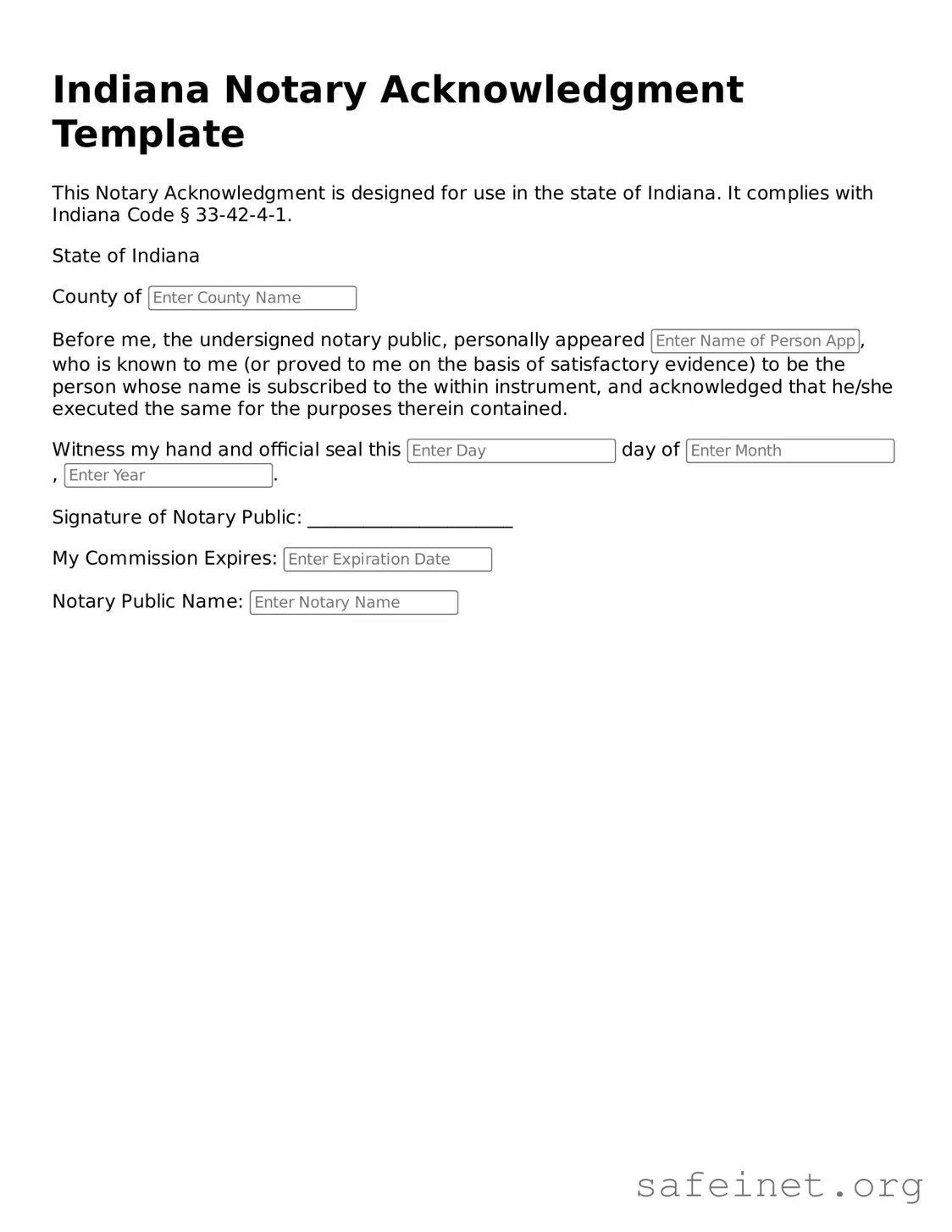
The Indiana Notary Acknowledgment form plays a crucial role in various legal and business transactions. This form serves as proof that a document has been signed in the presence of a notary public, ensuring the authenticity of the signature and the identity of the signer. It includes essential details such as the name of the signer, the date of the acknowledgment, and the notary's official seal. The form also requires the notary to confirm that the signer willingly signed the document. By using this form, individuals and businesses can enhance the credibility of their documents, making them more acceptable in legal settings. Understanding how to properly complete and use the Indiana Notary Acknowledgment form is important for anyone involved in the signing of legal documents in the state.
Indiana Notary Acknowledgment Template
This Notary Acknowledgment is designed for use in the state of Indiana. It complies with Indiana Code § 33-42-4-1.
State of Indiana
County of
Before me, the undersigned notary public, personally appeared , who is known to me (or proved to me on the basis of satisfactory evidence) to be the person whose name is subscribed to the within instrument, and acknowledged that he/she executed the same for the purposes therein contained.
Witness my hand and official seal this day of , .
Signature of Notary Public: ______________________
My Commission Expires:
Notary Public Name:
| Fact Name | Details |
|---|---|
| Purpose | The Indiana Notary Acknowledgement form is used to verify the identity of the signer and confirm that they signed the document voluntarily. |
| Governing Law | This form is governed by Indiana Code § 33-42-4-1, which outlines the requirements for notarial acts in the state. |
| Signature Requirement | The signer must personally appear before the notary public to sign the document in their presence. |
| Notary's Role | The notary public must complete the form by providing their signature, seal, and the date of the acknowledgment. |
| Record Keeping | Notaries are required to keep a record of all notarial acts, including the use of the acknowledgement form. |
After obtaining the Indiana Notary Acknowledgement form, you are ready to proceed with filling it out. This form is essential for confirming the identity of the signer and the voluntary nature of their signature. Follow these steps carefully to ensure the form is completed correctly.
Once you have completed these steps, the form will be ready for use. Ensure that all information is accurate and legible, as this will help prevent any issues in the future.
What is the purpose of the Indiana Notary Acknowledgement form?
The Indiana Notary Acknowledgement form serves to verify that a signer has willingly signed a document in the presence of a notary public. This form provides legal assurance that the individual’s identity was confirmed and that they understood the contents of the document being signed. It is commonly used in various legal and financial transactions to ensure authenticity and prevent fraud.
Who can serve as a notary public in Indiana?
In Indiana, any individual who is at least 18 years old, a resident of the state, and has not been convicted of a felony can apply to become a notary public. Applicants must complete a training course and pass an examination to ensure they understand their responsibilities. Once approved, notaries must adhere to state laws and regulations governing their duties.
What information is required on the Notary Acknowledgement form?
The Notary Acknowledgement form typically requires the following information: the name of the signer, the date of the acknowledgment, the type of document being signed, and the notary's signature and seal. Additionally, it may include the notary's commission number and the expiration date of their commission. Accurate and complete information is crucial for the form to be valid.
Is the Notary Acknowledgement form mandatory for all documents?
No, the Notary Acknowledgement form is not required for all documents. It is specifically necessary for documents that require notarization, such as deeds, contracts, and certain legal filings. However, it is advisable to use this form whenever notarization is involved, as it enhances the document's credibility and can help prevent disputes regarding authenticity.
How should the Notary Acknowledgement form be completed?
To complete the Notary Acknowledgement form, the signer must appear before the notary and provide valid identification. The notary will then fill out the form, including the details of the signing event. The notary must ensure that the signer understands the document before signing. After completion, the notary will sign and affix their seal to the form, finalizing the acknowledgment.
What are the consequences of improperly completing the Notary Acknowledgement form?
Improperly completing the Notary Acknowledgement form can lead to serious consequences. If the form is incomplete or contains inaccuracies, it may render the notarized document invalid. This could result in legal disputes, financial losses, or challenges in court. Notaries who fail to follow proper procedures may also face disciplinary action, including revocation of their notary commission.
Incorrect Date: Many individuals forget to enter the correct date of the acknowledgment. This can lead to confusion and potential issues with the validity of the document.
Missing Signatures: Failing to obtain the necessary signatures from the parties involved can invalidate the acknowledgment. Ensure all required individuals have signed.
Inaccurate Names: Spelling errors in the names of the signers can cause complications. Double-check that names match official identification.
Improper Notary Seal: Some notaries forget to affix their seal or use an outdated seal. The seal must be clear and legible to ensure proper authentication.
Not Including the Notary’s Information: Omitting the notary’s printed name or commission number can lead to questions about the validity of the acknowledgment.
Failure to Identify the Document: The acknowledgment form should reference the specific document being notarized. Without this, the purpose of the acknowledgment may be unclear.
Not Following State Guidelines: Each state has specific requirements for notary acknowledgments. Ignoring Indiana’s guidelines can result in a rejected form.
Using an Outdated Form: Some individuals may use an old version of the acknowledgment form. Always ensure you have the most current version to avoid issues.
Not Keeping Records: Failing to maintain a record of the acknowledgment can create problems if verification is needed later. Notaries should keep a log of their activities.
When dealing with legal documents in Indiana, the Notary Acknowledgement form is just one piece of the puzzle. Various other forms and documents are often used alongside it to ensure that transactions and agreements are properly executed and verified. Here are five common documents that may accompany the Notary Acknowledgement form.
These documents play crucial roles in legal proceedings and transactions. Understanding their purpose can help individuals navigate the complexities of legal requirements more effectively.
The Indiana Notary Acknowledgment form is similar to the Jurat form. Both documents require the presence of a notary public, who verifies the identity of the signer. In a Jurat, the signer swears or affirms that the contents of the document are true. This is different from an acknowledgment, where the signer simply confirms their identity and willingness to sign without affirming the truth of the document's content.
Another similar document is the Affidavit. An affidavit is a written statement confirmed by oath or affirmation. Like the acknowledgment, it requires a notary to verify the identity of the person making the statement. However, an affidavit typically contains factual assertions that the affiant swears to be true, while an acknowledgment does not require such assertions.
The Power of Attorney form also shares similarities with the Notary Acknowledgment. Both documents often require notarization to be valid. A Power of Attorney grants one person the authority to act on behalf of another, and the notary's role is to ensure that the principal understands the implications of granting such authority. The acknowledgment, in contrast, focuses solely on confirming the identity of the signer without transferring authority.
The Deed form is another document that often requires a notary. Similar to the acknowledgment, a notary verifies the identity of the parties involved in the transaction. A deed transfers ownership of property, and the notary's role is crucial in ensuring that the transaction is legitimate and that the parties are who they claim to be.
The Mortgage document also requires notarization, akin to the Indiana Notary Acknowledgment. The notary verifies the identity of the borrower and ensures that they understand the terms of the mortgage. While the acknowledgment simply confirms the signing, the mortgage involves a financial agreement that binds the borrower to specific obligations.
Another related document is the Certification of Trust. This document provides information about a trust and its terms. Notarization is often required to authenticate the signatures of the trustees. Like the acknowledgment, the notary's role is to confirm the identity of the signers, ensuring that the document is executed correctly and legally.
Lastly, the Last Will and Testament can also be similar in that it may require notarization. The notary's function is to confirm the identity of the testator and ensure that they are signing the will voluntarily. While the acknowledgment focuses on the act of signing, the will outlines the testator's wishes regarding the distribution of their assets after death.
When filling out the Indiana Notary Acknowledgement form, it is important to follow certain guidelines to ensure the form is completed correctly. Here’s a list of things to do and avoid:
When it comes to the Indiana Notary Acknowledgement form, there are several misconceptions that can lead to confusion. Understanding these can help ensure that the notary process is carried out correctly and efficiently.
While it is beneficial for a notary to be familiar with the signer, it is not a requirement. What matters most is that the notary can verify the identity of the signer through valid identification.
This is true for most situations. However, there are some exceptions where a notary can acknowledge a signature that was signed previously, provided that the signer is present to confirm it.
Notaries are not allowed to offer legal advice or services. Their role is strictly to verify signatures and administer oaths, not to interpret legal documents.
Each state has its own specific requirements for notary acknowledgements. Indiana has unique stipulations that must be followed, which may differ from those in other states.
While notaries have the right to refuse service, they must have a valid reason. This might include concerns about the signer's identity or the legality of the document being presented.
When it comes to using the Indiana Notary Acknowledgement form, there are several important points to keep in mind. Here are some key takeaways to ensure you navigate the process smoothly:
By keeping these takeaways in mind, you can effectively use the Indiana Notary Acknowledgement form and ensure that the process runs smoothly for everyone involved.