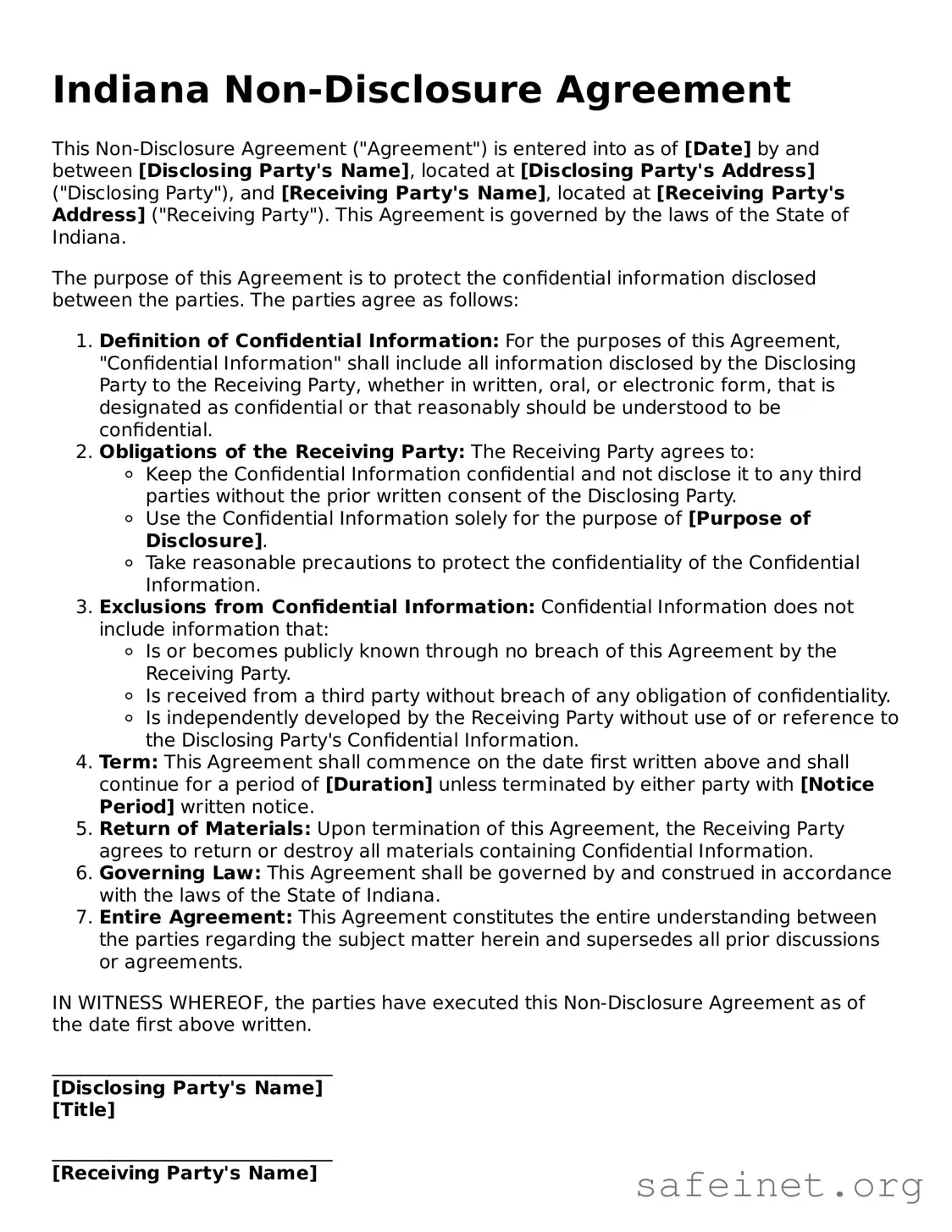
The Indiana Non-disclosure Agreement (NDA) is a crucial legal document designed to protect sensitive information shared between parties. This form is commonly utilized in various business contexts, including partnerships, employment relationships, and joint ventures. By establishing clear guidelines on confidentiality, the NDA ensures that proprietary data, trade secrets, and other confidential materials remain secure. It outlines the obligations of the parties involved, specifying what constitutes confidential information and the duration of the confidentiality obligation. Additionally, the agreement may include provisions for the consequences of unauthorized disclosures, offering a layer of security and recourse for the disclosing party. Understanding the key elements of the Indiana NDA can help individuals and businesses safeguard their interests while fostering trust and collaboration in professional relationships.
Indiana Non-Disclosure Agreement
This Non-Disclosure Agreement ("Agreement") is entered into as of [Date] by and between [Disclosing Party's Name], located at [Disclosing Party's Address] ("Disclosing Party"), and [Receiving Party's Name], located at [Receiving Party's Address] ("Receiving Party"). This Agreement is governed by the laws of the State of Indiana.
The purpose of this Agreement is to protect the confidential information disclosed between the parties. The parties agree as follows:
IN WITNESS WHEREOF, the parties have executed this Non-Disclosure Agreement as of the date first above written.
______________________________
[Disclosing Party's Name]
[Title]
______________________________
[Receiving Party's Name]
[Title]
| Fact Name | Details |
|---|---|
| Purpose | The Indiana Non-disclosure Agreement (NDA) is designed to protect confidential information shared between parties. |
| Parties Involved | The NDA typically involves at least two parties: the disclosing party and the receiving party. |
| Governing Law | The NDA is governed by Indiana state law, ensuring that any disputes are resolved under Indiana regulations. |
| Duration of Confidentiality | The agreement specifies how long the confidentiality obligations will last, which can vary based on the terms agreed upon by the parties. |
| Enforcement | If one party breaches the NDA, the other party may seek legal remedies, including injunctions and damages. |
After obtaining the Indiana Non-disclosure Agreement form, it is important to complete it accurately to ensure that all necessary information is provided. This will help facilitate the process of protecting sensitive information between parties.
What is an Indiana Non-disclosure Agreement (NDA)?
An Indiana Non-disclosure Agreement is a legal contract designed to protect confidential information shared between parties. It establishes the terms under which sensitive information can be disclosed and outlines the obligations of the parties to keep that information private.
Who typically uses an NDA in Indiana?
NDAs are commonly used by businesses, entrepreneurs, and individuals who need to share confidential information. This may include companies sharing trade secrets with employees, or businesses negotiating potential partnerships or mergers where sensitive information is exchanged.
What types of information can be protected by an NDA?
Confidential information can include trade secrets, proprietary data, business plans, financial information, customer lists, and any other sensitive materials that a party wishes to keep private. The NDA should clearly define what constitutes confidential information to avoid ambiguity.
How long does the confidentiality obligation last under an NDA?
The duration of the confidentiality obligation can vary. Typically, an NDA will specify a time frame, which can range from a few years to indefinitely. It is essential for parties to agree on a reasonable duration that aligns with the nature of the information being protected.
Can an NDA be enforced in Indiana?
Yes, NDAs can be enforced in Indiana, provided they meet legal requirements. The agreement must be clear, reasonable, and not contrary to public policy. If a party breaches the NDA, the other party may seek legal remedies, including damages or injunctive relief.
What happens if someone violates an NDA?
If a party violates the NDA, the injured party may take legal action. This can include seeking monetary damages for any losses incurred due to the breach or requesting a court order to prevent further disclosure of the confidential information.
Do I need a lawyer to create an NDA in Indiana?
While it is not legally required to have a lawyer draft an NDA, it is highly recommended. A legal professional can ensure that the agreement complies with Indiana laws and adequately protects the interests of the parties involved.
Can an NDA be terminated?
Yes, an NDA can be terminated under certain conditions. This may occur when the parties mutually agree to end the agreement or when the purpose of the NDA has been fulfilled. However, the confidentiality obligations may still survive beyond termination, depending on the terms outlined in the NDA.
Are there any exceptions to what can be kept confidential under an NDA?
Yes, there are exceptions. Information that is already public knowledge, independently developed by the receiving party, or disclosed due to legal obligations may not be subject to the confidentiality requirements of the NDA. These exceptions should be clearly stated in the agreement to avoid confusion.
Incomplete Information: Failing to fill out all required fields can lead to delays or invalid agreements. Ensure that names, addresses, and other details are fully completed.
Incorrect Dates: Using the wrong dates can create confusion about the agreement's validity. Double-check all date entries to confirm accuracy.
Not Defining Confidential Information: Vague language regarding what constitutes confidential information can lead to disputes. Clearly outline what information is protected under the agreement.
Missing Signatures: Without the necessary signatures, the agreement is not enforceable. Ensure that all parties sign the document before it is finalized.
Failure to Include Duration: Not specifying how long the confidentiality obligations last can create ambiguity. Include a clear timeframe for the agreement.
Ignoring State-Specific Requirements: Each state may have unique requirements for non-disclosure agreements. Familiarize yourself with Indiana's specific laws to avoid pitfalls.
Neglecting to Review: Skipping a final review can lead to overlooked errors. Always take the time to read through the completed form before submission.
When entering into a Non-disclosure Agreement (NDA) in Indiana, several other forms and documents may be necessary to ensure comprehensive protection of sensitive information. Each document serves a specific purpose in the context of confidentiality and business transactions. Below is a list of commonly used forms that complement the NDA.
Using these forms in conjunction with the Indiana Non-disclosure Agreement can help safeguard sensitive information and clarify the responsibilities of all parties involved. It is crucial to choose the right documents based on the specific circumstances of your situation.
The Indiana Non-disclosure Agreement (NDA) is similar to the Confidentiality Agreement, often used interchangeably. Both documents serve the primary purpose of protecting sensitive information shared between parties. A Confidentiality Agreement outlines the obligations of the parties involved to maintain secrecy regarding proprietary information. Like the NDA, it specifies what information is confidential, the duration of the confidentiality obligation, and the consequences of unauthorized disclosure. This ensures that both parties are on the same page regarding the handling of sensitive data.
Another document that resembles the Indiana NDA is the Non-compete Agreement. While a Non-disclosure Agreement focuses on protecting confidential information, a Non-compete Agreement restricts one party from engaging in business activities that compete with another party for a specified period and within a certain geographic area. Both agreements aim to safeguard business interests, but they do so in different ways. The Non-compete Agreement often includes clauses about the types of information that cannot be disclosed, making it complementary to the NDA.
The Employment Agreement also shares similarities with the Indiana NDA. When employees are hired, they often sign an Employment Agreement that includes confidentiality provisions. These provisions protect the employer's trade secrets and proprietary information during and after the employment period. Like the NDA, the confidentiality clauses in an Employment Agreement specify what information is considered confidential and outline the employee's obligations to protect that information, ensuring that sensitive company data remains secure.
A Mutual Non-disclosure Agreement is another document closely related to the Indiana NDA. This type of agreement is used when both parties intend to share confidential information with each other. Similar to the Indiana NDA, it lays out the terms of confidentiality, but it does so in a way that protects both parties equally. Each party agrees to keep the other’s information confidential, creating a balanced approach to information sharing. This document is particularly useful in negotiations where both sides have valuable insights to protect.
The Proprietary Information Agreement (PIA) is also akin to the Indiana NDA. This document specifically focuses on the protection of proprietary information, which can include trade secrets, business plans, and other sensitive data. A PIA outlines the obligations of the receiving party to keep the information confidential and often includes terms about how the information can be used. While the NDA may cover a broader range of confidential information, the PIA is more focused on proprietary aspects, making it a specialized form of confidentiality agreement.
Lastly, the Licensing Agreement can bear similarities to the Indiana NDA in certain contexts. When a business licenses its intellectual property to another entity, it often includes confidentiality provisions to protect sensitive information shared during the licensing process. These provisions are similar to those found in an NDA, as they outline what information must remain confidential and the obligations of both parties regarding that information. The Licensing Agreement ensures that proprietary information is safeguarded while allowing for the use of the licensed material.
When filling out the Indiana Non-disclosure Agreement form, it's important to approach the task carefully. Here are some key dos and don'ts to keep in mind:
By following these guidelines, you can help ensure that your Non-disclosure Agreement is filled out correctly and effectively protects your interests.
Non-disclosure agreements (NDAs) are essential tools for protecting sensitive information, but several misconceptions can lead to confusion. Here are six common misunderstandings about the Indiana Non-disclosure Agreement form:
Understanding these misconceptions can help individuals and businesses make informed decisions about using non-disclosure agreements effectively. By recognizing the nuances of NDAs, parties can better protect their sensitive information and foster trust in their professional relationships.
When dealing with sensitive information in Indiana, a Non-disclosure Agreement (NDA) is a crucial tool for protecting confidential data. Here are some key takeaways to consider when filling out and utilizing the Indiana Non-disclosure Agreement form:
By keeping these points in mind, parties can create a robust Non-disclosure Agreement that effectively protects their interests while fostering trust and collaboration.