In the competitive landscape of Indiana's job market, businesses often seek to protect their interests through non-compete agreements. These legal documents serve to restrict employees from engaging in similar work with competitors for a specified period after leaving a company. The Indiana Non-compete Agreement form outlines key elements such as the duration of the restriction, the geographical area it covers, and the specific activities that are prohibited. By clearly defining these parameters, the form aims to balance the employer's need for protection with the employee's right to seek new opportunities. Understanding this agreement is crucial for both employers looking to safeguard their trade secrets and employees who want to navigate their career paths without unnecessary hindrances. As you delve deeper into the nuances of the Indiana Non-compete Agreement, you'll discover how it shapes the employment landscape while ensuring fair play for all parties involved.
Indiana Non-Compete Agreement Template
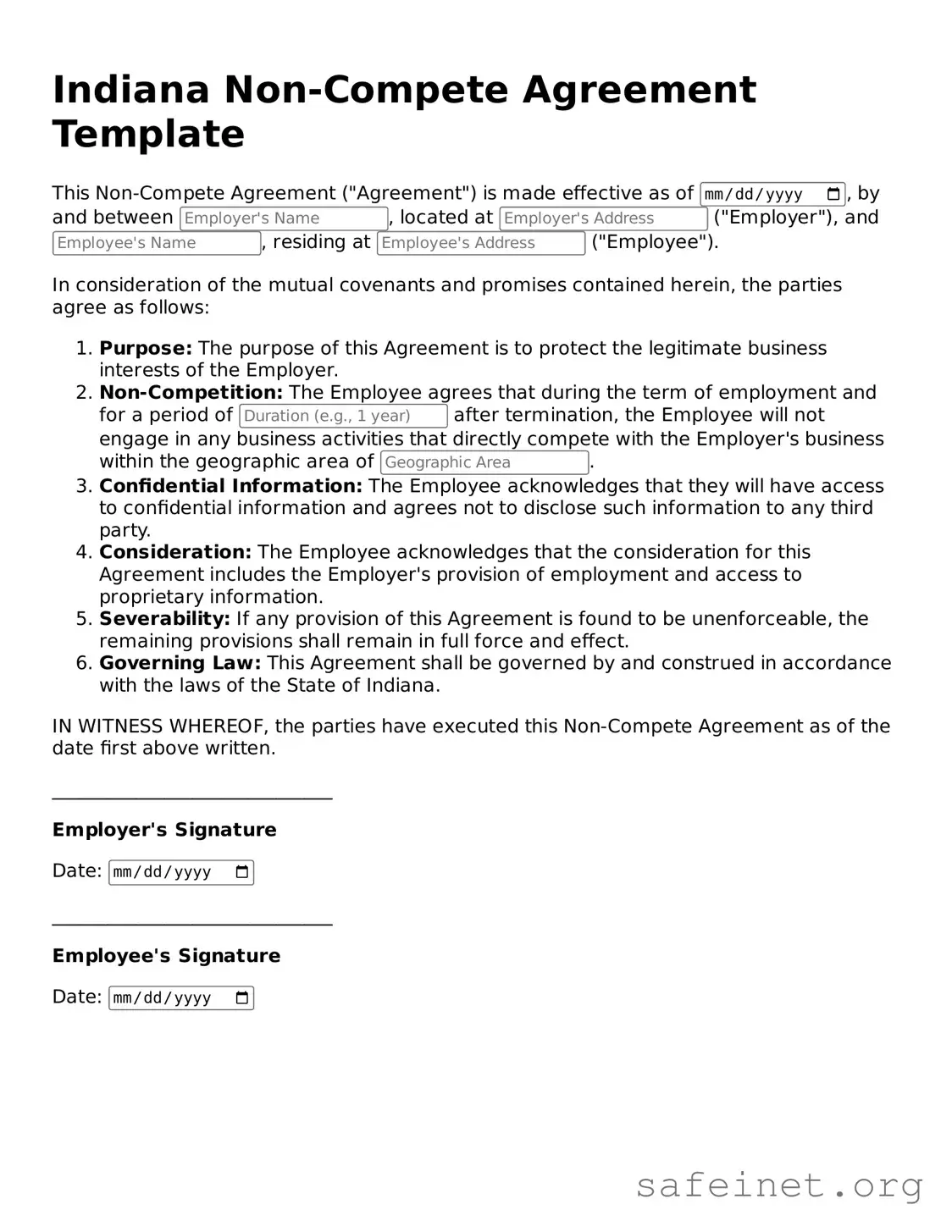
This Non-Compete Agreement ("Agreement") is made effective as of , by and between , located at ("Employer"), and , residing at ("Employee").
In consideration of the mutual covenants and promises contained herein, the parties agree as follows:
IN WITNESS WHEREOF, the parties have executed this Non-Compete Agreement as of the date first above written.
______________________________
Employer's Signature
Date:
______________________________
Employee's Signature
Date:
| Fact Name | Description |
|---|---|
| Definition | An Indiana Non-compete Agreement restricts an employee from working for competitors after leaving a job. |
| Governing Law | The agreement is governed by Indiana Code Title 24, Article 2, Chapter 8. |
| Duration | Typically, non-compete clauses last for a specified period, often between six months to two years. |
| Geographic Scope | The agreement must clearly define the geographic area where the restrictions apply. |
| Reasonableness | Indiana courts assess the reasonableness of non-compete agreements based on duration, geographic scope, and the interests of the employer. |
| Consideration | For a non-compete to be enforceable, the employee must receive something of value, such as a job offer or training. |
| Enforceability | Not all non-compete agreements are enforceable; courts may void overly broad or unfair clauses. |
| Exceptions | Some professions, like physicians and attorneys, may have specific regulations that impact non-compete agreements. |
| Employee Rights | Employees can negotiate terms before signing, and they should seek legal advice if unsure about the implications. |
Filling out the Indiana Non-compete Agreement form is a straightforward process that requires careful attention to detail. Once completed, the form will need to be reviewed and signed by both parties involved, ensuring that all terms are clearly understood and agreed upon.
What is a Non-compete Agreement in Indiana?
A Non-compete Agreement is a legal contract between an employer and an employee. It restricts the employee from engaging in certain activities that compete with the employer's business after leaving the job. In Indiana, these agreements must be reasonable in scope and duration to be enforceable.
What are the key elements of a valid Non-compete Agreement in Indiana?
To be considered valid, a Non-compete Agreement in Indiana typically must include a legitimate business interest, reasonable geographic limitations, and a defined duration of the restriction. The agreement should not impose undue hardship on the employee or be contrary to public policy.
How long can a Non-compete Agreement last in Indiana?
The duration of a Non-compete Agreement in Indiana varies based on the nature of the business and the role of the employee. Generally, agreements lasting one to two years are more likely to be upheld, while longer durations may face scrutiny regarding their reasonableness.
Are there specific industries in Indiana where Non-compete Agreements are more common?
Yes, Non-compete Agreements are particularly prevalent in industries such as technology, healthcare, and professional services. Employers in these fields often seek to protect proprietary information and client relationships, making these agreements more common.
Can an employee negotiate a Non-compete Agreement?
Employees can negotiate the terms of a Non-compete Agreement. It is advisable for employees to seek modifications that make the agreement more reasonable, such as reducing the duration or geographic scope. Open communication with the employer can lead to a more favorable outcome for both parties.
What happens if an employee violates a Non-compete Agreement?
If an employee violates a Non-compete Agreement, the employer may take legal action. This could include seeking an injunction to prevent the employee from continuing the competing activity or pursuing damages for any losses incurred due to the breach.
Is it possible to enforce a Non-compete Agreement in Indiana?
Enforcement of a Non-compete Agreement in Indiana is possible, but it depends on the agreement's reasonableness. Courts will evaluate the agreement based on its terms and the context in which it was created. An overly broad or harsh agreement may not be enforced.
Can Non-compete Agreements be modified or terminated?
Yes, Non-compete Agreements can be modified or terminated by mutual consent of both parties. It is essential to document any changes in writing to ensure clarity and avoid future disputes. Consulting legal counsel is advisable when considering modifications.
What should an employee do if they believe their Non-compete Agreement is unfair?
If an employee believes their Non-compete Agreement is unfair, they should first review the terms carefully. Consulting with a legal professional can provide clarity on the agreement's enforceability and options for negotiation or challenge. Understanding one's rights is crucial in these situations.
Not Understanding the Terms: Many individuals rush through the agreement without fully grasping what they are signing. This can lead to confusion about restrictions on future employment.
Incorrectly Identifying the Parties: It's crucial to clearly state the names of both the employer and the employee. Errors in this section can render the agreement invalid.
Omitting Key Details: Essential information, such as the duration of the non-compete and the geographical area it covers, is sometimes left out. This can lead to disputes later on.
Failing to Seek Legal Advice: Some people skip consulting a lawyer before signing. This can result in agreeing to terms that may not be in their best interest.
Not Considering State Laws: Indiana has specific laws regarding non-compete agreements. Ignoring these can lead to unenforceable agreements.
Signing Under Pressure: Individuals sometimes feel rushed to sign the agreement without taking the time to review it thoroughly. This can lead to regrettable decisions.
In the context of employment agreements, the Indiana Non-compete Agreement is often accompanied by several other forms and documents. These additional documents serve to clarify the terms of employment, protect the interests of both parties, and ensure compliance with state laws. Below is a list of commonly used documents that accompany a non-compete agreement in Indiana.
Each of these documents plays a vital role in establishing a clear understanding between employers and employees regarding their rights and obligations. By utilizing these forms, both parties can minimize misunderstandings and protect their respective interests in a competitive business environment.
A Non-disclosure Agreement (NDA) is similar to a Non-compete Agreement in that both documents aim to protect sensitive information. An NDA typically prevents employees from sharing proprietary information or trade secrets with outside parties. While a Non-compete Agreement restricts an employee's ability to work for competitors after leaving a job, an NDA focuses on keeping confidential information secure during and after employment. Both agreements help maintain a company's competitive edge and safeguard its interests.
A Non-solicitation Agreement is another document that shares similarities with a Non-compete Agreement. This type of agreement prevents former employees from soliciting clients or customers of their previous employer for a specified period. While a Non-compete Agreement restricts an employee's ability to work in a competing business, a Non-solicitation Agreement specifically targets the relationships that the employee developed during their time with the company. Both serve to protect business interests and client relationships.
An Employment Agreement often includes elements that overlap with a Non-compete Agreement. This document outlines the terms of employment, including job responsibilities, salary, and benefits. Sometimes, it also includes clauses that restrict employees from competing with the employer after leaving. While the primary purpose of an Employment Agreement is to establish the employment relationship, the inclusion of non-compete clauses helps to safeguard the employer's business interests and prevent potential conflicts of interest.
A Confidentiality Agreement can be likened to a Non-compete Agreement in its focus on protecting a business's sensitive information. This type of agreement ensures that employees do not disclose confidential information they may encounter during their employment. While a Non-compete Agreement restricts future employment opportunities in similar industries, a Confidentiality Agreement centers on the obligation to keep specific information private. Both documents are essential for maintaining a company's proprietary information and competitive advantage.
A Proprietary Information Agreement is also similar to a Non-compete Agreement, as it aims to protect a company's unique assets. This document specifically outlines what constitutes proprietary information and the obligations of employees to keep that information confidential. While a Non-compete Agreement restricts where an employee can work after leaving, a Proprietary Information Agreement focuses on the information itself and how it should be handled. Both agreements are vital tools for businesses to secure their intellectual property and maintain their market position.
When filling out the Indiana Non-compete Agreement form, it’s essential to approach the task with care. Here are some important do's and don'ts to keep in mind:
Many individuals and businesses in Indiana have misconceptions about the Non-compete Agreement form. Understanding these misconceptions can help parties navigate their agreements more effectively. Here are six common misunderstandings:
This is not true. While Indiana allows non-compete agreements, they must meet specific criteria to be enforceable. They should be reasonable in scope, duration, and geographic area.
Indiana courts typically do not uphold non-compete agreements that last for an unreasonable amount of time. A duration of one to two years is often considered acceptable.
This is a misconception. A properly drafted non-compete agreement may only restrict employment in specific areas or with particular companies, not a complete ban on working in the industry.
While they are common among executives and key employees, non-compete agreements can also be used for lower-level employees, particularly if they have access to sensitive information.
These two agreements serve different purposes. A non-compete agreement restricts where and how an employee can work after leaving a job, while a non-disclosure agreement protects confidential information.
This is incorrect. Employees can and should negotiate the terms of a non-compete agreement before signing. Changes can make the agreement more reasonable and fair.
When filling out and using the Indiana Non-compete Agreement form, consider the following key takeaways: