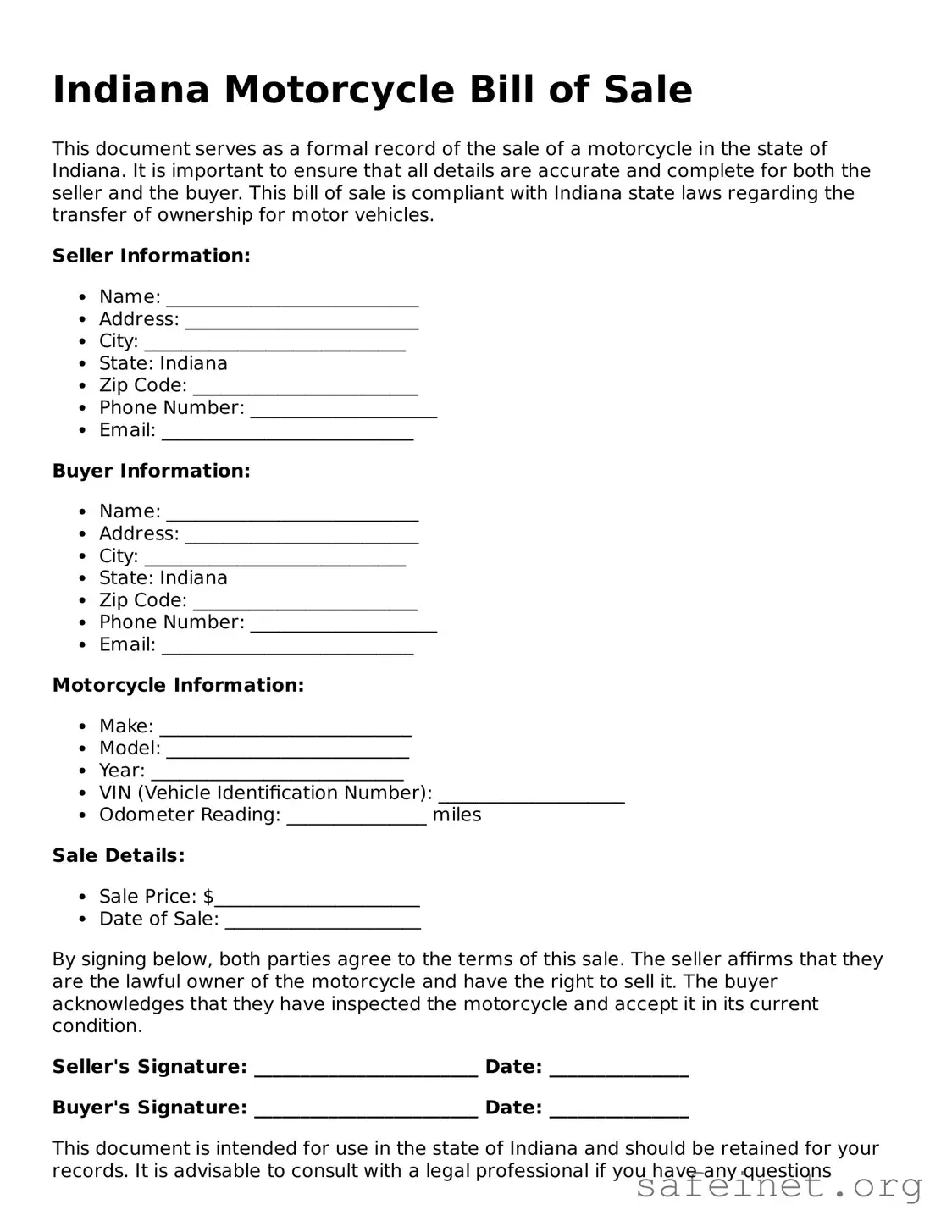
When buying or selling a motorcycle in Indiana, having a Motorcycle Bill of Sale form is essential. This document serves as proof of the transaction and outlines key details about the motorcycle and the parties involved. It typically includes the names and addresses of both the buyer and seller, the motorcycle's make, model, year, and Vehicle Identification Number (VIN). Additionally, the form should specify the sale price and any conditions of the sale, such as whether the motorcycle is sold "as is." Completing this form not only protects both parties but also helps facilitate the title transfer process with the Indiana Bureau of Motor Vehicles. Understanding the importance of this document can make your motorcycle transaction smoother and legally sound.
Indiana Motorcycle Bill of Sale
This document serves as a formal record of the sale of a motorcycle in the state of Indiana. It is important to ensure that all details are accurate and complete for both the seller and the buyer. This bill of sale is compliant with Indiana state laws regarding the transfer of ownership for motor vehicles.
Seller Information:
Buyer Information:
Motorcycle Information:
Sale Details:
By signing below, both parties agree to the terms of this sale. The seller affirms that they are the lawful owner of the motorcycle and have the right to sell it. The buyer acknowledges that they have inspected the motorcycle and accept it in its current condition.
Seller's Signature: ________________________ Date: _______________
Buyer's Signature: ________________________ Date: _______________
This document is intended for use in the state of Indiana and should be retained for your records. It is advisable to consult with a legal professional if you have any questions regarding the sale or transfer of ownership.
| Fact Name | Description |
|---|---|
| Purpose | The Indiana Motorcycle Bill of Sale serves as a legal document to transfer ownership of a motorcycle from one party to another. |
| Governing Law | The transfer of motorcycle ownership in Indiana is governed by Indiana Code Title 9, Article 13. |
| Required Information | The form must include the buyer's and seller's names, addresses, and signatures, as well as the motorcycle's make, model, year, and VIN. |
| Notarization | While notarization is not required, it is recommended to add an extra layer of verification to the transaction. |
| Sales Tax | Sales tax may apply to the transaction, and buyers should be aware of their responsibility to pay it when registering the motorcycle. |
| Record Keeping | Both the buyer and seller should keep a copy of the Bill of Sale for their records, as it may be needed for future reference. |
| As-Is Condition | The Bill of Sale can include a statement indicating that the motorcycle is sold "as-is," meaning no warranties are provided by the seller. |
| Age Requirement | Both parties involved in the sale must be at least 18 years old to enter into a legally binding agreement. |
| Transfer Process | After completing the Bill of Sale, the buyer must present it to the Indiana Bureau of Motor Vehicles (BMV) to register the motorcycle. |
| Template Availability | Templates for the Indiana Motorcycle Bill of Sale can be found online, but it is important to ensure they meet state requirements. |
Once you have the Indiana Motorcycle Bill of Sale form in hand, you are ready to complete it. This document will serve as a record of the sale, ensuring both parties have a clear understanding of the transaction details. Follow the steps below to fill out the form accurately.
After completing the form, retain a copy for your records. The buyer should also keep a copy as proof of purchase. This documentation will be essential for future registration or title transfer processes.
What is the purpose of the Indiana Motorcycle Bill of Sale form?
The Indiana Motorcycle Bill of Sale form serves as a legal document that records the sale and transfer of ownership of a motorcycle from one party to another. This document includes essential details such as the names and addresses of both the buyer and seller, the motorcycle's make, model, year, and Vehicle Identification Number (VIN). Having a Bill of Sale is important for both parties, as it provides proof of the transaction and can be used for registration purposes with the Indiana Bureau of Motor Vehicles (BMV).
Is the Indiana Motorcycle Bill of Sale form required for all motorcycle transactions?
What information should be included in the Indiana Motorcycle Bill of Sale?
The form should include several key pieces of information to ensure clarity and legality. This includes the full names and addresses of both the buyer and seller, the date of the transaction, and a detailed description of the motorcycle. Essential details such as the make, model, year, color, and VIN are crucial. Furthermore, the sale price should be stated clearly, and both parties should sign the document to validate the agreement.
Can I create my own Bill of Sale for my motorcycle in Indiana?
Yes, you can create your own Bill of Sale as long as it contains all the necessary information outlined above. However, using a standardized form can help ensure that you do not overlook any important details. Many templates are available online that can be customized to fit your specific transaction. Just make sure that the final document is clear, complete, and signed by both parties to avoid any potential issues.
What should I do after completing the Indiana Motorcycle Bill of Sale?
Once the Bill of Sale is completed and signed, both the buyer and seller should keep a copy for their records. The seller should provide the buyer with the original document, as it may be required for motorcycle registration. The buyer should then take the Bill of Sale to the Indiana BMV along with any other required documents to complete the registration process. Keeping a copy of the Bill of Sale is also a good practice in case any questions arise in the future regarding the transaction.
Failing to include the date of the sale. This is crucial for establishing the timeline of ownership.
Not providing the full names of both the buyer and seller. Incomplete names can lead to confusion and potential disputes.
Leaving out the vehicle identification number (VIN). This unique identifier is essential for accurately documenting the motorcycle.
Not specifying the purchase price. This detail is important for both parties and may be necessary for tax purposes.
Failing to sign the document. Both the buyer and seller must provide their signatures to validate the transaction.
Neglecting to include the address of both parties. This information helps in verifying identities and can be important for future correspondence.
Using incorrect or inconsistent motorcycle details. Ensure that the make, model, and year match the motorcycle being sold.
Not keeping a copy of the bill of sale. Both parties should retain a copy for their records, as it serves as proof of the transaction.
Overlooking the disclosure of any liens on the motorcycle. Full transparency is necessary to avoid legal issues later on.
Failing to check for additional requirements specific to Indiana. Different counties may have unique regulations that need to be followed.
When buying or selling a motorcycle in Indiana, several forms and documents are often used alongside the Motorcycle Bill of Sale. These documents help ensure a smooth transaction and provide necessary information for both parties involved. Below is a list of commonly used forms.
Using these documents in conjunction with the Motorcycle Bill of Sale can help ensure that both the buyer and seller are protected throughout the transaction. Always keep copies of all forms for your records to avoid any potential issues in the future.
The Indiana Motorcycle Bill of Sale form shares similarities with the Vehicle Bill of Sale. Both documents serve as proof of transfer of ownership for a motor vehicle. They typically include details such as the buyer's and seller's names, addresses, and signatures. Additionally, both forms require information about the vehicle, including the make, model, year, and vehicle identification number (VIN). This ensures that the transaction is documented clearly, providing legal protection for both parties involved.
Another document that resembles the Motorcycle Bill of Sale is the Boat Bill of Sale. Like the motorcycle version, the Boat Bill of Sale serves to record the sale of a watercraft. It includes essential information about the buyer and seller, as well as specifics about the boat, such as its registration number and hull identification number (HIN). This form protects both parties by establishing a clear record of ownership transfer, which is crucial for registration and insurance purposes.
The ATV Bill of Sale is also similar to the Motorcycle Bill of Sale. This document facilitates the transfer of ownership for all-terrain vehicles. It contains comparable information, including the buyer's and seller's details, vehicle specifications, and signatures. The ATV Bill of Sale ensures that the transaction is legally recognized, which is important for future registrations and potential disputes.
In addition, the Trailer Bill of Sale functions similarly to the Motorcycle Bill of Sale. This document is used when transferring ownership of a trailer. It captures essential details such as the buyer's and seller's information, trailer specifications, and VIN. The Trailer Bill of Sale provides a legal record of the transaction, which is beneficial for both parties in case of future claims or registrations.
The Snowmobile Bill of Sale is another document that aligns with the Motorcycle Bill of Sale. It is used for the sale of snowmobiles and includes similar elements, such as the names and addresses of the buyer and seller, as well as details about the snowmobile, including its VIN. This document serves as proof of ownership transfer, ensuring that both parties have a clear understanding of the transaction.
Lastly, the General Bill of Sale can be considered similar to the Motorcycle Bill of Sale. This document is versatile and can be used for various types of personal property transactions, including motorcycles. It includes the names and addresses of the parties involved, a description of the item being sold, and the sale price. While it may not contain specific vehicle-related details, it still serves as a legal record of the transaction, protecting both the buyer and seller.
When filling out the Indiana Motorcycle Bill of Sale form, there are important steps to follow. Here’s a list of what you should and shouldn’t do:
The Indiana Motorcycle Bill of Sale form is an essential document for anyone buying or selling a motorcycle in the state. However, several misconceptions surround this form that can lead to confusion. Here are eight common misconceptions, along with clarifications to help ensure a smooth transaction.
While not always legally required, having a Bill of Sale is highly recommended. It serves as proof of the transaction and can protect both the buyer and seller in case of disputes.
While a handwritten note may capture the basic details of the sale, it lacks the formal structure and legal protections of an official Bill of Sale. Using the proper form is advisable.
In Indiana, notarization is not a requirement for the Bill of Sale. However, having it notarized can add an extra layer of authenticity, which some parties may prefer.
Both the buyer and seller should sign the Bill of Sale. This ensures that both parties acknowledge the transaction and agree to its terms.
The Vehicle Identification Number (VIN) is crucial and must be included in the Bill of Sale. This information helps to accurately identify the motorcycle and prevents potential fraud.
While commonly used in private sales, a Bill of Sale can also be beneficial in transactions involving dealerships or other businesses. It provides a clear record of the sale.
While the Bill of Sale is a significant document, it does not eliminate the possibility of disputes. Buyers and sellers should still conduct due diligence to ensure a fair transaction.
Even in gift situations, a Bill of Sale is advisable. It provides a record of the transfer and can be useful for tax purposes or future ownership disputes.
Understanding these misconceptions can help ensure that all parties involved in a motorcycle transaction in Indiana are adequately protected and informed. Always consider consulting with a legal professional for specific guidance.
Filling out and using the Indiana Motorcycle Bill of Sale form is an important step in the process of buying or selling a motorcycle. This document serves as proof of the transaction and outlines the details of the sale. Below are key takeaways to consider when dealing with this form:
By following these key points, individuals can navigate the process of completing the Indiana Motorcycle Bill of Sale form with greater confidence and clarity.