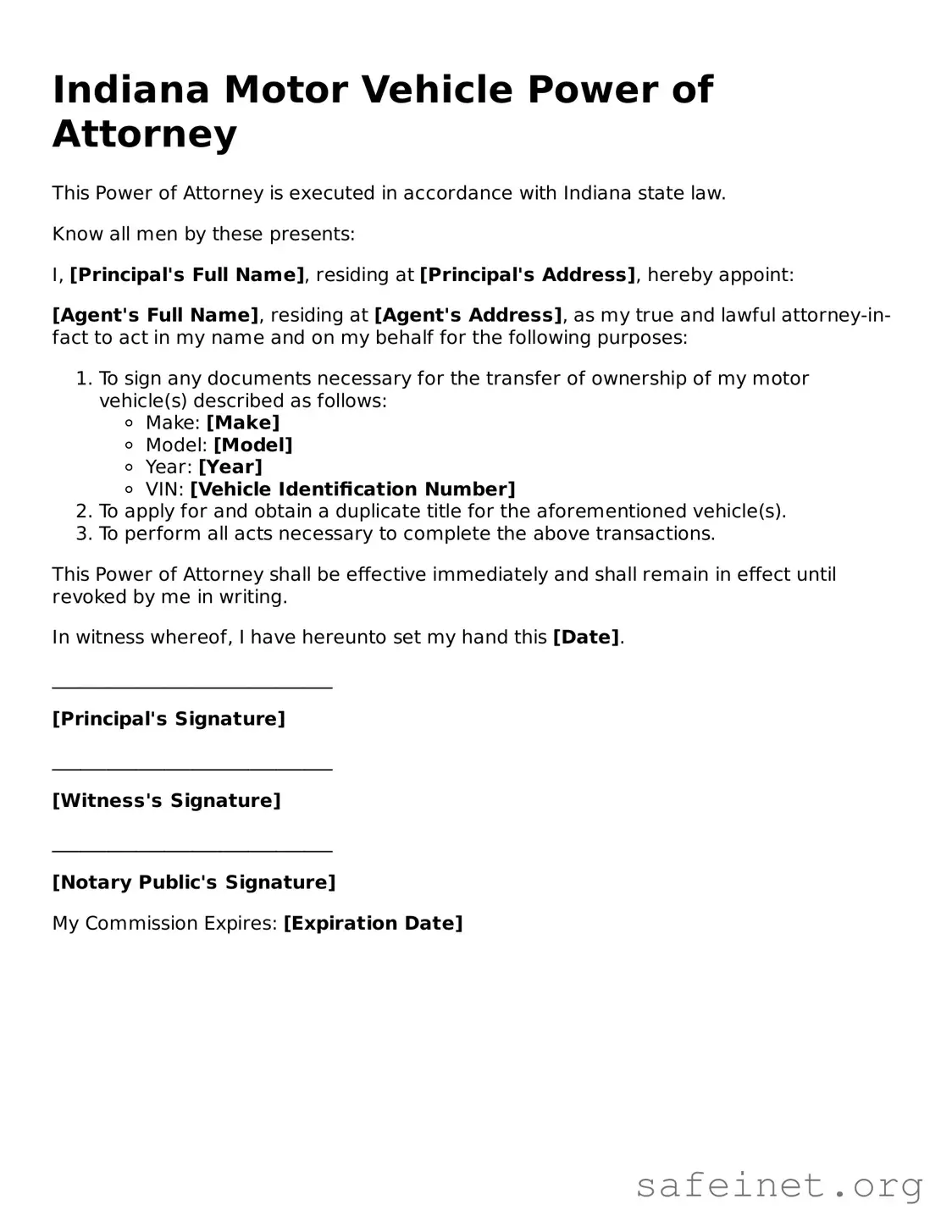
When it comes to managing motor vehicle transactions in Indiana, the Motor Vehicle Power of Attorney form plays a crucial role. This document allows individuals to designate another person, often referred to as an agent, to act on their behalf in matters related to their motor vehicles. Whether it involves the transfer of ownership, registration, or title issues, this form streamlines the process and ensures that all necessary actions can be taken without the principal's direct involvement. The form requires specific details, such as the names and addresses of both the principal and the agent, as well as a clear description of the powers granted. Additionally, it must be signed and dated to be legally binding. Understanding the nuances of this form can save time and reduce complications, making it an essential tool for vehicle owners in Indiana.
Indiana Motor Vehicle Power of Attorney
This Power of Attorney is executed in accordance with Indiana state law.
Know all men by these presents:
I, [Principal's Full Name], residing at [Principal's Address], hereby appoint:
[Agent's Full Name], residing at [Agent's Address], as my true and lawful attorney-in-fact to act in my name and on my behalf for the following purposes:
This Power of Attorney shall be effective immediately and shall remain in effect until revoked by me in writing.
In witness whereof, I have hereunto set my hand this [Date].
______________________________
[Principal's Signature]
______________________________
[Witness's Signature]
______________________________
[Notary Public's Signature]
My Commission Expires: [Expiration Date]
| Fact Name | Description |
|---|---|
| Purpose | The Indiana Motor Vehicle Power of Attorney form allows an individual to appoint someone else to handle motor vehicle transactions on their behalf. |
| Governing Law | This form is governed by Indiana Code § 32-21-13, which outlines the legal framework for powers of attorney in the state. |
| Signatures Required | The form must be signed by the principal (the person granting authority) and may require notarization to be legally binding. |
| Scope of Authority | The appointed agent can perform specific tasks related to motor vehicles, such as transferring titles or registering vehicles. |
| Revocation | The principal can revoke the power of attorney at any time, as long as they provide written notice to the agent and any relevant parties. |
Filling out the Indiana Motor Vehicle Power of Attorney form is a straightforward process. This document allows you to designate someone to act on your behalf regarding motor vehicle transactions. Follow these steps carefully to ensure accuracy.
After completing the form, it is essential to submit it to the appropriate parties as needed. Ensure your attorney-in-fact understands their responsibilities and has the necessary copies to act on your behalf.
What is the Indiana Motor Vehicle Power of Attorney form?
The Indiana Motor Vehicle Power of Attorney form is a legal document that allows one person to designate another person to act on their behalf regarding motor vehicle transactions. This can include tasks such as signing documents for vehicle registration, title transfer, or other related activities. It provides a way for individuals to delegate authority while ensuring that their interests are represented in motor vehicle matters.
Who can be designated as an attorney-in-fact?
Any competent adult can be designated as an attorney-in-fact in the Indiana Motor Vehicle Power of Attorney form. This means that the person you choose should be trustworthy and capable of handling the responsibilities associated with the power granted. It is common to appoint family members, friends, or trusted associates to fulfill this role.
Do I need to have the form notarized?
Yes, the Indiana Motor Vehicle Power of Attorney form must be notarized to be considered valid. Having a notary public witness the signing of the document adds an extra layer of authenticity and ensures that the signatures are legitimate. This step helps prevent potential disputes regarding the authority granted in the form.
Can I revoke the Power of Attorney once it is established?
Yes, you can revoke the Power of Attorney at any time as long as you are of sound mind. To do this, you should create a written revocation document and notify the attorney-in-fact and any relevant parties, such as the Department of Motor Vehicles. It is important to ensure that the revocation is clear and properly executed to avoid any confusion.
What types of transactions can be handled with this Power of Attorney?
The Indiana Motor Vehicle Power of Attorney allows the designated individual to handle a variety of motor vehicle-related transactions. These may include signing for vehicle registrations, transferring titles, obtaining license plates, and dealing with any other necessary paperwork associated with vehicle ownership. The scope of authority can be tailored to meet specific needs.
Is there a specific format for the Power of Attorney form?
While there is no strict format mandated by law, the Indiana Motor Vehicle Power of Attorney form should clearly state the names of both the principal (the person granting the power) and the attorney-in-fact, along with the specific powers being granted. It is advisable to use a template or a form provided by the Indiana Bureau of Motor Vehicles to ensure all necessary elements are included.
How long is the Power of Attorney valid?
The validity of the Indiana Motor Vehicle Power of Attorney typically lasts until it is revoked by the principal or until the specific task for which it was granted is completed. If you anticipate needing the authority for an extended period, consider including a specific expiration date in the document or renewing it as necessary.
What should I do if my attorney-in-fact is unable to fulfill their duties?
If your attorney-in-fact is unable to fulfill their duties due to circumstances such as illness or unavailability, you can appoint a new attorney-in-fact by creating a new Power of Attorney form. It is also wise to inform the previous attorney-in-fact of the change to avoid any confusion regarding authority.
Where can I obtain the Indiana Motor Vehicle Power of Attorney form?
The Indiana Motor Vehicle Power of Attorney form can be obtained from the Indiana Bureau of Motor Vehicles website or local BMV branches. Many legal service providers also offer templates that can be customized to meet individual needs. It is important to ensure that you are using the most current version of the form.
Failing to provide complete information about the principal, including their full name, address, and signature.
Not clearly identifying the agent by including their full name and contact information.
Leaving sections of the form blank, which can lead to confusion or rejection of the document.
Not specifying the powers granted to the agent, which can result in limitations on what the agent can do.
Neglecting to date the form, which is crucial for establishing the timeline of authority.
Overlooking the requirement for witnesses or notarization, depending on the specific circumstances.
Using outdated forms, which may not comply with current Indiana laws.
Not keeping a copy of the completed form for personal records, which is important for future reference.
The Indiana Motor Vehicle Power of Attorney form allows an individual to designate another person to handle specific vehicle-related tasks on their behalf. When using this form, there are several other documents that may be relevant or necessary to complete various transactions related to motor vehicles. Below is a list of these documents, along with brief descriptions of each.
Understanding these documents can help streamline the process of managing vehicle ownership and related transactions. It is advisable to ensure all necessary paperwork is completed accurately to avoid potential complications.
The Indiana Motor Vehicle Power of Attorney form is similar to the General Power of Attorney. Both documents grant an individual the authority to act on behalf of another person in various matters. The key difference lies in the scope of authority; while a General Power of Attorney covers a wide range of financial and legal decisions, the Indiana Motor Vehicle Power of Attorney is specifically tailored for handling vehicle-related transactions, such as registration and title transfers.
Another comparable document is the Durable Power of Attorney. This form allows one person to designate another to manage their affairs, even if they become incapacitated. Like the Indiana Motor Vehicle Power of Attorney, it can be used for specific transactions, but the Durable Power of Attorney generally applies to broader financial matters, ensuring that the appointed agent can continue to act on behalf of the principal under various circumstances.
The Limited Power of Attorney is also similar, as it allows an individual to grant specific powers to another person. This document is often used for particular transactions, such as selling a car or signing documents related to a property. The Indiana Motor Vehicle Power of Attorney shares this focus on limited authority, making it essential for those needing to delegate vehicle-related tasks without granting full control over their affairs.
The Medical Power of Attorney is another related document. While it primarily deals with healthcare decisions, it shares the fundamental principle of designating someone to act on another's behalf. Both forms require clear instructions and trust in the appointed agent, emphasizing the importance of choosing a reliable individual to represent one's interests.
The Real Estate Power of Attorney is similar in that it allows someone to handle real estate transactions on behalf of another person. This document is often used for buying or selling property, similar to how the Indiana Motor Vehicle Power of Attorney is used for vehicle transactions. Both forms streamline processes that may require the principal's physical presence, allowing agents to act efficiently.
The Financial Power of Attorney also shares similarities with the Indiana Motor Vehicle Power of Attorney. This document enables one person to manage another's financial matters, including banking and investments. While the Financial Power of Attorney is broader in scope, both documents empower agents to act decisively in specific areas, ensuring that the principal's interests are protected.
The Business Power of Attorney is relevant for individuals who need to delegate authority within a business context. This document allows an agent to make decisions regarding business operations, similar to how the Indiana Motor Vehicle Power of Attorney allows for vehicle-related decisions. Both documents are crucial for ensuring that important transactions can proceed smoothly in the absence of the principal.
The Trust Agreement is another document that shares a purpose with the Indiana Motor Vehicle Power of Attorney. While a Trust Agreement primarily focuses on managing assets for beneficiaries, it also allows for the appointment of a trustee to handle specific transactions. In this way, both documents facilitate the management of assets, albeit in different contexts.
The Living Will is similar in that it addresses the principal's wishes regarding medical treatment and end-of-life decisions. While it does not grant authority to another person in the same way as the Indiana Motor Vehicle Power of Attorney, it emphasizes the importance of having clear directives and trusted individuals in place to act according to one’s wishes.
Lastly, the Vehicle Title Transfer form is closely related, as it is often used in conjunction with the Indiana Motor Vehicle Power of Attorney. This document is essential for officially transferring ownership of a vehicle. While the Power of Attorney allows someone to act on behalf of the owner, the Vehicle Title Transfer form finalizes the transaction, highlighting the interconnectedness of these documents in vehicle ownership matters.
When filling out the Indiana Motor Vehicle Power of Attorney form, consider these important dos and don'ts.
Understanding the Indiana Motor Vehicle Power of Attorney form is crucial for anyone looking to delegate authority for vehicle-related transactions. However, several misconceptions can lead to confusion. Here are eight common misconceptions:
Clearing up these misconceptions can help individuals make informed decisions regarding their vehicle transactions in Indiana.
When dealing with the Indiana Motor Vehicle Power of Attorney form, there are several important points to keep in mind. This document allows you to authorize someone else to handle motor vehicle transactions on your behalf. Here are some key takeaways:
By following these guidelines, you can effectively use the Indiana Motor Vehicle Power of Attorney form to manage your vehicle-related transactions with confidence.