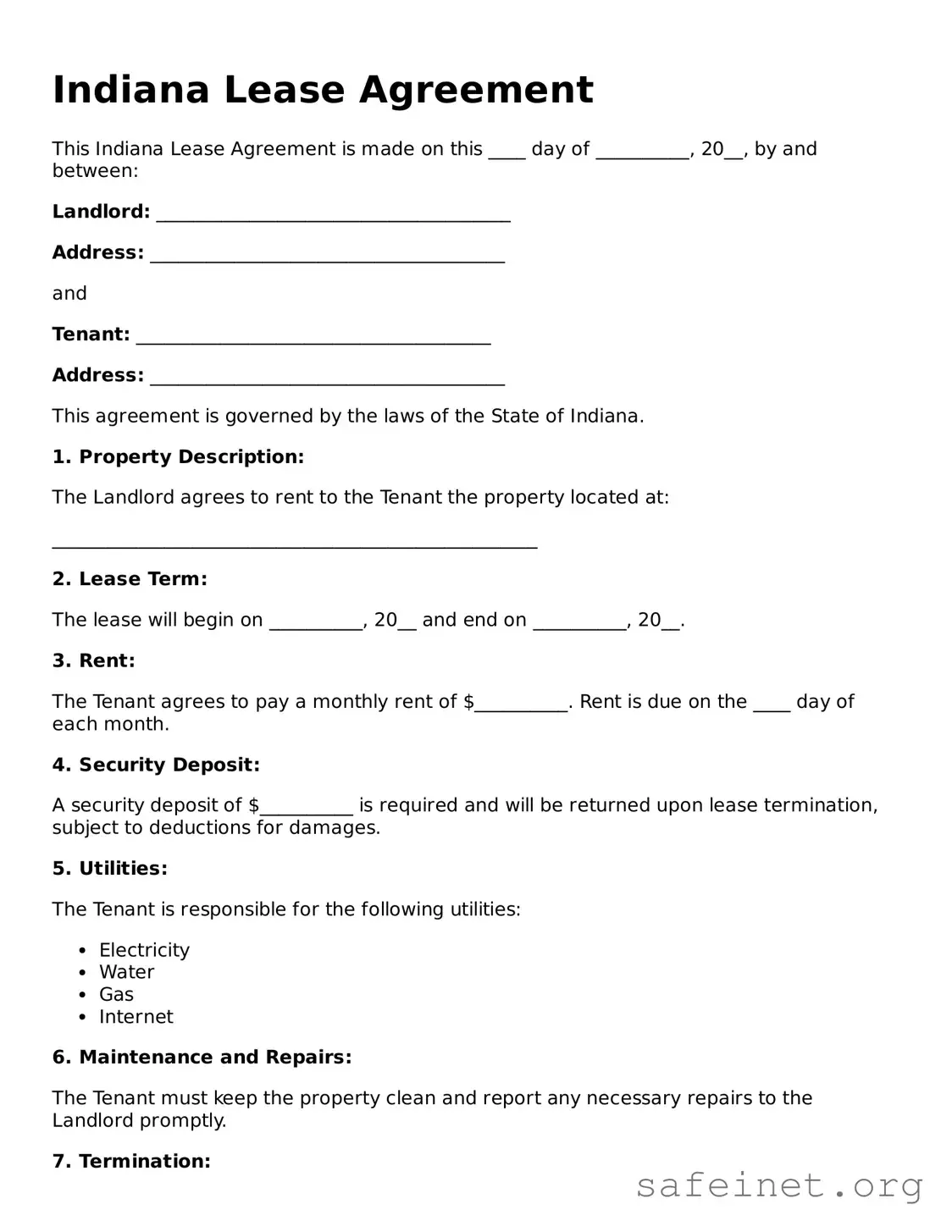
The Indiana Lease Agreement form serves as a crucial document for both landlords and tenants, outlining the terms and conditions governing the rental of residential or commercial property. This form typically includes essential details such as the names of the parties involved, the property address, and the duration of the lease. It also specifies the amount of rent due, payment methods, and any security deposit requirements. Furthermore, the agreement addresses responsibilities related to property maintenance, utilities, and any restrictions on the use of the property. By clearly defining the rights and obligations of both parties, the Indiana Lease Agreement helps to prevent misunderstandings and disputes, ensuring a smoother rental experience. Understanding the major aspects of this form is vital for anyone looking to rent or lease property in Indiana, as it lays the groundwork for a legally binding relationship between landlords and tenants.
Indiana Lease Agreement
This Indiana Lease Agreement is made on this ____ day of __________, 20__, by and between:
Landlord: ______________________________________
Address: ______________________________________
and
Tenant: ______________________________________
Address: ______________________________________
This agreement is governed by the laws of the State of Indiana.
1. Property Description:
The Landlord agrees to rent to the Tenant the property located at:
____________________________________________________
2. Lease Term:
The lease will begin on __________, 20__ and end on __________, 20__.
3. Rent:
The Tenant agrees to pay a monthly rent of $__________. Rent is due on the ____ day of each month.
4. Security Deposit:
A security deposit of $__________ is required and will be returned upon lease termination, subject to deductions for damages.
5. Utilities:
The Tenant is responsible for the following utilities:
6. Maintenance and Repairs:
The Tenant must keep the property clean and report any necessary repairs to the Landlord promptly.
7. Termination:
Either party may terminate this lease by providing a written notice of ____ days.
8. Governing Law:
This agreement will be interpreted according to the laws of the State of Indiana.
IN WITNESS WHEREOF, the parties have executed this Lease Agreement on the date first above written.
Landlord Signature: ___________________________
Date: ___________________________
Tenant Signature: ___________________________
Date: ___________________________
| Fact Name | Description |
|---|---|
| Governing Law | The Indiana Lease Agreement is governed by Indiana state law. |
| Parties Involved | The agreement involves a landlord and a tenant. |
| Property Description | The form requires a detailed description of the rental property. |
| Lease Term | The duration of the lease must be specified, whether it's month-to-month or for a fixed term. |
| Rent Amount | The lease must clearly state the amount of rent due and the payment schedule. |
| Security Deposit | The agreement should outline the amount and terms of the security deposit. |
| Utilities | The lease should specify which utilities are included in the rent and which are the tenant's responsibility. |
| Maintenance Responsibilities | The responsibilities for property maintenance and repairs must be defined. |
| Termination Conditions | Conditions under which the lease can be terminated should be included. |
| Signatures | Both parties must sign the lease to make it legally binding. |
Filling out the Indiana Lease Agreement form requires careful attention to detail. This process involves providing accurate information about both the landlord and the tenant, as well as the terms of the lease. Following the steps below will help ensure that the form is completed correctly.
After completing these steps, review the form for accuracy. Ensure that all necessary information is filled in before finalizing the agreement.
What is an Indiana Lease Agreement form?
An Indiana Lease Agreement form is a legal document that outlines the terms and conditions under which a landlord rents property to a tenant. This form includes details such as rent amount, duration of the lease, security deposit, and responsibilities of both parties. It serves to protect the rights of both the landlord and tenant during the rental period.
What should be included in an Indiana Lease Agreement?
A comprehensive Indiana Lease Agreement should include the names of the landlord and tenant, property address, lease term, rent amount, payment due dates, security deposit details, maintenance responsibilities, and any rules or regulations specific to the property. It’s also wise to include clauses about termination, renewal, and dispute resolution.
How long is a typical lease term in Indiana?
Lease terms in Indiana can vary widely. Most residential leases are for one year, but they can also be month-to-month or for a shorter or longer duration. The length of the lease should be clearly stated in the agreement to avoid any confusion later on.
Can a landlord increase rent during the lease term in Indiana?
Generally, a landlord cannot increase rent during the lease term unless the lease explicitly allows for it. Any rent increase must comply with the terms outlined in the lease agreement. Once the lease expires, the landlord can propose a new rental rate for the next term.
What happens if a tenant wants to break the lease early?
If a tenant wishes to break the lease early, they should review the lease agreement for any early termination clauses. These clauses may outline penalties or conditions for breaking the lease. Communication with the landlord is essential, as they may be willing to negotiate or find a new tenant to take over the lease.
Is a security deposit required in Indiana?
Yes, a security deposit is commonly required in Indiana. The amount is typically equal to one month's rent, but it can vary. The landlord must return the deposit within 45 days after the tenant vacates the property, minus any deductions for damages or unpaid rent, which should be documented.
What are the tenant's rights under Indiana law?
Tenants in Indiana have several rights, including the right to a habitable living environment, the right to privacy, and the right to receive a written notice before eviction. It’s important for tenants to understand these rights and to seek legal advice if they feel their rights have been violated.
Failing to include the full names of all tenants. Each tenant's name should be clearly stated to avoid confusion and ensure all parties are legally bound by the agreement.
Not specifying the lease term. Clearly outline the start and end dates of the lease. Omitting this information can lead to misunderstandings about the duration of the rental period.
Ignoring the security deposit details. The amount, payment method, and conditions for its return should be explicitly mentioned to protect both the landlord and tenants.
Leaving out rent payment details. Include the amount of rent, due dates, and acceptable payment methods. This clarity helps prevent late payments and disputes.
Not addressing utilities and maintenance responsibilities. Specify who is responsible for utilities and maintenance tasks to avoid confusion during the lease period.
Failing to outline rules and regulations for the property. Include any restrictions, such as pet policies or noise ordinances, to ensure tenants understand their obligations.
Overlooking the termination clause. Clearly define the process for ending the lease early, including any penalties or notice requirements.
Neglecting to include signatures from all parties. All tenants and the landlord must sign the agreement to make it legally binding.
Not providing a copy of the signed agreement to all parties. Each tenant and the landlord should retain a copy for their records to reference the terms of the lease.
Failing to review the lease for accuracy and completeness. Before signing, all parties should carefully read the agreement to ensure all information is correct and all terms are understood.
In addition to the Indiana Lease Agreement form, several other documents are commonly utilized in the leasing process. These documents help clarify the terms of the lease, establish responsibilities, and protect the rights of both landlords and tenants. Below is a list of forms and documents that may accompany the lease agreement.
These documents play a crucial role in ensuring a smooth leasing process. They provide clarity and protect the interests of both landlords and tenants, fostering a positive rental experience.
The Indiana Lease Agreement form shares similarities with a Rental Agreement. Both documents outline the terms under which a landlord allows a tenant to occupy a property. They specify the rental amount, payment due dates, and the duration of the tenancy. While a lease typically covers a longer period, often a year or more, a rental agreement may be for shorter terms, such as month-to-month. Both documents aim to protect the rights of both parties and provide a clear understanding of their responsibilities.
Another document that resembles the Indiana Lease Agreement is the Commercial Lease Agreement. This type of lease is specifically designed for businesses renting commercial space. Like the Indiana Lease Agreement, it details the rental amount, the length of the lease, and the responsibilities of both the landlord and the tenant. However, commercial leases often include additional clauses related to business operations, such as zoning laws and property use, which are not typically found in residential leases.
The Sublease Agreement also has similarities to the Indiana Lease Agreement. A sublease occurs when a tenant rents out their leased space to another individual, known as a subtenant. This document must adhere to the original lease terms while also establishing new terms between the tenant and the subtenant. Just like a standard lease, a sublease agreement outlines rent, duration, and responsibilities, ensuring that both parties understand their obligations.
A Roommate Agreement is another document that aligns with the Indiana Lease Agreement. This agreement is used when multiple individuals share a rental property. It sets out the terms of occupancy, including rent responsibilities, shared expenses, and rules for the common areas. While it may not replace the main lease, it complements it by providing clarity among roommates, similar to how a lease clarifies the landlord-tenant relationship.
Lastly, the Lease Extension Agreement is similar to the Indiana Lease Agreement in that it modifies an existing lease. When tenants and landlords agree to extend the duration of a lease, they may use this document to outline the new terms and conditions. This agreement maintains the original lease's provisions while adding or adjusting terms as necessary, ensuring that both parties remain on the same page as the lease continues.
When filling out the Indiana Lease Agreement form, it is important to follow certain guidelines to ensure accuracy and compliance. Below is a list of things you should and shouldn't do.
Understanding the Indiana Lease Agreement form is crucial for both landlords and tenants. However, several misconceptions can lead to confusion. Below is a list of common misunderstandings about this important document.
While it is strongly recommended to have a written lease for clarity and legal protection, oral leases can also be valid in Indiana, especially for leases that are less than one year. However, proving the terms of an oral agreement can be challenging.
Tenants may believe they can withhold rent if repairs are needed or if they feel the landlord has breached the lease. However, Indiana law requires tenants to follow specific procedures before withholding rent, including giving the landlord a chance to fix the issue.
Many tenants think that security deposits must be returned as soon as they move out. In reality, landlords have up to 45 days to return the deposit or provide an itemized list of deductions.
While landlords have the right to enter their property, they must provide reasonable notice, typically 24 hours, unless there is an emergency. This protects the tenant's right to privacy.
Although many terms can be negotiated, some may be non-negotiable due to local laws or property management policies. It's essential to understand which aspects can be changed and which cannot.
Lease agreements vary significantly by state. Indiana has specific laws and requirements that may differ from those in other states. It's important to use a lease that complies with Indiana law.
Many tenants assume that maintenance is solely the landlord's responsibility. However, tenants also have obligations to keep the property clean and report issues promptly to avoid further damage.
Even in month-to-month arrangements, having a lease is beneficial. It outlines the terms of the rental agreement and protects both parties, even if the lease is shorter in duration.
While verbal agreements can be binding, they are much harder to enforce. Written agreements provide clear evidence of the terms and can prevent disputes between landlords and tenants.
Some tenants may think their lease will automatically renew unless they provide notice. In Indiana, this depends on the specific terms of the lease. It's important to check the agreement for renewal clauses.
By dispelling these misconceptions, both landlords and tenants can better navigate their rights and responsibilities under the Indiana Lease Agreement form.
When filling out and using the Indiana Lease Agreement form, several key points should be considered to ensure clarity and legal compliance.