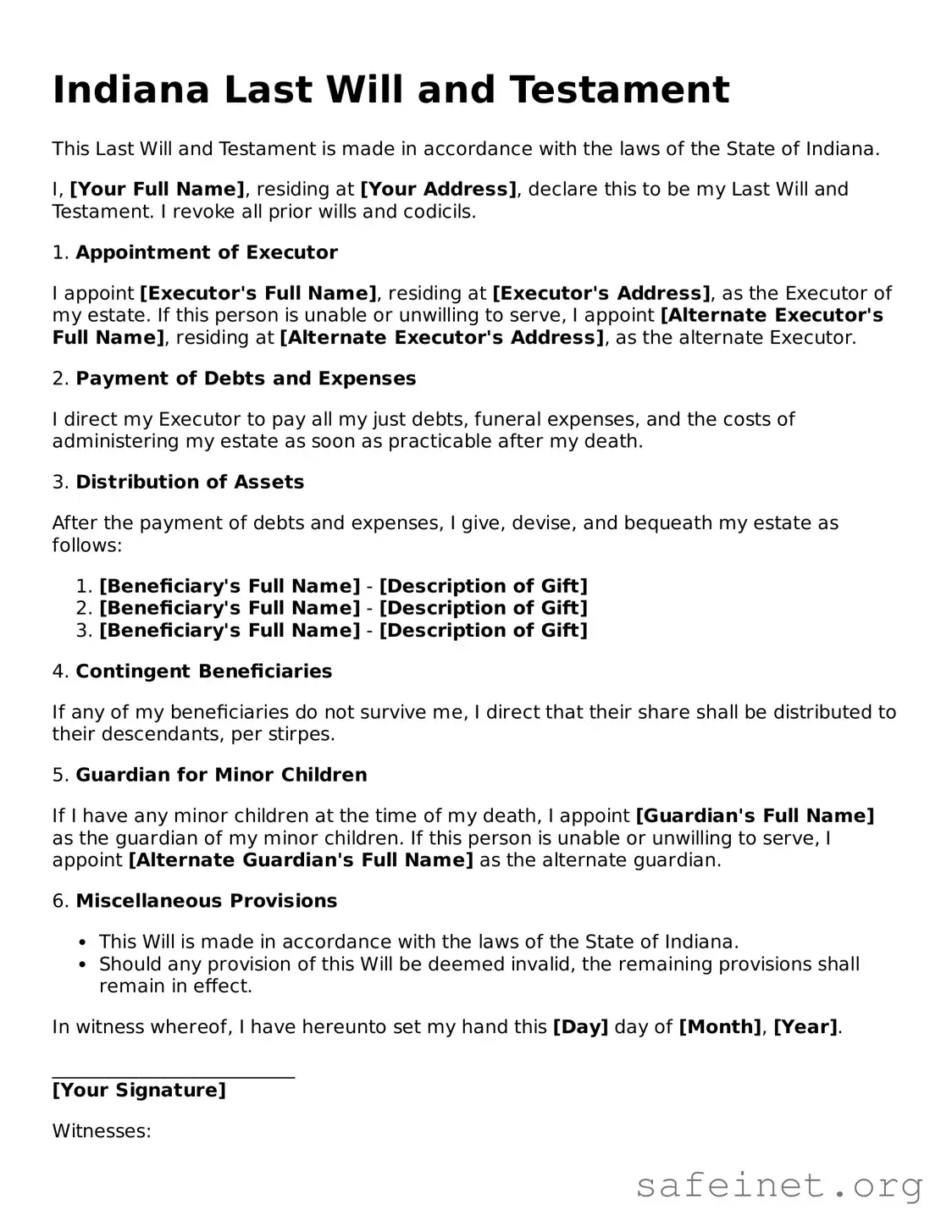
Creating a Last Will and Testament is a crucial step in ensuring that your wishes are honored after your passing. In Indiana, this legal document serves to outline how your assets will be distributed, who will serve as your executor, and who will care for any minor children. The form typically requires specific information, including the testator's name, address, and a declaration that the document is indeed their last will. It also allows for the appointment of guardians for dependents, ensuring their welfare is prioritized. Additionally, the Indiana Last Will and Testament form must be signed in the presence of at least two witnesses, who will also sign the document, affirming its authenticity. Understanding these components is essential for anyone looking to create a valid will in Indiana, as it not only helps in the smooth transition of assets but also provides peace of mind for both the testator and their loved ones.
Indiana Last Will and Testament
This Last Will and Testament is made in accordance with the laws of the State of Indiana.
I, [Your Full Name], residing at [Your Address], declare this to be my Last Will and Testament. I revoke all prior wills and codicils.
1. Appointment of Executor
I appoint [Executor's Full Name], residing at [Executor's Address], as the Executor of my estate. If this person is unable or unwilling to serve, I appoint [Alternate Executor's Full Name], residing at [Alternate Executor's Address], as the alternate Executor.
2. Payment of Debts and Expenses
I direct my Executor to pay all my just debts, funeral expenses, and the costs of administering my estate as soon as practicable after my death.
3. Distribution of Assets
After the payment of debts and expenses, I give, devise, and bequeath my estate as follows:
4. Contingent Beneficiaries
If any of my beneficiaries do not survive me, I direct that their share shall be distributed to their descendants, per stirpes.
5. Guardian for Minor Children
If I have any minor children at the time of my death, I appoint [Guardian's Full Name] as the guardian of my minor children. If this person is unable or unwilling to serve, I appoint [Alternate Guardian's Full Name] as the alternate guardian.
6. Miscellaneous Provisions
In witness whereof, I have hereunto set my hand this [Day] day of [Month], [Year].
__________________________
[Your Signature]
Witnesses:
We, the undersigned witnesses, hereby certify that the testator, [Your Full Name], signed this Last Will and Testament in our presence and that we witnessed the signing of this Will at the request of the testator.
__________________________
[Witness 1's Signature]
__________________________
[Witness 2's Signature]
| Fact Name | Description |
|---|---|
| Governing Law | The Indiana Last Will and Testament form is governed by Indiana Code Title 29, Article 1. |
| Age Requirement | Individuals must be at least 18 years old to create a valid will in Indiana. |
| Witness Requirement | A will must be signed by at least two witnesses who are present at the same time. |
| Revocation | Indiana law allows a will to be revoked by creating a new will or by physically destroying the original document. |
| Self-Proving Will | Indiana permits self-proving wills, which simplify the probate process by allowing witnesses to affirm the will's validity in advance. |
| Holographic Wills | Handwritten wills (holographic wills) are valid in Indiana if they are signed by the testator and the material provisions are in their handwriting. |
| Executor Appointment | The will allows the testator to name an executor, who will be responsible for managing the estate after death. |
| Distribution of Assets | The will specifies how the testator's assets will be distributed among beneficiaries, which can include family, friends, or charities. |
| Updating the Will | It is advisable to review and update the will regularly, especially after major life events such as marriage, divorce, or the birth of a child. |
Completing the Indiana Last Will and Testament form is an important step in ensuring that your wishes are honored regarding the distribution of your assets after your passing. This process allows you to express your intentions clearly and formally. Below are the steps to guide you through filling out the form.
Once the form is completed and signed, it is advisable to store it in a safe place and inform your executor and beneficiaries of its location. This will help ensure that your wishes are carried out as intended.
What is a Last Will and Testament in Indiana?
A Last Will and Testament is a legal document that outlines how a person's assets and property will be distributed after their death. In Indiana, this document allows individuals to specify beneficiaries, appoint guardians for minor children, and name an executor to manage the estate. It is essential for ensuring that your wishes are honored and can help avoid disputes among family members.
Who can create a Last Will and Testament in Indiana?
In Indiana, any individual who is at least 18 years old and of sound mind can create a Last Will and Testament. It is crucial that the person understands the implications of their decisions and is not under any undue influence. Minors cannot create a valid will, but they may inherit under the will of a parent or guardian.
What are the requirements for a valid Last Will and Testament in Indiana?
To be valid in Indiana, a Last Will and Testament must be in writing and signed by the testator (the person making the will). Additionally, it must be witnessed by at least two individuals who are present at the same time. These witnesses must also sign the will, affirming that they witnessed the testator sign the document. The will does not need to be notarized, but having a self-proving affidavit can simplify the probate process.
Can I change my Last Will and Testament once it is created?
Yes, you can change your Last Will and Testament at any time while you are alive and of sound mind. This is typically done through a codicil, which is an amendment to the original will, or by creating a new will that revokes the previous one. It’s important to ensure that any changes comply with Indiana's legal requirements to avoid confusion or disputes later on.
What happens if I die without a Last Will and Testament in Indiana?
If you die without a will, you are considered to have died "intestate." In this case, Indiana law determines how your assets will be distributed. Generally, your estate will be divided among your closest relatives, such as your spouse, children, or parents. This may not align with your wishes, making it crucial to have a will in place.
Can I include specific bequests in my Last Will and Testament?
Yes, you can include specific bequests in your Last Will and Testament. This means you can designate particular items or amounts of money to specific individuals or organizations. For example, you might leave a family heirloom to a child or a sum of money to a charity. Be clear and detailed to avoid any misunderstandings.
How is a Last Will and Testament executed in Indiana?
To execute a Last Will and Testament in Indiana, you must sign the document in the presence of at least two witnesses. These witnesses must also sign the will, affirming that they observed you signing it. After execution, it is advisable to store the will in a safe place and inform your executor or family members of its location to ensure it is accessible when needed.
Failing to properly identify themselves: Individuals often neglect to include their full legal name and current address, which can lead to confusion or disputes about the will's validity.
Not naming an executor: Omitting an executor or failing to choose someone trustworthy can create complications in the administration of the estate.
Inadequate witness signatures: Many people overlook the requirement for witnesses. In Indiana, at least two witnesses must sign the will in the presence of the testator.
Using ambiguous language: Vague terms or unclear instructions can lead to misinterpretation and potential conflicts among beneficiaries.
Neglecting to update the will: Life changes such as marriage, divorce, or the birth of a child should prompt a review and possible revision of the will.
Failing to include a residuary clause: Without this clause, any assets not specifically mentioned may not be distributed according to the testator's wishes.
Not considering tax implications: Individuals may not account for estate taxes, which can significantly affect the distribution of assets.
Overlooking state-specific requirements: Each state has unique laws regarding wills. Failing to adhere to Indiana's specific regulations can render a will invalid.
When preparing a Last Will and Testament in Indiana, it is often beneficial to consider additional documents that can complement this primary legal instrument. Each of these forms serves a specific purpose, helping to ensure that your wishes are clearly articulated and legally enforceable.
By considering these additional documents, individuals can create a more comprehensive estate plan that reflects their wishes and protects their loved ones. Each document plays a vital role in ensuring that your intentions are honored and that your family is supported during difficult times.
The Indiana Last Will and Testament form shares similarities with a Living Will. A Living Will outlines an individual's preferences regarding medical treatment in the event they become incapacitated. Both documents serve to express personal wishes and provide guidance to family members and healthcare providers. While the Last Will and Testament focuses on the distribution of assets after death, the Living Will addresses healthcare decisions during life, highlighting the importance of personal autonomy in both scenarios.
An Advance Directive is another document closely related to the Indiana Last Will and Testament. This legal document allows individuals to specify their healthcare preferences and appoint someone to make medical decisions on their behalf. Like a Last Will, an Advance Directive ensures that a person's wishes are respected. However, it specifically pertains to medical decisions rather than asset distribution, emphasizing the need for clear communication regarding personal health choices.
A Trust Agreement is another document that has a functional relationship with the Indiana Last Will and Testament. A Trust allows individuals to place their assets into a legal entity for management and distribution according to their wishes. Unlike a Last Will, which goes through probate, a Trust can help avoid this process, providing a more streamlined way to manage and transfer assets. Both documents aim to ensure that assets are handled according to the individual's desires, but they differ in their mechanisms and timing of implementation.
Lastly, a Codicil is a document that modifies an existing Last Will and Testament. It allows individuals to make changes or updates without creating an entirely new will. This is particularly useful for those who want to adjust their estate plan due to changes in circumstances, such as marriage, divorce, or the birth of a child. Both the Codicil and the Last Will work together to ensure that an individual's estate plan remains current and reflective of their wishes.
When filling out the Indiana Last Will and Testament form, it’s important to be careful and thorough. Here are some things you should and shouldn’t do:
When it comes to creating a Last Will and Testament in Indiana, many people hold onto certain misconceptions that can lead to confusion or even legal issues down the line. Here are seven common myths and the truths behind them:
This is not true! Indiana recognizes handwritten wills, also known as holographic wills, as valid as long as they are signed by the testator and reflect their intentions.
While it’s always a good idea to consult a lawyer for legal advice, Indiana law does not require you to have an attorney to draft a will. Many people choose to create their own will using templates or forms.
In Indiana, a will must be in writing to be considered valid. Oral wills are generally not recognized, so it’s important to put your wishes down on paper.
This is incorrect. You can modify or revoke your will at any time as long as you are mentally competent. Just make sure to follow the proper legal procedures for making changes.
Not necessarily. Some assets, like those held in trust or joint accounts, may bypass probate. It’s important to understand which assets are subject to probate and which are not.
Having a will does not exempt your estate from taxes. Estate taxes can still apply, depending on the value of your estate. Planning ahead can help minimize tax liabilities.
This is a common misconception. Everyone, regardless of wealth, should have a will to ensure their wishes are honored and to make the process easier for their loved ones.
Understanding these misconceptions can help you make informed decisions about your estate planning. It’s always best to educate yourself and consider your unique circumstances when creating a will.
When filling out and using the Indiana Last Will and Testament form, keep the following key points in mind:
Following these steps can help ensure that your wishes are honored and that the process goes smoothly for your loved ones.