For families in Indiana considering homeschooling, the Indiana Homeschool Letter of Intent form serves as an essential first step in the educational journey. This straightforward document notifies the local school district of a family's decision to educate their child at home. By submitting this letter, parents take on the responsibility of providing a curriculum that meets state educational standards while also ensuring their child's progress. The form typically requires basic information, including the child's name, age, and the address of the homeschooling family. Importantly, it also provides an opportunity for parents to express their educational philosophy and approach. Understanding the nuances of this form can empower families to navigate the homeschooling landscape with confidence and clarity, ensuring they meet all necessary requirements while fostering a rich learning environment at home.
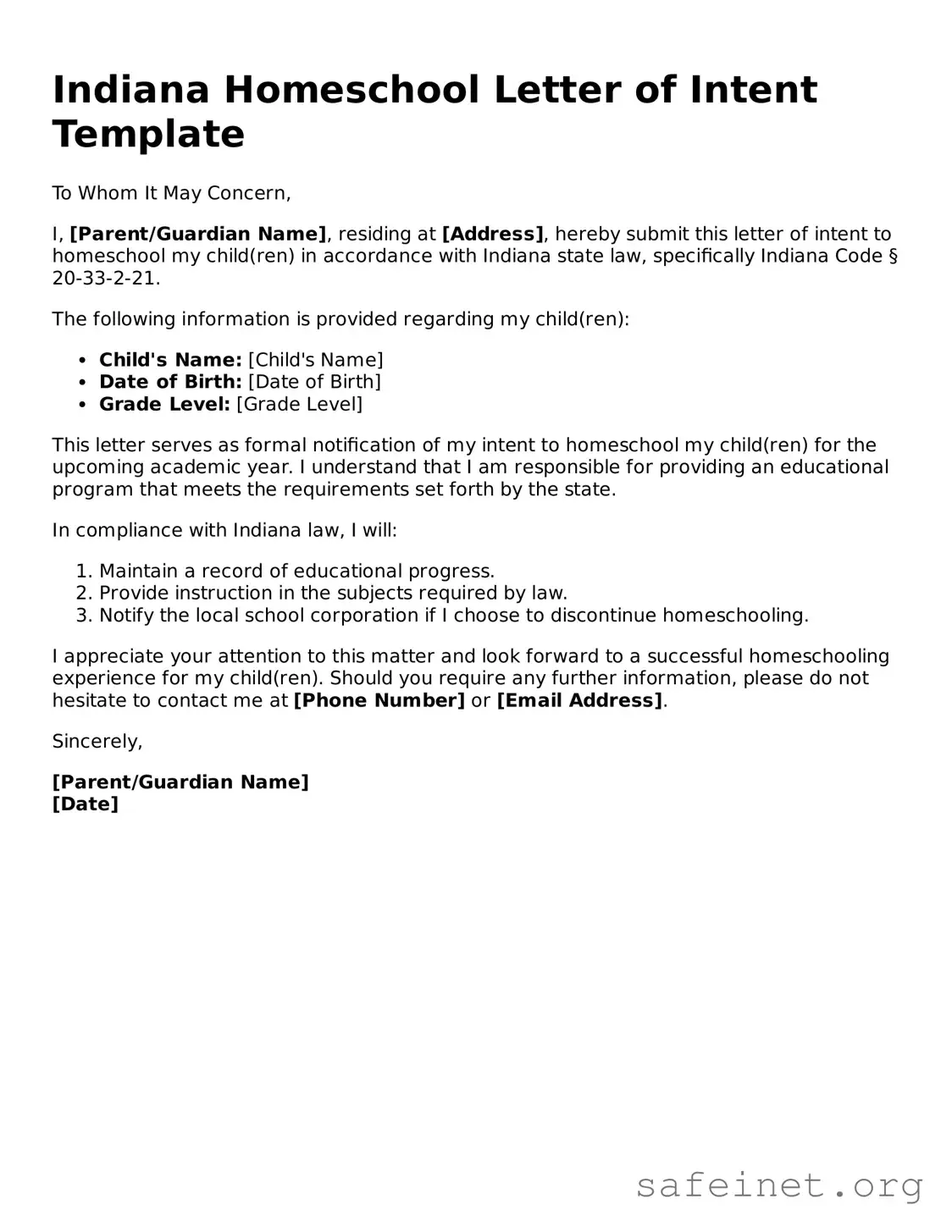
Indiana Homeschool Letter of Intent Template
To Whom It May Concern,
I, [Parent/Guardian Name], residing at [Address], hereby submit this letter of intent to homeschool my child(ren) in accordance with Indiana state law, specifically Indiana Code § 20-33-2-21.
The following information is provided regarding my child(ren):
This letter serves as formal notification of my intent to homeschool my child(ren) for the upcoming academic year. I understand that I am responsible for providing an educational program that meets the requirements set forth by the state.
In compliance with Indiana law, I will:
I appreciate your attention to this matter and look forward to a successful homeschooling experience for my child(ren). Should you require any further information, please do not hesitate to contact me at [Phone Number] or [Email Address].
Sincerely,
[Parent/Guardian Name]
[Date]
| Fact Name | Details |
|---|---|
| Purpose | The Indiana Homeschool Letter of Intent form is used to formally notify the state of Indiana of a parent's decision to homeschool their child. |
| Governing Law | The form is governed by Indiana Code § 20-33-2-21, which outlines the requirements for homeschooling in the state. |
| Submission Deadline | The Letter of Intent must be submitted within ten days of the beginning of the homeschool program. |
| Required Information | The form requires the child's name, age, and address, as well as the name and address of the parent or guardian. |
| Annual Requirement | The Letter of Intent is not required to be submitted annually, but parents must maintain educational records. |
| Notification Method | The form can be submitted via mail or in person to the local school corporation. |
| Record Keeping | Parents are responsible for keeping records of educational progress and must provide them upon request by the state. |
| Legal Protections | Submitting the Letter of Intent provides legal recognition of the homeschooling program under Indiana law. |
After completing the Indiana Homeschool Letter of Intent form, you will need to submit it to your local school corporation. This step is crucial as it officially notifies the school district of your intent to homeschool your child. Make sure to keep a copy for your records.
What is the Indiana Homeschool Letter of Intent form?
The Indiana Homeschool Letter of Intent form is a document that parents or guardians must submit to notify the local school corporation of their decision to homeschool their child. This form serves as a formal declaration of intent and is a necessary step in the homeschooling process in Indiana.
Who needs to submit the Letter of Intent?
Any parent or guardian who wishes to homeschool a child between the ages of 7 and 18 must submit the Letter of Intent. This requirement applies to all students who are not enrolled in a public or private school.
When should the Letter of Intent be submitted?
The Letter of Intent should be submitted at the beginning of the homeschooling process. Ideally, it should be filed before the start of the school year or when the family decides to withdraw a child from a traditional school setting. Timely submission helps ensure compliance with state regulations.
What information is required on the Letter of Intent?
The form typically requires basic information, including the names and addresses of the parents or guardians, the name and age of the child being homeschooled, and a statement of intent to homeschool. Some school corporations may have specific requirements, so it is advisable to check with the local school district.
Is there a specific format for the Letter of Intent?
While there is no mandated format for the Letter of Intent, it should be clear and concise. Many families choose to use a template or sample letter available online. It is important that the letter includes all necessary information to avoid any issues with local authorities.
Do I need to renew the Letter of Intent each year?
Yes, in Indiana, the Letter of Intent must be submitted annually. This requirement helps keep local school corporations informed about homeschooling families in their jurisdiction. Parents should ensure they submit the letter each year before the start of the school year.
What happens if I do not submit the Letter of Intent?
If a family fails to submit the Letter of Intent, they may be considered non-compliant with Indiana's homeschooling laws. This could lead to potential legal issues, including the possibility of the child being required to enroll in a traditional school. It is crucial to adhere to the state's requirements.
Can I change my mind after submitting the Letter of Intent?
Yes, parents can change their minds about homeschooling after submitting the Letter of Intent. If a family decides to enroll their child in a public or private school, they should notify the school corporation of this change. It is important to keep communication open with local authorities.
Where do I submit the Letter of Intent?
The Letter of Intent should be submitted to the local school corporation where the child resides. This can often be done by mail or in person. Some districts may also allow electronic submissions, so checking with the local school office for specific instructions is advisable.
Are there any additional requirements after submitting the Letter of Intent?
After submitting the Letter of Intent, parents must ensure they comply with Indiana's homeschooling laws, which may include maintaining educational records and providing instruction that meets state standards. Staying informed about any additional requirements is essential for successful homeschooling.
Failing to include the parent or guardian's name. This is essential for identification.
Not providing the physical address of the homeschool. This information is required for record-keeping.
Leaving out the names and ages of the children being homeschooled. This detail is crucial for compliance.
Incorrectly filling in the date of submission. This can lead to confusion about when the homeschooling officially starts.
Using an incomplete or inaccurate method of communication. Ensure the form is filled out clearly and legibly.
Not checking for required signatures. The form must be signed by the parent or guardian.
Failing to keep a copy of the submitted form for personal records. This can be important for future reference.
Neglecting to submit the form by the state's deadline. Timeliness is critical for compliance.
Overlooking the need to inform the local school district of any changes in homeschooling status.
Not understanding the legal requirements for homeschooling in Indiana. Familiarity with state laws is vital.
When families decide to homeschool in Indiana, they often need to submit various forms and documents alongside the Indiana Homeschool Letter of Intent. These documents help ensure compliance with state regulations and provide necessary information for educational planning. Below are some commonly used forms that may accompany the Letter of Intent.
Submitting these additional documents along with the Indiana Homeschool Letter of Intent can help create a well-rounded educational experience and ensure adherence to homeschooling regulations. Families should consider each document's importance in supporting their child's learning path.
The Indiana Homeschool Letter of Intent form shares similarities with the Public School Enrollment form. Both documents require parents or guardians to provide essential information about the student, including their name, age, and address. Just as the Letter of Intent notifies the state of a family's choice to homeschool, the Public School Enrollment form formally registers a child in a public school. Each form serves as a means of communication with educational authorities, ensuring that the child's educational path is clearly documented.
Another document akin to the Indiana Homeschool Letter of Intent is the Private School Enrollment form. Like the Letter of Intent, this form is used to notify the state about a child's educational setting. Parents fill out details about the student and the school they will attend. Both documents require similar information and serve the purpose of ensuring that the child is accounted for within the educational system, whether in a private institution or through homeschooling.
The Indiana Compulsory Education Exemption form is also comparable to the Homeschool Letter of Intent. This document is used when parents seek an exemption from mandatory school attendance laws. Both forms are necessary for parents who choose alternative educational paths for their children. They require similar information regarding the student and the reasons for opting out of traditional schooling, reinforcing the parents' role in making educational decisions.
Lastly, the Indiana Special Education Services Request form has parallels with the Homeschool Letter of Intent. While the Letter of Intent indicates a choice to homeschool, the Special Education Services Request form is used when parents seek specific educational services for their child. Both documents require parents to provide detailed information about the student and their needs. They are crucial in ensuring that the educational rights of the child are recognized and that appropriate resources are allocated, whether through homeschooling or special education services.
When filling out the Indiana Homeschool Letter of Intent form, it's important to follow certain guidelines to ensure a smooth process. Here are five things to do and five things to avoid:
Many people have misunderstandings about the Indiana Homeschool Letter of Intent form. Here are five common misconceptions:
Understanding these misconceptions can help parents navigate the homeschooling process more confidently.
Filling out and using the Indiana Homeschool Letter of Intent form is an important step for parents who wish to educate their children at home. Here are some key takeaways to keep in mind: