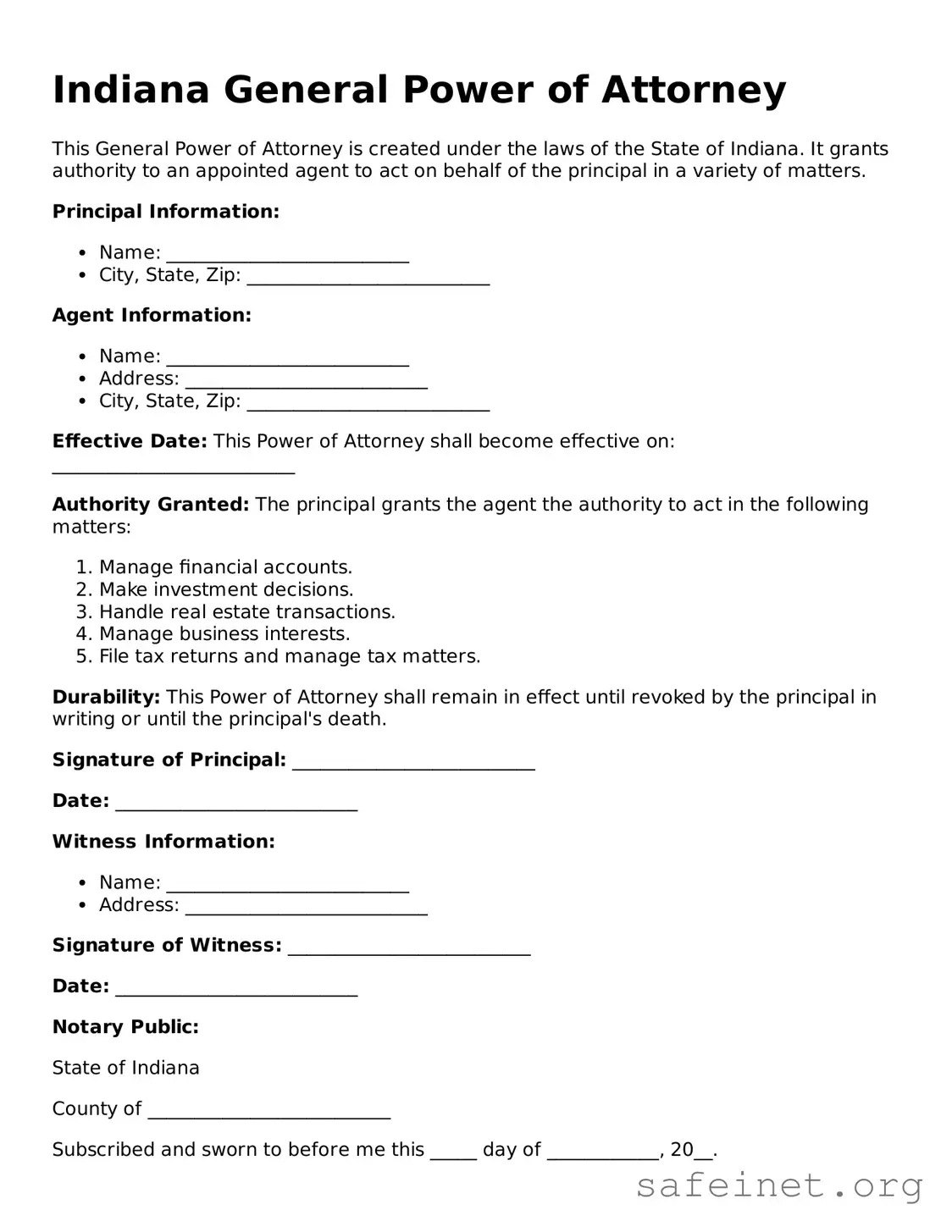
In Indiana, a General Power of Attorney form serves as a vital legal document that empowers an individual, known as the agent or attorney-in-fact, to make decisions on behalf of another person, referred to as the principal. This form is particularly useful in situations where the principal is unable to manage their own affairs due to reasons such as illness, absence, or incapacity. The scope of authority granted through this document is broad, allowing the agent to handle financial matters, manage real estate transactions, and make healthcare decisions, among other responsibilities. It is important for the principal to clearly outline the powers they wish to grant, as well as any limitations they may want to impose. Additionally, the General Power of Attorney can be effective immediately or can be set to activate upon a certain condition, such as the principal's incapacitation. Understanding the nuances of this form is essential for both the principal and the agent to ensure that the principal's wishes are honored and that their interests are protected.
Indiana General Power of Attorney
This General Power of Attorney is created under the laws of the State of Indiana. It grants authority to an appointed agent to act on behalf of the principal in a variety of matters.
Principal Information:
Agent Information:
Effective Date: This Power of Attorney shall become effective on: __________________________
Authority Granted: The principal grants the agent the authority to act in the following matters:
Durability: This Power of Attorney shall remain in effect until revoked by the principal in writing or until the principal's death.
Signature of Principal: __________________________
Date: __________________________
Witness Information:
Signature of Witness: __________________________
Date: __________________________
Notary Public:
State of Indiana
County of __________________________
Subscribed and sworn to before me this _____ day of ____________, 20__.
Signature of Notary Public: __________________________
My Commission Expires: __________________________
| Fact Name | Details |
|---|---|
| Definition | The Indiana General Power of Attorney form allows an individual (the principal) to appoint another person (the agent) to manage their financial and legal affairs. |
| Governing Law | This form is governed by Indiana Code Title 30, Article 5, Chapter 4, which outlines the rules for powers of attorney in the state. |
| Durability | The General Power of Attorney can be made durable, meaning it remains effective even if the principal becomes incapacitated. |
| Agent's Authority | The agent can perform a wide range of actions, including managing bank accounts, selling property, and handling investments. |
| Revocation | The principal can revoke the General Power of Attorney at any time, provided they are mentally competent. |
| Witness Requirements | Indiana law requires that the form be signed in the presence of at least one witness who is not the agent. |
| Notarization | While notarization is not mandatory, it is highly recommended to enhance the document's validity. |
| Limitations | The agent cannot make healthcare decisions unless specifically granted authority in a separate healthcare power of attorney. |
| Use Cases | This form is useful for individuals who want to ensure their financial matters are handled by a trusted person during their absence or incapacity. |
After obtaining the Indiana General Power of Attorney form, you will need to complete it accurately to ensure it meets your needs. This process involves providing specific information about yourself and the person you are appointing. Follow the steps outlined below to fill out the form correctly.
Once you have completed these steps, review the form for accuracy. It is advisable to keep a copy for your records and provide a copy to your agent. Ensure that your agent understands their responsibilities as outlined in the document.
What is a General Power of Attorney in Indiana?
A General Power of Attorney (GPOA) in Indiana is a legal document that allows an individual, known as the principal, to appoint another person, called the agent, to make decisions and take actions on their behalf. This authority can cover a wide range of matters, including financial transactions, property management, and legal decisions. The GPOA remains effective until the principal revokes it or passes away.
Who can be an agent under a General Power of Attorney?
In Indiana, any competent adult can serve as an agent under a General Power of Attorney. This includes family members, friends, or professional advisors. It is essential to choose someone trustworthy, as the agent will have significant authority over the principal's affairs.
Does a General Power of Attorney need to be notarized?
Yes, in Indiana, a General Power of Attorney must be signed by the principal in the presence of a notary public to be legally valid. This notarization helps ensure the authenticity of the document and the identity of the principal.
Can I limit the powers granted in a General Power of Attorney?
Absolutely. While a General Power of Attorney grants broad authority, the principal can specify limitations within the document. For instance, the principal may choose to restrict the agent's powers to certain financial matters or real estate transactions. Clear language outlining these limitations is crucial.
How does a General Power of Attorney become effective?
A General Power of Attorney can be effective immediately upon signing or can be set to become effective at a later date or upon the occurrence of a specific event, such as the principal's incapacitation. This is known as a "springing" power of attorney. The principal should clearly indicate their preference in the document.
Can a General Power of Attorney be revoked?
Yes, a principal can revoke a General Power of Attorney at any time, as long as they are mentally competent. To revoke the GPOA, the principal should provide a written notice to the agent and any relevant institutions or parties that relied on the authority of the GPOA.
What happens if the principal becomes incapacitated?
If the principal becomes incapacitated, the General Power of Attorney remains in effect unless it is a springing power of attorney that specifies otherwise. The agent can then act on behalf of the principal, managing their affairs as outlined in the document. It's essential to ensure that the agent is aware of their responsibilities in such situations.
Do I need an attorney to create a General Power of Attorney?
While it is not legally required to have an attorney draft a General Power of Attorney in Indiana, it is highly recommended. An attorney can provide valuable guidance, ensure that the document complies with state laws, and help tailor the powers granted to meet the principal's specific needs.
Failing to specify the powers granted. It's essential to clearly outline what authority you are giving to your agent.
Not signing the form in the presence of a notary public. A notary's signature is often required for the document to be valid.
Leaving sections blank. Omitting information can lead to confusion and may invalidate the form.
Using outdated versions of the form. Always ensure you have the most current form to avoid legal issues.
Not including a date. The absence of a date can create ambiguity about when the powers take effect.
Choosing an unreliable agent. Select someone trustworthy and capable of handling your affairs responsibly.
Failing to discuss the decision with the chosen agent. Communication is vital to ensure they understand your wishes.
Not considering a successor agent. If your primary agent cannot serve, having a backup is crucial.
Overlooking state-specific requirements. Indiana may have unique rules that must be followed for the form to be valid.
Neglecting to keep copies of the completed form. Retaining copies is important for both you and your agent.
When creating a General Power of Attorney in Indiana, several additional documents may be necessary to ensure comprehensive legal coverage. These documents help clarify the authority granted and provide additional protections for both the principal and the agent.
These documents, when used in conjunction with the General Power of Attorney, can help ensure that the principal's wishes are respected and that their affairs are managed effectively.
The Indiana General Power of Attorney form is similar to the Durable Power of Attorney. Both documents allow an individual to appoint someone else to make decisions on their behalf. However, the key difference lies in durability. The Durable Power of Attorney remains effective even if the principal becomes incapacitated, while the General Power of Attorney may not. This makes the Durable Power of Attorney a better option for long-term planning.
Another document that shares similarities with the Indiana General Power of Attorney is the Medical Power of Attorney. This form specifically grants authority to someone to make healthcare decisions for another person. While the General Power of Attorney can cover a wide range of financial and legal matters, the Medical Power of Attorney is focused solely on health-related decisions. Both documents require clear communication of the principal’s wishes.
The Healthcare Proxy is also akin to the Indiana General Power of Attorney. Like the Medical Power of Attorney, a Healthcare Proxy allows an individual to designate someone to make medical decisions if they are unable to do so. The distinction lies in the terminology and specific state laws governing each document. Both serve the purpose of ensuring that a person’s healthcare preferences are honored.
The Living Will is another related document. A Living Will outlines a person’s wishes regarding medical treatment in situations where they cannot communicate. While the General Power of Attorney allows someone to make decisions on behalf of another, the Living Will specifically details what types of treatment should or should not be administered. Together, they provide comprehensive guidance on a person’s healthcare preferences.
The Revocable Trust also shares similarities with the Indiana General Power of Attorney. Both documents allow for the management of assets and can help avoid probate. However, a Revocable Trust is a legal entity that holds assets, while the General Power of Attorney simply grants authority to manage those assets. The Revocable Trust can provide additional benefits, such as privacy and control over asset distribution.
Lastly, the Financial Power of Attorney is closely related to the Indiana General Power of Attorney. This document specifically focuses on financial matters, granting authority to manage bank accounts, investments, and other financial transactions. While the General Power of Attorney can include financial powers, the Financial Power of Attorney is more specialized. Both documents ensure that someone can handle financial responsibilities when the principal cannot.
When filling out the Indiana General Power of Attorney form, it is essential to follow certain guidelines to ensure that the document is valid and effective. Below is a list of things to do and avoid.
When considering the Indiana General Power of Attorney form, it is essential to address some common misconceptions. These misunderstandings can lead to confusion and may affect important decisions. Here are six misconceptions clarified:
Understanding these misconceptions can help individuals make informed choices regarding their legal documents. It is always wise to seek guidance if there are uncertainties.
Filling out and utilizing the Indiana General Power of Attorney form is an important step in managing your legal and financial affairs. Here are key takeaways to consider:
By following these guidelines, you can effectively use the Indiana General Power of Attorney form to safeguard your interests and ensure that your wishes are honored when you may not be able to communicate them yourself.