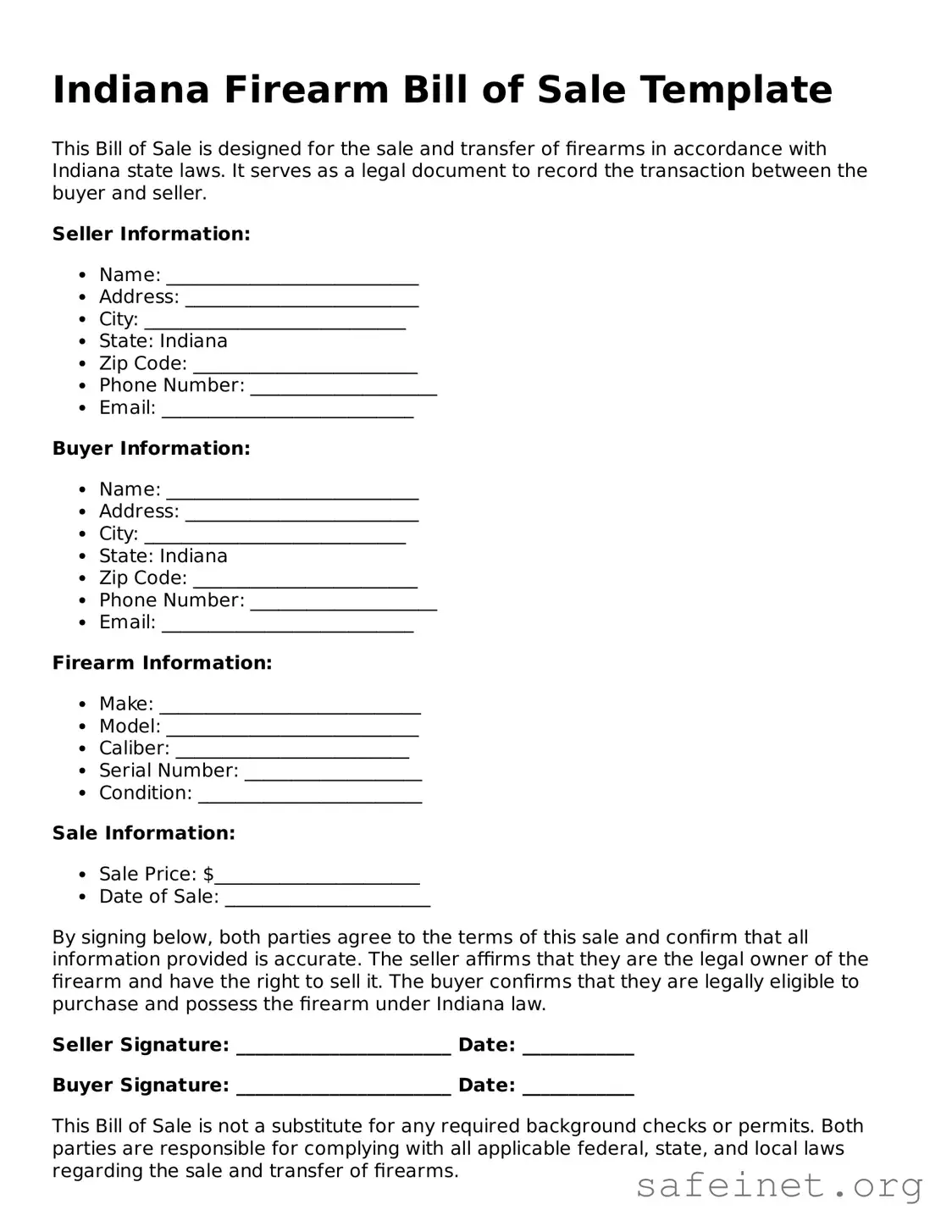
In the state of Indiana, the Firearm Bill of Sale form serves as a crucial document for individuals engaged in the private sale or transfer of firearms. This form not only provides a record of the transaction but also ensures that both the buyer and seller are protected throughout the process. Key components of the form typically include the names and contact information of both parties, a detailed description of the firearm being sold, and the agreed-upon purchase price. Additionally, the form may require the seller to affirm that they are legally permitted to sell the firearm, and the buyer to confirm their eligibility to purchase one. By completing this form, individuals can create a transparent and accountable record of the sale, thereby fostering responsible firearm ownership and compliance with state regulations. Understanding the importance of this document is essential for anyone considering the sale or purchase of a firearm in Indiana.
Indiana Firearm Bill of Sale Template
This Bill of Sale is designed for the sale and transfer of firearms in accordance with Indiana state laws. It serves as a legal document to record the transaction between the buyer and seller.
Seller Information:
Buyer Information:
Firearm Information:
Sale Information:
By signing below, both parties agree to the terms of this sale and confirm that all information provided is accurate. The seller affirms that they are the legal owner of the firearm and have the right to sell it. The buyer confirms that they are legally eligible to purchase and possess the firearm under Indiana law.
Seller Signature: _______________________ Date: ____________
Buyer Signature: _______________________ Date: ____________
This Bill of Sale is not a substitute for any required background checks or permits. Both parties are responsible for complying with all applicable federal, state, and local laws regarding the sale and transfer of firearms.
| Fact Name | Detail |
|---|---|
| Purpose | The Indiana Firearm Bill of Sale form documents the sale of a firearm between private parties. |
| Governing Law | The sale of firearms in Indiana is governed by Indiana Code Title 35, Article 47. |
| Parties Involved | The form is used by both the seller and the buyer of the firearm. |
| Identification Requirements | Both parties must provide valid identification, typically a driver's license or state ID. |
| Firearm Description | The form requires a detailed description of the firearm, including make, model, and serial number. |
| Sale Price | The agreed-upon sale price must be documented in the form. |
| Date of Sale | The date when the transaction occurs must be clearly stated on the form. |
| Signatures | Both the seller and buyer must sign the form to validate the transaction. |
| Record Keeping | It is advisable for both parties to keep a copy of the completed form for their records. |
| Legal Implications | Completing this form does not exempt either party from federal or state firearm laws. |
Filling out the Indiana Firearm Bill of Sale form is an important step in ensuring a smooth and legal transfer of ownership. After you complete the form, both parties should retain a copy for their records. This document serves as proof of the transaction and can be essential for future reference.
What is the Indiana Firearm Bill of Sale form?
The Indiana Firearm Bill of Sale form is a document used to record the sale or transfer of a firearm between two parties. This form serves as proof of the transaction and includes essential details such as the names and addresses of both the buyer and seller, the firearm's make, model, and serial number, and the date of the transaction. While it is not legally required in Indiana, having this form can provide protection for both parties in case of future disputes or legal issues.
Is the Firearm Bill of Sale form required in Indiana?
No, Indiana does not legally require a Bill of Sale for the transfer of firearms. However, it is highly recommended to use one. This document can help clarify ownership and serve as a record of the transaction. It may also be beneficial if questions arise about the firearm’s ownership or if the firearm is involved in a legal matter in the future.
What information should be included in the Firearm Bill of Sale?
A comprehensive Firearm Bill of Sale should include the following information: the full names and addresses of both the buyer and seller, the date of the transaction, a detailed description of the firearm (including make, model, caliber, and serial number), and the purchase price. Both parties should sign the document to validate the transaction. Additionally, it can be helpful to include a statement confirming that the buyer is legally eligible to own a firearm.
Can I create my own Firearm Bill of Sale form?
Yes, you can create your own Firearm Bill of Sale form. There are no specific legal requirements for the format, but it must include all relevant details to be effective. Many templates are available online that you can customize to suit your needs. Just ensure that it captures all necessary information and is signed by both parties to ensure its validity.
What should I do if I lose my Firearm Bill of Sale?
If you lose your Firearm Bill of Sale, it is advisable to recreate it if possible. You can contact the other party involved in the transaction to see if they have a copy. If not, you can draft a new Bill of Sale that includes all the original transaction details. While having a copy is important for your records, the absence of the form does not negate the legality of the transfer, provided the transaction was conducted lawfully.
Incomplete Information: Many individuals fail to provide all necessary details. This includes missing names, addresses, or firearm specifications. Ensure every section is filled out completely to avoid issues later.
Incorrect Dates: Some people mistakenly enter the wrong date of sale. It’s crucial to use the actual date of the transaction. An incorrect date can create confusion and complicate future ownership verification.
Failure to Sign: It’s common for sellers or buyers to forget to sign the form. Both parties must sign to validate the transaction. Without signatures, the document may not hold up legally.
Not Keeping a Copy: After filling out the form, some neglect to keep a copy for their records. Always retain a signed copy for future reference. This can be important if any disputes arise.
Ignoring Local Laws: Buyers and sellers sometimes overlook local regulations regarding firearm sales. Always check local laws to ensure compliance. Ignorance of the law is not an excuse and can lead to serious consequences.
The Indiana Firearm Bill of Sale form is an important document for the legal transfer of firearm ownership. When completing this transaction, several other forms and documents may also be relevant to ensure compliance with state and federal laws. Below is a list of commonly used documents that accompany the Bill of Sale.
Using these forms in conjunction with the Indiana Firearm Bill of Sale can help ensure a smooth and legally compliant transaction. Always consult with legal professionals if there are any questions about the requirements or processes involved in firearm sales.
The Indiana Firearm Bill of Sale form is similar to a general Bill of Sale used for various types of personal property transactions. Like the firearm-specific version, a general Bill of Sale serves as a written record of the transfer of ownership from one party to another. It typically includes details such as the buyer's and seller's names, a description of the item being sold, and the sale price. Both documents provide legal proof of the transaction, which can be important for future reference or disputes.
Another document that shares similarities is the Vehicle Bill of Sale. This form is used when transferring ownership of a motor vehicle. Much like the Firearm Bill of Sale, it includes pertinent information about the buyer and seller, the vehicle's make and model, and the sale price. Both documents protect the interests of both parties and help ensure a smooth transfer of ownership, providing necessary details for registration and title transfer.
The Lease Agreement is another document that bears resemblance to the Firearm Bill of Sale. While it serves a different purpose—establishing the terms under which one party rents property from another—it also includes specific details about the parties involved and the item in question. Both documents aim to clarify the rights and responsibilities of each party, ensuring that all terms are understood and agreed upon.
A Rental Agreement is similar in nature to the Lease Agreement but is often used for shorter-term rentals. Like the Firearm Bill of Sale, it outlines the terms of the agreement between the renter and the owner, including payment details and duration of the rental. Each document provides a clear record of the transaction and protects the interests of both parties involved.
The Power of Attorney document also shares some characteristics with the Firearm Bill of Sale. This legal document allows one person to act on behalf of another in legal or financial matters. Both documents require clear identification of the parties involved and specify the authority being granted or the transaction being completed. They serve to protect the rights and responsibilities of the individuals involved.
Similarly, the Warranty Deed is a document used in real estate transactions to transfer property ownership. Like the Firearm Bill of Sale, it includes essential details about the parties and the property being transferred. Both documents are critical in establishing a clear chain of ownership, which can be vital for legal purposes in the future.
The Employment Agreement is another document that, while focused on employment terms, shares similarities with the Firearm Bill of Sale. It outlines the relationship between employer and employee, detailing responsibilities, compensation, and other terms. Both documents aim to clarify the expectations and obligations of the parties involved, helping to prevent misunderstandings.
Lastly, the Non-Disclosure Agreement (NDA) is a document that protects sensitive information exchanged between parties. While it serves a different purpose, it is similar in that it formalizes an agreement between two parties. Both the NDA and the Firearm Bill of Sale require clear identification of the parties involved and establish the terms of the agreement, ensuring that each party understands their rights and obligations.
When filling out the Indiana Firearm Bill of Sale form, it is essential to approach the process with care and attention to detail. Below is a list of things you should and shouldn't do to ensure a smooth transaction.
Many people have misunderstandings about the Indiana Firearm Bill of Sale form. Here are eight common misconceptions, along with clarifications to help set the record straight.
Understanding these misconceptions can help ensure a smoother transaction and protect both parties involved in the sale of a firearm in Indiana.
When filling out and using the Indiana Firearm Bill of Sale form, there are several important points to keep in mind. Understanding these key takeaways can help ensure a smooth transaction.
By following these guidelines, you can facilitate a legal and efficient transfer of firearm ownership in Indiana.