The Indiana Durable Power of Attorney form is a vital legal document that allows individuals to designate someone they trust to make decisions on their behalf when they are unable to do so. This form is particularly important for managing financial and healthcare decisions, ensuring that your wishes are honored even if you become incapacitated. By completing this document, you empower your chosen agent to handle matters such as paying bills, managing investments, or making medical decisions, depending on the scope you define. The durable aspect of the power of attorney means it remains effective even if you lose the ability to make decisions due to illness or injury. It's essential to understand the responsibilities and limitations of the agent you appoint, as well as the specific powers you wish to grant. In Indiana, this form must be signed in the presence of a notary public to be legally binding, providing an additional layer of security for your choices. Understanding how to properly execute and utilize this form can help ensure that your personal and financial affairs are managed according to your preferences during times of need.
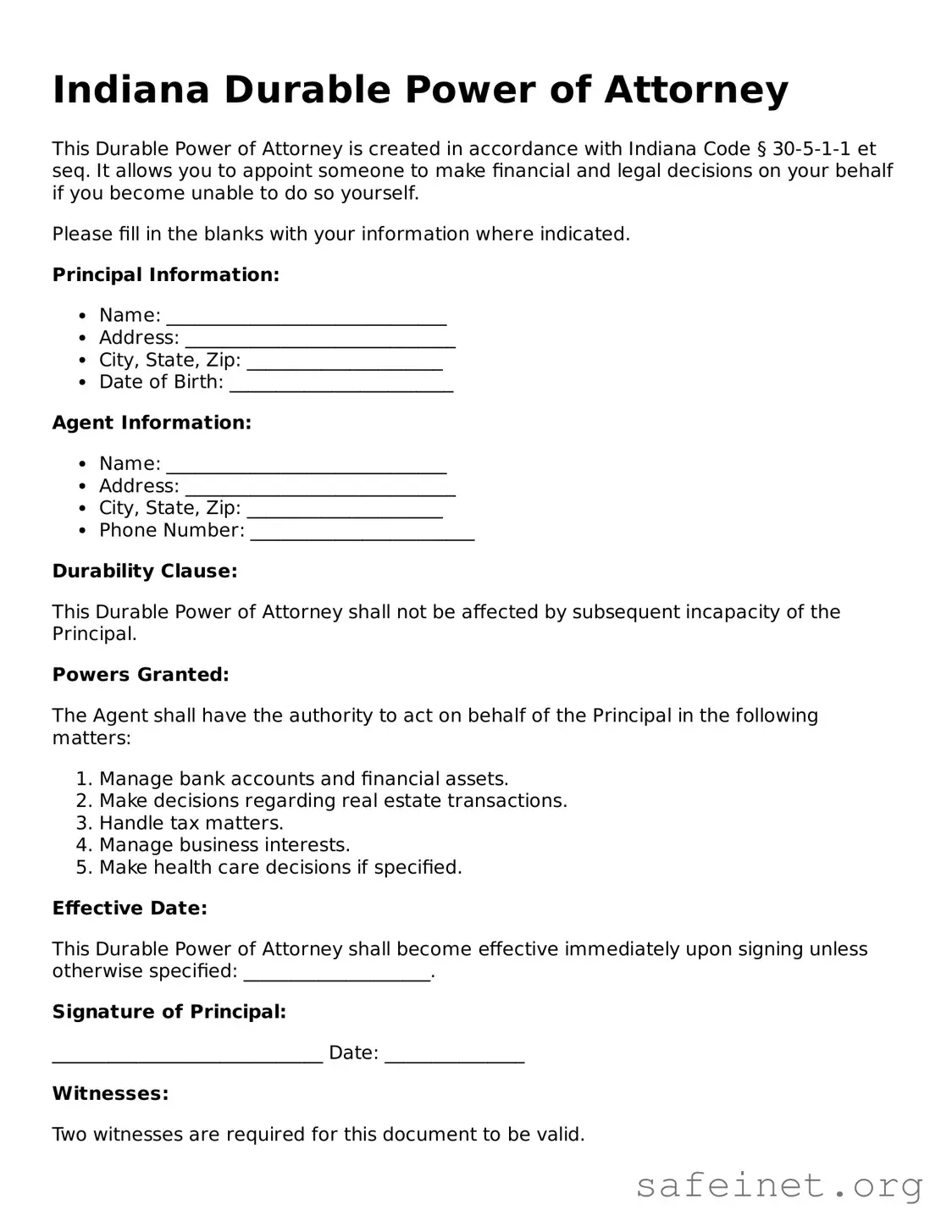
Indiana Durable Power of Attorney
This Durable Power of Attorney is created in accordance with Indiana Code § 30-5-1-1 et seq. It allows you to appoint someone to make financial and legal decisions on your behalf if you become unable to do so yourself.
Please fill in the blanks with your information where indicated.
Principal Information:
Agent Information:
Durability Clause:
This Durable Power of Attorney shall not be affected by subsequent incapacity of the Principal.
Powers Granted:
The Agent shall have the authority to act on behalf of the Principal in the following matters:
Effective Date:
This Durable Power of Attorney shall become effective immediately upon signing unless otherwise specified: ____________________.
Signature of Principal:
_____________________________ Date: _______________
Witnesses:
Two witnesses are required for this document to be valid.
Notary Public:
State of Indiana, County of ______________________
Subscribed and sworn to before me on this ____ day of __________, 20__.
_____________________________ Notary Public
My Commission Expires: ________________
| Fact Name | Description |
|---|---|
| Definition | An Indiana Durable Power of Attorney allows an individual (the principal) to appoint someone (the agent) to make decisions on their behalf, even if they become incapacitated. |
| Governing Law | This form is governed by Indiana Code Title 30, Article 5, which outlines the laws related to powers of attorney in the state. |
| Durability | The durable nature of this power of attorney means it remains effective even if the principal loses mental capacity. |
| Agent's Authority | The agent can be granted broad or limited powers, depending on the principal's wishes as specified in the document. |
| Revocation | The principal can revoke the durable power of attorney at any time, provided they are mentally competent to do so. |
| Execution Requirements | The form must be signed by the principal and witnessed by at least one person or notarized to be valid in Indiana. |
Filling out the Indiana Durable Power of Attorney form is a straightforward process. This document allows you to appoint someone to make decisions on your behalf if you become unable to do so. It is important to ensure that the form is completed accurately to avoid any complications in the future.
What is a Durable Power of Attorney in Indiana?
A Durable Power of Attorney (DPOA) is a legal document that allows you to appoint someone to make decisions on your behalf if you become unable to do so. This document remains effective even if you become incapacitated, which is what makes it "durable." It can cover financial, legal, and health-related decisions, depending on how you set it up.
Who can be appointed as an agent under a Durable Power of Attorney?
You can choose anyone you trust to be your agent. This can be a family member, friend, or professional, such as an attorney. It's important to select someone who understands your values and wishes, as they will be making significant decisions for you.
How do I create a Durable Power of Attorney in Indiana?
To create a DPOA in Indiana, you need to fill out the appropriate form. The form must be signed by you in the presence of a notary public. Make sure to clearly outline the powers you are granting to your agent. You can find templates online or consult with an attorney for assistance.
Do I need to have the Durable Power of Attorney notarized?
Yes, in Indiana, your Durable Power of Attorney must be notarized to be valid. This means you will need to sign the document in front of a notary public, who will verify your identity and witness your signature.
Can I revoke a Durable Power of Attorney?
Yes, you can revoke a Durable Power of Attorney at any time as long as you are still mentally competent. To revoke it, you should create a written notice stating your intention to revoke and inform your agent and any institutions that may have a copy of the original DPOA.
What happens if I do not have a Durable Power of Attorney?
If you do not have a DPOA and become incapacitated, a court may appoint a guardian to make decisions for you. This process can be lengthy, expensive, and may not reflect your wishes. Having a DPOA in place can help avoid this situation.
Can I limit the powers granted in a Durable Power of Attorney?
Yes, you can specify which powers you want to grant to your agent. You can limit their authority to certain areas, like financial decisions or medical care, or grant them broad powers. Be clear in the document about what your agent can and cannot do.
Is a Durable Power of Attorney effective immediately?
A Durable Power of Attorney can be effective immediately upon signing, or you can choose to make it effective only upon your incapacity. This decision should be clearly stated in the document. If it’s effective immediately, your agent can start acting on your behalf right away.
Can I be my own agent in a Durable Power of Attorney?
No, you cannot appoint yourself as your own agent in a Durable Power of Attorney. The purpose of the DPOA is to have someone else make decisions for you when you cannot, so an agent must be a separate individual.
What if my agent does not act in my best interest?
If your agent does not act in your best interest, you can revoke the DPOA, provided you are still competent. If you cannot revoke it, a court can intervene if there is evidence of abuse or mismanagement. It’s crucial to choose someone trustworthy as your agent.
Not naming an agent. Failing to designate a specific person as your agent can lead to confusion about who has the authority to act on your behalf.
Choosing the wrong agent. Selecting someone who may not be trustworthy or capable of handling your affairs can have serious consequences.
Not specifying powers clearly. If the powers granted to the agent are vague or unclear, it may lead to misunderstandings and disputes.
Forgetting to date the document. A missing date can create issues regarding the validity of the Durable Power of Attorney.
Not signing the form properly. Ensure that you and any witnesses or notaries sign the document as required. Incomplete signatures can invalidate the form.
Neglecting to inform the agent. Your agent should be aware of their responsibilities and your wishes. Failing to communicate can lead to unintended actions.
Not reviewing the form regularly. Life circumstances change. Failing to update the document can result in outdated information or choices.
Overlooking state-specific requirements. Each state has its own rules regarding Durable Power of Attorney forms. Ignoring these can result in a legally ineffective document.
When considering a Durable Power of Attorney in Indiana, it's essential to understand that this document often works in conjunction with several other forms and documents. Each of these plays a vital role in ensuring your wishes are honored and your affairs are managed appropriately. Below is a list of commonly used documents that complement a Durable Power of Attorney.
Understanding these documents can significantly enhance your planning process. They work together to ensure that your financial, medical, and personal wishes are clearly communicated and respected. Taking the time to prepare these forms can bring peace of mind, knowing that you have a comprehensive plan in place for your future.
The Indiana Durable Power of Attorney form shares similarities with the General Power of Attorney. Both documents allow an individual to appoint someone else to make decisions on their behalf. However, while a General Power of Attorney may become invalid if the principal becomes incapacitated, a Durable Power of Attorney remains effective even in such situations. This ensures that the designated agent can continue to manage the principal's affairs without interruption.
Another document similar to the Indiana Durable Power of Attorney is the Healthcare Power of Attorney. This form specifically grants an agent the authority to make medical decisions for the principal when they are unable to do so. Like the Durable Power of Attorney, it allows for the delegation of decision-making authority but focuses solely on health-related matters, ensuring that medical preferences are honored even during periods of incapacity.
The Living Will is also akin to the Indiana Durable Power of Attorney. While the Durable Power of Attorney appoints someone to make decisions, the Living Will outlines the principal's wishes regarding medical treatment in specific situations, such as terminal illness or irreversible conditions. Together, these documents provide a comprehensive approach to healthcare decision-making, combining both the appointment of an agent and the expression of personal wishes.
A Revocable Trust shares some characteristics with the Indiana Durable Power of Attorney, particularly in asset management. Both documents allow individuals to designate someone to manage their assets. However, a Revocable Trust can help avoid probate and may offer additional privacy, while the Durable Power of Attorney is primarily focused on granting authority to act on behalf of the principal during their lifetime.
The Financial Power of Attorney is another document that resembles the Indiana Durable Power of Attorney. Both forms empower an agent to handle financial matters on behalf of the principal. However, a Financial Power of Attorney typically focuses solely on financial transactions, whereas the Durable Power of Attorney can encompass a broader range of decisions, including legal and personal matters.
The Minor Child Power of Attorney is similar in that it allows a parent or guardian to appoint someone to make decisions for their minor child. This document is particularly useful in situations where the parent is temporarily unavailable. Like the Durable Power of Attorney, it provides a clear framework for decision-making, ensuring that the child’s needs are met during the parent's absence.
The Special Power of Attorney is another related document. It allows a principal to grant specific powers to an agent for particular tasks or transactions. Unlike the Durable Power of Attorney, which grants broad authority, the Special Power of Attorney is limited in scope. This specificity can be beneficial for individuals who want to delegate authority for a defined purpose while retaining control over other matters.
Lastly, the Advance Healthcare Directive is similar to the Indiana Durable Power of Attorney in that it combines aspects of both a Living Will and a Healthcare Power of Attorney. This document allows individuals to express their healthcare preferences and appoint an agent to make decisions if they are unable to communicate. Like the Durable Power of Attorney, it ensures that an individual’s wishes are respected during critical health situations.
When filling out the Indiana Durable Power of Attorney form, it is essential to follow specific guidelines to ensure that the document is valid and effective. Here are ten important do's and don'ts to consider:
Understanding the Indiana Durable Power of Attorney (DPOA) form is crucial for making informed decisions about your financial and medical affairs. However, several misconceptions can lead to confusion. Here are six common misconceptions:
This is not true. While a DPOA often covers financial decisions, it can also include medical and healthcare decisions if specified in the document.
In Indiana, a DPOA can be effective immediately upon signing or can be set to activate only when the principal becomes incapacitated, depending on the wording of the document.
This is false. The principal can revoke a DPOA at any time, as long as they are mentally competent. Revocation must be documented properly.
Not all powers of attorney are identical. A Durable Power of Attorney remains effective even if the principal becomes incapacitated, while a regular power of attorney does not.
This is incorrect. The agent can be anyone the principal trusts, such as a family member or friend. They do not need to have a legal or financial background.
A Durable Power of Attorney is beneficial for anyone, regardless of age. Life is unpredictable, and having a DPOA in place can provide peace of mind for all adults.
Clearing up these misconceptions can help individuals make better decisions regarding their legal and financial planning.
Filling out and using the Indiana Durable Power of Attorney form is an important step in ensuring that your financial and legal matters are managed according to your wishes. Here are some key takeaways to consider: