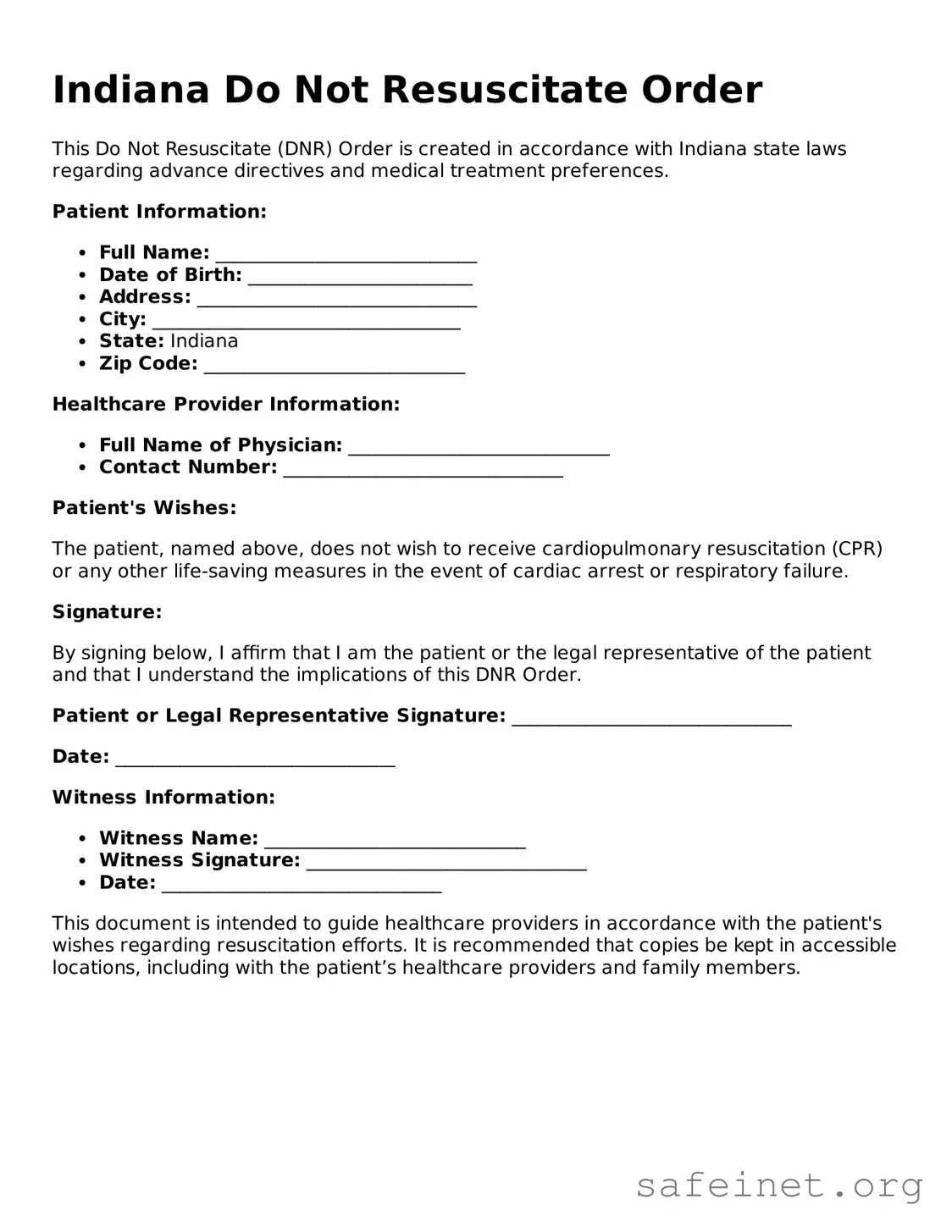
In Indiana, the Do Not Resuscitate (DNR) Order form serves as a crucial document for individuals who wish to communicate their preferences regarding emergency medical treatment. This form allows a person to indicate that they do not want resuscitation efforts, such as CPR or advanced cardiac life support, in the event of a cardiac arrest or respiratory failure. It is important for the form to be completed accurately and signed by a physician to ensure it is legally binding. The DNR Order must be readily available to medical personnel, so it is advisable to keep copies in accessible locations, such as with a trusted family member or in a medical file. Additionally, individuals can discuss their wishes with healthcare providers to ensure that their choices are understood and respected. Understanding the implications of a DNR Order is vital, as it can significantly impact end-of-life care and the quality of life for both the patient and their loved ones.
Indiana Do Not Resuscitate Order
This Do Not Resuscitate (DNR) Order is created in accordance with Indiana state laws regarding advance directives and medical treatment preferences.
Patient Information:
Healthcare Provider Information:
Patient's Wishes:
The patient, named above, does not wish to receive cardiopulmonary resuscitation (CPR) or any other life-saving measures in the event of cardiac arrest or respiratory failure.
Signature:
By signing below, I affirm that I am the patient or the legal representative of the patient and that I understand the implications of this DNR Order.
Patient or Legal Representative Signature: ______________________________
Date: ______________________________
Witness Information:
This document is intended to guide healthcare providers in accordance with the patient's wishes regarding resuscitation efforts. It is recommended that copies be kept in accessible locations, including with the patient’s healthcare providers and family members.
| Fact Name | Description |
|---|---|
| Purpose | The Indiana Do Not Resuscitate (DNR) Order form allows individuals to refuse resuscitation in the event of cardiac or respiratory arrest. |
| Eligibility | Any adult who is capable of making healthcare decisions can complete a DNR Order in Indiana. |
| Governing Law | The DNR Order is governed by Indiana Code § 16-36-6, which outlines the requirements and procedures for executing a DNR. |
| Signature Requirement | The form must be signed by the individual or their legal representative to be valid. |
| Medical Provider's Role | A physician must sign the DNR Order to confirm that the individual meets the criteria for a DNR. |
| Revocation | The DNR Order can be revoked at any time by the individual or their representative. |
| Distribution | It is important to provide copies of the DNR Order to all healthcare providers involved in the individual's care. |
Filling out the Indiana Do Not Resuscitate Order form is an important step for individuals who wish to express their medical preferences. Once completed, this form will guide healthcare providers in emergency situations regarding your wishes for resuscitation.
Once you have filled out the form, it’s crucial to discuss your wishes with your healthcare provider and loved ones. This ensures everyone understands your preferences and can act accordingly in an emergency.
What is a Do Not Resuscitate (DNR) Order in Indiana?
A Do Not Resuscitate Order is a legal document that allows individuals to express their wishes regarding resuscitation efforts in the event of a medical emergency. In Indiana, this order specifically instructs healthcare providers not to perform cardiopulmonary resuscitation (CPR) or other life-saving measures if a person’s heart stops beating or they stop breathing. It is an important part of end-of-life planning and can help ensure that a person’s preferences are respected during critical medical situations.
Who can request a DNR Order in Indiana?
In Indiana, a DNR Order can be requested by individuals who are 18 years or older and are capable of making their own healthcare decisions. If a person is unable to make decisions due to a medical condition, a legally authorized representative, such as a healthcare power of attorney or a family member, may request the order on their behalf. It is essential that the individual’s wishes are clearly communicated and documented to avoid confusion during emergencies.
How is a DNR Order implemented in Indiana?
To implement a DNR Order in Indiana, the individual must complete the official DNR form, which includes necessary information such as the person’s name, date of birth, and signature. The form must be signed by the individual or their authorized representative and a physician. Once completed, the DNR Order should be kept in a readily accessible location, such as a medical file or with personal belongings. It is also advisable to inform family members and healthcare providers about the existence of the DNR Order to ensure everyone is aware of the individual’s wishes.
Can a DNR Order be revoked in Indiana?
Yes, a DNR Order can be revoked at any time by the individual who signed it or their authorized representative. Revocation can be done verbally or in writing. If an individual decides to revoke their DNR Order, they should inform their healthcare providers and ensure that the revocation is documented properly. It is important to communicate any changes in wishes to avoid confusion during medical emergencies.
Failing to clearly state the patient's name. It's essential to ensure that the name is correct and matches official identification.
Not including the date of the order. This information is vital for determining the validity of the document.
Omitting the signature of the patient or their legal representative. Without a signature, the order may not be considered valid.
Neglecting to have a witness sign the form. In Indiana, a witness is often required to validate the order.
Using outdated forms. Always ensure that the most current version of the Do Not Resuscitate Order form is being used.
Not discussing the order with healthcare providers. Communication is key to ensure that everyone is on the same page regarding the patient's wishes.
Failing to review and update the order regularly. A patient's wishes may change over time, and it's important to reflect that in the order.
Inaccurate completion of medical information. Any medical conditions or relevant history should be accurately detailed.
Forgetting to provide copies of the order to relevant parties. Family members and healthcare providers should all have access to the document.
Not understanding the implications of the order. It's crucial to fully comprehend what a Do Not Resuscitate Order means for the patient's care.
When considering end-of-life decisions, individuals often use various documents alongside the Indiana Do Not Resuscitate Order (DNR) form. Each document serves a specific purpose, helping to ensure that a person's healthcare preferences are respected. Here are some common forms and documents that might be utilized in conjunction with a DNR order:
Using these documents together can create a clear and comprehensive plan that reflects an individual's healthcare wishes. It's essential to discuss these forms with family members and healthcare providers to ensure that everyone understands and respects the decisions made.
The Indiana Do Not Resuscitate (DNR) Order form shares similarities with the Advance Healthcare Directive. Both documents allow individuals to express their healthcare preferences in advance, particularly regarding life-sustaining treatments. An Advance Healthcare Directive typically includes a living will and a healthcare power of attorney, outlining the types of medical interventions a person wishes to receive or decline if they become unable to communicate their wishes. This ensures that medical decisions align with the individual's values and desires, similar to how a DNR specifies the refusal of resuscitation efforts.
Another document comparable to the DNR is the Physician Orders for Life-Sustaining Treatment (POLST) form. Like the DNR, the POLST is a medical order that provides specific instructions regarding a patient's treatment preferences in emergency situations. The POLST form goes further by addressing a broader range of medical interventions, such as the use of antibiotics or feeding tubes. Both documents serve to communicate the patient's wishes to healthcare providers, ensuring that their preferences are honored during critical moments.
The Living Will is another document that resembles the DNR Order. A Living Will allows individuals to specify their wishes about medical treatment in situations where they are terminally ill or permanently unconscious. While a DNR focuses specifically on resuscitation efforts, a Living Will can encompass a wider array of treatment preferences, including the use of life support. Both documents aim to guide healthcare providers and loved ones in making decisions that reflect the individual's values.
The Healthcare Power of Attorney (HCPA) is also similar to the DNR Order. This document allows a person to designate a trusted individual to make medical decisions on their behalf if they are unable to do so. While a DNR specifically addresses resuscitation, the HCPA can include instructions about various medical treatments and interventions. Both documents empower individuals to ensure their healthcare preferences are respected, even when they cannot communicate them directly.
The Medical Orders for Scope of Treatment (MOST) form is another document akin to the DNR. The MOST form is designed for individuals with serious illnesses and provides a comprehensive overview of their treatment preferences, including resuscitation efforts. Like the DNR, it is a medical order that healthcare providers must follow. The MOST form goes beyond resuscitation to cover other aspects of care, ensuring that all treatment aligns with the patient's goals and wishes.
Lastly, the Comfort Care Order is similar to the DNR Order in that it focuses on providing comfort rather than aggressive medical interventions. This document outlines the desire for palliative care and pain management instead of life-sustaining treatments. While the DNR specifically addresses resuscitation, the Comfort Care Order emphasizes the importance of quality of life and symptom relief, aligning with the values of individuals who prioritize comfort over invasive procedures.
When filling out the Indiana Do Not Resuscitate Order (DNR) form, it’s important to approach the process with care and clarity. Here are some guidelines to consider:
By following these dos and don’ts, you can help ensure that your DNR order reflects your wishes accurately and is respected by medical personnel when needed.
Understanding the Indiana Do Not Resuscitate (DNR) Order form can be challenging. Here are seven common misconceptions about this important document.
This is not true. A DNR specifically refers to not performing CPR in the event of cardiac arrest. Other medical treatments and interventions will still be provided as needed.
A DNR can be appropriate for anyone who wishes to avoid resuscitation, regardless of their health status. It is a personal choice based on individual values and preferences.
In Indiana, a DNR is valid in both hospital and non-hospital settings, including at home or in long-term care facilities, as long as it is properly completed.
This is a misconception. Individuals can complete a DNR form without legal assistance. However, it is important to ensure that the form meets state requirements.
In fact, a DNR can be revoked or modified at any time. Individuals should communicate any changes to their healthcare providers and keep a copy of the updated form.
While a DNR order must be respected, it is important to note that it only applies in situations of cardiac arrest. Other life-saving measures may still be administered.
This is incorrect. A DNR specifically addresses resuscitation efforts, while a living will covers a broader range of medical treatment preferences, including end-of-life decisions.
Understanding these misconceptions can help individuals make informed decisions about their healthcare preferences.
Filling out and using the Indiana Do Not Resuscitate (DNR) Order form is an important decision for individuals and their families. Here are some key takeaways to consider:
Understanding the Indiana DNR Order can help ensure that your healthcare preferences are respected. Take the time to consider your choices carefully.