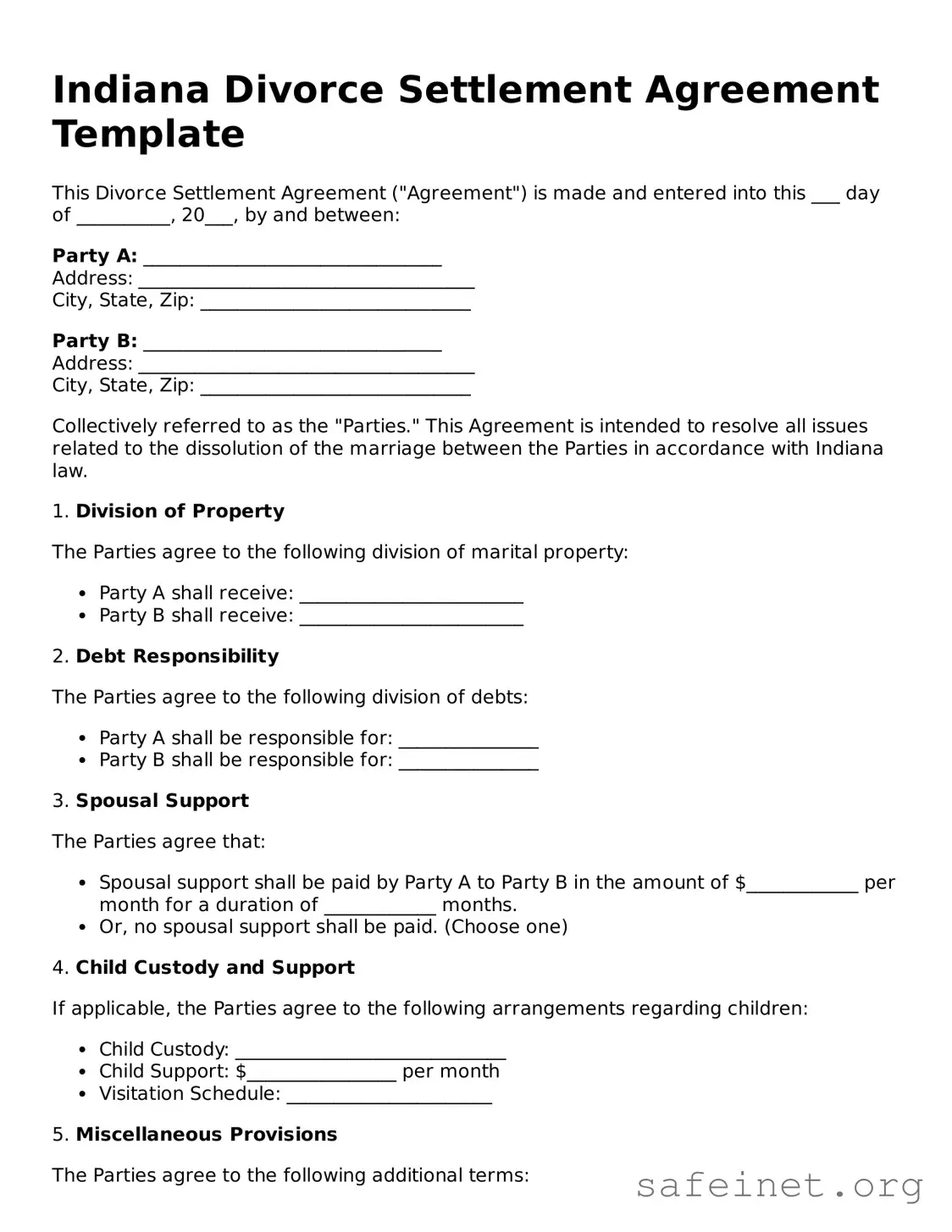
When navigating the complexities of divorce in Indiana, having a clear and comprehensive Divorce Settlement Agreement form is crucial. This document serves as a roadmap for both parties, outlining the terms and conditions that will govern their separation. Key aspects include the division of property, allocation of debts, child custody arrangements, and spousal support. Each section addresses vital issues such as who will keep the family home, how to manage shared assets, and what financial responsibilities each party will maintain post-divorce. Additionally, the form often covers child support obligations and visitation rights, ensuring that the needs of any children involved are prioritized. Understanding the components of this agreement can significantly ease the transition into a new chapter of life, making it essential for individuals to approach the form with clarity and intention.
Indiana Divorce Settlement Agreement Template
This Divorce Settlement Agreement ("Agreement") is made and entered into this ___ day of __________, 20___, by and between:
Party A: ________________________________
Address: ____________________________________
City, State, Zip: _____________________________
Party B: ________________________________
Address: ____________________________________
City, State, Zip: _____________________________
Collectively referred to as the "Parties." This Agreement is intended to resolve all issues related to the dissolution of the marriage between the Parties in accordance with Indiana law.
1. Division of Property
The Parties agree to the following division of marital property:
2. Debt Responsibility
The Parties agree to the following division of debts:
3. Spousal Support
The Parties agree that:
4. Child Custody and Support
If applicable, the Parties agree to the following arrangements regarding children:
5. Miscellaneous Provisions
The Parties agree to the following additional terms:
6. Governing Law
This Agreement shall be governed by and construed in accordance with the laws of the State of Indiana.
IN WITNESS WHEREOF, the Parties have executed this Divorce Settlement Agreement as of the date first above written.
_______________________________
Party A Signature
_______________________________
Party B Signature
_______________________________
Date
_______________________________
Witness Signature
_______________________________
Date
| Fact Name | Description |
|---|---|
| Definition | The Indiana Divorce Settlement Agreement form is a legal document used to outline the terms of a divorce settlement between spouses. |
| Governing Law | This form is governed by Indiana state law, specifically the Indiana Code Title 31, Article 15. |
| Purpose | The form is designed to ensure both parties agree on matters such as property division, child custody, and support payments. |
| Mutual Agreement | Both spouses must voluntarily agree to the terms outlined in the settlement agreement. |
| Filing Requirement | The completed form must be filed with the court as part of the divorce proceedings. |
| Legal Binding | Once approved by the court, the agreement becomes legally binding and enforceable. |
| Modifications | Changes to the agreement may be made, but both parties must consent to any modifications. |
| Child Support Guidelines | Indiana has specific guidelines for calculating child support, which should be followed in the agreement. |
| Resources | Indiana courts provide resources and guidelines to help individuals complete the settlement agreement accurately. |
After gathering the necessary information, you will be ready to fill out the Indiana Divorce Settlement Agreement form. This document outlines the terms agreed upon by both parties regarding the division of property, debts, and any arrangements for children. Completing this form accurately is essential for ensuring that the divorce process moves forward smoothly.
Once you have completed the form, it will need to be submitted to the appropriate court along with any other required documents. Make sure to keep copies for your records. Following these steps carefully will help facilitate a smoother divorce process.
What is the Indiana Divorce Settlement Agreement form?
The Indiana Divorce Settlement Agreement form is a legal document that outlines the terms agreed upon by both spouses during a divorce. This form typically includes details regarding the division of assets, debts, child custody, visitation rights, and child or spousal support. It serves to formalize the agreement between the parties and is submitted to the court for approval as part of the divorce process.
Who should use the Indiana Divorce Settlement Agreement form?
This form is suitable for couples who are seeking a divorce and have reached an agreement on the terms of their separation. It is particularly beneficial for those who wish to avoid a lengthy court battle and can negotiate amicably. Individuals should ensure that both parties fully understand the implications of the agreement before signing.
How do I complete the Indiana Divorce Settlement Agreement form?
To complete the form, both parties should gather all relevant financial documents and information regarding assets and debts. The form will require input on various sections, including property division, child custody arrangements, and support obligations. It is advisable to review the completed form carefully to ensure all details are accurate and reflect the mutual agreement. Legal counsel can provide guidance during this process, although it is not mandatory.
What happens after submitting the Indiana Divorce Settlement Agreement form?
Once the completed form is submitted to the court, a judge will review the agreement to ensure it is fair and complies with state laws. If the judge approves the settlement, it will be incorporated into the final divorce decree. If there are any concerns about the agreement, the court may request modifications or a hearing to address specific issues.
Can the Indiana Divorce Settlement Agreement be modified after it is finalized?
Yes, the Indiana Divorce Settlement Agreement can be modified after it has been finalized, but this typically requires court approval. If circumstances change significantly—such as a change in income, relocation, or changes in the needs of children—either party may petition the court for a modification. It is important to follow the legal process to ensure that any changes are enforceable.
Incomplete Information: Many individuals fail to provide all necessary details. Ensure that every section is filled out completely. Missing information can delay the process.
Incorrect Financial Disclosures: Some people underestimate or overestimate their assets and debts. Be accurate and honest about your financial situation to avoid complications later.
Neglecting Child Custody Arrangements: Parents often overlook specifying custody arrangements. Clearly outline custody and visitation schedules to prevent future disputes.
Failing to Review State Laws: Not all agreements comply with Indiana state laws. Familiarize yourself with local regulations to ensure your agreement is valid and enforceable.
Not Seeking Legal Advice: Some individuals proceed without consulting a lawyer. Professional guidance can help clarify complex issues and protect your rights.
When navigating a divorce in Indiana, it's essential to understand the various forms and documents that may accompany the Divorce Settlement Agreement. Each of these documents serves a specific purpose and helps facilitate the divorce process, ensuring that both parties are clear on their rights and obligations.
Understanding these documents can help streamline the divorce process and ensure that all necessary steps are taken. Each form plays a vital role in protecting your interests and facilitating a smoother transition during this challenging time.
The Indiana Divorce Settlement Agreement form shares similarities with the Marital Settlement Agreement. Both documents serve to outline the terms of a divorce, including the division of assets, debts, and child custody arrangements. A Marital Settlement Agreement is often used in divorce cases to provide a comprehensive framework for how the couple will separate their lives and responsibilities. This document is typically negotiated and agreed upon by both parties, ensuring that all aspects of their separation are clearly defined and legally binding.
Another document that resembles the Indiana Divorce Settlement Agreement is the Child Custody Agreement. This specific form focuses primarily on the arrangements regarding the care and custody of children following a divorce. While the Divorce Settlement Agreement may include custody provisions, the Child Custody Agreement delves deeper into parenting schedules, decision-making responsibilities, and visitation rights. Both documents aim to protect the best interests of the children involved and provide clarity for both parents.
The Separation Agreement is also similar to the Indiana Divorce Settlement Agreement. This document is often used when couples choose to live apart but are not yet ready to file for divorce. It outlines the same types of issues, such as property division and spousal support, as a Divorce Settlement Agreement. The key difference is that a Separation Agreement may be a temporary arrangement, whereas a Divorce Settlement Agreement is finalized as part of the divorce process.
The Property Settlement Agreement shares characteristics with the Indiana Divorce Settlement Agreement as well. This document specifically addresses the division of marital property and debts. It details how assets will be divided between the spouses, including real estate, bank accounts, and personal property. While the Divorce Settlement Agreement encompasses a broader range of issues, the Property Settlement Agreement zeroes in on financial matters, ensuring that both parties understand their rights and obligations regarding property division.
The Parenting Plan is another document that aligns closely with the Indiana Divorce Settlement Agreement. While the Divorce Settlement Agreement may contain elements of a parenting plan, the Parenting Plan is a detailed document that outlines how parents will raise their children post-divorce. It includes specifics about living arrangements, education, healthcare, and communication between parents. Both documents aim to create a stable environment for children while ensuring that both parents remain actively involved in their lives.
Lastly, the Spousal Support Agreement is akin to the Indiana Divorce Settlement Agreement. This document focuses specifically on financial support one spouse may provide to the other following a divorce. It details the amount, duration, and conditions of support payments. While spousal support may be a component of the Divorce Settlement Agreement, the Spousal Support Agreement provides a more focused discussion on financial obligations, ensuring clarity and understanding between the parties involved.
When filling out the Indiana Divorce Settlement Agreement form, it is important to approach the process with care. Here are ten guidelines to follow:
When dealing with divorce, many individuals have misconceptions about the Indiana Divorce Settlement Agreement form. Understanding the truth behind these misunderstandings can help ease the process. Here are five common misconceptions:
Understanding these misconceptions can lead to a smoother divorce process and better outcomes for all parties involved.
When filling out and using the Indiana Divorce Settlement Agreement form, keep these key takeaways in mind: