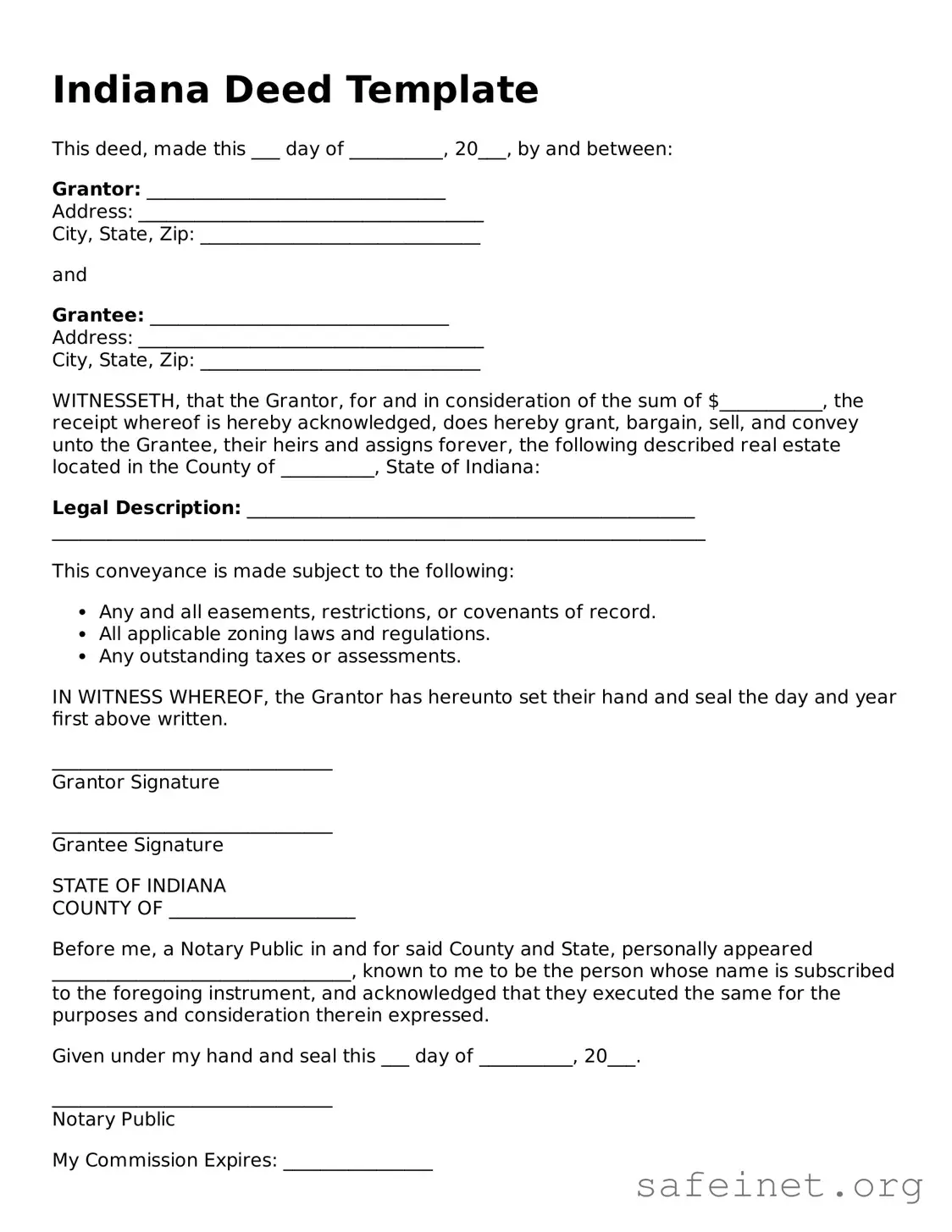
The Indiana Deed form serves as a crucial legal document in real estate transactions within the state. It facilitates the transfer of property ownership from one party to another, ensuring that the transaction is recorded and legally recognized. This form includes essential information such as the names of the grantor and grantee, a description of the property being transferred, and any applicable consideration or payment involved in the transaction. Additionally, the Indiana Deed form may require signatures from witnesses or notarization to validate the transfer. Understanding the components and requirements of this form is vital for anyone involved in buying or selling property in Indiana, as it helps to protect the rights of both parties and provides a clear record of ownership. Properly completing and filing the Indiana Deed form can prevent future disputes over property rights and ensure a smooth transition of ownership.
Indiana Deed Template
This deed, made this ___ day of __________, 20___, by and between:
Grantor: ________________________________
Address: _____________________________________
City, State, Zip: ______________________________
and
Grantee: ________________________________
Address: _____________________________________
City, State, Zip: ______________________________
WITNESSETH, that the Grantor, for and in consideration of the sum of $___________, the receipt whereof is hereby acknowledged, does hereby grant, bargain, sell, and convey unto the Grantee, their heirs and assigns forever, the following described real estate located in the County of __________, State of Indiana:
Legal Description: ________________________________________________
______________________________________________________________________
This conveyance is made subject to the following:
IN WITNESS WHEREOF, the Grantor has hereunto set their hand and seal the day and year first above written.
______________________________
Grantor Signature
______________________________
Grantee Signature
STATE OF INDIANA
COUNTY OF ____________________
Before me, a Notary Public in and for said County and State, personally appeared ________________________________, known to me to be the person whose name is subscribed to the foregoing instrument, and acknowledged that they executed the same for the purposes and consideration therein expressed.
Given under my hand and seal this ___ day of __________, 20___.
______________________________
Notary Public
My Commission Expires: ________________
| Fact Name | Description |
|---|---|
| Governing Law | The Indiana Deed form is governed by the Indiana Code Title 32, Article 21. |
| Types of Deeds | Indiana recognizes several types of deeds, including warranty deeds, quitclaim deeds, and special warranty deeds. |
| Execution Requirements | The deed must be signed by the grantor, and the signature must be acknowledged before a notary public. |
| Recording | To provide public notice, the deed should be recorded in the county where the property is located. |
| Consideration | The deed must include a statement of consideration, which is the value exchanged for the property. |
| Legal Description | A legal description of the property must be included to clearly identify the parcel being transferred. |
| Transfer Tax | Indiana imposes a transfer tax on real estate transactions, which must be paid at the time of recording. |
| Delivery | The deed is not effective until it is delivered to the grantee, signifying the grantor's intent to transfer ownership. |
Once you have the Indiana Deed form in hand, it's essential to complete it accurately to ensure the transfer of property is legally binding. After filling out the form, you will need to sign it in front of a notary public. Once notarized, the deed should be filed with the county recorder's office where the property is located.
What is an Indiana Deed form?
An Indiana Deed form is a legal document used to transfer ownership of real property from one party to another. It outlines the details of the property, the parties involved, and the terms of the transfer. This form is essential for ensuring that the change in ownership is recorded and legally recognized.
What types of deeds are available in Indiana?
Indiana recognizes several types of deeds, including Warranty Deeds, Quitclaim Deeds, and Special Warranty Deeds. A Warranty Deed provides a guarantee that the seller holds clear title to the property. A Quitclaim Deed transfers any interest the seller has without making any guarantees. A Special Warranty Deed offers limited warranties, covering only the time the seller owned the property.
How do I complete an Indiana Deed form?
To complete an Indiana Deed form, you need to provide specific information such as the names of the grantor (seller) and grantee (buyer), a legal description of the property, and the date of the transfer. It's important to ensure that all information is accurate and that the form is signed by the grantor in the presence of a notary public.
Is notarization required for an Indiana Deed?
Yes, notarization is required for an Indiana Deed. The grantor must sign the deed in front of a notary public to ensure that the document is valid and legally binding. The notary will then affix their seal to the document, confirming the authenticity of the signatures.
Where should I file the Indiana Deed form?
The completed Indiana Deed form should be filed with the county recorder's office in the county where the property is located. Filing the deed ensures that the transfer of ownership is officially recorded and protects the rights of the new owner.
Are there any fees associated with filing an Indiana Deed?
Yes, there are fees for filing an Indiana Deed. The amount varies by county, so it's advisable to check with the local county recorder's office for the exact fee. Additionally, there may be other costs, such as notarization fees or taxes related to the transfer of property.
Can I use a generic deed form for Indiana?
While you can find generic deed forms online, it is recommended to use an Indiana-specific deed form to ensure compliance with state laws. Using a form tailored for Indiana helps avoid potential issues with the transfer process and ensures that all required information is included.
What happens if I don't file the Indiana Deed?
If you do not file the Indiana Deed, the transfer of ownership will not be officially recognized. This can lead to complications in proving ownership, selling the property in the future, or dealing with legal disputes. Filing the deed is crucial for protecting your property rights.
Can I revoke a deed in Indiana?
Revoking a deed in Indiana is possible, but it typically requires filing a new deed that explicitly states the intention to revoke the previous one. This process can be complex, so consulting with a legal professional is advisable to ensure that it is done correctly and legally.
Failing to include the legal description of the property. This description must be precise and is essential for identifying the property being transferred.
Not providing the names of all parties involved in the transaction. All grantors and grantees must be listed to ensure the deed is valid.
Using incorrect or outdated property addresses. The address should match the current records to avoid confusion and potential legal issues.
Neglecting to sign the deed. All parties must sign the document in the appropriate places for it to be legally binding.
Not having the deed witnessed or notarized. In Indiana, a deed must be acknowledged by a notary public to be enforceable.
Omitting the date of execution. This date is crucial for establishing when the deed was created and can affect the priority of claims against the property.
Failing to check for liens or encumbrances on the property. A thorough title search should be conducted to ensure there are no outstanding claims that could complicate the transfer.
Not filing the deed with the appropriate county recorder's office. After completion, the deed must be recorded to provide public notice of the property transfer.
When completing a property transfer in Indiana, several additional forms and documents may be necessary to ensure a smooth transaction. Each of these documents serves a specific purpose and helps protect the interests of all parties involved.
Understanding these documents can significantly ease the property transfer process. Each serves a vital role in ensuring that the transaction is legally sound and that all parties are protected throughout the process.
The Indiana Quitclaim Deed is similar to the standard Deed form as both documents facilitate the transfer of property ownership. A Quitclaim Deed, however, conveys whatever interest the grantor has in the property without guaranteeing that the title is clear. This means that the recipient may not receive full ownership rights, as the grantor does not warrant the title. The simplicity of the Quitclaim Deed makes it a popular choice for transferring property between family members or in situations where the parties trust each other.
The Warranty Deed is another document akin to the Indiana Deed form. Unlike the Quitclaim Deed, a Warranty Deed guarantees that the grantor holds clear title to the property and has the right to sell it. This type of deed provides more protection to the buyer, as it assures them that there are no outstanding claims or liens against the property. The Warranty Deed is often used in traditional real estate transactions where buyers seek assurance of their investment.
The Special Warranty Deed shares similarities with the Warranty Deed but includes a specific limitation on the grantor’s liability. It guarantees that the grantor has not encumbered the property during their ownership but does not cover any issues that may have existed prior to their ownership. This type of deed is commonly used in commercial real estate transactions, where the seller may not be aware of all historical claims against the property.
The Bargain and Sale Deed is another document related to the Indiana Deed form. This deed implies that the grantor has the right to sell the property but does not provide any warranties regarding the title. It is often used in foreclosure sales or tax sales, where the seller may not be able to offer guarantees about the property’s condition or title. Buyers should exercise caution when dealing with this type of deed, as it does not protect them against potential claims.
The Grant Deed is similar to the Indiana Deed form in that it transfers property ownership. However, it also includes implied warranties that the property has not been sold to anyone else and that there are no undisclosed encumbrances. This type of deed is commonly used in California and offers a middle ground between a Warranty Deed and a Quitclaim Deed, providing some level of assurance to the buyer.
The Executor’s Deed is relevant when a property is transferred as part of an estate settlement. This deed is used by the executor of an estate to convey real estate to heirs or beneficiaries. While it may not provide the same level of protection as a Warranty Deed, it is a necessary legal document that formalizes the transfer of property from the deceased to the living. The Executor’s Deed ensures that the wishes of the deceased are honored and that the property is legally transferred.
The Trustee’s Deed is another document that shares similarities with the Indiana Deed form, particularly in the context of trusts. When a property is held in a trust, the trustee can use a Trustee’s Deed to transfer the property to a beneficiary or third party. This deed conveys the property without warranties, similar to a Quitclaim Deed. It is essential for trustees to ensure that they are acting within the terms of the trust when executing this type of deed.
When filling out the Indiana Deed form, it is important to follow certain guidelines to ensure the process goes smoothly. Here are seven things to do and not do:
Understanding the Indiana Deed form is crucial for anyone involved in real estate transactions in the state. However, several misconceptions can lead to confusion. Here are nine common misconceptions:
Not all deeds serve the same purpose. Indiana recognizes various types of deeds, including warranty deeds, quitclaim deeds, and special warranty deeds, each with different implications for ownership and liability.
While a deed can be valid without recording, failing to do so can create complications. Recording a deed provides public notice and protects the buyer's interest against claims from third parties.
While legal assistance can be beneficial, individuals can prepare a deed on their own as long as they follow the state’s requirements. However, mistakes can lead to significant issues.
A deed can be amended or revoked, but this must be done through the proper legal channels. Simply altering a signed deed is not permissible.
In Indiana, it is not necessary for all parties to be present at the same time. As long as each party signs the deed, it can be valid.
While a deed transfers ownership, it does not necessarily convey all rights, such as easements or restrictions that may exist on the property.
In Indiana, a deed must be signed in the presence of a notary public to be valid. This adds a layer of authenticity and legal recognition.
Recording a deed does not make it immune to challenges. Disputes can arise over ownership, validity, or other legal issues even after recording.
While deeds are generally permanent, legal actions such as rescission or reformation can be pursued under certain circumstances to address mistakes or fraud.
By understanding these misconceptions, individuals can navigate the complexities of real estate transactions in Indiana more effectively.
When filling out and using the Indiana Deed form, several important considerations should be kept in mind. The following key takeaways can help ensure the process is completed accurately and effectively: