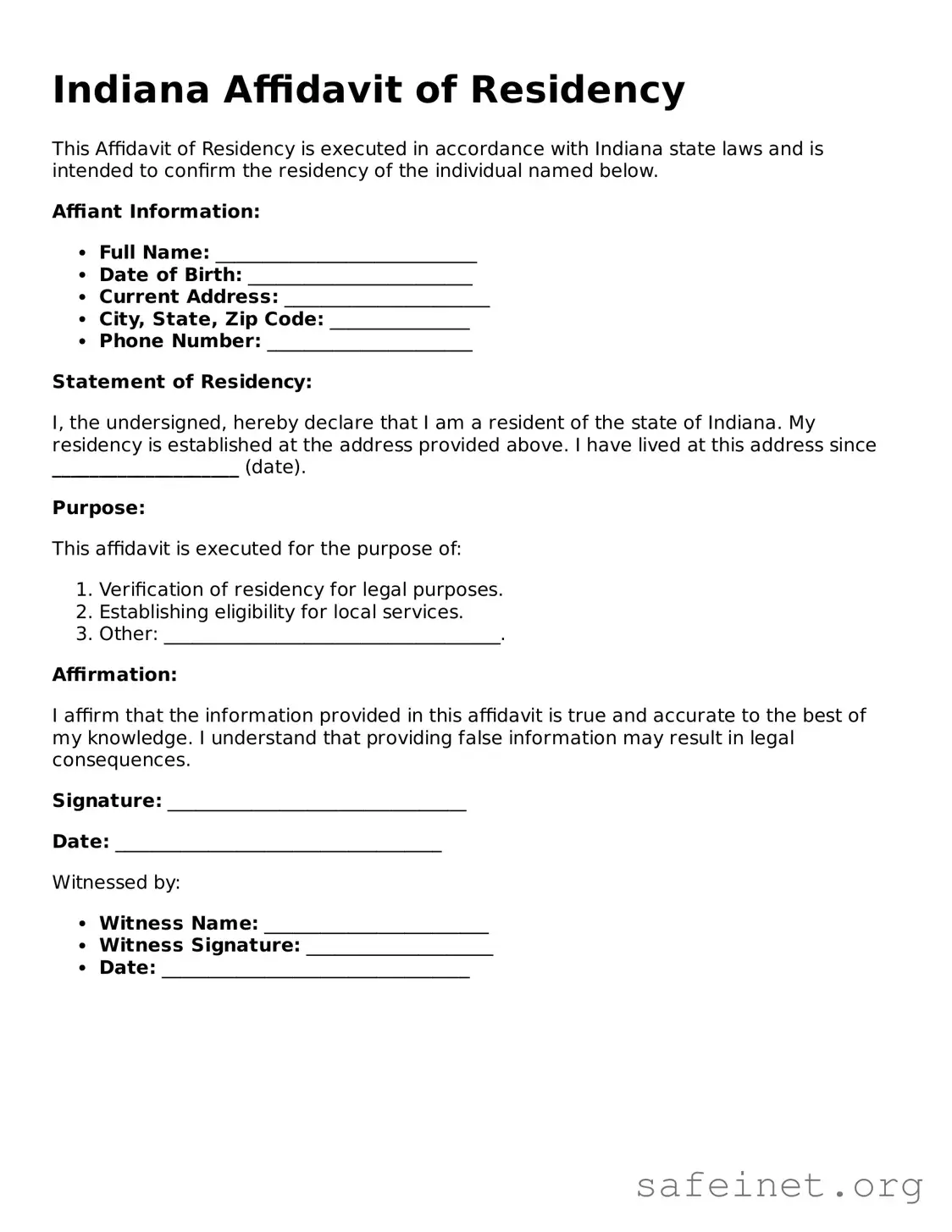
In the state of Indiana, establishing residency is a crucial step for various legal and administrative purposes, such as enrolling in schools, obtaining a driver’s license, or registering to vote. The Indiana Affidavit of Residency form serves as a vital document that individuals can use to affirm their residence within the state. This form requires the individual to provide essential details, including their name, address, and the duration of their residency. Additionally, it may necessitate the signature of a witness or a notary to verify the authenticity of the information provided. Understanding the requirements and implications of this form is important, as it plays a significant role in ensuring that individuals are recognized as residents and can access the rights and services afforded to them. By completing the affidavit accurately, individuals can avoid potential legal complications and ensure that their residency status is clearly established in the eyes of the law.
Indiana Affidavit of Residency
This Affidavit of Residency is executed in accordance with Indiana state laws and is intended to confirm the residency of the individual named below.
Affiant Information:
Statement of Residency:
I, the undersigned, hereby declare that I am a resident of the state of Indiana. My residency is established at the address provided above. I have lived at this address since ____________________ (date).
Purpose:
This affidavit is executed for the purpose of:
Affirmation:
I affirm that the information provided in this affidavit is true and accurate to the best of my knowledge. I understand that providing false information may result in legal consequences.
Signature: ________________________________
Date: ___________________________________
Witnessed by:
| Fact Name | Description |
|---|---|
| Purpose | The Indiana Affidavit of Residency form is used to verify a person's residence within the state of Indiana. |
| Governing Law | This form is governed by Indiana Code § 4-21.5-3-1. |
| Who Can Use It | Any Indiana resident can complete this affidavit to affirm their residency for various legal purposes. |
| Required Information | The form requires the individual's name, address, and a declaration of residency. |
| Signature Requirement | The affidavit must be signed in the presence of a notary public to be valid. |
| Use Cases | This affidavit is commonly used for voter registration, school enrollment, and other legal matters requiring proof of residency. |
Filling out the Indiana Affidavit of Residency form is an important step for individuals needing to establish their residency in the state. Once completed, this form will be submitted to the appropriate authority as part of the process to verify residency status.
What is the Indiana Affidavit of Residency form?
The Indiana Affidavit of Residency form is a legal document used to verify an individual's residence in the state of Indiana. It is often required for various purposes, such as enrolling in schools, applying for government assistance, or establishing residency for voting purposes.
Who needs to complete the Affidavit of Residency?
Individuals who need to confirm their residency in Indiana may be required to complete this form. This includes students enrolling in schools, individuals applying for state benefits, or those who need to prove their residence for legal reasons.
Where can I obtain the Affidavit of Residency form?
The Affidavit of Residency form can typically be obtained from local government offices, such as the county clerk's office, or it may be available online through official state or local government websites.
What information is required on the form?
The form generally requires personal information such as the individual's name, address, date of birth, and sometimes additional details like the names of family members or roommates. The individual may also need to provide proof of residency, such as utility bills or lease agreements.
How do I submit the completed form?
Once completed, the Affidavit of Residency form should be submitted to the appropriate authority. This could be a school district, government agency, or court, depending on the purpose for which the affidavit is being used. Some entities may allow electronic submission, while others may require a physical copy.
Is there a fee associated with the Affidavit of Residency?
Typically, there is no fee for completing the Affidavit of Residency itself. However, there may be fees for obtaining supporting documents or for processing the form by the receiving agency. It is advisable to check with the specific entity to determine if any fees apply.
Can the Affidavit of Residency be used for multiple purposes?
Yes, the Affidavit of Residency can often be used for multiple purposes, such as school enrollment, applying for state assistance, or verifying residency for legal matters. However, it is important to ensure that the form meets the specific requirements of each situation.
What happens if I provide false information on the form?
Providing false information on the Affidavit of Residency can lead to serious consequences, including legal penalties. Individuals may face charges of perjury or fraud, which can result in fines or other legal repercussions. It is crucial to provide accurate and truthful information.
How long is the Affidavit of Residency valid?
The validity of the Affidavit of Residency can vary depending on the purpose for which it is used. Some entities may require a new affidavit each year, while others may accept a single affidavit for an extended period. It is advisable to check with the receiving agency for their specific requirements.
Can I get assistance in completing the Affidavit of Residency?
Yes, individuals can seek assistance in completing the Affidavit of Residency. This help can come from legal aid organizations, local government offices, or community resources. It is important to ensure that the form is filled out correctly to avoid any issues.
Incomplete Information: Many individuals fail to provide all necessary details, such as their full name, address, and date of birth. Omitting any of these can lead to delays or rejections.
Incorrect Address: Some people mistakenly enter an outdated or incorrect address. It is essential to ensure that the address matches official records to avoid complications.
Signature Issues: A common mistake is not signing the affidavit. Some individuals may overlook this requirement, thinking that filling out the form is sufficient.
Not Notarizing: Failing to have the affidavit notarized is a frequent oversight. The notarization process adds credibility and is often required for the affidavit to be valid.
Providing False Information: Intentionally or unintentionally providing false information can lead to legal consequences. Honesty is crucial when completing this document.
Missing Supporting Documents: Some individuals forget to include necessary supporting documents, such as proof of residency. These documents help substantiate the claims made in the affidavit.
Ignoring Deadlines: Many people fail to submit the affidavit by the required deadline. Awareness of timelines is essential to ensure compliance with legal requirements.
Not Reviewing the Form: Skipping the review process can lead to overlooked errors. Taking the time to double-check the form can prevent many common mistakes.
Assuming the Form is Universal: Some individuals mistakenly believe that the affidavit form is the same across different states. Each state may have specific requirements, so it is important to use the correct form for Indiana.
When completing an Indiana Affidavit of Residency, several other forms and documents may be necessary to ensure a smooth process. These documents provide additional verification of residency and identity, helping to clarify your situation to authorities or institutions. Below is a list of commonly used forms that often accompany the Affidavit of Residency.
Gathering these documents alongside the Indiana Affidavit of Residency can streamline your process and provide the necessary evidence to support your residency claim. Always ensure that you have the most current versions of these documents to avoid any complications.
The Indiana Affidavit of Residency form shares similarities with the Affidavit of Support, commonly used in immigration cases. Both documents require individuals to provide a sworn statement affirming certain facts. In the case of the Affidavit of Support, a sponsor must declare their financial ability to support an immigrant. Like the Indiana form, this affidavit is often used to establish eligibility for specific benefits or legal statuses, relying on the credibility of the signer to verify the information presented.
Another document that parallels the Indiana Affidavit of Residency is the Declaration of Homestead. This form allows homeowners to declare their primary residence and often provides certain legal protections. Both documents serve to affirm residency status. While the Indiana form focuses on confirming where a person lives for legal purposes, the Declaration of Homestead can also impact tax benefits and creditor protections, highlighting the importance of residency in various legal contexts.
The Voter Registration Affidavit is also similar to the Indiana Affidavit of Residency. This document is used to verify a person's eligibility to vote based on their residency. Both forms require the individual to attest to their current address and residency status. The Voter Registration Affidavit often necessitates additional identification or proof of residency, ensuring that only eligible residents participate in elections, much like the Indiana form seeks to establish residency for other legal matters.
Additionally, the Affidavit of Identity is comparable to the Indiana Affidavit of Residency. This document is often used when individuals need to confirm their identity, particularly in legal or financial transactions. Both affidavits involve a sworn statement and require the signer to provide personal information. While the Indiana form focuses on residency, the Affidavit of Identity is crucial for establishing a person's identity in various legal contexts, emphasizing the importance of accurate information in legal processes.
Finally, the Certificate of Residency is another document that resembles the Indiana Affidavit of Residency. This certificate is often required for tax purposes or to qualify for certain benefits. Like the Indiana affidavit, it serves to confirm a person's residency status. The Certificate of Residency typically involves official verification from local authorities, while the Indiana form relies on the individual's sworn statement, showcasing different methods of validating residency in legal frameworks.
When filling out the Indiana Affidavit of Residency form, it's important to be careful and thorough. Here are some key points to keep in mind:
Understanding the Indiana Affidavit of Residency form is essential for those who need to establish their residency status. However, several misconceptions surround this form. Here are seven common misunderstandings:
Many believe that the affidavit is exclusively for students. In reality, it can be used by anyone needing to verify their residency for various purposes, such as voting or obtaining a driver's license.
Some individuals think that notarization is mandatory. While notarization can add credibility, it is not a requirement for the affidavit to be valid.
There is a misconception that the affidavit can be filled out and submitted online. However, it typically requires a physical signature and submission in person or via mail.
People often assume that one affidavit can serve multiple needs. Different agencies or institutions may require a specific version of the affidavit tailored to their requirements.
Some think the affidavit is only for those moving to Indiana. Long-term residents may also need to complete the form for various official purposes, such as updating records.
There is a belief that submitting the affidavit automatically guarantees residency status. While it serves as a declaration, the final determination rests with the reviewing agency.
Many feel that completing the affidavit is a complex task. In truth, the form is straightforward, and most individuals can fill it out without legal assistance.
Clarifying these misconceptions can help individuals navigate the residency verification process more effectively.
Filling out the Indiana Affidavit of Residency form is an important step for various legal and administrative purposes. Here are some key takeaways to keep in mind:
By following these guidelines, you can navigate the process of completing the Indiana Affidavit of Residency with confidence.