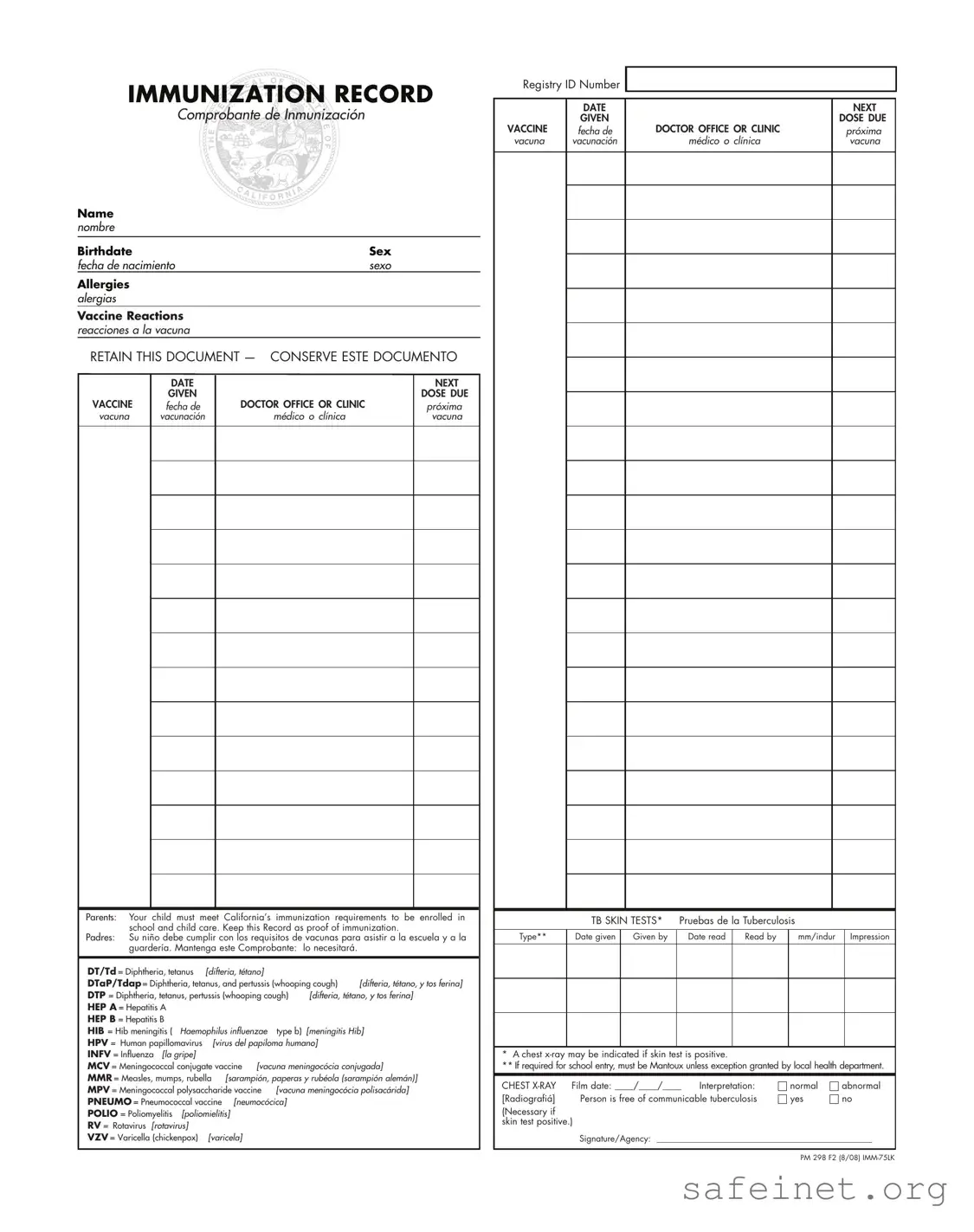
The Immunization Record form serves as a vital document for parents and guardians, ensuring that children meet the immunization requirements necessary for enrollment in schools and childcare facilities in California. This form includes essential details such as the child's name, birthdate, and sex, along with a section for documenting any allergies and vaccine reactions. It is crucial to retain this document, as it acts as proof of immunization, which may be required by educational institutions. The form also outlines the various vaccines administered, including DTaP, MMR, and Hepatitis B, among others, along with the dates when these vaccines were given and when the next doses are due. Additionally, it features sections for tuberculosis skin tests and chest x-ray interpretations, ensuring a comprehensive health overview. Parents are advised to keep this record in a safe place, as it will be necessary for school entry and may play a role in safeguarding public health.
IMMUNIZATION RECORD
Comprobante de Inmunización
Name nombre
Birthdate |
|
|
Sex |
||
fecha de nacimiento |
|
sexo |
|||
Allergies |
|
|
|
|
|
alergias |
|
|
|
|
|
Vaccine Reactions |
|
|
|
|
|
reacciones a la vacuna |
|
|
|
|
|
RETAIN THIS DOCUMENT — CONSERVE ESTE DOCUMENTO |
|||||
|
DATE |
|
|
NEXT |
|
|
|
|
|||
|
GIVEN |
|
|
DOSE DUE |
|
VACCINE |
fecha de |
DOCTOR OFFICE OR CLINIC |
|
próxima |
|
vacuna |
vacunación |
médico o clínica |
|
vacuna |
|
|
|
|
|
|
|
|
|
|
|
|
|
|
|
|
|
|
|
|
|
|
|
|
|
|
|
|
|
|
|
|
|
|
|
|
|
|
|
|
|
|
|
|
|
|
|
|
|
|
|
|
|
|
|
|
|
|
|
|
|
|
|
|
|
|
|
|
|
|
|
|
|
|
|
|
|
|
|
|
|
|
|
|
|
|
|
|
|
|
|
Parents: Your child must meet California’s immunization requirements to be enrolled in school and child care. Keep this Record as proof of immunization.
Padres: Su niño debe cumplir con los requisitos de vacunas para asistir a la escuela y a la guardería. Mantenga este Comprobante: lo necesitará.
DT/Td = Diphtheria, tetanus |
[difteria, tétano] |
|
|
|
|
DTaP/Tdap = Diphtheria, tetanus, and pertussis (whooping cough) |
[difteria, tétano, y tos ferina] |
||||
DTP = Diphtheria, tetanus, pertussis (whooping cough) |
[difteria, tétano, y tos ferina] |
||||
HEP A = Hepatitis A |
|
|
|
|
|
HEP B = Hepatitis B |
|
|
|
|
|
HIB = Hib meningitis ( |
Haemophilus influenzae |
type b) |
[meningitis Hib] |
||
HPV = Human papillomavirus |
[virus del papiloma humano] |
|
|||
INFV = Influenza [la gripe] |
|
|
|
|
|
MCV = Meningococcal conjugate vaccine [vacuna meningocócia conjugada] |
|||||
MMR = Measles, mumps, rubella [sarampión, paperas y rubéola (sarampión alemán)] |
|||||
MPV = Meningococcal polysaccharide vaccine |
[vacuna meningocócia polisacárida] |
||||
PNEUMO = Pneumococcal vaccine [neumocócica] |
|
|
|||
POLIO = Poliomyelitis |
[poliomielitis] |
|
|
|
|
RV = Rotavirus [rotavirus] |
|
|
|
|
|
VZV = Varicella (chickenpox) |
[varicela] |
|
|
|
|
Registry ID Number
|
DATE |
|
NEXT |
|
GIVEN |
|
DOSE DUE |
VACCINE |
fecha de |
DOCTOR OFFICE OR CLINIC |
próxima |
vacuna |
vacunación |
médico o clínica |
vacuna |
|
TB SKIN TESTS* |
Pruebas de la Tuberculosis |
|
|
|||
|
|
|
|
|
|
|
|
Type** |
Date given |
Given by |
Date read |
Read by |
|
mm/indur |
Impression |
|
|
|
|
|
|
|
|
|
|
|
|
|
|
|
|
|
|
|
|
|
|
|
|
* A chest
** If required for school entry, must be Mantoux unless exception granted by local health department.
CHEST |
Film date: ____/____/____ |
Interpretation: |
|
normal |
|
abnormal |
|
[Radiografiá] |
Person is free of communicable tuberculosis |
|
yes |
|
|
no |
|
|
|
|
|||||
(Necessary if skin test positive.)
Signature/Agency: __________________________________________________
PM 298 F2 (8/08)
| Fact Name | Details |
|---|---|
| Purpose | The Immunization Record form serves as proof of immunization for children enrolling in school and child care in California. |
| Governing Law | California Education Code Section 49403 mandates immunization records for school enrollment. |
| Required Information | The form must include the child's name, birthdate, sex, and any allergies. |
| Vaccine Types | It lists various vaccines such as DTaP, MMR, and HPV, which are essential for children's health. |
| Retention | Parents should retain this document as it is necessary for school enrollment and future medical needs. |
| Next Dose | The form includes fields for the date the next vaccine is due, ensuring timely immunization. |
| TB Testing | It requires documentation of TB skin tests if applicable, including the date given and results. |
| Chest X-ray | A chest x-ray may be necessary if the TB skin test is positive, as indicated on the form. |
| Signature Requirement | A signature from the healthcare provider or agency is required to validate the immunization record. |
| Language Accessibility | The form is available in both English and Spanish, ensuring accessibility for diverse populations. |
Filling out the Immunization Record form is an important step in ensuring your child's compliance with school and childcare immunization requirements. This document will serve as proof of immunization, so it’s essential to complete it accurately. Follow the steps below to fill out the form correctly.
What is the purpose of the Immunization Record form?
The Immunization Record form serves as an official document that tracks a child's vaccination history. It is essential for parents to keep this record, as it provides proof of immunization. In California, for instance, children must meet specific immunization requirements to enroll in school and child care. This form helps ensure that children receive the necessary vaccines to protect their health and the health of those around them.
What information is included in the Immunization Record form?
The form contains several key pieces of information. It includes the child's name, birthdate, and sex, as well as any allergies and vaccine reactions. Additionally, it lists the vaccines administered, along with the dates they were given and when the next doses are due. The form also provides space for the doctor's office or clinic to record relevant details, making it a comprehensive record of a child's immunization status.
Why is it important to keep this document?
Keeping the Immunization Record is crucial for several reasons. First, it serves as proof that a child has received the required vaccinations, which is often necessary for school enrollment. Second, it helps parents keep track of upcoming vaccinations, ensuring that their child stays up-to-date on immunizations. Lastly, having this document readily available can assist healthcare providers in making informed decisions about a child's health care.
What should parents do if they lose the Immunization Record?
If parents lose the Immunization Record, they should contact their child's healthcare provider or the clinic where the vaccinations were administered. Many clinics maintain records of vaccinations and can provide a replacement or a copy of the immunization history. Additionally, parents can check with local health departments, as they may also have access to immunization records.
What are the consequences of not meeting immunization requirements?
Failing to meet immunization requirements can lead to significant consequences for children. In many states, including California, children may be denied enrollment in school or child care facilities if they do not have the necessary vaccinations. This can disrupt a child's education and social development. Moreover, unvaccinated children may be at a higher risk for contracting and spreading preventable diseases, posing a threat to public health.
Inaccurate Personal Information: Failing to provide correct details such as the child's name or birthdate can lead to issues with school enrollment and immunization tracking.
Missing Vaccine Dates: Not filling in the dates when vaccines were administered can result in a lack of proof of immunization, which is crucial for school entry.
Omitting Allergies: Not disclosing any known allergies can pose health risks. This information is essential for healthcare providers to make informed decisions.
Incorrect Vaccine Information: Providing wrong details about the vaccines received, such as the type or dosage, can lead to complications in immunization records.
Neglecting to Retain the Document: Failing to keep a copy of the Immunization Record can create problems later when proof of vaccination is needed for school or other activities.
The Immunization Record form is essential for documenting a child's vaccination history. Alongside this form, several other documents are commonly used to ensure compliance with immunization requirements and provide necessary health information. Below is a list of related forms and documents that may be required or beneficial in conjunction with the Immunization Record.
Each of these documents plays a crucial role in maintaining accurate health records and ensuring that children receive the necessary vaccinations for their well-being. Parents should keep these documents organized and accessible to facilitate smooth communication with healthcare providers and schools.
The Immunization Record form is similar to the Birth Certificate. Both documents serve as essential proof of a person's identity and health history. While the Birth Certificate establishes legal identity and age, the Immunization Record details the vaccines a child has received, which is crucial for school enrollment and public health compliance. Both documents are often required for various applications, such as enrolling in school or applying for government services.
Another document closely related to the Immunization Record is the Health Insurance Card. This card provides information about an individual's health coverage and often includes details about immunizations covered by the insurance plan. Just like the Immunization Record, the Health Insurance Card is vital for accessing medical care and ensuring that vaccinations are administered as part of a broader healthcare plan. Both documents play a role in facilitating healthcare services and ensuring compliance with health regulations.
The School Health Record is also similar to the Immunization Record. Schools often maintain these records to track students' health and immunization status. This document includes information about vaccinations and any health concerns that may affect a child's ability to participate in school activities. Like the Immunization Record, the School Health Record helps schools ensure that students meet health requirements for attendance and participation in programs.
Additionally, the Medical History Form shares similarities with the Immunization Record. This form collects comprehensive information about a person's past health conditions, allergies, and vaccinations. Both documents are essential for healthcare providers to understand a patient's health background and make informed decisions about future medical care. They ensure that healthcare providers have access to critical health information that can impact treatment options.
Finally, the Travel Vaccination Record is akin to the Immunization Record. This document is used when individuals travel internationally and need to show proof of vaccinations to enter certain countries. Both records contain detailed information about the vaccines received, ensuring compliance with health regulations in various jurisdictions. They serve as important documentation for protecting public health and preventing the spread of diseases across borders.
When filling out the Immunization Record form, it is crucial to ensure accuracy and compliance with requirements. Below is a list of ten things to do and not do during this process.
Here are five common misconceptions about the Immunization Record form:
When filling out and using the Immunization Record form, keep the following key takeaways in mind:
By following these guidelines, you can effectively manage your child's immunization records and ensure compliance with health regulations.