In Illinois, the Small Estate Affidavit serves as a streamlined tool for individuals dealing with the estate of a deceased person when the total value of the estate falls below a certain threshold. This form simplifies the process of transferring assets without the need for formal probate proceedings, which can be time-consuming and costly. Typically, the Small Estate Affidavit can be used when the estate's value is under $100,000, excluding certain types of property like real estate. The affidavit allows heirs or beneficiaries to claim personal property, such as bank accounts, vehicles, or other assets, directly from institutions or individuals holding the deceased's assets. By providing a sworn statement that outlines the decedent's assets, debts, and the rightful heirs, this form facilitates a smoother transition of property. Moreover, it ensures that the deceased's wishes are honored while minimizing the burden on family members during a challenging time. Understanding the nuances of the Small Estate Affidavit is crucial for anyone navigating the complexities of estate management in Illinois.
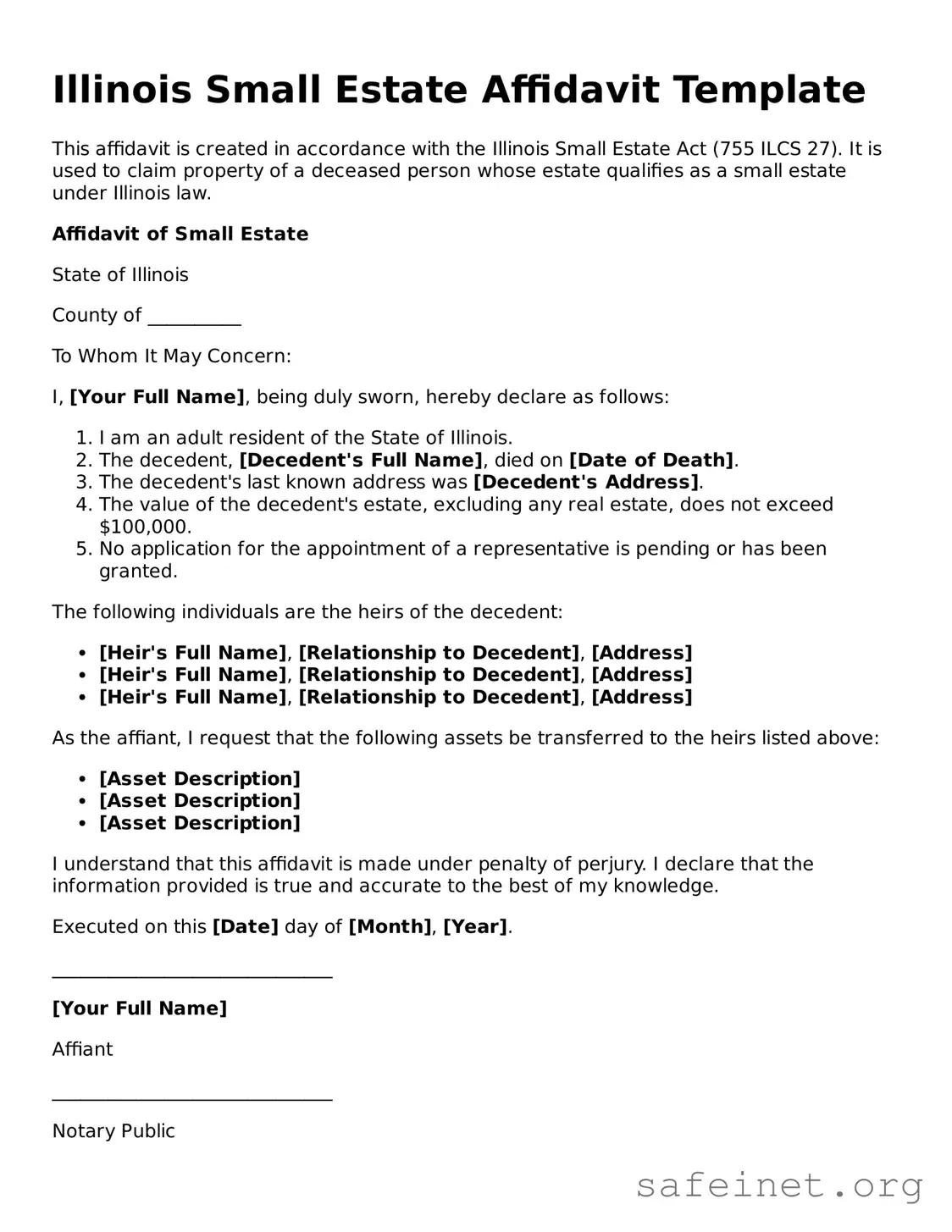
Illinois Small Estate Affidavit Template
This affidavit is created in accordance with the Illinois Small Estate Act (755 ILCS 27). It is used to claim property of a deceased person whose estate qualifies as a small estate under Illinois law.
Affidavit of Small Estate
State of Illinois
County of __________
To Whom It May Concern:
I, [Your Full Name], being duly sworn, hereby declare as follows:
The following individuals are the heirs of the decedent:
As the affiant, I request that the following assets be transferred to the heirs listed above:
I understand that this affidavit is made under penalty of perjury. I declare that the information provided is true and accurate to the best of my knowledge.
Executed on this [Date] day of [Month], [Year].
______________________________
[Your Full Name]
Affiant
______________________________
Notary Public
| Fact Name | Details |
|---|---|
| Purpose | The Illinois Small Estate Affidavit allows heirs to collect assets of a deceased person without going through probate. |
| Eligibility | This form is applicable when the total value of the estate is $100,000 or less, excluding real estate. |
| Governing Law | The use of the Small Estate Affidavit is governed by 755 ILCS 27/1 et seq. |
| Filing Requirements | The affidavit must be signed by all heirs and notarized to be valid. |
| Assets Covered | The affidavit can be used to claim bank accounts, personal property, and other assets, excluding real estate. |
| Timeframe | Heirs can use the affidavit immediately after the death of the decedent, provided they meet all requirements. |
| Notarization | Notarization is essential; it adds a layer of authenticity to the document. |
| Limitations | It cannot be used for estates with debts that exceed the value of the assets. |
| Distribution | Assets are distributed according to Illinois intestacy laws if there is no will. |
| Legal Advice | While the form is straightforward, consulting with a legal professional can provide guidance tailored to individual situations. |
After gathering the necessary information and documents, you will proceed to fill out the Illinois Small Estate Affidavit form. This form is crucial for settling the estate of a deceased individual without going through the lengthy probate process. Completing it accurately will help ensure that the assets can be distributed to the rightful heirs efficiently.
What is the Illinois Small Estate Affidavit?
The Illinois Small Estate Affidavit is a legal document that allows individuals to claim property of a deceased person without going through the formal probate process. This form is typically used when the total value of the deceased's estate is below a certain threshold, which is currently set at $100,000 for personal property and $200,000 for real estate as of 2023.
Who can use the Small Estate Affidavit?
Any individual who is an heir or a legatee of the deceased may use the Small Estate Affidavit. This includes family members such as spouses, children, or siblings. Additionally, the individual must be able to demonstrate that they have a legal right to the property in question.
What is the process for completing the Small Estate Affidavit?
The process involves filling out the Small Estate Affidavit form accurately. The individual must provide information about the deceased, including their name, date of death, and details about the estate's assets. Once completed, the affidavit must be signed in front of a notary public. After notarization, it can be presented to financial institutions or other entities holding the deceased's assets.
Is there a filing fee for the Small Estate Affidavit?
There is no filing fee associated with submitting the Small Estate Affidavit itself. However, certain institutions may have their own policies regarding fees for processing the affidavit or releasing assets. It is advisable to check with those entities beforehand.
What assets can be claimed using the Small Estate Affidavit?
Assets that can typically be claimed include bank accounts, personal property, and vehicles. Real estate may also be included, but the total value of all assets must not exceed the established limits. It is important to ensure that the assets are solely in the name of the deceased.
How long does it take to process a Small Estate Affidavit?
The processing time can vary depending on the institution or entity holding the assets. In many cases, once the affidavit is presented, the institution may release the assets immediately or within a few business days. However, some institutions may take longer to verify the information provided.
Can multiple people use the Small Estate Affidavit for the same estate?
Yes, multiple heirs can use the Small Estate Affidavit to claim their respective shares of the estate. Each individual must complete their own affidavit and provide the necessary documentation to support their claim. Coordination among heirs may help streamline the process.
What happens if the estate value exceeds the Small Estate Affidavit limits?
If the total value of the estate exceeds the limits set for the Small Estate Affidavit, the heirs will need to initiate formal probate proceedings. This involves filing a petition with the court and may require legal representation. It is essential to assess the estate's value accurately to determine the appropriate course of action.
Where can I obtain the Illinois Small Estate Affidavit form?
The Illinois Small Estate Affidavit form can be obtained from various sources, including the Illinois Secretary of State's website, local county clerk offices, or legal aid organizations. It is important to ensure that the most current version of the form is used to avoid any issues during the process.
Not verifying eligibility: Many individuals fail to confirm that the estate qualifies as a small estate under Illinois law. The total value of the estate must be less than $100,000, excluding certain assets.
Incomplete information: Some people do not fill out all required fields on the form. Missing information can delay the process or lead to rejection.
Incorrect asset valuation: Underestimating or overestimating the value of assets is common. Accurate valuations are crucial to ensure compliance with the small estate requirements.
Failure to list all heirs: Omitting heirs or beneficiaries can create legal complications. All individuals entitled to the estate must be identified.
Not signing the affidavit: Some individuals forget to sign the affidavit. A missing signature can invalidate the document.
Not notarizing the document: The affidavit must be notarized to be legally binding. Failing to have it notarized can lead to issues during the probate process.
Ignoring deadlines: People often overlook deadlines for submitting the affidavit. Timeliness is essential to avoid complications in the estate settlement process.
Not providing supporting documents: Some individuals neglect to include necessary supporting documents, such as death certificates or asset titles. These documents help validate the claims made in the affidavit.
Assuming the form is the same for all counties: The Small Estate Affidavit form may vary by county. Using the wrong version can cause delays or rejections.
Failing to seek legal advice: Many individuals do not consult with a legal expert before submitting the affidavit. Legal guidance can help avoid mistakes and ensure compliance with state laws.
When dealing with the Illinois Small Estate Affidavit, several other forms and documents may be necessary to ensure a smooth process. These documents help clarify the estate's details and facilitate the transfer of assets. Here are some commonly used forms:
Having these documents ready can streamline the process of handling a small estate in Illinois. Each plays a vital role in ensuring that the estate is administered according to the law and the deceased's wishes.
The Illinois Small Estate Affidavit is similar to a Last Will and Testament in that both documents serve to distribute a deceased person's assets. A Last Will outlines the deceased's wishes regarding asset distribution, while the Small Estate Affidavit allows heirs to claim assets without going through the lengthy probate process. Both documents require careful consideration of the deceased's intentions and the legal requirements for execution.
Another document akin to the Small Estate Affidavit is the Living Trust. A Living Trust allows individuals to manage their assets during their lifetime and distribute them after death without probate. While the Small Estate Affidavit is used for smaller estates, a Living Trust can be beneficial for larger estates, providing flexibility and privacy in asset distribution.
The Durable Power of Attorney shares similarities with the Small Estate Affidavit in that both documents facilitate decision-making. A Durable Power of Attorney allows someone to make financial decisions on behalf of another person if they become incapacitated. While the Small Estate Affidavit is used posthumously, both documents ensure that an individual's wishes are honored, whether during life or after death.
Similar to the Small Estate Affidavit is the Affidavit of Heirship. This document is often used to establish the heirs of a deceased person when there is no will. Like the Small Estate Affidavit, it simplifies the process of transferring property to heirs, but it specifically focuses on proving heirship rather than claiming assets directly.
The Claim Against an Estate form resembles the Small Estate Affidavit in its purpose of addressing debts and claims related to a deceased person's estate. While the Small Estate Affidavit helps heirs claim assets, the Claim Against an Estate form allows creditors to seek payment from the estate. Both documents play crucial roles in the overall management of the estate's financial obligations.
Another comparable document is the Petition for Probate. This legal document initiates the probate process, allowing for the distribution of assets according to a will. In contrast, the Small Estate Affidavit bypasses probate for smaller estates, offering a quicker resolution for heirs. Both documents reflect the deceased's wishes but differ in their procedural requirements.
The Declaration of Trust also shares similarities with the Small Estate Affidavit, as both can facilitate asset management after death. A Declaration of Trust outlines how assets are to be handled and distributed, often avoiding probate. The Small Estate Affidavit serves a similar purpose but is specifically designed for smaller estates, allowing heirs to claim assets directly.
The Transfer on Death (TOD) Deed is another document that operates similarly to the Small Estate Affidavit. A TOD Deed allows property to pass directly to a designated beneficiary upon the owner’s death, avoiding probate. Like the Small Estate Affidavit, it streamlines the transfer of assets, providing a straightforward method for beneficiaries to receive property without legal complications.
Lastly, the Assignment of Interest in Estate document is akin to the Small Estate Affidavit in that it allows individuals to claim their share of an estate. This document can be used when heirs wish to assign their rights to an estate to another party. Both documents facilitate the transfer of interests but serve slightly different purposes within the estate management process.
When filling out the Illinois Small Estate Affidavit form, it is crucial to follow certain guidelines to ensure the process goes smoothly. Here are ten important dos and don'ts:
The Illinois Small Estate Affidavit is a useful tool for settling estates with limited assets. However, several misconceptions surround its use. Below are some common misunderstandings about this form:
Understanding these misconceptions can help individuals navigate the process of settling a small estate more effectively.
The Illinois Small Estate Affidavit is a useful tool for settling the estate of a deceased individual when the total value of the estate is below a certain threshold. Here are key takeaways to consider when filling out and using this form:
Understanding these key points can streamline the process of settling a small estate in Illinois.