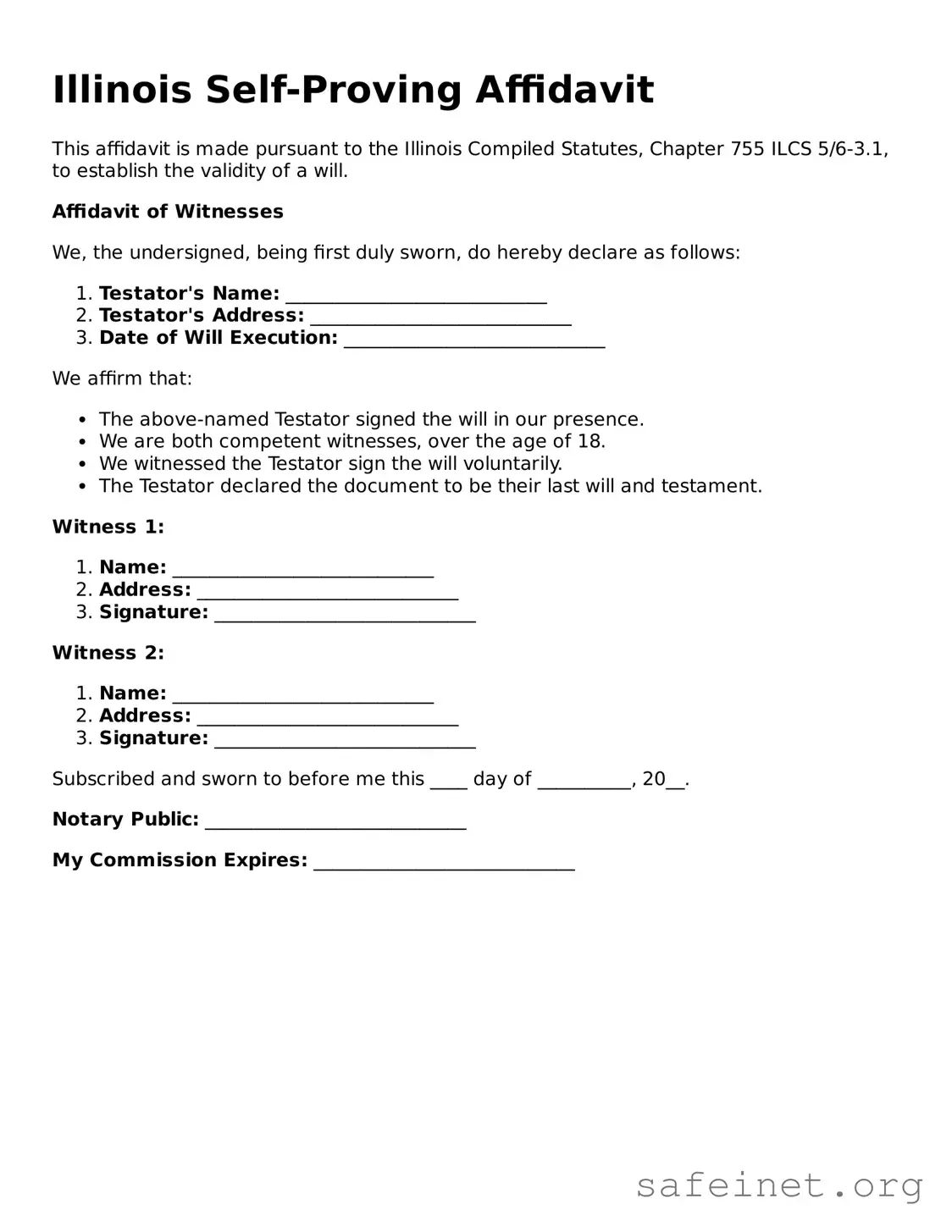
The Illinois Self-Proving Affidavit form serves as a valuable tool in the estate planning process, particularly for those creating a will. This form allows testators to affirm the validity of their will, making it easier for the document to be accepted in probate court without requiring additional witness testimony. By including a self-proving affidavit, individuals can streamline the probate process, reducing potential delays and complications for their heirs. The form must be signed by the testator and witnessed by two individuals, who also sign the affidavit, confirming that they observed the testator signing the will. This process not only enhances the credibility of the will but also provides peace of mind, knowing that the wishes of the deceased will be honored without unnecessary legal hurdles. Understanding the importance and requirements of the Illinois Self-Proving Affidavit is essential for anyone looking to ensure their estate is managed according to their wishes.
Illinois Self-Proving Affidavit
This affidavit is made pursuant to the Illinois Compiled Statutes, Chapter 755 ILCS 5/6-3.1, to establish the validity of a will.
Affidavit of Witnesses
We, the undersigned, being first duly sworn, do hereby declare as follows:
We affirm that:
Witness 1:
Witness 2:
Subscribed and sworn to before me this ____ day of __________, 20__.
Notary Public: ____________________________
My Commission Expires: ____________________________
| Fact Name | Description |
|---|---|
| Purpose | The Illinois Self-Proving Affidavit serves to simplify the probate process by allowing a will to be accepted without the need for witness testimony. |
| Governing Law | This form is governed by the Illinois Probate Act, specifically 755 ILCS 5/6-3. |
| Requirements | The affidavit must be signed by the testator and at least two witnesses in the presence of each other. |
| Notarization | A notary public must also sign the affidavit to validate the signatures of the testator and witnesses. |
| Form Availability | The form can be obtained from various legal resources, including state websites and legal document providers. |
| Execution Timing | It is recommended to execute the affidavit at the same time as the will to ensure consistency and validity. |
| Legal Effect | Once executed, the affidavit provides a presumption of the will's validity, easing the burden on the estate's executor. |
| Revocation | The affidavit can be revoked if the testator creates a new will or modifies the existing one without including a new affidavit. |
| Importance | Utilizing a self-proving affidavit can expedite the probate process and reduce potential disputes among heirs. |
After gathering the necessary information, you will need to complete the Illinois Self-Proving Affidavit form. This document is important for ensuring that your will can be validated without requiring the testimony of witnesses in court. Completing the form accurately is crucial for it to serve its intended purpose.
After filling out the form, ensure that it is stored safely alongside your will. This will help streamline the probate process in the future.
What is an Illinois Self-Proving Affidavit?
An Illinois Self-Proving Affidavit is a legal document that allows a will to be validated without the need for witnesses to testify in court. It essentially serves as a declaration that the will was properly executed, helping to streamline the probate process.
Why would I need a Self-Proving Affidavit?
This affidavit can save time and reduce complications during the probate process. By having this document, the executor can avoid the hassle of locating witnesses to the will, which can be particularly beneficial if witnesses are unavailable or have passed away.
How do I create a Self-Proving Affidavit?
To create a Self-Proving Affidavit in Illinois, you typically need to include a statement affirming that the testator (the person who made the will) signed the will in the presence of two witnesses. Both witnesses must also sign the affidavit in front of a notary public. It's important to follow the specific format required by Illinois law.
Do I need a lawyer to prepare a Self-Proving Affidavit?
While it's not mandatory to have a lawyer, consulting one can be beneficial. A legal professional can ensure that the affidavit meets all legal requirements and is correctly executed, which can help prevent issues later on.
Can I use a Self-Proving Affidavit for any will?
Yes, a Self-Proving Affidavit can be used for any will that meets the requirements set forth by Illinois law. However, it must be executed at the same time as the will or shortly thereafter to be valid.
What happens if I don’t have a Self-Proving Affidavit?
If a will does not include a Self-Proving Affidavit, the probate court may require the witnesses to testify about the will's validity. This can complicate and prolong the probate process, potentially leading to disputes among heirs.
Is there a specific format for the Self-Proving Affidavit?
Yes, Illinois law provides a specific format for the Self-Proving Affidavit. It should clearly state that the testator signed the will in the presence of the witnesses, and it must include the signatures of both witnesses and a notary public. Using the correct format is essential for the affidavit to be valid.
How long is a Self-Proving Affidavit valid?
Once properly executed, a Self-Proving Affidavit remains valid indefinitely. As long as the will is not revoked and the affidavit is not challenged, it can be used in probate proceedings whenever necessary.
Can I revoke a Self-Proving Affidavit?
Yes, a Self-Proving Affidavit can be revoked if the testator decides to change their will or create a new one. It's crucial to ensure that any previous affidavits are properly revoked to avoid confusion during the probate process.
Not including the correct date. It is important to write the date when the affidavit is signed. Leaving this blank can lead to confusion about the document's validity.
Failing to sign in the right places. All required signatures must be present. Missing a signature can invalidate the affidavit.
Using incorrect witness information. Witnesses must meet certain criteria. Providing inaccurate details can undermine the affidavit's credibility.
Not having the affidavit notarized. A notary public must witness the signing of the affidavit. Without notarization, the document may not be accepted.
Overlooking the requirement for witnesses. Some states require a specific number of witnesses. Failing to meet this requirement can affect the document's legality.
Writing unclear or ambiguous language. The affidavit should be clear and concise. Vague language can lead to misinterpretation of the intentions.
Not keeping a copy of the signed affidavit. It is wise to retain a copy for personal records. This can help resolve any future disputes regarding the document.
When preparing a will in Illinois, you may encounter several important forms and documents that work alongside the Illinois Self-Proving Affidavit. Each of these documents serves a specific purpose in ensuring that your wishes are honored and that the legal process runs smoothly. Below is a list of commonly used forms.
Understanding these documents can help you navigate the estate planning process more effectively. Each form plays a critical role in protecting your wishes and ensuring that your affairs are managed according to your desires.
The Illinois Self-Proving Affidavit is similar to the Affidavit of Execution. This document is used to confirm that a will was executed in accordance with the legal requirements. It typically includes statements from witnesses who observed the signing of the will. Both documents aim to establish the authenticity of a will, but the Self-Proving Affidavit allows for a more streamlined probate process by eliminating the need for witness testimony in court.
Another document that shares similarities is the Will Declaration. This declaration serves to affirm the intentions of the testator regarding their estate. Like the Self-Proving Affidavit, it often includes statements of fact that validate the will's legitimacy. However, the Will Declaration may not require the same formalities as a Self-Proving Affidavit, which can lead to different implications during the probate process.
The Durable Power of Attorney is also comparable in that it allows individuals to designate someone to make decisions on their behalf. While it primarily focuses on financial and healthcare decisions, both documents reflect the individual's wishes and intentions. The Self-Proving Affidavit and Durable Power of Attorney both require signatures and can be executed in the presence of witnesses, ensuring that the individual's choices are respected.
The Living Will is another document that shares a purpose with the Self-Proving Affidavit. Both documents express an individual's preferences regarding end-of-life care. While the Self-Proving Affidavit is related to the distribution of assets, the Living Will focuses on medical decisions. Each document requires clear articulation of the individual's desires, ensuring that their wishes are honored when they can no longer communicate them.
Trusts, particularly Revocable Living Trusts, are similar as they also deal with the distribution of assets after death. A Self-Proving Affidavit can accompany a will, while a trust operates independently. Both documents require careful planning and execution to ensure that the individual's intentions are carried out, but they differ in their structure and the legal processes involved in managing the estate.
The Affidavit of Heirship is another related document, as it is used to establish the heirs of a deceased individual. This affidavit can help clarify the distribution of assets when no will exists. While the Self-Proving Affidavit affirms the validity of a will, the Affidavit of Heirship serves a different purpose by identifying rightful heirs, which can be crucial in probate proceedings.
Lastly, the Certificate of Trust can be seen as similar to the Self-Proving Affidavit in that it provides evidence of a trust's existence and terms. Both documents aim to facilitate the transfer of assets and ensure that the individual's wishes are carried out. However, the Certificate of Trust specifically pertains to trusts, while the Self-Proving Affidavit is tied to wills, highlighting the different pathways individuals can take in estate planning.
When filling out the Illinois Self-Proving Affidavit form, it’s important to follow certain guidelines to ensure the document is valid and properly executed. Here are some dos and don’ts to keep in mind:
Understanding the Illinois Self-Proving Affidavit form can be challenging, leading to various misconceptions. Here are nine common misunderstandings about this legal document:
Many people believe that using a Self-Proving Affidavit is required for all wills in Illinois. In reality, it is an optional tool that can simplify the probate process.
While attorneys often assist in drafting legal documents, individuals can prepare a Self-Proving Affidavit themselves, provided they follow the correct guidelines.
This form does not remove the requirement for witnesses when signing a will. It simply provides a way to affirm the validity of the will later in court.
Some think that both documents must be signed simultaneously. However, the affidavit can be signed after the will, as long as it meets the necessary requirements.
Each state has its own laws and requirements. What is true in Illinois may not apply elsewhere, so it is important to be aware of local regulations.
While this form helps establish the will's authenticity, it does not guarantee that the will cannot be contested or challenged in court.
People often assume that only complicated estates require this form. In fact, it can benefit estates of any size by streamlining the probate process.
Individuals can update or revoke a Self-Proving Affidavit if they make changes to their will. It is important to ensure that all documents are consistent.
This misconception overlooks the fact that anyone can use this form, regardless of the size of their estate, to ease the probate process for their heirs.
By addressing these misconceptions, individuals can better understand the purpose and function of the Illinois Self-Proving Affidavit form, ensuring they make informed decisions regarding their estate planning.
When dealing with the Illinois Self-Proving Affidavit form, it’s important to understand how to fill it out correctly and how it can be utilized effectively. Here are some key takeaways: