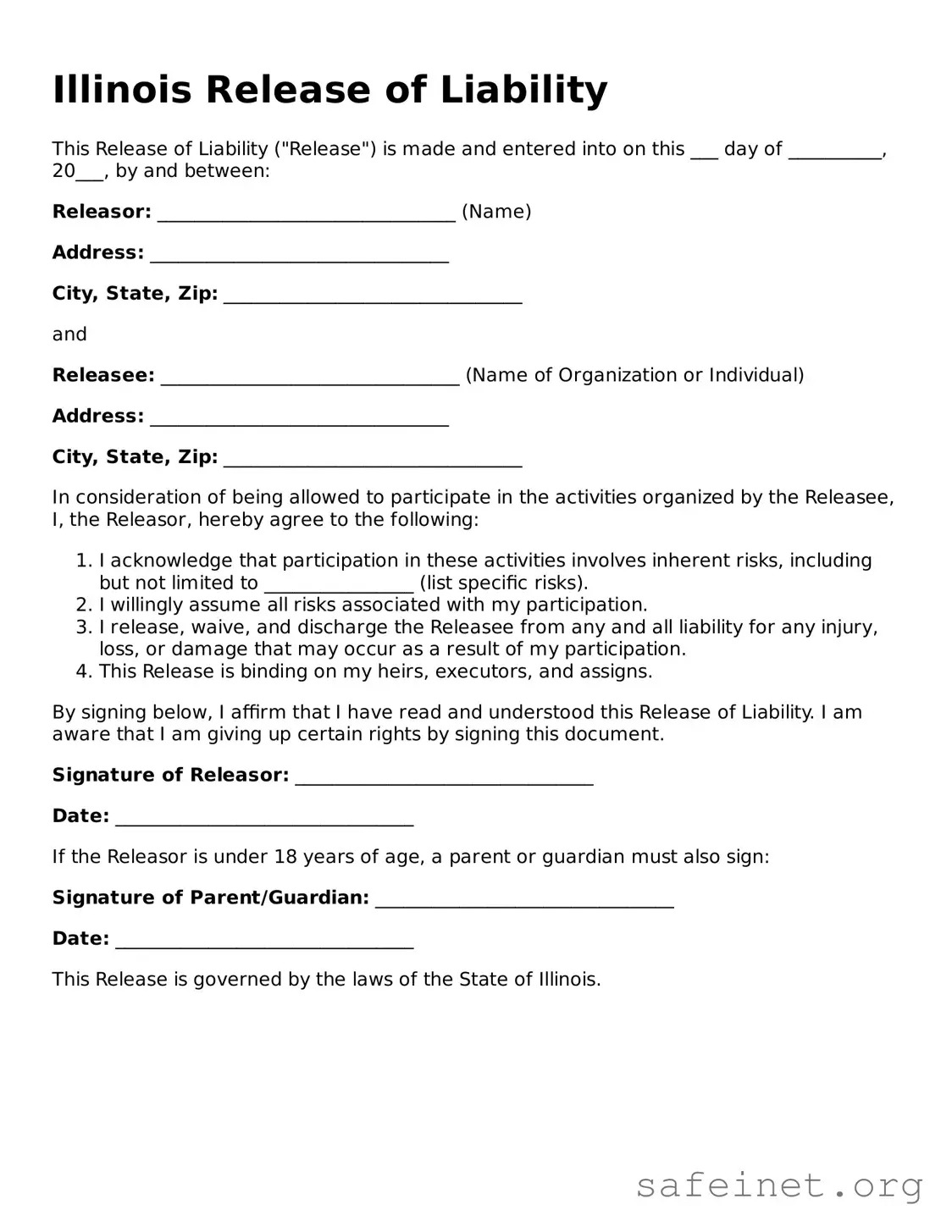
The Illinois Release of Liability form serves as a crucial document for individuals and organizations looking to protect themselves from legal claims arising from potential injuries or damages during activities or events. This form is often utilized in various contexts, such as sports, recreational activities, or events where participants may face inherent risks. By signing the release, participants acknowledge their understanding of these risks and agree not to hold the organizers or sponsors liable for any accidents that may occur. It is essential for both parties to clearly understand the terms outlined in the form, as it helps establish mutual agreement and ensures that participants are informed of the potential dangers involved. Additionally, the form typically requires participants to provide their personal information, including names and contact details, along with their signatures, which signifies their consent. This document not only fosters a sense of responsibility but also promotes safety and awareness among participants.
Illinois Release of Liability
This Release of Liability ("Release") is made and entered into on this ___ day of __________, 20___, by and between:
Releasor: ________________________________ (Name)
Address: ________________________________
City, State, Zip: ________________________________
and
Releasee: ________________________________ (Name of Organization or Individual)
Address: ________________________________
City, State, Zip: ________________________________
In consideration of being allowed to participate in the activities organized by the Releasee, I, the Releasor, hereby agree to the following:
By signing below, I affirm that I have read and understood this Release of Liability. I am aware that I am giving up certain rights by signing this document.
Signature of Releasor: ________________________________
Date: ________________________________
If the Releasor is under 18 years of age, a parent or guardian must also sign:
Signature of Parent/Guardian: ________________________________
Date: ________________________________
This Release is governed by the laws of the State of Illinois.
| Fact Name | Description |
|---|---|
| Purpose | The Illinois Release of Liability form is used to protect individuals and organizations from legal claims related to activities that could cause injury or damage. |
| Governing Law | This form is governed by Illinois state law, specifically the Illinois Compiled Statutes. |
| Voluntary Agreement | Participants must sign the form voluntarily, indicating their understanding of the risks involved. |
| Scope of Release | The release typically covers all claims, including negligence, unless specifically excluded. |
| Minors | For minors, a parent or guardian must sign the form on their behalf to make it legally binding. |
| Legal Enforceability | If properly drafted and signed, the release is generally enforceable in Illinois courts. |
| Limitations | Some claims, such as those arising from gross negligence or willful misconduct, may not be waived. |
| Retention of Copy | It is advisable for both parties to retain a copy of the signed form for their records. |
Filling out the Illinois Release of Liability form requires attention to detail and careful consideration of the information requested. Once completed, the form will serve a specific purpose related to liability and risk management.
What is an Illinois Release of Liability form?
An Illinois Release of Liability form is a legal document that helps protect individuals or organizations from being held responsible for injuries or damages that may occur during a specific activity or event. By signing this form, participants acknowledge the risks involved and agree not to hold the organizers liable for any accidents or injuries that might happen.
Who typically uses a Release of Liability form?
This form is commonly used by businesses, organizations, or individuals who host events or activities that carry some level of risk. Examples include sports leagues, recreational facilities, and adventure tour companies. It is also used in situations like renting equipment or participating in physical activities.
Is a Release of Liability form legally binding in Illinois?
Yes, a properly drafted Release of Liability form can be legally binding in Illinois, provided it meets certain criteria. The form must be clear, voluntary, and specific about the risks involved. However, courts may not enforce a release if it is deemed overly broad or if it attempts to waive liability for gross negligence.
Can a minor sign a Release of Liability form?
Minors cannot legally sign contracts, including a Release of Liability form, on their own. However, a parent or legal guardian can sign the form on behalf of the minor. This ensures that the minor is still covered under the terms of the release while acknowledging the risks involved.
What should be included in a Release of Liability form?
A comprehensive Release of Liability form should include several key elements: a clear description of the activity, acknowledgment of the risks involved, a statement of release from liability, and the signatures of the participants (and parents or guardians for minors). It may also include a section for emergency contact information.
Can participants still sue if they sign a Release of Liability form?
While signing a Release of Liability form limits the ability to sue, it does not completely eliminate it. Participants may still pursue legal action if there is evidence of gross negligence or intentional misconduct. Courts will evaluate the specifics of each case to determine enforceability.
How can I ensure my Release of Liability form is effective?
To create an effective Release of Liability form, it is advisable to consult with a legal professional who understands Illinois law. The form should be clearly written, unambiguous, and tailored to the specific activity. Additionally, participants should be given sufficient time to read and understand the document before signing.
What happens if a participant refuses to sign the form?
If a participant refuses to sign the Release of Liability form, they may not be allowed to participate in the activity. The form is a tool to manage risk, and without it, the organizers may feel exposed to potential legal claims. It is essential to communicate the importance of the form to participants.
Can I modify a standard Release of Liability form?
Yes, a standard Release of Liability form can be modified to fit the specific needs of your activity or organization. However, any modifications should be made carefully to ensure that the form remains legally sound and that all necessary elements are included. Consulting a legal professional is recommended when making changes.
Where can I find a template for an Illinois Release of Liability form?
Templates for an Illinois Release of Liability form can often be found online through legal document websites or local business resources. However, it is important to review any template carefully and consider having it customized by a legal professional to ensure it meets your specific needs and complies with state laws.
Incomplete Information: One common mistake is failing to provide all required personal details. Individuals often overlook sections that ask for contact information or emergency contacts. This can lead to delays or complications in processing the form.
Not Understanding the Terms: Many signers do not fully read or comprehend the terms outlined in the form. This lack of understanding can result in unintended waivers of rights or acceptance of risks that individuals may not have been aware of initially.
Improper Signatures: Signatures must be clear and legible. Some people may sign with initials or in a way that is difficult to read. This can create issues regarding the validity of the release.
Missing Dates: Failing to include the date of signing is a frequent oversight. This omission can affect the enforceability of the release, particularly if disputes arise later.
Neglecting Witness Requirements: Certain situations may require a witness to the signing of the form. Not adhering to this requirement can render the document less effective or even invalid.
The Illinois Release of Liability form serves as a crucial document to protect organizations and individuals from legal claims related to activities or events. However, several other forms and documents complement this release, ensuring comprehensive coverage and clarity for all parties involved. Below is a list of these documents, each serving a specific purpose in the context of liability and risk management.
Utilizing these documents alongside the Illinois Release of Liability form enhances legal protection and fosters clear communication among all parties. Proper documentation is vital for minimizing risks and ensuring a safe environment for participants.
The Illinois Waiver of Liability form is similar to the Hold Harmless Agreement. Both documents aim to protect one party from legal claims arising from accidents or injuries. In a Hold Harmless Agreement, one party agrees not to hold the other responsible for any damages. This is often used in contracts where one party may be exposed to risks, such as in construction or event planning. By signing this agreement, individuals acknowledge the risks involved and agree to take responsibility for their own safety.
The Participant Agreement also shares similarities with the Illinois Release of Liability form. This document is commonly used in sports and recreational activities. It requires participants to acknowledge the inherent risks associated with the activity and to release the organizers from liability. Just like the Release of Liability, the Participant Agreement emphasizes personal responsibility and ensures that participants understand the potential dangers before engaging in the activity.
The Indemnity Agreement is another document that resembles the Illinois Release of Liability form. This agreement involves one party agreeing to compensate the other for any losses or damages incurred. It is often used in business contracts where one party may face risks due to the actions of another. By signing an Indemnity Agreement, individuals protect themselves from financial liability, similar to how a Release of Liability form protects against legal claims.
The Consent to Treat form is also comparable to the Illinois Release of Liability. This document is often used in medical settings, allowing healthcare providers to treat a patient while protecting themselves from legal repercussions. Patients acknowledge the risks of treatment and consent to proceed, similar to how individuals release liability in other scenarios. Both forms require clear communication about risks and responsibilities.
Lastly, the Liability Waiver is another document that serves a similar purpose. This form is often used in various activities, from fitness classes to adventure sports. It releases the provider from responsibility for injuries that may occur during the activity. Like the Illinois Release of Liability, it requires participants to accept the risks involved and agree not to hold the provider liable for any accidents or injuries that may happen.
When filling out the Illinois Release of Liability form, it is essential to approach the task with care. Understanding the nuances of this form can help ensure that your rights are protected and that you comply with legal requirements. Here are ten things you should and shouldn't do:
By following these guidelines, you can navigate the process of completing the Illinois Release of Liability form more effectively, ensuring that you are both informed and protected.
Understanding the Illinois Release of Liability form can be challenging, especially with various misconceptions surrounding it. Here are eight common misunderstandings, along with clarifications to help you navigate this important document.
Misconception 1: The form completely absolves all responsibility.
This is not entirely true. While the form can limit liability for certain activities, it does not protect against gross negligence or intentional misconduct.
Misconception 2: Signing the form means you cannot sue under any circumstances.
In reality, you may still have the right to pursue legal action if the other party fails to uphold their duty of care or engages in reckless behavior.
Misconception 3: The form is only necessary for physical activities.
While often associated with sports or outdoor events, the form can apply to various situations, including recreational activities and events held in private spaces.
Misconception 4: Minors cannot sign the form.
Actually, a parent or legal guardian can sign on behalf of a minor, which can provide the necessary legal protection for the organization or individual involved.
Misconception 5: A verbal agreement is as binding as a written form.
Written agreements, such as the Release of Liability form, are generally more enforceable than verbal agreements, which can be difficult to prove in court.
Misconception 6: The form is the same for all activities.
Each Release of Liability form should be tailored to the specific activity or event, as different circumstances may require different language and provisions.
Misconception 7: Once signed, the form cannot be revoked.
You may have the ability to revoke consent, but this typically needs to be done before the activity takes place. Always check the specific terms outlined in the form.
Misconception 8: The form protects against all types of injuries.
The Release of Liability form generally covers only those risks that are known and understood by the signer. It does not cover unforeseen or inherent risks associated with the activity.
Being informed about these misconceptions can help you make better decisions regarding the use and implications of the Illinois Release of Liability form. Always consider consulting with a legal professional for personalized advice.
When filling out and using the Illinois Release of Liability form, consider the following key takeaways: