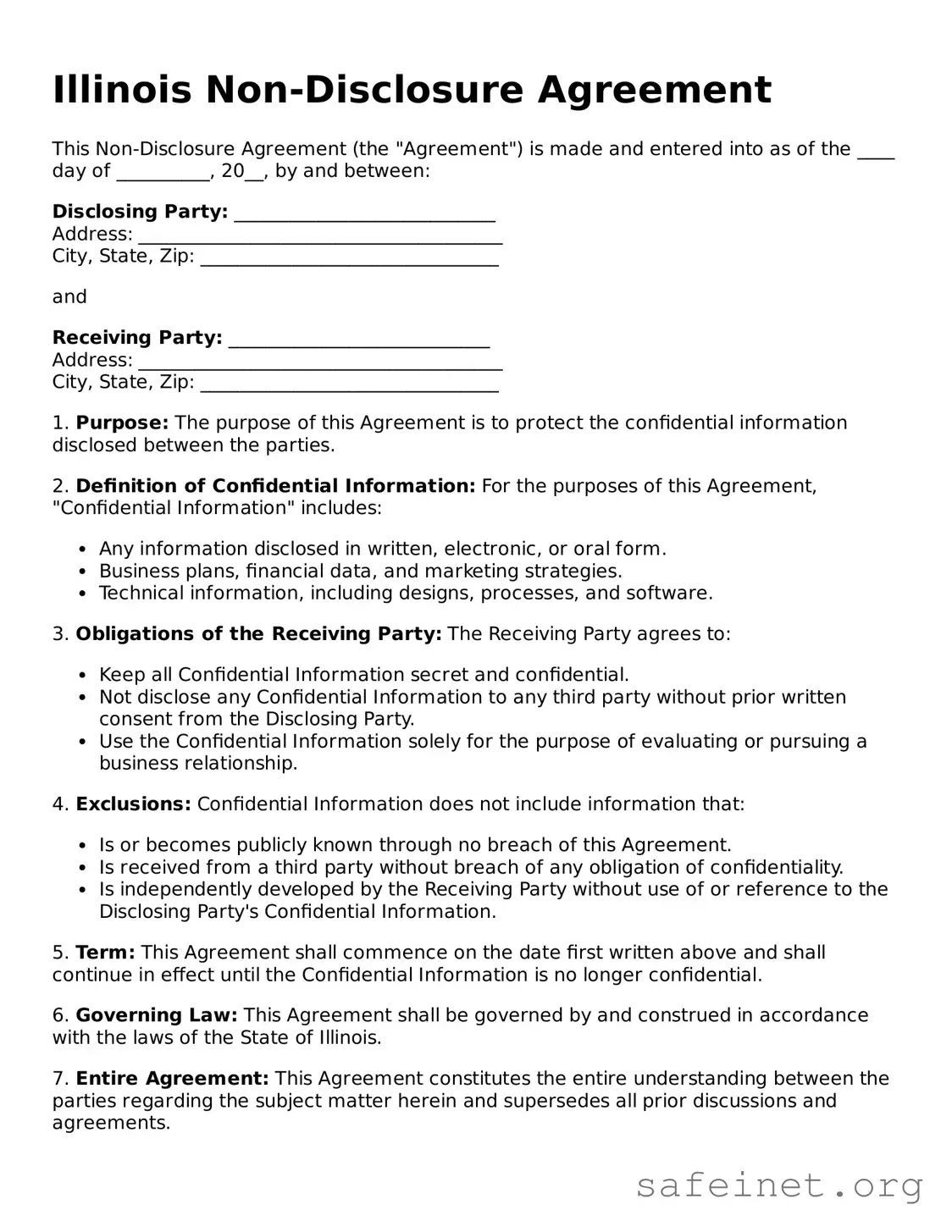
In the realm of business and personal relationships, confidentiality is paramount. The Illinois Non-disclosure Agreement (NDA) form serves as a vital tool for individuals and organizations seeking to protect sensitive information from being disclosed to unauthorized parties. This legally binding document outlines the specific information considered confidential, detailing the obligations of the parties involved. It establishes clear guidelines on how the information can be used and emphasizes the consequences of any breach. By signing this agreement, parties not only affirm their commitment to maintaining privacy but also gain peace of mind knowing that their proprietary information, trade secrets, or personal data are safeguarded. Understanding the nuances of the Illinois NDA form can empower individuals and businesses to navigate their professional landscapes with confidence, fostering trust and collaboration while protecting their interests.
Illinois Non-Disclosure Agreement
This Non-Disclosure Agreement (the "Agreement") is made and entered into as of the ____ day of __________, 20__, by and between:
Disclosing Party: ____________________________
Address: _______________________________________
City, State, Zip: ________________________________
and
Receiving Party: ____________________________
Address: _______________________________________
City, State, Zip: ________________________________
1. Purpose: The purpose of this Agreement is to protect the confidential information disclosed between the parties.
2. Definition of Confidential Information: For the purposes of this Agreement, "Confidential Information" includes:
3. Obligations of the Receiving Party: The Receiving Party agrees to:
4. Exclusions: Confidential Information does not include information that:
5. Term: This Agreement shall commence on the date first written above and shall continue in effect until the Confidential Information is no longer confidential.
6. Governing Law: This Agreement shall be governed by and construed in accordance with the laws of the State of Illinois.
7. Entire Agreement: This Agreement constitutes the entire understanding between the parties regarding the subject matter herein and supersedes all prior discussions and agreements.
IN WITNESS WHEREOF, the parties have executed this Non-Disclosure Agreement as of the date first above written.
Disclosing Party Signature: ____________________________
Date: ____________________________
Receiving Party Signature: ____________________________
Date: ____________________________
| Fact Name | Details |
|---|---|
| Purpose | The Illinois Non-disclosure Agreement (NDA) is designed to protect confidential information shared between parties. |
| Governing Law | This NDA is governed by the laws of the State of Illinois. |
| Parties Involved | The agreement typically involves at least two parties: the disclosing party and the receiving party. |
| Duration | The duration of confidentiality obligations can vary, but it is often specified within the agreement. |
After obtaining the Illinois Non-disclosure Agreement form, you will need to fill it out carefully to ensure all necessary information is included. This process involves providing details about the parties involved, the nature of the confidential information, and the terms of the agreement. Completing this form accurately is essential for protecting sensitive information.
What is an Illinois Non-disclosure Agreement (NDA)?
An Illinois Non-disclosure Agreement is a legal contract that protects confidential information shared between parties. It ensures that sensitive information, such as trade secrets, business strategies, or proprietary data, remains confidential. By signing an NDA, the parties agree not to disclose this information to unauthorized individuals or entities.
Who should use an Illinois Non-disclosure Agreement?
Any individual or business that plans to share sensitive information with another party should consider using an NDA. This includes entrepreneurs sharing business ideas with potential investors, companies discussing mergers or acquisitions, and employees accessing proprietary information. An NDA helps safeguard valuable information and can prevent potential legal disputes in the future.
What are the key components of an Illinois Non-disclosure Agreement?
An effective NDA typically includes several important components. These include a clear definition of what constitutes confidential information, the obligations of both parties regarding the use and protection of this information, the duration of the confidentiality obligation, and any exceptions to the agreement. Additionally, it may outline the consequences of breaching the NDA, providing a framework for addressing violations.
How can I enforce an Illinois Non-disclosure Agreement?
Enforcing an Illinois NDA involves taking legal action if one party breaches the agreement. The injured party may seek remedies such as monetary damages or injunctive relief, which prevents further disclosure of confidential information. To strengthen enforcement, it is crucial to keep records of the NDA, document any breaches, and consult with a legal professional to explore available options.
Not Identifying the Parties Clearly: It's crucial to clearly identify all parties involved in the agreement. Failing to do so can lead to confusion about who is bound by the terms.
Omitting the Definition of Confidential Information: A common mistake is not providing a clear definition of what constitutes confidential information. Without this, it can be difficult to enforce the agreement.
Leaving Out the Purpose of Disclosure: The agreement should specify why the confidential information is being shared. This context is important for understanding the scope of the agreement.
Not Including a Time Frame: It's essential to state how long the confidentiality obligation lasts. Failing to include this can lead to misunderstandings later on.
Neglecting to Address Exceptions: There should be a section that outlines any exceptions to confidentiality. Omitting this can create loopholes that may undermine the agreement.
Forgetting to Specify the Governing Law: Indicating which state's laws will govern the agreement is important. Without this, parties may face challenges in case of a dispute.
Not Including a Non-Compete Clause: If applicable, a non-compete clause should be included to protect business interests. Leaving this out can expose sensitive information to competitors.
Failing to Get Signatures: An unsigned agreement is not enforceable. Ensure that all parties sign and date the document to validate it.
Using Ambiguous Language: Clear and precise language is vital. Ambiguity can lead to different interpretations, which can complicate enforcement.
Not Keeping Copies: After signing, each party should retain a copy of the agreement. Without copies, it can be difficult to reference the terms later.
When entering into a Non-disclosure Agreement (NDA) in Illinois, several other forms and documents may be necessary to ensure comprehensive protection of sensitive information. Each of these documents plays a crucial role in establishing clear expectations and legal obligations between parties. Below is a list of commonly used forms alongside an NDA.
Utilizing these documents alongside an Illinois Non-disclosure Agreement can help establish a robust legal framework for protecting sensitive information and intellectual property. Each serves a unique purpose, reinforcing the importance of confidentiality and mutual respect in business relationships.
A Non-Disclosure Agreement (NDA) is a crucial tool for protecting sensitive information. It shares similarities with a Confidentiality Agreement. While both documents aim to prevent the sharing of proprietary information, a Confidentiality Agreement often has a broader scope. It can cover not only trade secrets but also any confidential information exchanged between parties. This document is frequently used in various contexts, such as business partnerships and employment relationships, ensuring that all parties understand their obligations regarding confidentiality.
Another document akin to an NDA is the Non-Compete Agreement. This type of agreement restricts an individual from engaging in business activities that compete with their employer for a specified period after leaving the company. While NDAs focus on keeping information secret, Non-Compete Agreements aim to protect a business's market position. Both documents serve to safeguard a company's interests, but they do so through different mechanisms.
The Non-Solicitation Agreement is also similar to an NDA. This document prevents individuals from soliciting clients or employees of a former employer. While NDAs protect confidential information, Non-Solicitation Agreements focus on maintaining business relationships. They are often used in conjunction with NDAs to ensure comprehensive protection of a business's interests.
Then, there’s the Mutual Non-Disclosure Agreement. Unlike a one-sided NDA, this agreement is used when both parties plan to share confidential information. It establishes a framework for how both parties will handle sensitive information, ensuring that neither side discloses the other’s trade secrets. This type of agreement is especially common in joint ventures or partnerships where trust and confidentiality are paramount.
A Proprietary Information Agreement is another document that aligns closely with an NDA. This agreement specifically addresses the protection of proprietary information, which is any information that a company considers its own and wishes to keep secret. While NDAs can be broader, Proprietary Information Agreements are often more focused on specific types of information, such as formulas, processes, or methods that provide a competitive edge.
In the realm of intellectual property, a Licensing Agreement bears similarities to an NDA. This document grants permission to use certain intellectual property while imposing restrictions on how that information can be used or shared. While NDAs primarily focus on confidentiality, Licensing Agreements also address the rights and obligations associated with the use of intellectual property, ensuring that both parties understand their limits.
The Release of Information Agreement is another document that shares characteristics with an NDA. This agreement allows one party to disclose certain information to another while setting clear guidelines on how that information can be used. It often appears in medical or legal contexts, where sensitive information needs to be shared but protected at the same time. Like an NDA, it emphasizes the importance of confidentiality but in a more controlled manner.
Lastly, the Data Use Agreement is similar to an NDA, especially in contexts involving research or data sharing. This document outlines how data can be used, shared, and protected. It is particularly relevant in academic and healthcare settings, where sensitive data must be handled with care. Both NDAs and Data Use Agreements emphasize confidentiality, but the latter often includes specific provisions related to data management and compliance with regulations.
When filling out the Illinois Non-disclosure Agreement (NDA) form, it is essential to be thorough and careful. Here are some important dos and don'ts to keep in mind:
By following these guidelines, you can ensure that your Illinois Non-disclosure Agreement is filled out correctly and serves its intended purpose.
When it comes to the Illinois Non-disclosure Agreement (NDA), there are several misconceptions that can lead to confusion. Understanding these can help you navigate the process more effectively. Here are nine common misconceptions:
By clarifying these misconceptions, you can approach NDAs with a better understanding and make informed decisions that protect your interests.
Filling out and using the Illinois Non-disclosure Agreement (NDA) form is an important step in protecting sensitive information. Here are some key takeaways to consider:
By keeping these key points in mind, individuals and businesses can effectively use the Illinois Non-disclosure Agreement to safeguard their confidential information.