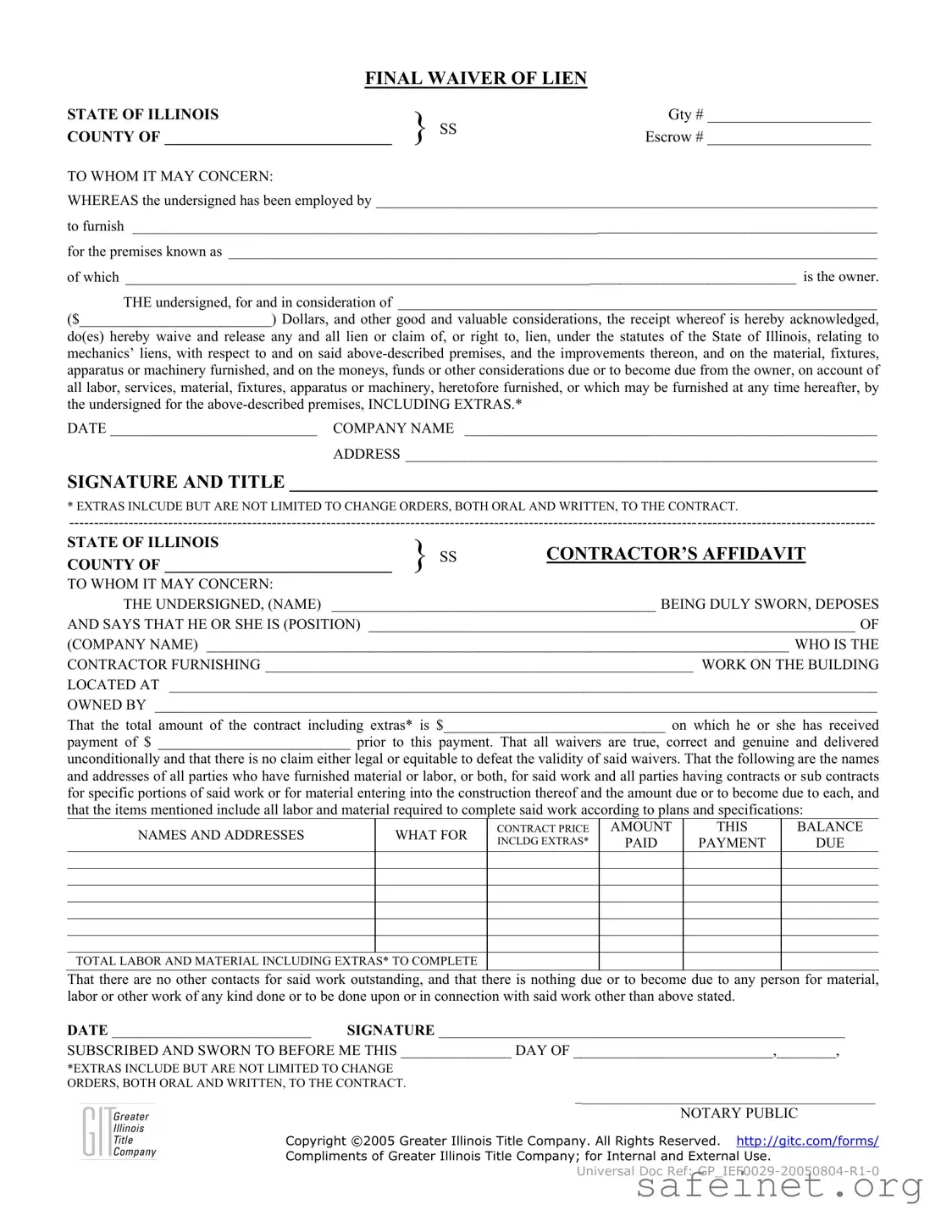
The Illinois Final Waiver of Lien form serves as a crucial document in the construction and real estate industries, ensuring that all parties involved in a project are protected from potential disputes regarding payments. This form is typically utilized by contractors and subcontractors to formally relinquish their right to file a mechanics' lien against a property, thereby providing peace of mind to property owners and lenders. It includes essential details such as the name of the contractor, the specific work performed, and the total amount of the contract, including any extras or change orders. By signing this document, the contractor acknowledges receipt of payment and confirms that all labor and materials have been provided as agreed. Additionally, the form requires a sworn affidavit, affirming that there are no outstanding claims against the property and that all parties who contributed to the work have been accounted for. This comprehensive approach not only protects the contractor's interests but also safeguards the property owner from unexpected liens, making the Illinois Final Waiver of Lien a vital instrument in the real estate transaction process.
FINAL WAIVER OF LIEN
STATE OF ILLINOIS |
} SS |
Gty # _____________________ |
COUNTY OF _____________________________ |
Escrow # _____________________ |
TO WHOM IT MAY CONCERN:
WHEREAS the undersigned has been employed by ____________________________________________________________________
to furnish _____________________________________________________________________________________________________
for the premises known as ________________________________________________________________________________________
of which ___________________________________________________________________________________________ is the owner.
THE undersigned, for and in consideration of _________________________________________________________________
($__________________________) Dollars, and other good and valuable considerations, the receipt whereof is hereby acknowledged,
do(es) hereby waive and release any and all lien or claim of, or right to, lien, under the statutes of the State of Illinois, relating to mechanics’ liens, with respect to and on said
DATE ____________________________ COMPANY NAME ________________________________________________________
ADDRESS ________________________________________________________________
SIGNATURE AND TITLE _______________________________________________________________
* EXTRAS INLCUDE BUT ARE NOT LIMITED TO CHANGE ORDERS, BOTH ORAL AND WRITTEN, TO THE CONTRACT.
STATE OF ILLINOIS |
} SS |
CONTRACTOR’S AFFIDAVIT |
COUNTY OF _____________________________ |
||
TO WHOM IT MAY CONCERN: |
|
|
THE UNDERSIGNED, (NAME) ____________________________________________ BEING DULY SWORN, DEPOSES
AND SAYS THAT HE OR SHE IS (POSITION) __________________________________________________________________ OF
(COMPANY NAME) _______________________________________________________________________________ WHO IS THE
CONTRACTOR FURNISHING __________________________________________________________ WORK ON THE BUILDING
LOCATED AT ________________________________________________________________________________________________
OWNED BY __________________________________________________________________________________________________
That the total amount of the contract including extras* is $______________________________ on which he or she has received
payment of $ __________________________ prior to this payment. That all waivers are true, correct and genuine and delivered
unconditionally and that there is no claim either legal or equitable to defeat the validity of said waivers. That the following are the names and addresses of all parties who have furnished material or labor, or both, for said work and all parties having contracts or sub contracts for specific portions of said work or for material entering into the construction thereof and the amount due or to become due to each, and that the items mentioned include all labor and material required to complete said work according to plans and specifications:
NAMES AND ADDRESSES
WHAT FOR
CONTRACT PRICE INCLDG EXTRAS*
AMOUNT
PAID
THIS
PAYMENT
BALANCE
DUE
TOTAL LABOR AND MATERIAL INCLUDING EXTRAS* TO COMPLETE
That there are no other contacts for said work outstanding, and that there is nothing due or to become due to any person for material, labor or other work of any kind done or to be done upon or in connection with said work other than above stated.
DATE ___________________________ SIGNATURE _______________________________________________________
SUBSCRIBED AND SWORN TO BEFORE ME THIS _______________ DAY OF ___________________________,________,
*EXTRAS INCLUDE BUT ARE NOT LIMITED TO CHANGE
ORDERS, BOTH ORAL AND WRITTEN, TO THE CONTRACT.
________________________________________________
NOTARY PUBLIC
Copyright ©2005 Greater Illinois Title Company. All Rights Reserved. http://gitc.com/forms/
Compliments of Greater Illinois Title Company; for Internal and External Use.
Universal Doc Ref:
| Fact Name | Fact Description |
|---|---|
| Purpose | The Illinois Final Waiver of Lien form is used to waive and release any lien claims against a property after payment has been made for labor or materials provided. |
| Governing Law | This form is governed by the Illinois Mechanics Lien Act, which outlines the rights and responsibilities related to lien claims in construction and improvement projects. |
| Parties Involved | The form requires information from the contractor, including their name, position, and the company they represent, as well as details about the property and payment received. |
| Extras Definition | Extras refer to additional costs that may arise from change orders, which can be both oral and written, and are included in the waiver of lien. |
Filling out the Illinois Final Waiver of Lien form is an important step in ensuring that all parties involved in a construction project are clear about payments and claims. Once completed, this document will serve as a formal acknowledgment that a contractor or subcontractor has received payment and waives any future claims against the property for the work performed.
What is the Illinois Final Waiver of Lien form?
The Illinois Final Waiver of Lien form is a legal document used in the construction industry. It serves as a formal declaration by a contractor or subcontractor that they have received payment for their work and materials provided for a specific project. By signing this form, the contractor waives any future claims or liens against the property for the work completed. This helps protect property owners from potential legal disputes regarding unpaid services or materials.
Who needs to use the Illinois Final Waiver of Lien form?
What information is required on the form?
The Illinois Final Waiver of Lien form requires several key pieces of information. You must include the name of the contractor or subcontractor, the project location, and details about the work performed. Additionally, you need to specify the total contract amount, the amount paid prior to this waiver, and any extras related to the contract. Signatures from the contractor and a notary public are also necessary to validate the document. This information ensures clarity and transparency between all parties involved.
What happens after the form is signed?
Once the Illinois Final Waiver of Lien form is signed and notarized, it should be delivered to the property owner or the relevant party who requested it. The contractor officially releases any claims to the property regarding the work performed. This means that the contractor cannot later assert a lien for unpaid services related to that project. It is crucial to keep a copy of the signed waiver for your records, as it serves as proof that you have been paid and have relinquished any rights to claim against the property.
Incomplete Information: Failing to fill in all required fields, such as the property address or the owner's name, can lead to delays or invalidation of the waiver.
Incorrect Payment Amount: Entering the wrong amount in the payment section can create confusion. Ensure that the amount matches what has been agreed upon.
Missing Signatures: Not signing the document or forgetting to include the title can render the waiver unenforceable.
Neglecting to Include Extras: Failing to mention any change orders or extras can result in losing the right to claim payment for those items later.
Not Notarizing the Document: A waiver that is not notarized may not be considered valid. Always ensure that a notary public is present during the signing.
Incorrect Contractor Information: Providing incorrect details about the contractor, such as name or position, can lead to disputes regarding the waiver’s authenticity.
Omitting Other Parties: Not listing all parties involved in the project can create legal issues. It's important to include everyone who has provided labor or materials.
Failing to Review Prior Payments: Not accurately reporting prior payments received can lead to misunderstandings about the financial status of the project.
Ignoring State Requirements: Each state may have specific requirements for lien waivers. Not adhering to Illinois laws can invalidate the waiver.
The Illinois Final Waiver of Lien form is a crucial document in the construction industry, particularly for contractors and subcontractors. It serves to release any claims against a property for work completed or materials supplied. However, several other forms and documents are often used alongside this waiver to ensure proper legal compliance and protection for all parties involved. Below is a list of such documents.
Using these documents in conjunction with the Illinois Final Waiver of Lien form helps ensure that all parties are protected and that the project runs smoothly. Proper documentation can prevent disputes and facilitate timely payments, ultimately contributing to the successful completion of construction projects.
The Illinois Final Waiver of Lien form shares similarities with the Contractor's Affidavit, which is also utilized in construction projects. This document serves as a declaration by the contractor, affirming that all payments related to the contract have been received and that no outstanding claims exist against the property. Just like the Final Waiver of Lien, it ensures that all parties involved are aware of the financial status of the project, thereby protecting the property owner from potential liens. Both documents aim to confirm that the contractor has fulfilled their obligations and that any rights to claim a lien on the property have been relinquished.
Another document that resembles the Illinois Final Waiver of Lien is the Partial Waiver of Lien. This form is used when a contractor or subcontractor has received a portion of the payment for work completed. Similar to the Final Waiver, it releases the right to claim a lien but only for the amount that has been paid. This distinction allows for ongoing work and payments while providing assurance to property owners that they are not at risk of a lien for the completed portion of the project. The Partial Waiver maintains transparency between parties and helps manage financial expectations throughout the construction process.
The Release of Lien is yet another document akin to the Illinois Final Waiver of Lien. This form is typically issued after payment has been made, confirming that the contractor or supplier has received compensation for their services or materials. Like the Final Waiver, it releases any claims against the property for the work performed. The Release of Lien serves as a safeguard for property owners, ensuring that once payment is rendered, the contractor cannot later assert a lien for that same work. Both documents are essential in maintaining clear communication and trust among all parties involved in a construction project.
Additionally, the Subcontractor's Waiver of Lien is comparable to the Illinois Final Waiver of Lien. This document is specifically designed for subcontractors, allowing them to waive their right to place a lien on the property for the work they have completed. Much like the Final Waiver, it provides assurance to the property owner that all subcontractors have been paid for their contributions. By using this waiver, property owners can mitigate the risk of multiple liens arising from various subcontractors, ensuring a smoother project completion and reducing potential disputes.
Lastly, the Mechanic's Lien Release is another document that aligns with the Illinois Final Waiver of Lien. This release is typically filed with the county recorder's office after a lien has been placed and subsequently satisfied. It serves to formally remove the lien from the public record, indicating that the contractor has been paid and no longer has a claim against the property. Both the Mechanic's Lien Release and the Final Waiver of Lien are crucial in protecting property owners from future claims and ensuring that all parties have fulfilled their financial obligations. They facilitate a clear resolution to any financial disputes that may arise during or after a construction project.
When filling out the Illinois Final Waiver of Lien form, it is essential to approach the task with care and attention to detail. Below is a list of important do's and don'ts to help ensure the process goes smoothly.
By following these guidelines, you can help protect your interests and ensure that the waiver is processed correctly. If you have any questions during the process, consider reaching out to a professional for assistance.
Understanding the Illinois Final Waiver of Lien form can be crucial for anyone involved in construction or contracting. However, several misconceptions may cloud its true purpose and function. Here are five common misconceptions:
Being informed about these misconceptions can help individuals navigate the complexities of construction agreements more effectively. Understanding the true nature of the Illinois Final Waiver of Lien form is essential for protecting your rights and interests in any construction project.
Here are key takeaways regarding the Illinois Final Waiver of Lien form: