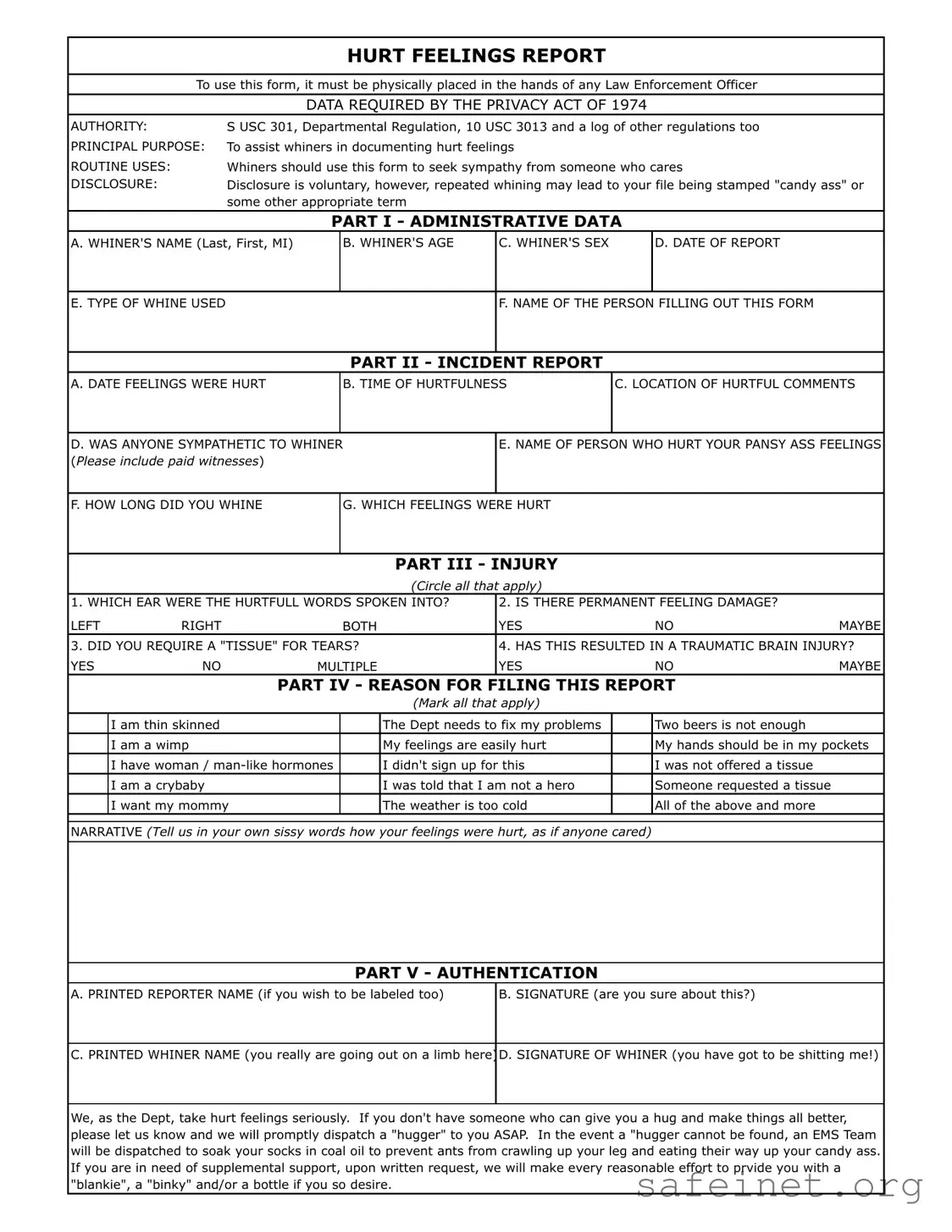
The Hurt Feelings Report form has gained attention for its unique approach to addressing emotional distress. While it may seem unconventional, this form is designed to help individuals document their feelings in a structured manner. It requires basic information, such as the name and age of the person filing the report, as well as details about the incident that caused the hurt feelings. Sections of the form allow users to specify the nature of their emotional injury, including whether they felt any permanent damage or if they required a tissue for tears. The form also includes a narrative section, encouraging users to express their feelings in their own words. Importantly, the form emphasizes that filing a report is voluntary, although it humorously warns that repeated submissions may lead to a less than flattering label. The intention behind this document is to provide a lighthearted yet serious means of acknowledging and addressing feelings of hurt, while also offering support for those who may need it. In a world where emotional well-being is increasingly recognized, this form serves as a quirky tool for individuals seeking sympathy and validation.
| Fact Name | Description |
|---|---|
| Purpose | This form is designed to assist individuals in documenting instances of hurt feelings. |
| Privacy Act Compliance | The form complies with the Privacy Act of 1974, ensuring the protection of personal information. |
| Voluntary Disclosure | Disclosure of information on the form is voluntary, but repeated submissions may lead to informal labeling. |
| Incident Reporting | Part II of the form requires detailed information about the incident, including the time and location of hurtful comments. |
| Injury Assessment | Part III includes questions about potential permanent emotional damage and whether tissues were required. |
| State-Specific Forms | Some states may have specific forms governed by local laws regarding emotional distress and reporting procedures. |
Once you have the Hurt Feelings Report form in hand, it’s important to fill it out carefully. This will help ensure that your concerns are documented properly. After completing the form, you will need to submit it to a law enforcement officer. Follow these steps to fill out the form correctly.
Once you have filled out all sections, make sure to review your responses for accuracy. Then, present the completed form to a law enforcement officer to ensure it is processed appropriately.
What is the purpose of the Hurt Feelings Report form?
The Hurt Feelings Report form is designed to assist individuals in documenting their feelings of hurt. It allows individuals to express their grievances and seek sympathy from someone who cares. The form serves as a means for individuals to communicate their emotional distress in a structured manner.
Who should fill out the Hurt Feelings Report form?
This form should be filled out by anyone who feels their feelings have been hurt and wishes to document the incident. The individual completing the form is referred to as the "whiner." It is important that the report is physically handed to a law enforcement officer for it to be processed.
What information is required on the form?
The form requires various pieces of information including the whiner's name, age, sex, and details about the incident such as the date, time, location, and the person responsible for the hurtful comments. It also asks about the emotional impact and any sympathetic responses received.
Is the disclosure of information on the form mandatory?
Disclosure of information on the Hurt Feelings Report form is voluntary. However, repeated submissions may lead to a negative label being attached to the individual’s file. It is advisable to consider the implications of submitting the form multiple times.
What types of injuries can be reported?
The form includes a section where individuals can circle various types of emotional injuries. These may include whether the hurtful words were spoken into a specific ear, if there is permanent feeling damage, and whether a tissue was required for tears. It also asks if the individual experienced a traumatic brain injury as a result of the incident.
What should be included in the narrative section of the form?
The narrative section allows individuals to describe in their own words how their feelings were hurt. This is an opportunity to provide context and detail about the incident, although it is noted that the emotional impact may not be taken seriously by all readers.
What support is available for individuals who submit the form?
The department takes hurt feelings seriously and offers support. If an individual does not have someone to comfort them, a "hugger" may be dispatched. If a hugger is unavailable, an EMS team may be sent to provide additional support. Supplemental items such as a "blankie," "binky," or bottle can also be requested.
Are there any consequences for filing this report?
While the report is intended to provide a means for individuals to express their hurt feelings, there may be social consequences. Individuals may face ridicule or be labeled in a negative manner if they file multiple reports. It is important to consider the potential impact on one’s reputation when deciding to submit the form.
How can I submit the Hurt Feelings Report form?
The form must be physically handed to a law enforcement officer to be considered valid. It is essential that the individual ensures the report reaches the appropriate authority for it to be processed and acknowledged.
Inaccurate Personal Information: One common mistake is failing to provide accurate details in the administrative section. This includes the whiner's name, age, and sex. Missing or incorrect information can delay the processing of the report.
Vague Incident Descriptions: When detailing the incident, many individuals write vague descriptions. It’s crucial to specify the date, time, and location of the hurtful comments. Without this clarity, the report may lack the necessary context for understanding the situation.
Neglecting to Identify Witnesses: Some people forget to mention any witnesses who were sympathetic to their feelings. Including names of those who can corroborate the incident adds credibility to the report and may enhance the sympathy received.
Failure to Circle Applicable Injuries: In the injury section, individuals often overlook circling all applicable options. Accurately indicating whether there was permanent feeling damage or if tissues were required is essential for a complete report.
Inadequate Narrative Explanation: The narrative section is an opportunity to express how feelings were hurt. Many people provide minimal explanations, which can undermine the seriousness of their claims. A thoughtful and detailed account can make a significant difference in how the report is received.
When dealing with feelings of hurt or distress, it can be beneficial to utilize various forms and documents that complement the Hurt Feelings Report. These documents serve different purposes, helping individuals articulate their experiences, seek support, or formally address grievances. Below is a list of commonly used forms that may accompany the Hurt Feelings Report.
Utilizing these forms in conjunction with the Hurt Feelings Report can enhance the support received and provide a clearer understanding of the emotional challenges faced. Each document serves a unique purpose, helping individuals navigate their feelings and seek the assistance they need.
The first document similar to the Hurt Feelings Report is the Incident Report form used by various organizations, including law enforcement and schools. This form captures details about an event where an individual feels wronged or harmed. It typically includes sections for the date, time, location, and nature of the incident, much like the Hurt Feelings Report. Both forms aim to provide a structured way for individuals to express their grievances, although the Incident Report is often more formal and factual in tone.
Another comparable document is the Grievance Form found in many workplace environments. This form allows employees to formally express their dissatisfaction with a workplace issue, such as harassment or unfair treatment. Like the Hurt Feelings Report, it requires personal information and a description of the incident. However, the Grievance Form is generally used for more serious complaints that could lead to investigations or corrective actions, whereas the Hurt Feelings Report has a more humorous and light-hearted approach.
The Customer Feedback Form is also similar, as it allows consumers to report their experiences with a product or service. Both forms encourage individuals to articulate their feelings and experiences. While the Customer Feedback Form typically seeks constructive criticism to improve services, the Hurt Feelings Report leans more towards seeking sympathy and understanding for personal grievances.
The Complaint Form used by various organizations serves a similar purpose. Individuals fill out this form to report issues they have encountered, whether with products, services, or interpersonal interactions. Both documents require a narrative section where the individual can explain their concerns in detail. However, the Complaint Form often has a more serious tone and may lead to formal investigations, unlike the light-hearted approach of the Hurt Feelings Report.
The Emotional Support Request Form is another document that shares similarities with the Hurt Feelings Report. Individuals use this form to request emotional support services, such as counseling or therapy. Both forms recognize the importance of addressing emotional well-being, but the Emotional Support Request Form is typically more focused on seeking professional help, while the Hurt Feelings Report emphasizes personal expression and humor.
The Apology Request Form is akin to the Hurt Feelings Report in that it allows individuals to express their feelings about being wronged and to seek an apology. Both documents provide a platform for individuals to communicate their hurt feelings, but the Apology Request Form is more about reconciliation and resolving conflicts, whereas the Hurt Feelings Report leans towards expressing feelings in a light-hearted manner.
The Personal Reflection Journal serves a similar function in that it allows individuals to document their thoughts and feelings about various experiences. While the Hurt Feelings Report has a specific focus on hurt feelings and seeking sympathy, the Personal Reflection Journal is broader and encourages individuals to explore their emotions in a more private setting. Both emphasize the importance of acknowledging and processing feelings.
The Feedback Survey, often used in educational settings, is another document that shares similarities. It collects information about students' experiences and feelings regarding their learning environment. Both forms allow individuals to express their feelings, but the Feedback Survey is typically more structured and aimed at improving the educational experience, while the Hurt Feelings Report is more personal and humorous.
Lastly, the Self-Assessment Questionnaire can be compared to the Hurt Feelings Report. This document allows individuals to evaluate their emotional states and identify areas of concern. Both forms encourage self-reflection and provide a means to articulate feelings. However, the Self-Assessment Questionnaire is often more clinical and aimed at personal growth, while the Hurt Feelings Report adopts a playful tone in discussing emotional hurt.
When filling out the Hurt Feelings Report form, it's important to keep a few things in mind. Here are five dos and don'ts to guide you:
Following these guidelines can help streamline the process and ensure your report is properly considered.
There are several misconceptions surrounding the Hurt Feelings Report form that can lead to confusion. Here are seven of the most common ones, along with explanations to clarify the truth.
Understanding these misconceptions can help individuals feel more comfortable utilizing the Hurt Feelings Report form. It is a resource meant to support emotional expression, not to judge or belittle those who choose to use it.
Filling out and using the Hurt Feelings Report form requires careful attention to detail. Here are some key takeaways to consider:
Completing this form thoroughly can help ensure that your concerns are taken seriously. Don't hesitate to reach out for support if needed.