Homepage > Blank Horse Riding Template
Article Structure

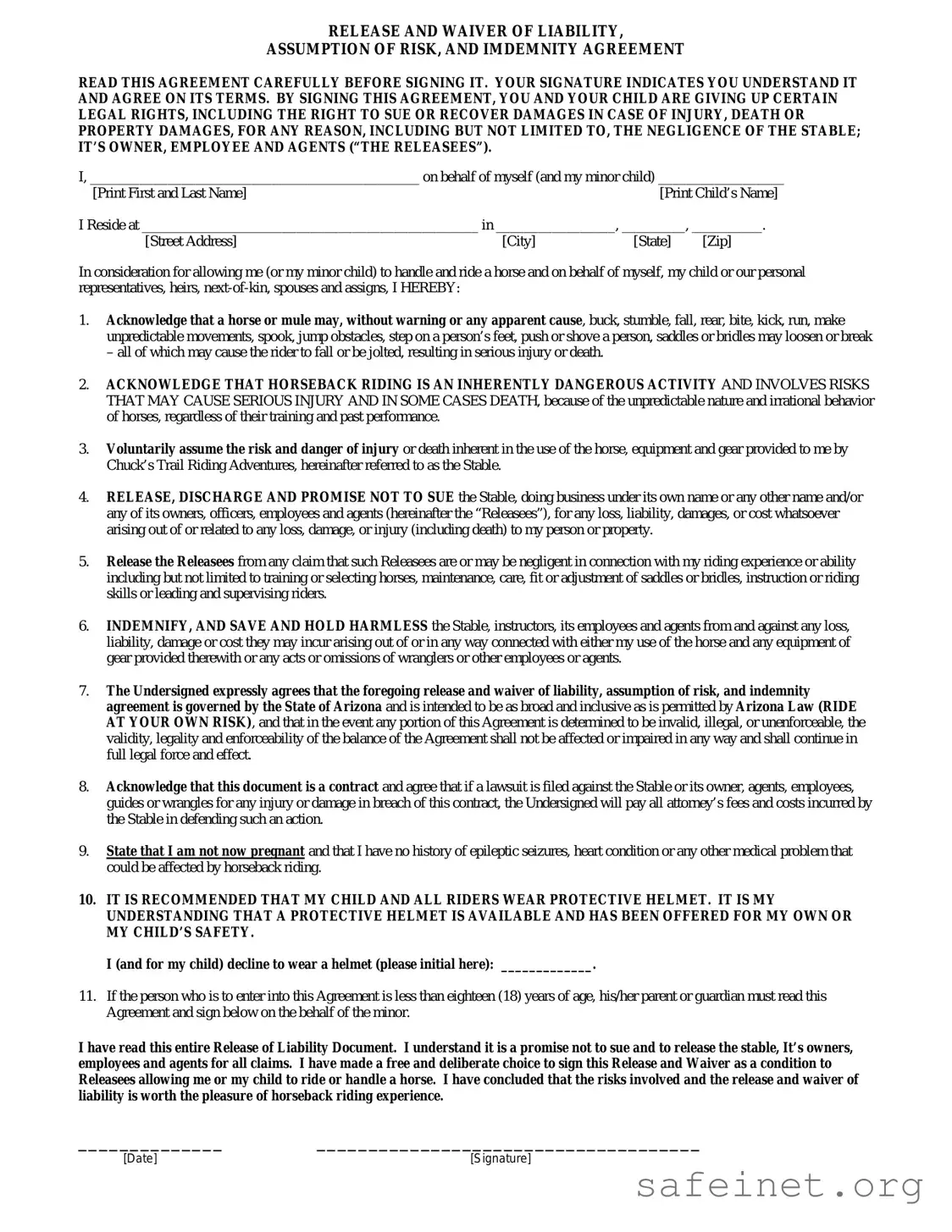
The Horse Riding form serves as a crucial document for anyone wishing to engage in horseback riding activities, particularly at facilities like Chuck’s Trail Riding Adventures. This form outlines the inherent risks associated with horseback riding, which can include unpredictable behavior from horses, potential injuries, and even fatalities. Riders must acknowledge that despite any training or experience, the nature of horses can lead to sudden movements or accidents. The form also includes a release and waiver of liability, which indicates that participants are giving up certain legal rights, including the ability to sue for injuries that may occur due to the negligence of the stable or its employees. Additionally, the agreement emphasizes the importance of personal responsibility by requiring riders to assume all risks associated with the activity. It is essential to note that the document is governed by Arizona law and includes specific provisions regarding indemnification and the requirement for parental consent for minors. Participants are encouraged to wear protective gear, such as helmets, to enhance their safety while riding. By signing the form, individuals not only acknowledge their understanding of the risks involved but also affirm their choice to engage in this adventurous and rewarding experience.

Form Sample

______________ _____________________________________
RELEASE AND WAIVER OF LIABILITY,
ASSUMPTION OF RISK, AND IMDEMNITY AGREEMENT
READ THIS AGREEMENT CAREFULLY BEFORE SIGNING IT. YOUR SIGNATURE INDICATES YOU UNDERSTAND IT
AND AGREE ON ITS TERMS. BY SIGNING THIS AGREEMENT, YOU AND YOUR CHILD ARE GIVING UP CERTAIN
LEGAL RIGHTS, INCLUDING THE RIGHT TO SUE OR RECOVER DAMAGES IN CASE OF INJURY, DEATH OR
PROPERTY DAMAGES, FOR ANY REASON, INCLUDING BUT NOT LIMITED TO, THE NEGLIGENCE OF THE STABLE;
IT’S OWNER, EMPLOYEE AND AGENTS (“THE RELEASEES”).
I, _______________________________________________ on behalf of myself (and my minor child) __________________
[Print First and Last Name] [Print Child’s Name]
I Reside at ________________________________________________ in _________________, _________, __________.
[Street Address] [City] [State] [Zip]
In consideration for allowing me (or my minor child) to handle and ride a horse and on behalf of myself, my child or our personal
representatives, heirs, next-of-kin, spouses and assigns, I HEREBY:
1. Acknowledge that a horse or mule may, without warning or any apparent cause, buck, stumble, fall, rear, bite, kick, run, make
unpredictable movements, spook, jump obstacles, step on a person’s feet, push or shove a person, saddles or bridles may loosen or break
all of which may cause the rider to fall or be jolted, resulting in serious injury or death.
2. ACKNOWLEDGE THAT HORSEBACK RIDING IS AN INHERENTLY DANGEROUS ACTIVITY AND INVOLVES RISKS
THAT MAY CAUSE SERIOUS INJURY AND IN SOME CASES DEATH, because of the unpredictable nature and irrational behavior
of horses, regardless of their training and past performance.
3. Voluntarily assume the risk and danger of injury or death inherent in the use of the horse, equipment and gear provided to me by
Chuck’s Trail Riding Adventures, hereinafter referred to as the Stable.
4. RELEASE, DISCHARGE AND PROMISE NOT TO SUE the Stable, doing business under its own name or any other name and/or
any of its owners, officers, employees and agents (hereinafter the “Releasees”), for any loss, liability, damages, or cost whatsoever
arising out of or related to any loss, damage, or injury (including death) to my person or property.
5. Release the Releasees from any claim that such Releasees are or may be negligent in connection with my riding experience or ability
including but not limited to training or selecting horses, maintenance, care, fit or adjustment of saddles or bridles, instruction or riding
skills or leading and supervising riders.
6. INDEMNIFY, AND SAVE AND HOLD HARMLESS the Stable, instructors, its employees and agents from and against any loss,
liability, damage or cost they may incur arising out of or in any way connected with either my use of the horse and any equipment of
gear provided therewith or any acts or omissions of wranglers or other employees or agents.
7. The Undersigned expressly agrees that the foregoing release and waiver of liability, assumption of risk, and indemnity
agreement is governed by the State of Arizona and is intended to be as broad and inclusive as is permitted by Arizona Law (RIDE
AT YOUR OWN RISK), and that in the event any portion of this Agreement is determined to be invalid, illegal, or unenforceable, the
validity, legality and enforceability of the balance of the Agreement shall not be affected or impaired in any way and shall continue in
full legal force and effect.
8. Acknowledge that this document is a contract and agree that if a lawsuit is filed against the Stable or its owner, agents, employees,
guides or wrangles for any injury or damage in breach of this contract, the Undersigned will pay all attorney’s fees and costs incurred by
the Stable in defending such an action.
9. State that I am not now pregnant
and that I have no history of epileptic seizures, heart condition or any other medical problem that
could be affected by horseback riding.
10. IT IS RECOMMENDED THAT MY CHILD AND ALL RIDERS WEAR PROTECTIVE HELMET. IT IS MY
UNDERSTANDING THAT A PROTECTIVE HELMET IS AVAILABLE AND HAS BEEN OFFERED FOR MY OWN OR
MY CHILD’S SAFETY.
I (and for my child) decline to wear a helmet (please initial here): _____________.
11. If the person who is to enter into this Agreement is less than eighteen (18) years of age, his/her parent or guardian must read this
Agreement and sign below on the behalf of the minor.
I have read this entire Release of Liability Document. I understand it is a promise not to sue and to release the stable, It’s owners,
employees and agents for all claims. I have made a free and deliberate choice to sign this Release and Waiver as a condition to
Releasees allowing me or my child to ride or handle a horse. I have concluded that the risks involved and the release and waiver of
liability is worth the pleasure of horseback riding experience.
[Date] [Signature]

Document Specifications

Fact Name Details
Release and Waiver This agreement releases the stable and its employees from liability for injuries, including death, that may occur during horseback riding.
Assumption of Risk Participants acknowledge the inherent risks of horseback riding, including unpredictable behavior of horses.
Indemnification Riders agree to indemnify the stable and its agents against any claims arising from their riding activities.
Governing Law This agreement is governed by the laws of the State of Arizona.
Helmet Recommendation It is recommended that all riders wear a protective helmet for safety, which is available upon request.
Minor Participants If the participant is under 18, a parent or guardian must sign the agreement on their behalf.

Steps to Filling Out Horse Riding

Completing the Horse Riding form is an important step before participating in any riding activities. This process ensures that all necessary information is collected and that participants understand the associated risks. Follow the steps below to fill out the form accurately.

  1. Begin by printing your full name in the designated space at the top of the form.
  2. Next, provide your minor child's name in the specified area.
  3. Fill in your complete address, including street address, city, state, and zip code.
  4. Read the entire agreement carefully to understand the terms and conditions.
  5. Initial next to the statement regarding the decline of wearing a protective helmet if applicable.
  6. If you are signing on behalf of a minor, ensure that you read the agreement thoroughly before signing.
  7. Sign and date the form at the bottom, confirming your understanding and acceptance of the terms.

More About Horse Riding

What is the purpose of the Horse Riding form?

The Horse Riding form serves as a Release and Waiver of Liability, Assumption of Risk, and Indemnity Agreement. It is designed to inform participants about the inherent risks associated with horseback riding. By signing the form, individuals acknowledge these risks and agree not to hold the stable or its employees liable for any injuries or damages that may occur during their riding experience.

What are the risks associated with horseback riding?

Horseback riding is inherently dangerous. Horses can exhibit unpredictable behaviors, such as bucking, rearing, or spooking, which can lead to serious injuries or even death. The form emphasizes that these risks exist regardless of the horse's training or past performance. Participants must be aware that they are assuming these risks by choosing to ride.

Who needs to sign the form?

The form must be signed by all participants. If a rider is under the age of eighteen, a parent or guardian must read and sign the form on their behalf. This ensures that the responsible adult understands the risks and agrees to the terms outlined in the document.

What does it mean to indemnify the stable?

Indemnifying the stable means that participants agree to protect the stable and its employees from any claims or legal actions that may arise due to their riding experience. If an injury occurs, the participant accepts responsibility for any costs or damages, which may include legal fees incurred by the stable in defending against such claims.

Is wearing a helmet mandatory?

While the form strongly recommends that all riders wear protective helmets for safety, it is not mandatory. Participants can choose to decline helmet use by initialing a designated section on the form. However, it is advisable to prioritize safety and wear a helmet while riding.

What happens if part of the agreement is found to be invalid?

If any portion of the agreement is deemed invalid, illegal, or unenforceable, the remaining sections of the agreement will still remain in effect. The intent is to ensure that the agreement continues to be valid and enforceable to the fullest extent allowed by law.

What should I do if I have medical concerns?

Participants must disclose any medical conditions that could be affected by horseback riding, such as pregnancy or a history of seizures. The form includes a statement confirming that the signer does not have any such conditions. It is crucial for individuals to be honest about their health to ensure their safety during the riding experience.

Common mistakes

  1. Incomplete Personal Information: Failing to provide full names, addresses, or contact information can lead to confusion or issues in case of emergencies.

  2. Neglecting to Read the Agreement: Skimming through the document without understanding the terms can result in unforeseen consequences.

  3. Missing Signatures: Omitting required signatures, especially for minors, can invalidate the form.

  4. Incorrect Age Declaration: Misrepresenting the age of a minor can lead to legal complications and liability issues.

  5. Failure to Disclose Medical History: Not mentioning relevant medical conditions can pose serious risks during riding activities.

  6. Declining Helmet Use: Not initialing the helmet decline section may suggest that the rider is unaware of safety recommendations.

  7. Ignoring Risks: Not acknowledging the inherent risks associated with horseback riding can lead to misunderstandings about liability.

  8. Inaccurate Date Entry: Providing an incorrect date can create confusion regarding the agreement's validity.

  9. Not Keeping a Copy: Failing to retain a copy of the signed form for personal records can complicate future interactions with the stable.

Documents used along the form

When participating in horseback riding activities, several other forms and documents may be required to ensure safety and legal compliance. These documents help clarify responsibilities, outline risks, and provide necessary information for both riders and operators. Below is a list of commonly used forms alongside the Horse Riding form.

  • Medical Release Form: This document allows riders to authorize medical treatment in case of an emergency. It typically includes personal health information and emergency contact details.
  • Participant Agreement: This agreement outlines the expectations and responsibilities of both the participant and the riding facility. It may include rules of conduct and safety guidelines.
  • Helmet Waiver: If riders choose not to wear a helmet, this form acknowledges their decision and releases the facility from liability related to that choice.
  • Minor Release Form: For participants under 18, this form must be signed by a parent or guardian. It confirms that the guardian understands the risks and agrees to the terms on behalf of the minor.
  • Emergency Contact Form: This document collects important contact information for the rider's emergency contacts, ensuring that help can be reached quickly if needed.
  • Liability Insurance Information: This form provides details about the insurance coverage held by the riding facility. It may outline what is covered in case of accidents or injuries.
  • Rider Profile Form: This document gathers information about the rider's experience level, medical conditions, and any special needs. It helps instructors tailor the riding experience to each individual.
  • Horse Assignment Form: This form assigns a specific horse to the rider, detailing the horse's characteristics and any known behavioral issues to ensure safety.
  • Safety Briefing Acknowledgment: Riders sign this document to confirm they have received a safety briefing before riding. It ensures that they understand the risks and safety protocols.

These documents play a crucial role in ensuring a safe and enjoyable horseback riding experience. They help to clarify expectations, manage risks, and protect both riders and operators from potential legal issues.

Similar forms

The Horse Riding form shares similarities with a **Release of Liability form** commonly used in various recreational activities. Both documents aim to protect the organization or individual offering the activity from legal claims resulting from injuries. They typically require participants to acknowledge the risks involved and agree not to hold the provider responsible for any accidents that may occur. This mutual understanding helps to clarify the responsibilities of both parties, ensuring that participants are aware of the potential dangers associated with the activity.

Another document that resembles the Horse Riding form is the **Assumption of Risk Agreement**. This type of agreement emphasizes the participant's acceptance of the inherent risks associated with an activity. Just like the Horse Riding form, it requires individuals to acknowledge that they are voluntarily engaging in an activity that could lead to injury or harm. By signing this agreement, participants take responsibility for their actions and the risks they choose to undertake, which can help to mitigate liability for the organization involved.

The Horse Riding form is also similar to a **Medical Release form**, often used in sports and recreational settings. This document typically allows organizations to obtain necessary medical information about participants, ensuring that they can provide appropriate care in case of an emergency. While the focus of a Medical Release form is on health and safety, both documents share the common goal of protecting the organization from legal repercussions, especially when participants are made aware of their health conditions and the risks they may face.

Lastly, the Horse Riding form is akin to a **Parental Consent form** for minors participating in activities. This document requires a parent or guardian's signature to acknowledge that they understand the risks involved and consent to their child's participation. Like the Horse Riding form, it emphasizes the importance of informed consent and the understanding of potential dangers, reinforcing the idea that parents are taking an active role in their child's safety while engaging in recreational activities.

Dos and Don'ts

When filling out the Horse Riding form, it’s essential to approach the process with care. Here are some important dos and don’ts to keep in mind:

  • Do read the entire form carefully before signing.
  • Do ensure that all personal information is accurate and complete.
  • Do discuss any concerns with the staff before signing.
  • Do acknowledge the risks involved with horseback riding.
  • Do have a parent or guardian sign for minors.
  • Don’t rush through the form; take your time to understand each section.
  • Don’t ignore any instructions about safety equipment, such as helmets.
  • Don’t leave any required fields blank; this could delay your experience.
  • Don’t sign if you have questions that remain unanswered.

By following these guidelines, you can ensure a smoother experience while prioritizing safety and understanding.

Misconceptions

Misconceptions about horseback riding can lead to misunderstandings about the risks and responsibilities involved. Here are nine common misconceptions:

  1. Horseback riding is completely safe. Many people believe that riding horses is a risk-free activity. However, horseback riding is inherently dangerous and can lead to serious injuries or even death due to the unpredictable nature of horses.
  2. Only inexperienced riders get injured. Injuries can happen to riders of all skill levels. Even seasoned riders can face unexpected situations that may lead to accidents.
  3. Wearing a helmet is optional. Some riders think that helmets are not necessary. In reality, wearing a protective helmet significantly reduces the risk of head injuries during falls.
  4. The stable is responsible for all injuries. Many believe that stables are liable for any injuries that occur. However, riders often sign waivers that release the stable from liability, acknowledging the risks involved.
  5. Horses are always calm and predictable. People may assume that all horses are well-trained and calm. In truth, horses can behave unpredictably, regardless of their training.
  6. Children are safe riding without supervision. Some parents think that children can ride independently without supervision. It's crucial for children to have adult supervision and guidance while riding.
  7. All riding gear is safe and reliable. Riders often assume that all equipment is in good condition. It's essential to regularly check the gear, as faulty saddles or bridles can lead to accidents.
  8. Injuries only happen during competitions. Many people think that injuries occur only during competitive events. However, injuries can happen during casual riding sessions as well.
  9. Signing a waiver means I can’t sue for any reason. While waivers release stables from liability for certain risks, they do not protect against gross negligence. If a stable is found to be grossly negligent, legal action may still be possible.

Understanding these misconceptions is crucial for anyone involved in horseback riding. Awareness of the risks and responsibilities can help ensure a safer riding experience.

Key takeaways

Filling out and using the Horse Riding form is an important process. Here are some key takeaways to keep in mind:

  • Read Carefully: Always read the entire agreement before signing. It outlines important information about risks and responsibilities.
  • Understand Your Rights: By signing, you are giving up certain legal rights, including the right to sue for injuries or damages.
  • Provide Accurate Information: Fill in your name and your child's name clearly. Make sure to include your correct address.
  • Acknowledge Risks: Recognize that horseback riding can be dangerous and involves risks that may lead to serious injury or death.
  • Assume Responsibility: You are voluntarily accepting the risks associated with riding and handling horses.
  • Release Liability: By signing, you release the stable and its staff from any claims related to injuries or damages that may occur.
  • Indemnity Clause: Be aware that you agree to protect the stable from any claims arising from your use of their horses and equipment.
  • Contract Agreement: Understand that this document is a legal contract and will be governed by Arizona law.
  • Helmet Recommendation: It's advised to wear a protective helmet for safety. You can decline this option, but it's important to consider.
  • Minor Signatures: If the rider is under 18, a parent or guardian must sign the form on their behalf.

Completing the Horse Riding form is a crucial step to ensure a safe and enjoyable experience. Always keep a copy for your records.