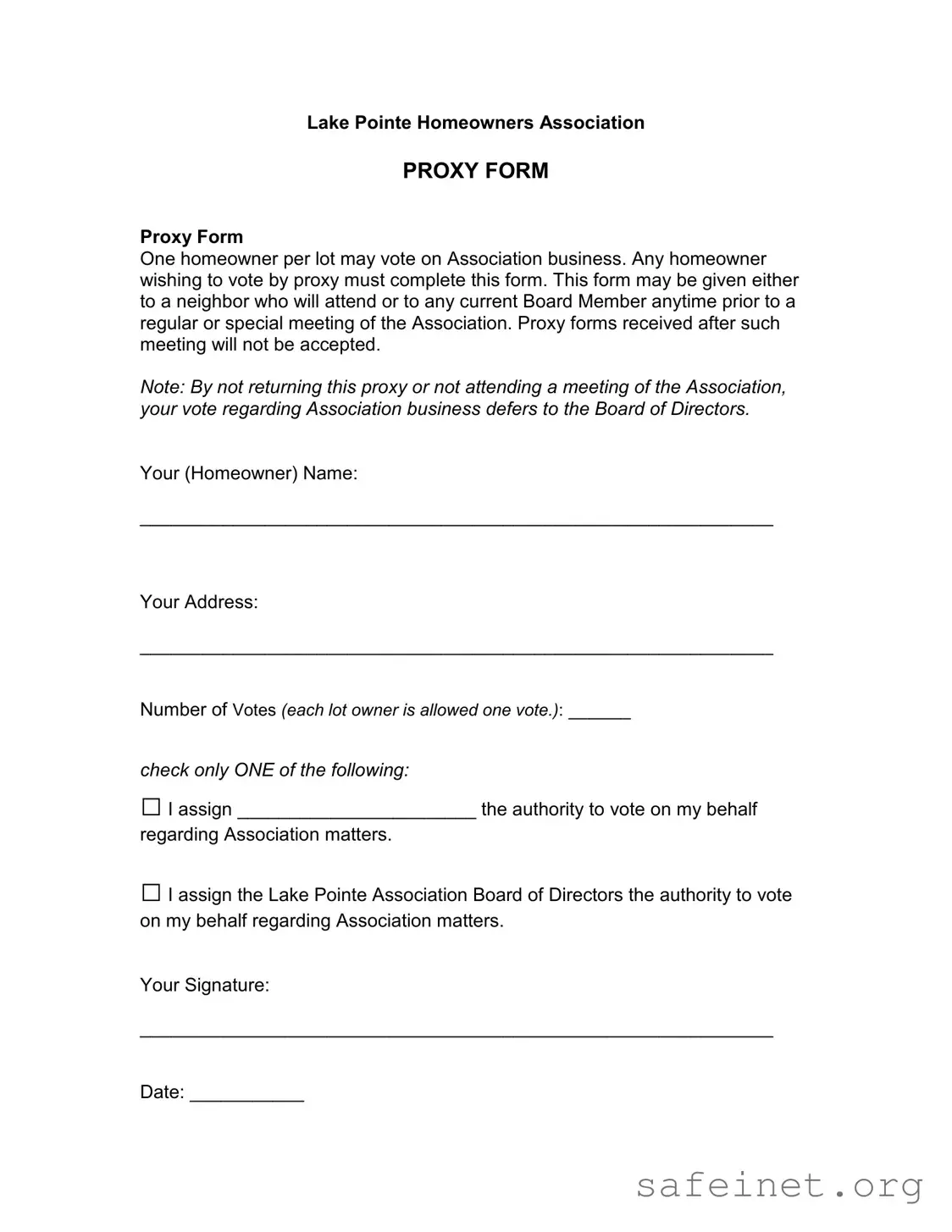
When it comes to participating in the decision-making processes of a Homeowners Association (HOA), the proxy form serves as an essential tool for homeowners who cannot attend meetings in person. This form allows homeowners to authorize another individual, whether it be a neighbor or a board member, to cast their vote on important association matters. To ensure that your voice is still heard, it is crucial to complete the form accurately and submit it before the scheduled meeting, as any proxy forms received after the meeting will not be accepted. Each homeowner is entitled to one vote per lot, and the form provides space for you to indicate the number of votes you hold. Additionally, you can choose to assign your voting authority to a specific individual or to the HOA Board of Directors. Remember, your signature and the date are required to validate the proxy, making it a straightforward yet vital aspect of HOA governance.

| Fact Name | Description |
|---|---|
| One Homeowner per Lot | Only one homeowner is allowed to vote on Association business for each lot. |
| Proxy Voting Requirement | Homeowners wishing to vote by proxy must complete the designated proxy form. |
| Authorized Representatives | The completed form can be given to a neighbor or any current Board Member. |
| Submission Deadline | Proxy forms must be submitted prior to a regular or special meeting of the Association. |
| Post-Meeting Submissions | Any proxy forms received after the meeting will not be accepted. |
| Signature Requirement | The homeowner must sign the form to validate the proxy assignment. |
| Date of Submission | Homeowners should include the date on which the proxy form is signed. |
| Voting Authority Assignment | Homeowners can assign voting authority to an individual or to the Board of Directors. |
| State-Specific Regulations | Proxy voting laws may vary by state; check local laws for specific requirements. |
| Importance of Proxy Voting | Proxy voting allows homeowners who cannot attend meetings to still participate in decisions. |
After completing the Homeowners Association Proxy form, you will need to submit it to either a neighbor attending the meeting or a current Board Member. Make sure to do this before the meeting date to ensure your vote counts.
What is a Homeowners Association Proxy Form?
A Homeowners Association Proxy Form is a document that allows a homeowner to authorize another individual to vote on their behalf during Association meetings. This is particularly useful for homeowners who cannot attend meetings in person but still wish to have their voices heard on important matters affecting the community.
Who can I assign to vote on my behalf?
You can assign a neighbor who will be attending the meeting or any current member of the Board of Directors. This flexibility ensures that you can still participate in the decision-making process, even if you cannot be present.
When should I submit my Proxy Form?
The Proxy Form must be submitted before a regular or special meeting of the Association. It is important to note that any forms received after the meeting will not be accepted. To ensure your vote counts, complete and deliver your form in a timely manner.
How do I complete the Proxy Form?
To complete the Proxy Form, fill in your name, address, and the number of votes you are entitled to cast. You then need to assign someone to vote on your behalf by checking the appropriate box and signing the form. Make sure to include the date as well.
What happens if I don’t submit a Proxy Form?
If you do not submit a Proxy Form and cannot attend the meeting, you will forfeit your right to vote on Association matters during that meeting. This could mean missing out on important decisions that impact your community and property.
Can I revoke my Proxy once it is submitted?
Yes, you can revoke your Proxy at any time before the meeting. If you decide to attend the meeting yourself or wish to assign a different person, simply inform the Board or the individual you originally assigned. It’s always best to communicate any changes as soon as possible to avoid confusion on voting day.
Failing to complete all required fields. Every section of the proxy form must be filled out to ensure validity.
Not providing a clear name for the assigned proxy. It is essential to specify the individual who will vote on your behalf.
Assigning the proxy incorrectly. Homeowners should only assign a neighbor or a member of the Board of Directors.
Submitting the form after the deadline. Proxy forms must be delivered before the regular or special meeting to be accepted.
Neglecting to sign the form. A signature is necessary to validate the proxy assignment.
Omitting the date of submission. Including the date helps establish the timeline for the proxy assignment.
Not understanding the number of votes assigned. Homeowners should clarify how many votes they are entitled to before filling out the form.
Using unclear or ambiguous language. The instructions should be followed precisely to avoid misunderstandings.
Forgetting to communicate with the assigned proxy. It is important to inform the person about their responsibilities.
Assuming that verbal agreements are sufficient. All assignments must be documented in writing on the proxy form.
When participating in a Homeowners Association (HOA) meeting, several important documents often accompany the Proxy form. Each of these documents serves a specific purpose and helps facilitate the decision-making process within the community. Understanding these forms can enhance your engagement and ensure that your interests are represented effectively.
Familiarity with these documents can empower homeowners to participate more fully in their community's governance. By understanding the context and purpose of each form, individuals can make informed decisions and advocate effectively for their interests within the HOA.
The Homeowners Association Proxy form shares similarities with a Power of Attorney (POA) document. A POA allows one person to make decisions on behalf of another, particularly in legal or financial matters. Like the proxy form, a POA must be signed by the person granting authority, and it can specify the extent of the powers given. Both documents serve to ensure that someone can act in the best interest of another when they are unable to do so themselves, whether in a meeting or in broader circumstances.
Another document similar to the Homeowners Association Proxy form is the Voting Ballot. A voting ballot is used during elections, allowing individuals to express their preferences on various issues or candidates. Just as the proxy form allows homeowners to delegate their voting rights to another individual, a voting ballot can be submitted by someone who is unable to attend the election in person. Both documents aim to facilitate participation in decision-making processes.
The Authorization to Release Information form is also comparable to the proxy form. This document permits one party to share personal information with another, often used in medical or legal contexts. Similar to how the proxy form allows homeowners to authorize someone else to vote on their behalf, this form enables individuals to give permission for their information to be accessed or shared, ensuring that their interests are represented even when they cannot be present.
A Limited Liability Company (LLC) Operating Agreement bears some resemblance to the proxy form as well. This document outlines the management structure and operating procedures of an LLC. Just like the proxy form allows homeowners to designate someone to make decisions for them, the Operating Agreement can specify who has the authority to make decisions on behalf of the LLC. Both documents establish a framework for governance and decision-making.
The Shareholder Proxy form is another document that functions similarly to the Homeowners Association Proxy form. This form allows shareholders to appoint someone else to vote on their behalf during corporate meetings. Like the proxy form, it is a means for individuals to ensure their voice is heard in important decisions, even if they cannot attend the meeting in person. Both documents emphasize the importance of representation in decision-making processes.
Additionally, the Durable Power of Attorney for Healthcare is akin to the proxy form in its purpose of designating someone to make decisions on behalf of another. This document specifically addresses medical decisions, allowing a designated individual to act in healthcare matters when the original signer is incapacitated. The proxy form serves a similar function in the context of community governance, allowing homeowners to ensure their interests are represented even when they are not physically present.
The Consent to Treatment form can also be compared to the Homeowners Association Proxy form. This document grants permission for medical professionals to provide treatment when the patient is unable to give consent. Much like the proxy form, which allows homeowners to authorize another person to vote, the Consent to Treatment form ensures that decisions can be made on behalf of someone who cannot express their wishes at that moment.
The Assignment of Benefits form is another similar document. This form allows a patient to transfer their insurance benefits to a healthcare provider, enabling the provider to bill the insurance company directly. In a similar vein, the proxy form allows homeowners to assign their voting rights to another individual, ensuring that their interests are represented even if they cannot attend the meeting themselves. Both documents facilitate the efficient management of rights and responsibilities.
Finally, the Release of Liability Waiver has parallels with the Homeowners Association Proxy form. This document protects an organization from legal claims by having participants acknowledge the risks involved in an activity. While it does not delegate decision-making authority like the proxy form, it similarly allows individuals to authorize someone else to act on their behalf, thereby ensuring that their interests are protected in various scenarios.
Filling out a Homeowners Association (HOA) proxy form can seem daunting, but it doesn’t have to be. Here are some important do's and don'ts to keep in mind to ensure your voice is heard.
By following these guidelines, you can ensure that your interests are represented, even if you can’t attend the meeting in person. Remember, your participation matters!
Misconception 1: Only certain homeowners can use the proxy form.
In reality, any homeowner can utilize the proxy form to vote on Association matters. This includes all homeowners in good standing, regardless of their involvement in the community.
Misconception 2: Proxy votes are not counted if submitted on the day of the meeting.
This is incorrect. Proxy forms must be submitted prior to the meeting. If they are received after the meeting has commenced, they will not be accepted.
Misconception 3: Homeowners can only assign their vote to a neighbor.
Homeowners have the option to assign their vote to any current Board Member as well. This provides flexibility in choosing a representative for voting.
Misconception 4: Completing the proxy form is a complicated process.
The proxy form is straightforward. Homeowners simply need to fill in their name, address, number of votes, and designate their proxy. It does not require extensive legal knowledge.
Misconception 5: A proxy vote is the same as an absentee ballot.
While both allow participation without attending a meeting, they are not the same. A proxy vote authorizes someone else to vote on behalf of the homeowner, whereas an absentee ballot allows the homeowner to vote directly, typically by mail.
Misconception 6: Proxy votes can be revoked at any time.
Once a proxy form is submitted, it is binding until the meeting occurs. Homeowners should be aware that they cannot change their proxy assignment after submission unless they formally withdraw it before the meeting.
Filling out and using the Homeowners Association Proxy form can be straightforward if you keep a few key points in mind. Here are some important takeaways:
By following these guidelines, you can ensure that your voice is heard even if you cannot attend the meeting in person.