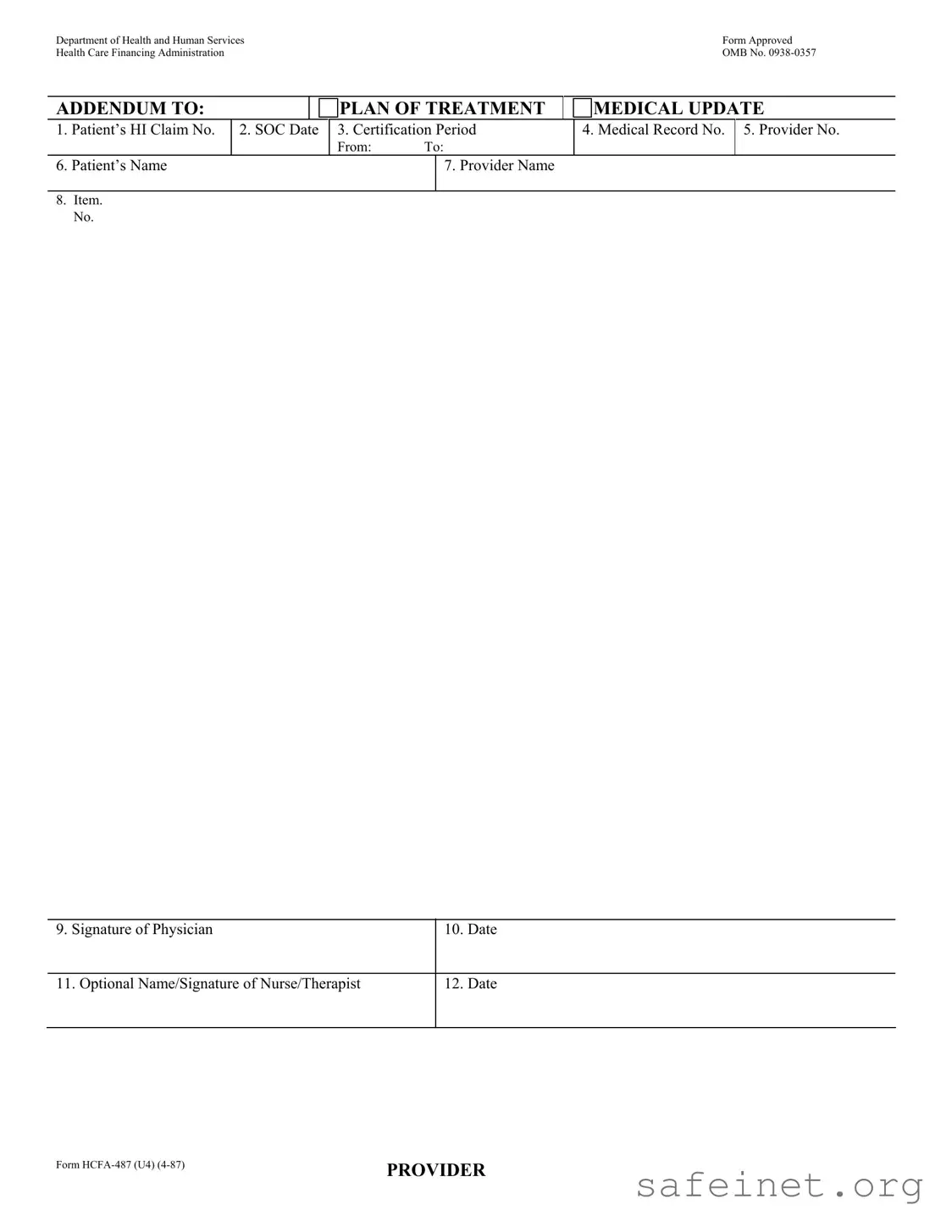
The HCFA 487 form serves as an essential tool in the healthcare system, specifically designed for medical updates related to patient treatment plans. This form is used to document significant aspects of a patient's ongoing care, ensuring that all relevant information is accurately recorded and communicated among healthcare providers. Key components of the form include the patient's Health Insurance claim number, the date of service certification, and the certification period, which collectively help to track the patient's treatment timeline. It also requires the patient's name and medical record number, along with details about the provider, including their identification number. A physician's signature is mandatory, confirming the authenticity of the information provided, and there is an optional section for the name and signature of a nurse or therapist, further validating the updates. The HCFA 487 form plays a critical role in maintaining continuity of care and compliance with healthcare regulations.

| Fact Name | Details |
|---|---|
| Form Purpose | The HCFA 487 form serves as an addendum to a patient's plan of treatment, specifically for medical updates. |
| Patient Information | This form requires essential patient details such as the patient's HI Claim number, certification period, and medical record number. |
| Provider Details | Providers must include their name and identification number, ensuring accurate record-keeping and accountability. |
| Governing Laws | In many states, the use of the HCFA 487 form is governed by federal regulations under the Social Security Act and state-specific healthcare laws. |
Completing the HCFA 487 form is a necessary step in the process of updating a patient's medical treatment plan. This form helps ensure that all relevant information is accurately recorded and communicated between healthcare providers. Follow these steps carefully to fill out the form correctly.
What is the HCFA 487 form?
The HCFA 487 form, also known as the Addendum to Plan of Treatment Medical Update, is a document used in the healthcare industry. It is primarily utilized to provide updates on a patient's treatment plan and medical status. This form is essential for ensuring that healthcare providers have the most current information regarding a patient's care.
Who needs to fill out the HCFA 487 form?
This form is typically completed by healthcare providers, such as physicians, nurses, or therapists. They fill it out to document any changes in a patient's treatment plan or medical condition. It may also be necessary for insurance purposes, ensuring that claims are processed correctly.
What information is required on the HCFA 487 form?
The HCFA 487 form requires several pieces of information, including the patient's health insurance claim number, the start and end dates of the certification period, and the patient's name. Additionally, it includes details about the provider, the medical record number, and signatures from the physician and, optionally, a nurse or therapist.
How is the HCFA 487 form used in patient care?
This form plays a critical role in patient care by ensuring that all healthcare providers involved in a patient's treatment are on the same page. It helps maintain an accurate and up-to-date record of the patient's treatment plan, which can lead to better health outcomes.
Is the HCFA 487 form mandatory?
How can I obtain a copy of the HCFA 487 form?
Providers can obtain the HCFA 487 form through various means, such as downloading it from the official Health and Human Services website or requesting it directly from their healthcare facility's administrative office. It’s important to ensure that you are using the most current version of the form.
What happens if the HCFA 487 form is not filled out correctly?
If the HCFA 487 form is filled out incorrectly or is incomplete, it may lead to delays in processing claims or issues with patient care. Insurance companies might deny claims if the necessary information is missing, so accuracy is crucial.
Can patients access their HCFA 487 form?
Patients typically do not fill out the HCFA 487 form themselves, but they can request to see it as part of their medical records. It’s important for patients to stay informed about their treatment plans, and having access to this form can help facilitate that understanding.
What should be done after completing the HCFA 487 form?
Once the HCFA 487 form is completed, it should be submitted to the relevant parties, such as the patient's insurance company or the healthcare facility's billing department. Keeping a copy for your records is also a good practice.
Are there any updates or changes to the HCFA 487 form?
Updates to the HCFA 487 form can occur over time, as regulations and requirements change. Providers should stay informed about any modifications by regularly checking official resources or consulting with their administrative offices.
Failing to include the Patient’s HI Claim Number. This number is crucial for processing the claim accurately.
Leaving out the Start of Care (SOC) Date. This date indicates when the patient began receiving care and is essential for establishing timelines.
Not specifying the Certification Period. This period defines the duration for which the treatment is authorized.
Omitting the Medical Record Number. This number helps in tracking the patient’s medical history and treatments.
Incorrectly filling in the Provider Number. This number must match the provider’s official identification to ensure proper billing.
Neglecting to write the Patient’s Name clearly. Ambiguities in the name can lead to delays or denials in processing.
Forgetting to include the Provider Name. This information is necessary for identifying who is responsible for the patient’s care.
Not signing the form where indicated. The Signature of Physician is required to validate the document.
Failing to provide the Date next to the physician's signature. This date serves as a record of when the form was completed.
The HCFA 487 form is an important document used in healthcare settings, specifically for medical updates related to a patient's plan of treatment. Along with this form, there are several other documents that are often utilized to ensure comprehensive patient care and proper billing. Below is a list of four commonly used forms that complement the HCFA 487.
Using these documents together with the HCFA 487 form helps create a clear and organized approach to patient care and billing. Proper documentation is essential for ensuring that patients receive the care they need while also facilitating smooth communication between healthcare providers and insurance companies.
The HCFA 1500 form is a widely used document in the healthcare industry, similar to the HCFA 487 form. It serves as a standard claim form for submitting medical claims to insurance companies. Both forms require detailed patient information, including the patient’s name and medical record number. The HCFA 1500 focuses on billing for services rendered, while the HCFA 487 is specifically designed for updates to a patient’s plan of treatment. This distinction highlights the HCFA 1500's role in the financial aspect of healthcare, whereas the HCFA 487 emphasizes ongoing patient care.
The CMS-1450 form, also known as the UB-04, is another document that bears similarities to the HCFA 487. This form is primarily used by institutional providers, such as hospitals, to bill Medicare and other insurers for services provided. Like the HCFA 487, it includes essential patient and provider information, but it is tailored for inpatient and outpatient services. The CMS-1450 captures a broader range of services, while the HCFA 487 focuses on specific treatment updates, making them complementary in the healthcare billing process.
The CMS-855A form is a provider enrollment application that shares some characteristics with the HCFA 487. Both documents require detailed information about healthcare providers, including their identification numbers and certification periods. The CMS-855A is essential for providers seeking to enroll in Medicare, while the HCFA 487 is used to update treatment plans for existing patients. This commonality lies in their roles in maintaining accurate records and facilitating communication between healthcare providers and insurers.
The Authorization for Release of Health Information form is another document that aligns with the HCFA 487 in terms of patient information management. This form allows healthcare providers to obtain permission from patients to share their medical records with other entities. Similar to the HCFA 487, it emphasizes the importance of patient consent and confidentiality. While the HCFA 487 updates treatment plans, the Authorization form ensures that necessary information is shared appropriately, highlighting the importance of patient rights in the healthcare system.
Lastly, the Patient Health Questionnaire (PHQ-9) is a screening tool that, while not a billing form, relates to the HCFA 487 in its role in patient assessment. Both documents are used in the context of ongoing patient care, with the PHQ-9 focusing on mental health evaluation. The HCFA 487 updates treatment plans based on medical assessments, and the PHQ-9 provides critical data for those assessments. Together, they underscore the importance of comprehensive patient evaluations in developing effective treatment strategies.
When filling out the HCFA 487 form, follow these guidelines to ensure accuracy and compliance.
The HCFA 487 form, also known as the Addendum to Plan of Treatment Medical Update, is often misunderstood. Here are six common misconceptions about this form:
Understanding these misconceptions can help healthcare providers navigate the complexities of patient documentation more effectively.
When filling out the HCFA 487 form, it is important to keep several key points in mind to ensure accuracy and compliance. Below are some essential takeaways: